08 Jun Adapting SEO Strategies for AI Search and Revenue Growth
SEO Strategy • AI Search • Revenue Growth
Adapting SEO strategies is no longer just about reacting to algorithm updates. Search is changing because buyers are using Google, AI tools, map results, snippets, reviews, and content summaries to make decisions before they ever contact a business.
“`
SEO strategy has changed. Rankings still matter, but they are no longer the whole game.
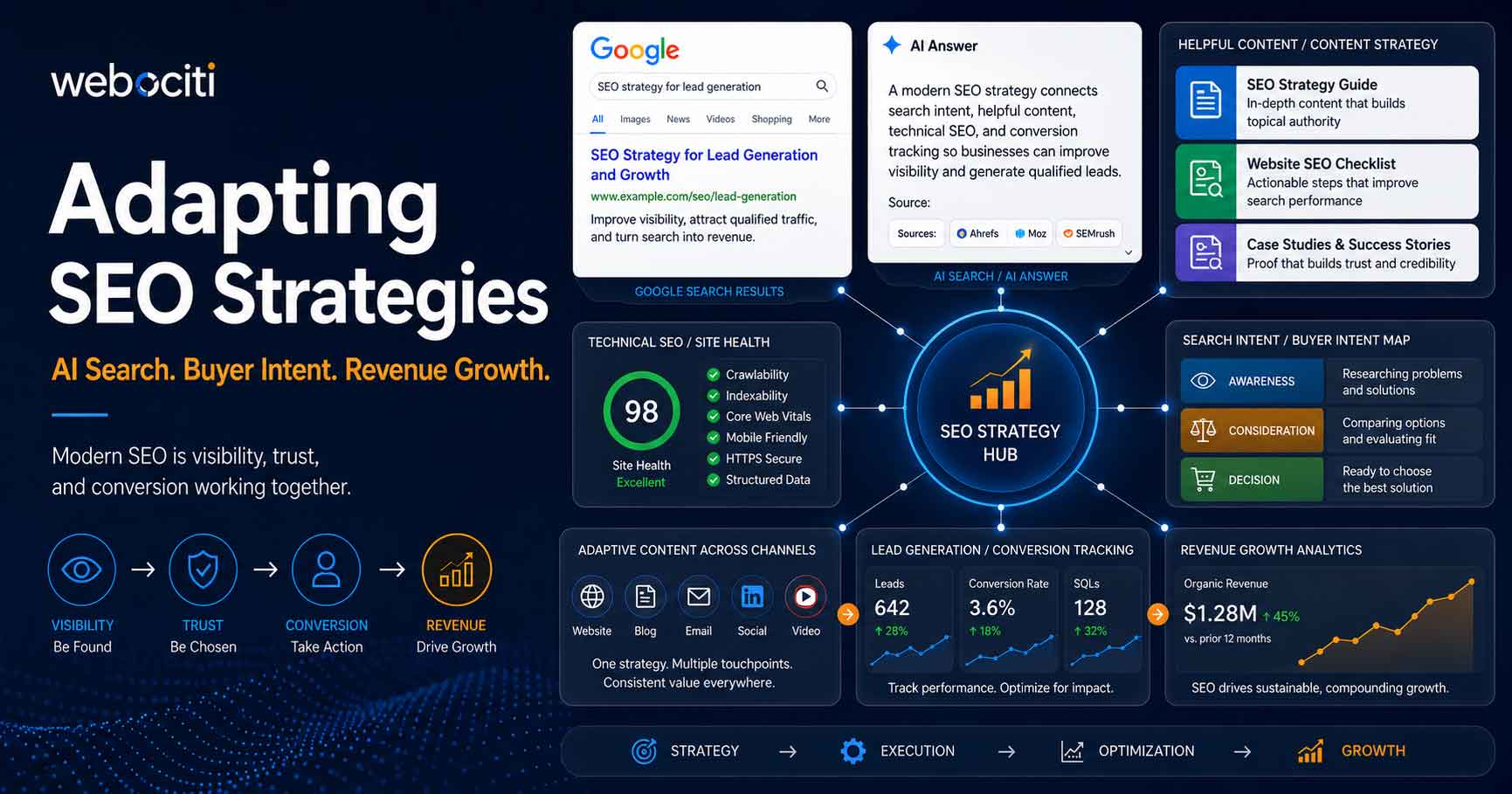
Modern SEO needs to focus on:
- Buyer intent, not just keywords
- Helpful content with a clear point of view
- Technical performance and crawlability
- AI search visibility and answer-ready content
- Adaptive content that can work across multiple channels
- Lead generation, conversion tracking, and revenue outcomes
“`
Originally published in 2024. Updated for 2026 with new guidance on AI search, adaptive content, helpful content, technical SEO, and revenue growth strategy.
Search engine optimization has always changed. Algorithms update. Search behavior shifts. New platforms emerge. Old tactics lose effectiveness.
But the bigger shift today is not just another Google update. It is the way people discover, compare, and evaluate businesses before they ever land on a website.
Buyers now use search results, AI-generated answers, map packs, reviews, videos, social content, snippets, comparison pages, and industry resources to form opinions quickly. That means your SEO strategy has to do more than chase rankings.
It needs to help the right buyers find you, understand your value, trust your expertise, and take the next step.
If your SEO strategy still depends on old keyword tactics, thin blog posts, or technical checklists that are disconnected from business outcomes, it is time to adapt.
For businesses that need stronger organic visibility, Webociti provides
SEO services for small business
built around search visibility, content, technical performance, and lead generation.
Why SEO Strategy Has to Adapt
SEO used to be easier to explain. Find keywords, optimize pages, publish content, build links, and improve rankings.
Those fundamentals still matter, but they are not enough by themselves.
Search engines have become better at evaluating intent, usefulness, authority, technical quality, and user experience. Buyers have also become more selective. They do not just want a page that matches a keyword. They want an answer that helps them make a better decision.
That changes how SEO should be managed.
A modern SEO strategy should answer questions like:
- Who are we trying to attract?
- What problems are they trying to solve?
- What information do they need before they are ready to talk?
- What pages should rank for commercial intent?
- What content builds authority and trust?
- Where is traffic failing to convert?
- How does SEO support pipeline and revenue?
Adapting SEO strategies means moving from keyword activity to a connected search visibility system.
1. AI Search Is Changing How Buyers Discover Answers
AI search is changing how people interact with information. More buyers are getting summarized answers, recommendations, comparisons, and explanations before clicking through to a website.
That does not mean SEO is dead. It means SEO has to become clearer, more structured, and more useful.
If your content is vague, thin, generic, or indistinguishable from every other page in your market, it becomes harder to stand out in both traditional search and AI-driven discovery.
To adapt, your content should be:
- Clear enough for buyers to understand quickly
- Structured enough for search engines to interpret
- Specific enough to show expertise
- Useful enough to answer real buyer questions
- Connected enough to guide visitors toward the next step
AI search rewards clarity. If your content does not clearly explain who you help, what problem you solve, and why your answer is credible, you are making search visibility harder than it needs to be.
2. Helpful Content Still Matters, But It Needs a Clear Point of View
Helpful content is not just longer content. It is not keyword-stuffed content. It is not a generic explanation rewritten from the same sources everyone else is using.
Helpful content gives the reader useful guidance. It helps them understand a problem, compare options, avoid mistakes, or make a decision.
That requires a point of view.
For example, a basic SEO article might say:
SEO helps businesses improve visibility in search engines.
That is true, but weak. A stronger SEO article explains what kind of visibility matters, which buyers it should attract, how that traffic should convert, and what the business should do next.
That is the difference between content that fills a page and content that supports growth.
3. SEO Must Align With Buyer Intent, Not Just Keywords
Keywords still matter, but buyer intent matters more.
Two people can search similar phrases and want very different things. One may be researching. One may be comparing providers. One may be ready to schedule a call. If your SEO strategy treats all search traffic the same, you will attract traffic that does not convert.
A stronger SEO strategy maps content to intent:
- Informational intent: educational content, guides, explanations, FAQs
- Commercial intent: service pages, comparison pages, case studies, proof
- Local intent: location pages, Google Business visibility, reviews, local content
- Decision intent: offers, consultations, assessments, conversion pages
This is where many SEO programs break. They generate content, but the content is not mapped to how buyers actually move from research to decision.
If your traffic is growing but qualified leads are not, your SEO problem may not be visibility. It may be intent alignment.
4. Technical SEO and Site Experience Still Matter
Strategy and content matter, but technical SEO still matters too.
Search engines need to crawl, understand, and index your website. Users need pages that load quickly, work well on mobile, and make it easy to take action.
Technical SEO should focus on:
- Site speed and performance
- Mobile usability
- Clean URL structure
- Internal linking
- Schema markup where appropriate
- Indexing and crawlability
- Redirects and broken links
- Page titles, meta descriptions, and headings
- Conversion paths and calls to action
Technical SEO is especially important during website redesigns or migrations. A new website can look better and still lose rankings if redirects, URLs, metadata, internal links, and tracking are not handled correctly.
If you are redesigning your website, use our
website migration SEO checklist
before launch.
5. Adaptive Content Helps SEO Work Across More Search Surfaces
SEO no longer lives only on blog posts and service pages.
A strong idea can support website content, social posts, email campaigns, video scripts, FAQs, sales enablement, local pages, and AI-friendly summaries. That is where adaptive content becomes valuable.
Adaptive content means creating core messaging and content assets that can be reused, reshaped, and distributed across multiple channels without losing the main strategy.
Instead of creating random content for every platform, businesses should build a content system around:
- Core buyer problems
- Search intent
- Service positioning
- FAQs and objections
- Industry-specific proof
- Conversion goals
This helps SEO because your message becomes more consistent, more complete, and easier to reinforce across search and other discovery channels.
For more on this approach, read
Use Adaptive Content to Reach All Your Potential Customers.
6. SEO Should Connect to Lead Generation and Revenue
Rankings are useful, but rankings are not the final outcome.
Traffic is useful, but traffic alone does not create growth.
SEO should be connected to lead generation and revenue. That means every SEO strategy should eventually answer:
- Which pages are attracting qualified visitors?
- Which keywords are tied to real business opportunities?
- Which content supports buyer decisions?
- Which pages generate calls, forms, or booked appointments?
- Where are visitors dropping off?
- What should be improved next?
This is where SEO becomes part of a larger growth system. When positioning, demand generation, pipeline, conversion, and feedback are connected, SEO can support more than visibility. It can support predictable revenue.
For a deeper look at how these pieces fit together, read our guide to building a
revenue growth system.
7. SEO and Paid Search Should Work Together
SEO and paid search are often treated as separate channels. That is a mistake.
Paid search can help test keywords, offers, headlines, and landing pages quickly. SEO can use those insights to build better organic content and conversion pages. SEO can also reduce long-term dependence on paid traffic by building compounding visibility over time.
Businesses should not ask whether SEO or PPC is universally better. The better question is which strategy fits the current goal.
- Need leads quickly? Paid search may help.
- Need long-term authority? SEO matters.
- Need both speed and sustainability? Use both inside a broader SEM strategy.
For more on that decision, read
PPC vs SEO vs SEM: Which Strategy Should Your Business Use?.
8. How to Audit and Update Your SEO Strategy
Adapting SEO strategies starts with diagnosis. Do not assume the answer is simply publishing more content.
A useful SEO audit should review:
- Positioning: Is the website clear about who it helps and why the business is different?
- Search intent: Are pages mapped to what buyers are actually searching for?
- Content quality: Is the content useful, specific, and up to date?
- Technical SEO: Can search engines crawl and understand the site?
- Internal linking: Are important pages supported by related content?
- Conversion paths: Are calls to action clear and easy to follow?
- Measurement: Are forms, calls, rankings, traffic, and lead sources being tracked?
The goal of an SEO audit is not to create a long list of technical issues. The goal is to identify what is preventing search visibility from turning into qualified opportunities.
Strategic Takeaway
“`
The biggest SEO shift is not one algorithm update. It is the move from keyword-focused activity to intent-driven, AI-aware, revenue-connected search strategy.
Businesses that adapt will build clearer content, stronger technical foundations, better internal links, more useful buyer journeys, and a stronger connection between search visibility and revenue.
“`
SEO Strategy
“`
Need an SEO Strategy Built for Search, AI, and Revenue?
Webociti helps businesses improve search visibility, strengthen content, fix technical SEO issues, and connect organic traffic to lead generation and revenue growth.
Adapting SEO Strategies FAQs
“`
Quick answers to common questions about adapting SEO strategies for AI search, algorithm changes, technical SEO, and revenue growth.
What does adapting SEO strategies mean?
Adapting SEO strategies means updating your approach as search engines, AI search tools, buyer behavior, and competition change. It includes improving content quality, technical SEO, search intent alignment, internal linking, and conversion paths.
How is AI search changing SEO?
AI search is changing SEO by giving users summarized answers, recommendations, and comparisons before they click through to a website. This makes clear, structured, helpful, and authoritative content more important.
Is SEO still important if AI search gives users answers directly?
Yes. SEO is still important because businesses need to be visible, credible, and useful wherever buyers are researching. AI search makes strong content, clear positioning, technical structure, and authority even more important.
How often should SEO strategies be updated?
SEO strategies should be reviewed regularly, especially after major website changes, ranking drops, traffic changes, content decay, algorithm shifts, or changes in buyer behavior. At minimum, businesses should review SEO performance quarterly.
What is the biggest mistake businesses make with SEO?
The biggest mistake is treating SEO as keyword activity instead of a growth system. SEO should connect search intent, content, technical performance, internal linking, lead generation, and conversion strategy.
“`

expectations will include: