Digital Marketing Insights & Strategies

Digital marketing is most effective when channels work together toward a
clear business objective.

This collection of digital marketing insights covers SEO, paid advertising,
content marketing, email automation, and conversion optimization. Each article
explores how businesses can drive growth through integrated digital strategies
that turn traffic into measurable results.

If you’re looking to strengthen your overall digital strategy, explore the
articles below or learn more about our

Digital Marketing Services
.

PPC vs SEM: What’s the Difference? (Complete Guide for Businesses)

Quick Summary:

PPC is a paid advertising model where businesses pay for each click on their ads.
SEM is a broader strategy that includes both PPC advertising and search engine optimization.

Most successful businesses combine PPC and SEO within a larger SEM strategy to generate both immediate leads and long-term organic traffic.

Many businesses hear the terms PPC (Pay-Per-Click) and SEM (Search Engine Marketing) used interchangeably, but they are not the same thing.

PPC is a paid advertising model where businesses pay each time someone clicks their ad. SEM is a broader strategy that includes both paid search advertising and organic strategies like SEO services for small businesses.

Understanding the difference between PPC and SEM helps businesses choose the right strategy to generate leads, increase website traffic, and grow revenue.

Businesses looking for a complete online growth strategy often combine SEO and paid advertising through structured digital marketing programs that align lead generation, search visibility, and long-term business growth.

Watch: SEM vs PPC Explained

What Is the Difference Between PPC and SEM?

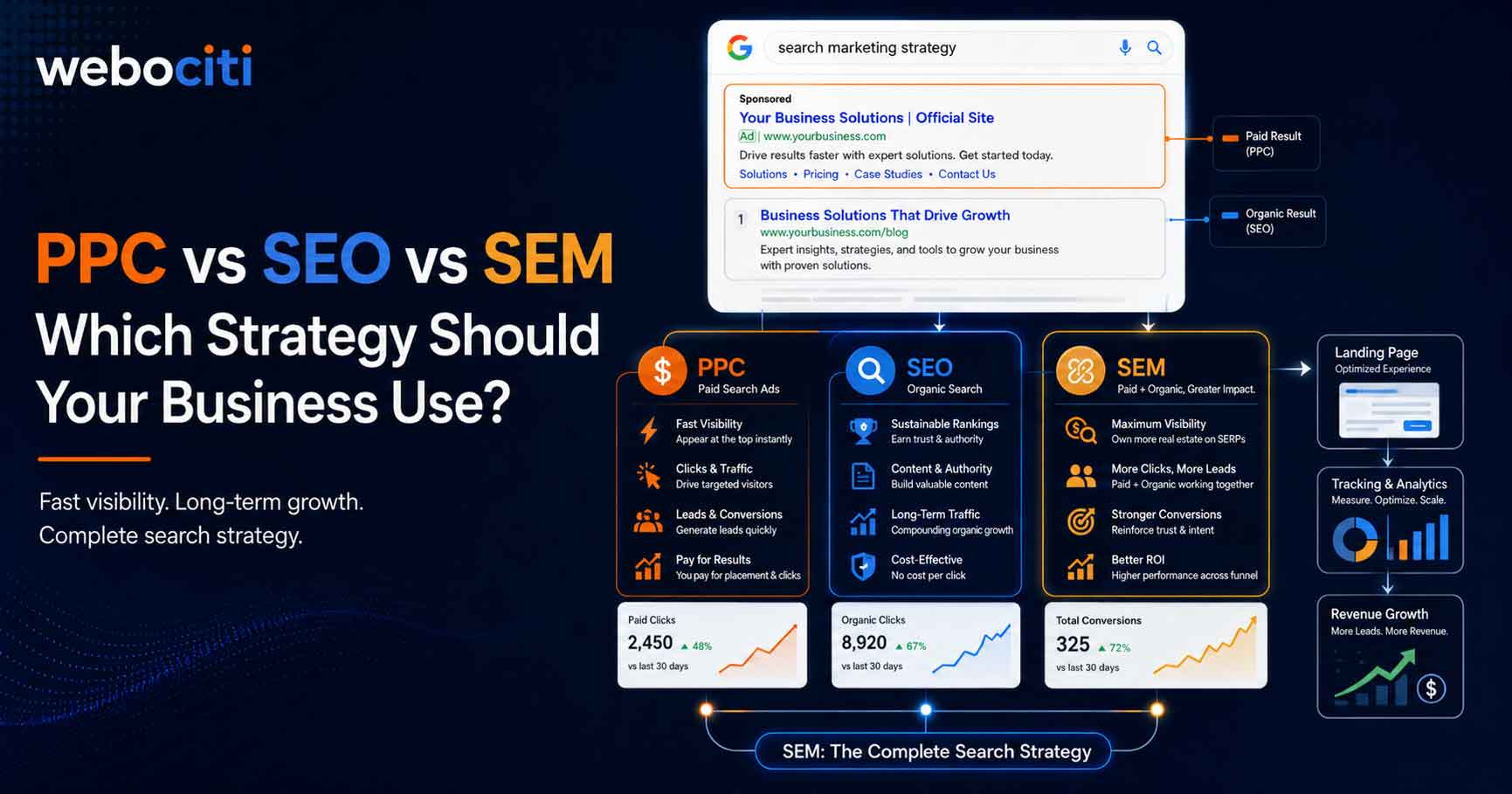
PPC (Pay-Per-Click) is a paid advertising model where businesses pay for every click on their ad. SEM (Search Engine Marketing) is a broader digital marketing strategy that includes PPC advertising as well as search engine optimization and other methods that increase visibility in search engines.

In simple terms, PPC is part of SEM. Many businesses use PPC to generate quick traffic while SEM strategies such as professional SEO services build long-term growth.

PPC vs SEM: Key Differences

Feature PPC (Pay-Per-Click) SEM (Search Engine Marketing)
Type Paid advertising Overall search marketing strategy
Traffic Speed Immediate results Long-term growth
Cost Pay for each click Combination of paid and organic strategies
Sustainability Stops when ads stop Long-term traffic and authority
Best For Immediate leads and promotions Long-term visibility and brand authority

In short, PPC delivers immediate paid traffic while SEM includes both PPC and long-term strategies like SEO that build sustainable organic visibility.

SEM vs SEO vs PPC: What’s the Difference?

Many business owners also ask how SEM, SEO, and PPC differ. While these terms are related, they play different roles in digital marketing.

  • SEO (Search Engine Optimization) focuses on improving a website’s organic rankings in search engines through content, technical optimization, and backlinks.
  • PPC (Pay-Per-Click) is paid advertising where businesses pay for each click on their ad.
  • SEM (Search Engine Marketing) is the overall strategy that includes both SEO and PPC to increase visibility in search results.

PPC vs SEO vs SEM: What Businesses Should Know

Many businesses also compare PPC vs SEO when deciding how to invest their marketing budget. While both strategies help generate website traffic, they work in very different ways.

  • PPC generates traffic immediately through paid ads.
  • SEO builds organic search rankings over time.
  • PPC stops generating traffic when the ads stop running.
  • SEO can continue driving traffic long after the work is completed.

For most companies, the best approach is combining both strategies. PPC can generate leads quickly while SEO services for small businesses build long-term visibility and sustainable traffic.

Most successful companies combine organic search strategies with paid advertising. Businesses investing in long-term visibility often pair SEO with Google Ads management services to generate both short-term leads and long-term growth.

How Paid Digital Advertising Increases Revenue

If you’ve been blindly placing pay-per-click ads and hoping for a massive influx of sales, you may be disappointed. Successful PPC advertising campaigns require strategy, testing, and ongoing optimization.

Effective digital advertising campaigns usually involve:

  • Researching high-performing keywords
  • Analyzing competitor advertising strategies
  • Setting clear budgets and performance goals
  • Creating optimized ad copy and landing pages
  • Testing different ads and audiences
  • Continually refining campaigns for better results

Without these steps, businesses may generate impressions but fail to convert those views into clicks and customers.

What is SEM? (Search Engine Marketing)

Search Engine Marketing focuses on increasing a website’s visibility in search engine results pages. SEM strategies include both paid advertising and organic tactics such as SEO, technical optimization, and content marketing.

When a website is optimized correctly with relevant content, proper keyword usage, and strong user experience, search engines begin to recognize it as a trusted resource. This increases rankings and drives more traffic.

What is PPC? (Pay-Per-Click Advertising)

Pay-Per-Click advertising refers to the ads that appear at the top of search engine results pages. Businesses bid on keywords and only pay when someone clicks their advertisement.

If you’re planning to launch a new website, it’s important to protect your search rankings during the transition. Learn how to avoid traffic loss during a website migration.

The cost of each click depends on competition and search volume. Highly competitive keywords may cost several dollars per click, while niche keywords may cost far less.

Advertisers typically set a daily budget for their campaigns. Once that budget is reached, the ads stop running until the next day.

Professional Google Ads management services can help businesses maximize the return on their advertising spend.

When Should a Business Use PPC?

  • Launching a new product or service
  • Promoting limited-time offers
  • Competing in highly competitive industries
  • Generating immediate leads
  • Testing marketing messages

When Should Businesses Focus on SEM?

  • Increasing organic website traffic
  • Building brand authority
  • Reducing long-term advertising costs
  • Generating consistent inbound leads

Related Questions About PPC and SEM

Business owners researching search marketing often ask several related questions about PPC, SEO, and SEM. Understanding how these strategies work together can help you build a stronger digital marketing plan.

  • What is the difference between PPC and SEO?
  • Is Google Ads the same as PPC?
  • How much should a small business spend on PPC?
  • Can PPC help SEO rankings?
  • Should businesses use SEO and PPC together?

Most successful businesses use a combination of SEO, PPC advertising, and broader SEM strategies to create both immediate lead generation and long-term search visibility.

People Also Ask About PPC and SEM

Is SEM just another name for PPC?

No. PPC is a type of paid advertising where businesses pay each time someone clicks their ad. SEM is a broader digital marketing strategy that includes PPC advertising along with organic tactics like search engine optimization (SEO).

Does PPC help SEO rankings?

PPC does not directly improve SEO rankings. However, running PPC campaigns can help businesses test keywords, messaging, and landing pages, which can improve the effectiveness of their SEO strategy.

Should businesses invest in both SEO and PPC?

Most successful businesses use both strategies together. PPC provides immediate visibility and leads, while SEO builds long-term organic traffic and authority in search engines.

PPC vs SEM Frequently Asked Questions

Is PPC the same as SEM?

No. PPC is a paid advertising model, while SEM is a broader marketing strategy that includes PPC along with other search marketing tactics like SEO.

Which is better, PPC or SEM?

PPC delivers quick traffic and leads, while SEM strategies such as SEO services for small businesses generate sustainable long-term growth.

Do small businesses need PPC advertising?

Many small businesses use PPC advertising to generate immediate leads while their SEO and SEM strategies build long-term traffic.

How long does it take for SEO vs PPC to work?

PPC campaigns can begin generating traffic immediately after launch. SEO typically takes 3–6 months to build strong rankings, but once it does, it can generate consistent organic traffic without paying for every click.

If you’re launching a new website or redesigning your existing one, it’s critical to protect rankings during the transition. Our website migration guide explains how to replace a website without losing SEO traffic, while our website migration SEO checklist provides a step-by-step process to protect your rankings.

Ready to Grow Your Business Online?

If you’re unsure whether PPC, SEO, or SEM is the best strategy for your business, the team at Webociti can help.

We specialize in helping small businesses generate predictable leads through SEO, Google Ads, and strategic digital marketing campaigns.

PPC campaigns can begin generating traffic immediately after launch. SEO typically takes 3–6 months to build strong rankings, but once it does, it can generate consistent organic traffic without paying for every click.

Call 678-892-7157 or schedule a free consultation today.

Real Estate Marketing • Positioning & Strategy

Real Estate Marketing Has Changed: Strategy Beats Listings (Redfin Confirms It)

Listings aren’t the advantage anymore. Strategy is. Here’s how top agents differentiate and win more listings through insight—not inventory.

AI TL;DR:

  • Listings are no longer the competitive advantage in real estate.
  • Consumers already have access — they need strategic guidance.
  • Agents who position themselves as decision-making advisors win more listings.
  • Marketing must shift from promotion to positioning.

As featured in Redfin

Redfin featured Webociti’s perspective on how top agents differentiate through strategy—not listings.

Read the Redfin article →

“Most buyers and sellers don’t need an agent to find listings anymore. What they really need is someone who helps them make smart decisions in a crowded market.”

— Joe Mediate, Webociti (quoted in Redfin)

For years, real estate marketing revolved around one thing: listings. More exposure. More portals. More visibility.

Today, buyers and sellers don’t need an agent to find homes. Inventory is accessible. The advantage has shifted.

The new differentiator isn’t access. It’s guidance. Agents who win today position themselves as strategic advisors—before the first conversation ever happens.

If you want your website and messaging to reflect this shift, here’s how we approach real estate marketing for agents and brokers and combine it with local SEO for small business to build visibility where it matters most.

Listings Are No Longer the Advantage

Ten years ago, access to listings was leverage. Today, it’s commoditized. Consumers don’t hire agents because they can’t find homes. They hire agents because they:

  • Don’t understand pricing strategy
  • Need neighborhood context and local nuance
  • Want negotiation confidence
  • Fear making expensive mistakes

Information is everywhere. Interpretation is rare. That’s why your marketing should reinforce the one thing portals can’t replicate: clear, strategic guidance.

Why Most Real Estate Marketing Is Broken

Most real estate marketing still looks like “post listings and boost them.” Agents end up stuck in:

  • Over-reliance on third-party portals
  • No local differentiation
  • Inconsistent lead flow
  • Websites with generic messaging
  • Random tactics with no compounding system

Marketing without strategy creates activity not predictable growth.

That’s why we build strategy-first real estate marketing systems designed to create consistent visibility and a predictable pipeline often starting with our Growth Strategy Program.

Executive Summary

Real estate marketing has shifted. Access to listings is commoditized. What differentiates successful agents today is strategic guidance: pricing insight, negotiation clarity, local authority, and risk reduction.

Agents who market themselves as strategic advisors (not inventory promoters) attract higher-quality listings and reduce dependence on third-party platforms. Positioning—not promotion—is now the competitive advantage.

Real Estate Marketing FAQs

Quick answers to the most common questions agents ask as the market shifts from “promoting listings” to “positioning expertise.”

What is “strategy-first” real estate marketing?

Strategy-first marketing starts with positioning why someone should choose you—then builds the system around it: local visibility, authority content, conversion-focused pages, and campaigns that support predictable listing growth.

Do listings still matter for real estate marketing?

Listings matter, but they aren’t what differentiates you anymore. Buyers and sellers can find inventory anywhere. What they’re looking for is clarity—pricing insight, neighborhood nuance, negotiation confidence, and risk reduction.

How can agents win more listings without relying on portals?

Build owned visibility: local SEO, Google Business visibility, neighborhood-specific content, and seller-focused landing pages. Then reinforce it with retargeting and follow-up that turns interest into conversations.

How long does real estate marketing take to show results?

You can see early activity in weeks with paid campaigns and better positioning. Sustainable growth typically builds over 60–120 days as SEO, authority, and conversion systems compound.

What should an agent’s website say if listings aren’t the hook?

Lead with guidance: how you help clients make smarter decisions. Be specific about your market, your process, the mistakes you help people avoid, and the outcomes you deliver—confidence, clarity, and fewer costly surprises.

Want predictable listing growth—without portal dependence?

Webociti builds strategy-first marketing systems for agents, brokers, and teams who want to win more listings by owning local authority.


Explore Real Estate Marketing Services →

TL;DR: If you’re comparing internet marketing companies in Atlanta, don’t start with tactics.
Start with strategy, measurement, and proof they can drive qualified leads (not just traffic). This guide shows what to look for in SEO, PPC, content, and conversion plus the red flags to avoid.

In Summary

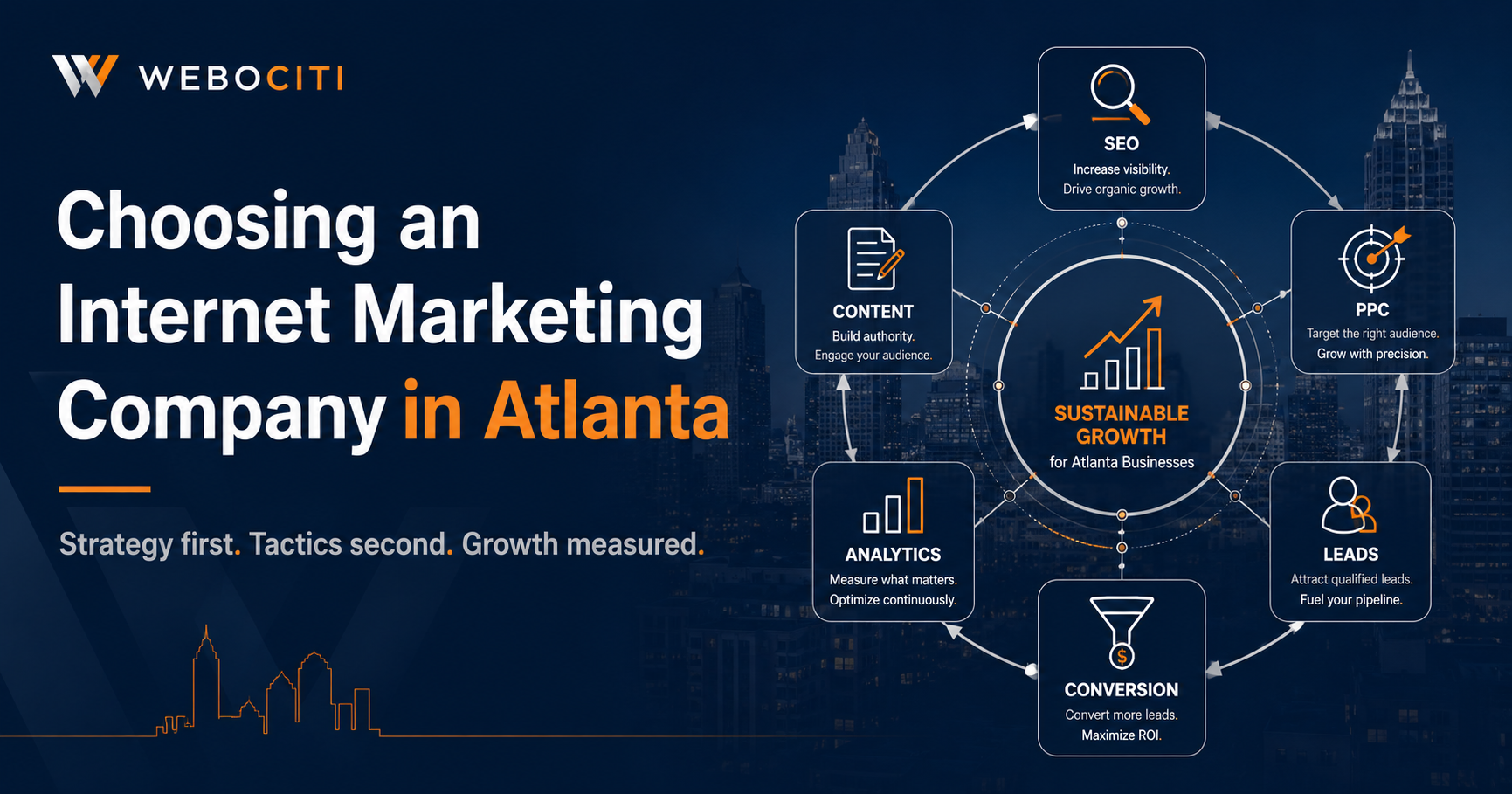
Most Atlanta businesses don’t need “more marketing.” They need a system that turns visibility into revenue: the right traffic, the right message, and a conversion path that works. This page explains how to evaluate an internet marketing company in Atlanta what services matter, how to assess strategy and reporting, and how to avoid agencies that sell activity instead of outcomes.

How to Choose an Internet Marketing Company in Atlanta (2026 Guide)

If you’re evaluating internet marketing companies in Atlanta, the most important factor is alignment not just services. The right marketing partner should integrate SEO, PPC, content, analytics, and conversion strategy into one measurable growth system. In a competitive market like Atlanta, disconnected tactics waste budget quickly. If you want to understand what modern search strategy actually requires, this explains what makes SEO work today.

This guide explains how to compare agencies, evaluate pricing models, identify red flags, and determine whether an SEO-focused firm or a full-service marketing company is the better fit for your business.

What Is an Internet Marketing Company?

An internet marketing company in Atlanta typically provides services such as search engine optimization (SEO), paid advertising (PPC), content marketing, website optimization, and analytics tracking. Some firms specialize in a single channel, while others build integrated growth systems across multiple digital platforms.


Types of Internet Marketing Companies in Atlanta

The phrase internet marketing company is broad. Two agencies can use the same label and deliver completely different outcomes. Before you compare proposals, clarify what kind of partner you’re actually hiring:

  • SEO-focused agency: organic visibility, content strategy, technical SEO, local search performance
  • PPC / media buying firm: paid search, paid social, YouTube, programmatic, landing page testing
  • Content-led growth team: blogs, thought leadership, authority-building, conversion content
  • Web/creative shop: design and build work sometimes with light SEO, often without growth strategy
  • Full-funnel growth partner: messaging, strategy, channel mix, measurement, CRO, compounding systems

Executive takeaway: You’re not hiring “marketing.” You’re hiring a growth system or a set of disconnected tasks.


How Atlanta Businesses Should Evaluate a Marketing Company

If you want outcomes, evaluate agencies on the things that actually drive outcomes. Here’s the practical checklist.

1) Strategy Before Tactics

A strong Atlanta marketing partner should be able to explain why specific channels will work for your business not just list services. They should ask about your ideal customers, sales cycle, margin, and competitive density. That alignment only works when you understand how search engines drive business growth and how intent translates into revenue.

  • Do they understand your ICP and buyer journey?
  • Can they prioritize channels based on intent and economics?
  • Do they talk about positioning and conversion not just traffic?

2) Measurement, Attribution, and Accountability

Many agencies report on activity (posts, clicks, impressions). You want a partner who reports on outcomes (leads, booked calls, pipeline, revenue contribution where possible).

  • What KPIs define success for your business?
  • How do they track lead quality — not just lead volume?
  • How often do you review results and adjust strategy?
  • Do you own the accounts, data, and tracking infrastructure?

3) Ability to Compete in a Dense Market

Atlanta is crowded. If your category has strong incumbents, local competitors, and aggressive ad spend, the agency must know how to build a realistic plan that wins over time.

  • Can they show examples from competitive markets?
  • Do they understand local search dynamics (maps, reviews, proximity signals)?
  • Can they improve conversion rate so traffic turns into revenue?

SEO vs PPC vs Content vs Social: What Should You Invest In?

Most businesses don’t fail because they “picked the wrong channel.” They fail because they treat channels as separate tactics instead of building a connected system.

SEO (Long-Term Demand Capture)

SEO works best when you want compounding visibility for searches with real intent — especially in service categories where buyers research options before they call. If you’re questioning whether SEO still matters, this explains why search engine optimization still matters for serious growth businesses.

If you’re specifically evaluating SEO help in Atlanta, this is the most direct resource:
Atlanta SEO Services.

If you want the “why this matters” view — and how SEO compounds — this guide explains it clearly:
Why SEO Is Still the Most Reliable Long-Term Growth Channel.

For businesses with multiple service lines or product categories, structure matters. This guide explains how category page SEO improves search visibility. If you’re selling products or service packages, this explains how product page SEO directly impacts revenue.

PPC (Speed + Control)

Paid campaigns can generate demand quickly but only if conversion tracking is correct, landing pages match intent, and the offer is strong.

Content (Authority + Trust)

Content is not “blogging.” In competitive markets, it’s how you become the obvious choice.

Social (Support, Not the Foundation)

Social is valuable for trust and visibility, but it’s rarely the primary growth engine.

Rule: Your channel mix should match your buyer’s intent and your tracking should prove what’s working.


Red Flags When Hiring a Marketing Agency in Atlanta

  • Guaranteed rankings or “#1 on Google” promises
  • No questions about your buyer
  • Reporting focused on impressions and clicks
  • No plan for conversion
  • Everything is “content” with no technical SEO or internal linking
  • You don’t own your accounts

When Should an Atlanta Business Hire an Internet Marketing Company?

Hiring a marketing partner becomes high-leverage when:

  • You’ve plateaued and need a clearer strategy to break through
  • You’re spending on ads but don’t have consistent lead quality
  • Your website gets traffic but doesn’t convert into calls or purchases
  • You want predictable growth without relying only on referrals
  • You need senior-level marketing leadership without a full-time CMO hire

If you’re still unsure where to start, this framework connects the full system (SEO + ads + messaging + conversion):
Internet Marketing for Business Growth.


Questions to Ask Before You Sign an Agency Agreement

  • What does success look like in 90 days, 6 months, and 12 months?
  • Which KPIs do you report on — and how do you define lead quality?
  • What is your strategy for improving conversion rate?
  • How do you decide what to prioritize each month?
  • What access do we have to accounts, tracking, and data?
  • How do you handle competitive markets and rising ad costs?

What to Do Next

If you’re evaluating internet marketing companies in Atlanta, the winning move is to hire a partner that builds a measurable growth system not one that sells disconnected deliverables.

If your priority is search visibility and qualified inbound demand, start here:
Atlanta SEO Services.

And if you want a broader strategy-first view of how all channels connect into one growth engine, use this guide as your reference point:
Internet Marketing for Business Growth.


Internet Marketing Companies in Atlanta: Quick FAQs

Below are the most common questions businesses ask when comparing internet marketing companies in Atlanta.

How much do marketing companies in Atlanta typically cost?
Pricing varies by scope and accountability. Strategy-led retainers are usually higher than “task-based” packages because they include planning, measurement, and optimization not just deliverables.
Should I hire an SEO agency or a full-service marketing company?
If SEO is your primary growth lever, hire an SEO-focused partner with technical depth and conversion alignment. If you need a connected multi-channel system, a strategy-led partner is usually a better fit.
How long does it take to see results?
PPC can generate results in weeks. SEO usually compounds over 3–6 months and becomes a durable growth asset over 6–12 months.

TL;DR: Category page SEO is the practice of optimizing eCommerce collection pages to rank for high-intent commercial keywords that drive revenue—not just traffic.

In Summary

Category pages often generate more organic revenue than individual product pages because they align with how buyers search and compare options. Effective category page SEO requires intent-driven keyword targeting, controlled indexation, strong internal linking, optimized category content, and conversion-ready UX. When structured correctly, category pages become durable ranking assets that scale with inventory.

Category Page SEO: How to Optimize Category Pages for Revenue

In eCommerce, product pages close the sale but category pages usually attract the buyer. When someone searches “men’s waterproof hiking boots” or “best espresso machines under $500,” they’re not looking for a single SKU. They’re looking for a curated set of options they can compare.

That’s why category pages (Shopify collections, WooCommerce product categories, and similar templates) often carry the biggest revenue SEO potential. Done right, they become stable ranking assets that generate consistent demand.


Why Category Page SEO Drives More Revenue Than Product Pages

Category pages tend to rank for broader, commercial-intent terms that capture buyers earlier in the journey. They also consolidate authority across products, reduce “orphan page” risk, and help search engines understand your site structure.

If your eCommerce SEO strategy is focused on revenue (not vanity traffic), category pages are often the highest-leverage place to improve.

Executive takeaway: Category pages aren’t navigation. They’re strategic landing pages for high-intent buyers.


Step 1: Align Category Pages With Purchase Intent

The most common category SEO mistake is building categories around internal naming instead of buyer language.

  • Bad: “Winter Collection 2026”
  • Better: “Men’s Insulated Winter Jackets”
  • Best: “Men’s Waterproof Winter Jackets for Extreme Cold”

Category pages should map to how customers search:

  • Product type + modifier (waterproof, insulated, non-toxic, etc.)
  • Brand + product type
  • Use case + product type
  • Problem-based searches (skin type, space constraints, pain points)

If your category pages don’t match purchase intent, you end up ranking for broad informational terms — or not ranking at all.


Step 2: Add Strategic Category Content (Without Killing UX)

A lot of stores either leave category pages thin and empty… or overload them with keyword-stuffed paragraphs. The best approach is:

  • 150–300 words of helpful, scannable copy (not fluff)
  • Clear “who this is for” guidance
  • Quick buyer considerations (materials, fit, sizing, use cases)
  • Subcategory links that help both customers and crawlers

Keep the copy tight. Your goal is to support relevance and trust — not to bury the products.

Rule: Category content should help a buyer decide — and help Google understand the page in under 30 seconds.


Step 3: Build Internal Linking That Makes Categories Rank

Category pages are the backbone of your internal linking architecture. They should be easy to reach and clearly supported by links from:

  • Homepage and primary navigation
  • Subcategory hubs
  • Relevant blog content (guides, comparisons, best-of lists)
  • High-authority pages across your site

Internal linking is how you “vote” for which categories matter. If a category page is buried 4–6 clicks deep, it will struggle to rank.

Related reading:
SEO for eCommerce Websites: What Actually Drives Revenue
(cornerstone).


Step 4: Control Indexation, Filters, and Duplicate URLs

Category pages are where eCommerce SEO can get messy fast because platforms generate duplicates via:

  • Filter URLs
  • Sort parameters
  • Pagination
  • Variants and collection paths
  • Tag archives

If you allow every variation to index, you create “index bloat” — too many low-value pages competing for the same keywords and diluting authority.

  • Canonicalize duplicates to the primary category page
  • Prevent thin filter variations from indexing
  • Keep one clean URL as the “ranking page” per intent

Reference: Google’s Core Web Vitals documentation emphasizes how performance impacts user experience and search visibility.
Google Core Web Vitals documentation.


Step 5: Optimize Category UX for Conversion (Because Rankings Don’t Pay Bills)

Category pages rank best when users engage. If visitors bounce, rankings eventually slip. The conversion-ready category page includes:

  • Fast load speed (especially on mobile)
  • Helpful filters that improve shopping (without creating index bloat)
  • Clear pricing and shipping/returns visibility
  • Trust signals (reviews, badges, guarantees where applicable)
  • Clean layout that supports scanning and comparison

Search visibility and conversion performance are connected. A page that ranks but doesn’t help customers decide won’t hold position long-term.

Related reading:
Product Page SEO: How to Optimize Product Pages for Revenue.


Common Category Page SEO Mistakes

  • Targeting internal naming instead of buyer intent keywords
  • Thin categories with no relevance signals
  • Over-indexing filters/tags/sort URLs
  • Poor internal link depth (categories too far from authority)
  • Bloated content that harms UX and engagement

How Category Page SEO Compounds Over Time

Strong categories compound because:

  • They support future product launches with built-in authority
  • They stabilize rankings across changing inventory
  • They create repeatable “money page” templates you can scale
  • They improve crawl efficiency and site understanding

This is why category architecture is one of the most durable long-term growth levers in eCommerce SEO.

Companion guide:
Why SEO Is Still the Most Reliable Long-Term Growth Channel.


Where Category SEO Fits in the Bigger System

Category SEO isn’t standalone. It works when your system is aligned:

  • Technical foundation (crawl/indexation/performance)
  • Category architecture (intent-driven collections)
  • Product pages (unique content + decision support)
  • Internal linking (authority flow + discoverability)
  • Conversion alignment (UX and trust)

If you want a broader view of how this connects with other growth channels, this guide helps:
Internet Marketing for Business Growth.

Category page SEO works best when integrated into a complete eCommerce SEO system. Technical health, product optimization, and internal linking must support category intent for rankings to compound over time.


What To Do Next

If you want category pages to rank consistently and drive revenue, start by choosing one priority category and optimizing it end-to-end: intent keyword targeting → structure → internal linking → index control → conversion UX.

If your business competes in a high-density market and needs strategy-led search visibility, you’ll see the same system applied in our location work as well — including Atlanta SEO services.

TL;DR: Product page SEO drives revenue when search intent, technical structure, trust signals, and conversion clarity work together. Rankings alone don’t sell optimized decision-making does.

In summary

Most product pages rank poorly or rank but don’t convert because they focus on keywords instead of buyer intent. High-performing product pages combine technical SEO, structured data, persuasive content, internal linking, and frictionless UX to turn search visibility into measurable revenue.

Why Product Page SEO Is Where Revenue Actually Happens

In eCommerce, category pages attract traffic but product pages close the sale.

If your product pages don’t rank for high-intent searches or fail to support decision-making once visitors arrive, your SEO investment stalls at visibility instead of revenue.


Step 1: Align the Product Page With Purchase Intent

Product page SEO starts with understanding the exact query that brings the buyer to the page. Is the search branded? Comparison-based? Feature-specific? Use-case driven?

  • Target long-tail purchase queries (brand + product + attribute)
  • Match page title and H1 to buyer language
  • Avoid keyword stuffing prioritize clarity
  • Ensure metadata reflects transactional intent

Product pages should answer the buyer’s final question not introduce the product for the first time.


Step 2: Build Unique, Conversion-Supporting Content

Manufacturer copy rarely ranks — and it rarely persuades. High-performing product pages include original content that supports decision confidence.

  • Clear value proposition above the fold
  • Use-case explanations
  • Specifications formatted for scanability
  • Benefit-driven subheadings
  • FAQ blocks that reduce purchase friction

If your product description looks identical to 20 competitors, search engines and buyers have no reason to choose you.


Step 3: Implement Clean Product Structured Data

Product schema enhances visibility and improves click-through rate by enabling rich results.

  • Product
  • Offer
  • AggregateRating (when applicable)
  • Review
  • Availability

Structured data doesn’t improve rankings directly but it improves how your listings appear, which increases performance.


Step 4: Strengthen Internal Linking to Support Rankings

Many eCommerce stores accidentally create orphaned product pages. Without internal links, Google treats those pages as low priority.

  • Link products from relevant categories
  • Add “Related Products” and cross-sells
  • Link from blog guides to priority SKUs
  • Reduce crawl depth for high-margin products

Internal linking isn’t just for SEO it also increases average order value.

If you’re restructuring an ecommerce website or launching a redesign, follow our website migration SEO checklist
to avoid losing rankings during site changes.


Step 5: Remove Conversion Friction

Even perfectly optimized pages fail when buyers hesitate.

  • Clear pricing
  • Visible shipping & returns
  • Trust badges
  • Customer reviews
  • Fast mobile performance

As we discussed in our guide on
Why SEO Is Still the Most Reliable Long-Term Growth Channel, sustainable SEO growth depends on alignment between visibility and conversion.


Common Product Page SEO Mistakes

  • Thin content
  • Duplicate manufacturer descriptions
  • Over-optimized anchor text
  • Slow mobile performance
  • Too many filter-indexed variations
  • Ignoring search intent mismatch

How Product Page SEO Compounds

When structured properly:

  • Each optimized product builds domain authority
  • Internal links strengthen priority categories
  • Rich snippets improve click-through rates
  • Better UX increases repeat buyers

Product page optimization is not a one-time task it’s an ongoing performance system.


Where Product Page SEO Fits Into the Bigger System

Product page SEO works best when connected to:

  • Category page strategy
  • Technical SEO structure
  • Content marketing
  • Conversion optimization

If you haven’t read it yet, start with our foundational guide: SEO for eCommerce Websites: What Actually Drives Revenue.


What To Do Next

If your product pages are ranking but not converting or not ranking at all the issue is rarely “more keywords.”

It’s alignment between search intent, technical execution, and buyer decision-making.

When those elements work together, product page SEO becomes a predictable revenue driver not a guessing game.

If you’re scaling ecommerce growth, working with an experienced SEO services team helps align strategy, technical execution, and conversion performance.

Want to improve product page performance?

Request a technical SEO review and we’ll identify where your product pages are losing visibility, conversions, and revenue.

Request a Free SEO Review

TL;DR:SEO for eCommerce websites drives revenue when technical foundations, category structure, product intent, and conversion paths work together as a system not isolated “SEO tasks.”

In summary

Most eCommerce SEO fails because it chases traffic instead of purchase intent. The stores that win build search visibility around how customers actually browse, compare, and buy using category architecture, product page optimization, internal linking, and technical performance to turn rankings into revenue.

Why SEO for eCommerce Websites Is Different Than “Normal” SEO

eCommerce sites don’t have a handful of service pages — they have dozens (or thousands) of products, multiple collections, filters, variants, and constantly changing inventory. That complexity is exactly why SEO can become a revenue engine… or a mess that burns time without meaningful outcomes.

The goal isn’t to “rank more pages.” The goal is to build visibility for the searches that indicate buying intent, then make it easy for searchers to choose you and complete a purchase.

Why Traffic Alone Doesn’t Drive Revenue

Many stores see an SEO bump and still don’t see sales lift. That’s usually because they’re ranking for broad, informational queries that don’t match purchase intent or because the site experience doesn’t convert once visitors arrive.

Sustainable eCommerce SEO focuses on the full chain: discovery → evaluation → decision. If any link breaks, rankings become a vanity metric.

The 5 Revenue Drivers of eCommerce SEO

1) Technical Foundation That Helps Search Engines Trust the Site

You can’t “content your way” out of technical problems. eCommerce SEO requires clean crawling and indexing, fast performance, stable templates, and controlled duplication from filters and variants.

  • Indexation control (what should and shouldn’t be indexed)
  • Canonical strategy for variants and duplicate URLs
  • Core Web Vitals + mobile performance
  • Clean category/product hierarchy and internal link depth

As Google explains, performance directly impacts both user experience and search rankings.

2) Category Page Strategy (Where Most Revenue SEO Lives)

In eCommerce, category and collection pages often carry the biggest revenue weight — because they match
how people shop (browse by intent, then narrow down).

  • Build category pages around buyer language, not internal naming
  • Target “money” queries: brand + product type + use case
  • Add helpful category content (brief, scannable, non-fluffy)
  • Use internal links to push authority into the right collections

3) Product Page Optimization That Supports Decision-Making

Product pages are where intent becomes revenue. SEO is only helpful if the page answers the questions buyers need to feel confident.

  • Unique product copy (not manufacturer boilerplate)
  • Clear value, specs, use cases, and trust signals
  • Strong internal linking: related products, accessories, “frequently bought together”
  • Clean structured data (Product, Offer, AggregateRating when applicable)

4) Internal Linking That Guides Both Crawlers and Customers

eCommerce sites naturally create “orphan” pages — products that exist but aren’t supported by internal links. Internal linking is how you control what ranks and what fades.

  • Use category → subcategory → product pathways consistently
  • Link to top collections from authority content (guides, “best of,” comparisons)
  • Reduce crawl depth for priority revenue pages
  • Avoid creating index bloat from thin tag/filter pages

5) Conversion Alignment (Because Rankings Don’t Pay Bills)

Search visibility is only valuable when it leads to action. That means aligning SEO landing pages with clear conversion paths — and removing friction in the purchase journey.

  • Fast pages, clear pricing, shipping/returns visibility
  • Stronger PDP trust: reviews, guarantees, comparison points
  • Better category UX: filters that help buyers, not hurt indexing
  • Landing-page intent match: the page must match the query’s promise

Platform Notes: Shopify vs WooCommerce vs Custom Stores

The fundamentals are the same, but execution varies. Shopify can create duplication through collections and URL patterns. WooCommerce can get heavy with plugins and performance issues. Custom builds often struggle with template consistency and crawl logic.

The key is not the platform — it’s the system: technical control + intent-driven architecture + conversion alignment.

Platform migrations require careful SEO planning. Our website migration checklist walks through the exact process to protect rankings.


Serious about scaling eCommerce revenue?
If you need an SEO system designed around revenue architecture — not traffic vanity metrics explore our SEO strategy framework →

How eCommerce SEO Compounds Over Time

Unlike paid traffic, SEO compounds. A strong category architecture strengthens future category launches. Great product pages rank and convert for years. Internal links push authority where you want it. And every improvement builds on the last.

This is why we’ve framed SEO as a long-term asset in our guide: Why SEO Is Still the Most Reliable Long-Term Growth Channel.

When to Invest in eCommerce SEO

eCommerce SEO becomes high-leverage when:

  • You sell products with repeat or evergreen demand
  • You’re competing in a category where ads are expensive
  • You want more first-time buyers without perpetual ad spend
  • You need stronger visibility for “ready to buy” searches

What to Do Next

If your SEO efforts are generating traffic but not revenue, it’s time to audit the system not the keywords., start by treating it as a system. That system connects search intent, technical structure, category architecture, product optimization, and conversion performance.

If your business competes in a high-density market and needs a strategy-led approach to search visibility, you’ll see the same framework applied in our location-based work as well including
Atlanta SEO services.

And if you’re mapping a broader marketing system that integrates SEO with the rest of your digital growth engine, this companion guide helps: Internet Marketing for Business Growth.


When SEO is engineered into the structure of the business not layered on top it becomes an asset that compounds for years.

If you’re evaluating how search should support revenue at scale, the first step is not more keywords. It’s clarity around structure, intent alignment, and conversion architecture.

This systems approach to search visibility is the same foundation we apply in competitive markets — including Atlanta SEO services.

TL;DR: Internet marketing works best when SEO, content, and digital channels are aligned around buyer intent and business goals not executed as isolated tactics.

In summary

Internet marketing today is no longer about individual channels or quick wins. Sustainable growth comes from aligning SEO, content, paid media, and strategy around how buyers actually discover, evaluate, and choose businesses.

What Internet Marketing Really Means Today

Internet marketing is the practice of using digital channels to attract, engage, and convert customers online. While the term once referred primarily to websites and email, modern internet marketing encompasses search engines, content, paid media, social platforms, and conversion optimization.

The key difference today is integration. No single channel operates in isolation, and results improve when each supports the others. For businesses comparing providers, this is especially important when evaluating an internet marketing company in Atlanta that builds strategy before tactics.

The Core Channels of Internet Marketing

Most effective internet marketing strategies are built on a combination of:

  • Search Engine Optimization (SEO) to capture demand when buyers are actively searching
  • Content marketing to educate, build authority, and support long sales cycles
  • Paid media to accelerate visibility and test demand
  • Website optimization to convert attention into action
  • Analytics and measurement to guide decisions and investment

Why SEO Anchors Internet Marketing

SEO often serves as the foundation of internet marketing because it captures high-intent demand and compounds over time. Unlike paid advertising, SEO continues generating visibility and traffic long after content is published.

For a deeper look at why SEO continues to outperform short-term channels, see why SEO compounds over time as a long-term growth strategy
.

If you’re evaluating whether SEO is still relevant in today’s environment, this explains why search engine optimization still matters for long-term growth businesses.

Execution also matters. This breakdown explains what makes SEO work today in competitive markets.

The Problem With Channel-First Marketing

Many businesses struggle with internet marketing because they approach it tactically. One vendor handles SEO, another runs ads, and content is produced without a clear strategy tying it all together.

The result is fragmented execution—activity without momentum and metrics without clarity.

How Strategy Changes Internet Marketing Outcomes

When internet marketing is driven by strategy, channels stop competing for credit and start reinforcing each other. SEO insights inform content, content improves conversion rates, and paid media validates demand.

This approach reduces wasted spend, shortens learning curves, and produces more predictable growth.

This same system-level thinking is explored in more detail in our breakdown of how search engines drive business growth.

What Internet Marketing Success Looks Like

Effective internet marketing produces outcomes that extend beyond traffic:

  • Consistent inbound demand from qualified prospects
  • Lower customer acquisition costs over time
  • Stronger brand authority in competitive markets
  • Clear insight into what drives growth

For businesses selling structured services or products, aligning search structure matters. Optimizing category-level SEO and strengthening product page SEO for revenue are examples of how channels reinforce one another.

Applying Internet Marketing Locally

While internet marketing principles apply broadly, execution often changes at the local level. For example, businesses competing in major metros require search and content strategies tailored to competitive density and buyer behavior.

This is the same strategic framework we apply when delivering Atlanta SEO services designed to support long-term, sustainable growth.

Internet Marketing as a Growth System

Internet marketing works best when viewed as a system—not a checklist. Businesses that invest in alignment, measurement, and strategy gain a durable competitive advantage that compounds over time.

When channels work together, internet marketing becomes more than promotion—it becomes a growth engine.

Businesses looking to operationalize this approach can explore how we apply integrated strategy across our digital marketing services.


Related Strategic Insights

TL;DR: SEO remains the most reliable long-term growth channel because it compounds over time, aligns with buyer intent, and continues generating demand long after the work is done.

In summary

While marketing tactics come and go, search engine optimization continues to deliver durable, compounding growth. This article explains why SEO remains the most reliable long-term growth channel—and how businesses can use it to build sustainable demand instead of chasing short-term wins.

The Problem With Short-Term Growth Tactics

Many businesses rely heavily on short-term marketing tactics like paid advertising, promotions, or campaign-based traffic. While these approaches can generate quick wins, they stop producing results the moment spending or effort pauses.

This creates a cycle of dependency where growth becomes unpredictable and increasingly expensive over time. For businesses evaluating strategic marketing direction, this broader framework explains how internet marketing drives sustainable business growth.

Why SEO Behaves Differently Than Other Channels

SEO works because it aligns with how buyers naturally search, research, and make decisions. Instead of interrupting audiences, it positions your business where demand already exists.

Each improvement—technical performance, content relevance, authority—builds on the last. Over time, SEO compounds instead of resetting. If you’re unsure what modern optimization requires, this breakdown explains what makes SEO work today.

How SEO Compounds Over Time

Unlike paid channels where results reset daily, SEO gains accumulate. Pages that rank today can continue driving traffic, leads, and revenue for months or years.

  • Content continues attracting qualified buyers
  • Authority strengthens across your entire site
  • Cost per acquisition decreases over time
  • Visibility supports every stage of the buyer journey

For businesses selling products or structured services, this is where strategic structure matters. Optimizing category-level search visibility and improving product page SEO for revenue accelerates compounding growth.

SEO Aligns With How Buyers Actually Decide

Modern buyers rely on search engines to understand problems, compare solutions, and evaluate providers. SEO supports this process by ensuring your business appears at the moments that matter most.

When search visibility is aligned with buyer intent, SEO becomes a trust-building mechanism—not just a traffic source. This is especially critical in competitive local markets like Atlanta, where choosing the right internet marketing company in Atlanta determines whether strategy or tactics lead the plan.

Why SEO Outlasts Algorithm Changes

While algorithms evolve, the fundamentals of SEO remain stable. Search engines consistently reward sites that deliver relevance, authority, and a strong user experience.

Businesses that treat SEO as a system—rather than a checklist—are far more resilient to updates and shifts in technology.

Where Businesses Go Wrong With SEO

SEO fails when it’s treated as a series of disconnected tactics. Common mistakes include:

  • Chasing keywords without understanding intent
  • Publishing content without conversion paths
  • Ignoring technical issues that block visibility
  • Measuring rankings instead of revenue impact

Many businesses lose visibility during redesigns because they overlook technical SEO planning. Use our website migration SEO checklist to protect rankings during major website changes.

If your SEO efforts aren’t producing results, it may be because the system isn’t aligned. This guide explains how search engines drive measurable business growth when executed strategically.

Why SEO Is Especially Powerful for Competitive Markets

In competitive and local markets, SEO creates a defensible advantage by capturing demand before buyers ever engage with ads or sales teams.

This is the same framework we apply when delivering Atlanta SEO services designed to support sustained growth in competitive environments.

What This Means for Long-Term Business Growth

SEO isn’t about quick wins—it’s about building an asset that supports your business year after year. When executed correctly, it becomes a reliable engine for visibility, trust, and revenue.

For businesses focused on long-term growth rather than short-term spikes, SEO remains the most dependable channel available.

Final Takeaway

Marketing trends will continue to change, but search behavior will not. Businesses that invest in SEO as a long-term growth system position themselves to win—not just today, but for years to come.

For businesses focused on long-term growth, working with an experienced SEO services team helps ensure strategy, execution, and measurement stay aligned.


Related Strategic Insights

TL;DR: Local SEO helps businesses get found by nearby customers at the exact moment they’re searching. When done correctly, it drives high-intent traffic, trust, and consistent local growth.

In summary

Local search plays a critical role in how customers discover, compare, and choose nearby businesses. This article explains how local SEO works, why it matters more than ever, and how search visibility turns local intent into real customer demand.

What Is Local SEO?

Local SEO is the practice of optimizing your online presence so your business appears when people search for products or services in a specific geographic area. These searches often include location modifiers like “near me,” city names, or neighborhood terms.

Unlike traditional SEO, which targets broad or national visibility, local SEO focuses on connecting businesses with customers who are ready to take action nearby. If you’re evaluating how local visibility fits into broader strategy, this guide explains why search engine optimization still matters as a growth channel.

Why Local Search Has Become the Default Buying Path

Today’s buyers rely on search engines to solve immediate problems. Whether they’re looking for a service provider, comparing options, or checking availability, local search is often the first step.

Search engines prioritize local relevance because proximity, intent, and trust signals help deliver better results to users. Businesses that appear in these results gain a significant advantage before a customer ever visits a website. This is part of the larger framework outlined in how search engines drive business growth.

How Local SEO Translates Visibility Into Customers

Local SEO works by aligning your business with how search engines evaluate relevance and trust. When done well, it helps your business appear consistently across key local touchpoints.

  • Search results for location-based queries
  • Google Business Profile listings
  • Maps and mobile search results
  • Local directories and citations

This visibility builds familiarity and credibility, making customers more likely to choose your business when they’re ready to act.

To understand how local visibility fits into a broader search strategy, revisit our article on What Makes SEO Work Today, which explains SEO as a long-term system.

What Actually Matters for Local SEO Today

Modern local SEO is not about stuffing city names into pages. It requires a coordinated approach that supports both search engines and real buyers.

  • Accurate and consistent business information
  • Clear alignment with local search intent
  • Authority signals like reviews and trusted mentions
  • Location-relevant content that answers real questions
  • Technical foundations that support crawlability and speed

When these elements work together, local SEO becomes a predictable growth channel rather than a guessing game. This compounding effect is why many businesses treat SEO as a long-term growth channel rather than a short-term tactic.

Where Many Local SEO Efforts Fall Short

Many businesses struggle with local SEO because they focus on isolated tactics instead of outcomes. Rankings are tracked, profiles are created, and content is published—but results remain inconsistent.

The missing piece is strategy. Without a clear plan that connects visibility to customer behavior, local SEO activity often fails to translate into measurable growth. This is especially common when comparing internet marketing companies in Atlanta that emphasize tasks instead of systems.

How Local SEO Supports Long-Term Business Growth

Unlike short-term advertising, local SEO compounds over time. Each improvement strengthens your visibility, trust, and relevance within your market.

Businesses that invest in local search visibility benefit from lower acquisition costs, stronger brand recognition, and demand that continues even when marketing budgets fluctuate. This alignment is part of a broader internet marketing growth strategy.

What This Means for Businesses Competing Locally

For businesses operating in competitive regions, local SEO must be treated as a system—not a checklist. Success comes from aligning technical execution, content, authority, and conversion paths with how local buyers actually search.

This same framework is applied when delivering Atlanta SEO services designed to help businesses capture local demand and convert search visibility into real revenue.

Final Takeaway

Local SEO influences nearly every local buying decision. When built correctly, it becomes a reliable engine for attracting qualified customers and supporting sustainable business growth.


Related Strategic Insights

TL;DR: Search engines shape how buyers discover, evaluate, and choose businesses.
SEO leads the way by turning search demand into long-term visibility, trust, and revenue.

In summary:
Search engines influence nearly every buying decision by shaping how customers discover, compare, and evaluate businesses. This article explains how search visibility drives sustainable business growth—and why SEO remains the foundation of long-term digital strategy.

How Search Engines Drive Business Growth (And Why SEO Leads the Way)

Search engines are no longer just tools for finding information — they are the primary way buyers research problems, compare solutions, and decide which businesses they trust. For companies competing in crowded markets, search visibility has become a direct driver of growth, not a supporting tactic.

Search Engines as the Starting Point for Modern Buyers

Today’s buyers rely on search engines at every stage of the decision-making process. Whether they are identifying a problem, researching options, or validating a short list of providers, search results shape perception long before a conversation ever begins.

This shift means business growth increasingly depends on how well your company appears when buyers are actively looking — not when you interrupt them with ads. This is the broader strategic framework behind internet marketing for business growth.

How Search Visibility Translates Into Revenue

Search engines reward relevance, clarity, and authority. When your business consistently appears for the right searches, it builds familiarity and trust before a prospect ever visits your website.

  • High-intent searches signal readiness to evaluate or buy
  • Visibility reinforces credibility and expertise
  • Repeated exposure shortens sales cycles

This is why search performance is no longer measured only in rankings or traffic, but in qualified leads, pipeline influence, and long-term demand. Businesses evaluating partners often explore how to choose an internet marketing company in Atlanta based on this strategic alignment.

Why SEO Leads the Search Growth System

Search Engine Optimization sits at the center of sustainable search growth because it aligns with how search engines actually work. Unlike short-term tactics, SEO builds durable assets that compound over time.

Modern SEO combines:

  • Technical SEO: Ensuring your site can be crawled, indexed, and trusted
  • Content Strategy: Answering real buyer questions at every stage
  • Authority Building: Earning relevance through links and brand signals
  • Conversion Alignment: Turning visibility into measurable outcomes

This system-based approach allows SEO to support both awareness and revenue — not just rankings. For a deeper breakdown of execution alignment, see what makes SEO work today.

SEO vs. Short-Term Search Tactics

Paid ads, social campaigns, and one-off promotions can drive bursts of traffic, but they stop working the moment spend stops. SEO, by contrast, continues to deliver value as long as buyers are searching.

That’s why many businesses treat SEO as a growth foundation rather than a channel. It supports every other marketing effort by capturing demand that already exists. This long-term compounding effect is explained further in why SEO compounds over time as a growth strategy

How SEO Supports the Buyer Journey

Awareness

SEO content helps buyers understand problems and opportunities, positioning your brand as a trusted guide early in the journey.

Evaluation

As searches become more specific, SEO ensures your expertise is visible when buyers compare options and solutions.

Decision

At the point of action, search visibility reinforces confidence and supports conversion through clear messaging and intent-driven pages. This is why understanding why search engine optimization still matters is critical for growth-focused businesses.

When SEO Makes the Most Business Sense

SEO is particularly effective for businesses that:

  • Compete in crowded or competitive markets
  • Have longer or more considered sales cycles
  • Serve defined geographic or service areas
  • Want sustainable growth instead of short-term spikes

For companies operating in competitive regions like Atlanta, strong SEO visibility creates a measurable advantage by capturing demand at the exact moment buyers are searching.

For businesses operating in competitive regional markets, location-specific SEO becomes even more critical. Local visibility strategies, such as those outlined in Local SEO Explained, support geographic demand capture.

Learn how Webociti approaches Atlanta SEO services
to support long sales cycles, competitive industries, and sustainable growth.

SEO as a Business Growth System

When SEO is treated as an ongoing system — rather than a checklist — it becomes one of the
most reliable growth engines available to modern businesses.

By aligning search visibility with buyer intent, technical performance, and conversion
strategy, SEO turns search engines into long-term revenue drivers instead of unpredictable
traffic sources.

If you’re evaluating SEO as a growth channel, explore our SEO services for growing businesses to see how strategy-led optimization supports sustainable results.

Final Takeaway

Search engines now influence nearly every buying decision. Businesses that understand how search drives discovery, trust, and evaluation — and invest in SEO accordingly — are better positioned to grow consistently in competitive markets.


Related Strategic Insights