Originally published in 2017. Updated for 2026.

Real Estate Marketing • Trends & Strategy

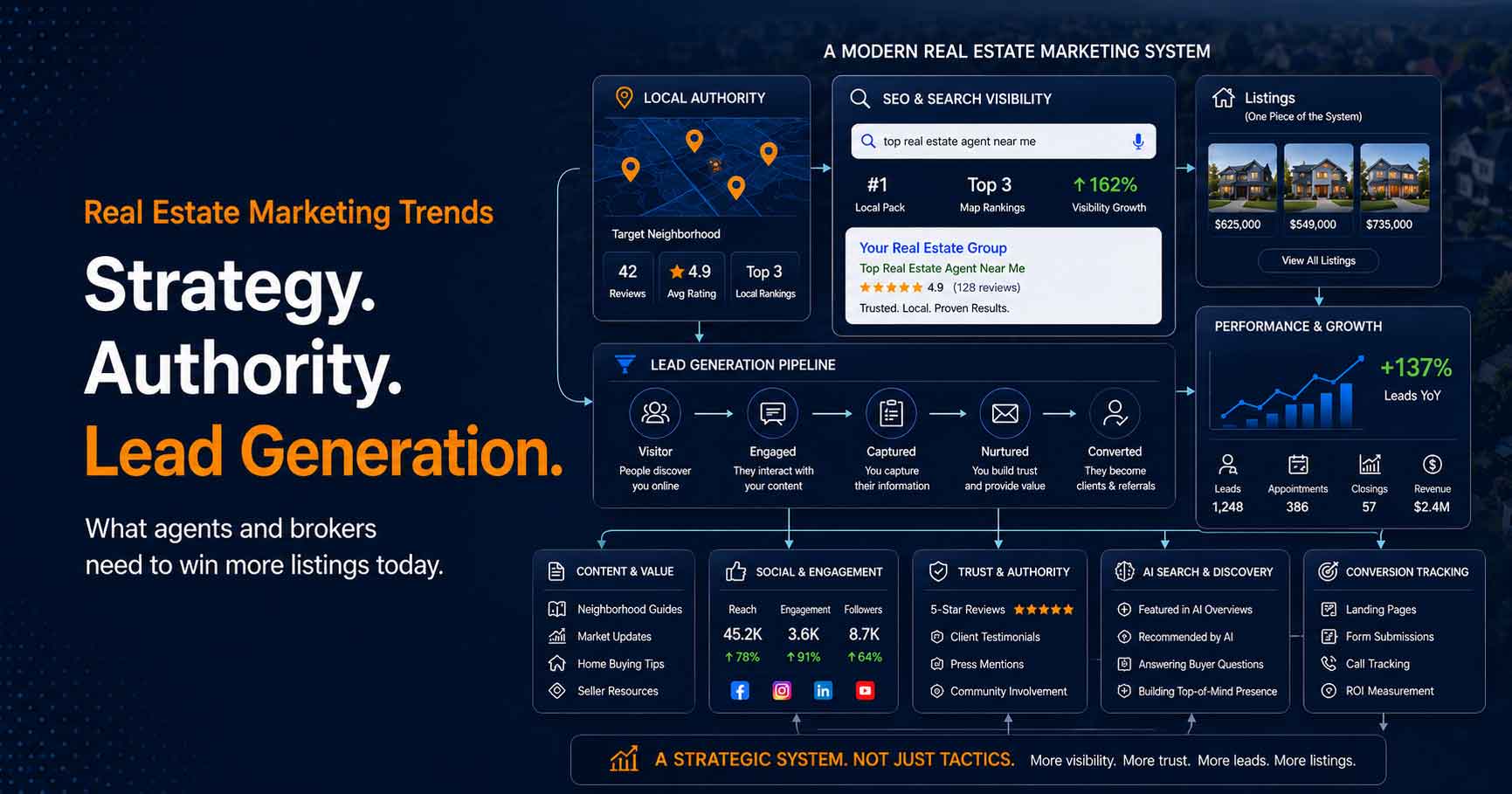
Real estate marketing trends have shifted. Listings alone no longer differentiate agents, brokers, or teams. Today, the strongest real estate marketing is built around positioning, local authority, lead generation, and measurable growth.

AI TL;DR:

  • Listings are no longer enough to stand out in real estate marketing.
  • Agents and brokers need stronger positioning, local authority, and trust-building content.
  • Real estate SEO, Google visibility, and neighborhood-focused content are becoming more important.
  • Lead generation needs follow-up, tracking, and conversion systems — not just form fills.
  • The agents who win are the ones who build a marketing system, not random marketing activity.

Real estate marketing used to revolve around exposure. Get the listing in front of more people, promote the property, run a few ads, and wait for inquiries.

That approach is no longer enough.

Buyers and sellers can now find listings almost anywhere. They can search portals, compare homes, review neighborhoods, study pricing trends, and research agents before they ever make contact.

The challenge is no longer simply getting seen. The challenge is being trusted, remembered, and chosen.

That is why modern real estate marketing must move beyond listing promotion. Agents and brokers need clear positioning, stronger local authority, better website messaging, smarter SEO, and a lead generation system that turns attention into conversations.

For a deeper look at how Webociti helps agents and brokers build these systems, explore our real estate marketing services.

1. Listings Are No Longer the Advantage

One of the biggest real estate marketing trends is the shift away from listings as the primary differentiator.

Listings still matter, but they are no longer enough to separate one agent or brokerage from another. Buyers and sellers can access inventory through portals, search engines, apps, and local real estate websites.

What buyers and sellers need now is guidance. Sellers want to know how to price correctly, prepare the home, avoid costly mistakes, and choose the right strategy. Buyers want neighborhood insight, negotiation confidence, and clarity in a competitive market.

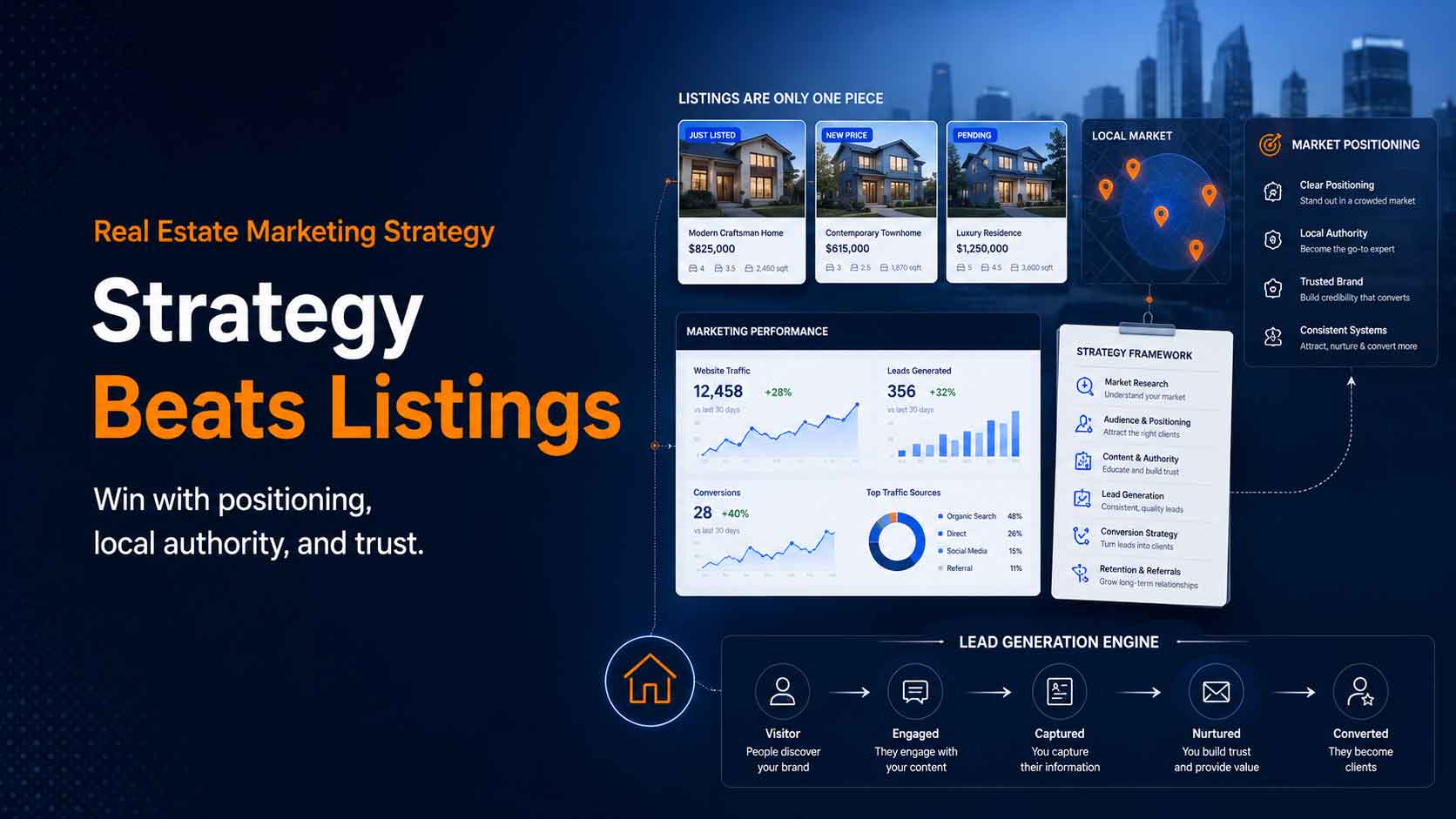
That is why the best real estate marketing now positions agents as trusted advisors, not just listing promoters. Read more in our related article: Real Estate Marketing Strategy: Strategy Beats Listings.

2. Local Authority Matters More Than Broad Visibility

Real estate is local. Buyers and sellers want to work with someone who understands their neighborhoods, pricing patterns, school zones, market shifts, and local buyer behavior.

Broad visibility can help, but local authority is what creates trust. Agents who publish useful local content, optimize their Google presence, build neighborhood-specific pages, and show real market expertise are more likely to stand out.

Strong local authority can include:

  • Neighborhood market updates
  • Seller guides for specific communities
  • Buyer resources by area
  • Local pricing insights
  • Google Business Profile optimization
  • Reviews and testimonials
  • Community-specific landing pages

This is where local SEO for small business becomes especially important for real estate professionals.

3. Real Estate SEO Is Becoming More Competitive

Search visibility remains one of the most valuable real estate marketing channels, but it is also more competitive than it used to be.

Agents and brokers are competing with large portals, national brands, directories, paid search ads, local competitors, and AI-driven search results. Ranking for broad real estate terms can be difficult, but there are still strong opportunities in local, niche, and intent-based searches.

Instead of only targeting broad phrases, real estate websites should focus on specific searches such as:

  • Homes for sale in specific neighborhoods
  • Best areas to live in a local market
  • How to sell a home in a specific city
  • Real estate agent for a specific community
  • Local market reports
  • Seller-focused questions

Real estate SEO works best when it is tied to positioning, content strategy, local authority, and conversion-focused website pages.

4. Agent and Broker Websites Need Better Positioning

Many real estate websites still look and sound the same. They lead with listings, generic claims, and basic contact forms.

A modern real estate website should quickly answer one important question:

Why should a buyer or seller choose you instead of another agent, brokerage, or portal?

Strong real estate positioning may include:

  • Clear buyer and seller messaging
  • Local market specialization
  • Proof of results
  • Reviews and testimonials
  • Helpful content for buyers and sellers
  • Clear calls to action
  • Conversion-focused landing pages

A website should not just display listings. It should build trust and guide visitors toward a conversation.

5. Lead Generation Needs Follow-Up, Not Just Form Fills

Another major real estate marketing trend is the shift from basic lead capture to full lead management.

Getting a form submission is only the beginning. Many real estate leads are not ready to transact immediately. Some are researching neighborhoods. Some are comparing agents. Some are months away from buying or selling.

A stronger real estate lead generation system may include:

  • Seller valuation offers
  • Buyer guides
  • Neighborhood landing pages
  • Email follow-up sequences
  • Retargeting campaigns
  • CRM lead routing
  • Call tracking and conversion tracking

The goal is not just more leads. The goal is better conversations with people who are more likely to become clients.

6. Paid Advertising Works Best With a Clear Strategy

Paid advertising can still be useful for real estate marketing, but it works best when it is connected to a clear strategy.

Running ads without strong positioning, landing pages, follow-up, and tracking often creates wasted spend. The ad may generate clicks, but the system behind the click determines whether that attention turns into a qualified lead.

Paid media can support:

  • Seller lead generation
  • Listing promotion
  • Retargeting website visitors
  • Local awareness campaigns
  • Open house promotion
  • Recruiting for brokerages and teams

For agents and brokers, paid advertising should not stand alone. It should support the broader message, funnel, and growth strategy.

7. Content Should Answer Buyer and Seller Questions

Real estate content should do more than fill a blog. It should answer the questions buyers and sellers are already asking.

Useful content helps build authority before someone is ready to contact an agent. It also gives your website more opportunities to appear in search results and AI-driven discovery experiences.

Strong real estate content topics include:

  • How to prepare a home for sale
  • How pricing strategy affects offers
  • Common seller mistakes
  • Neighborhood comparisons
  • Local market updates
  • Buyer checklists
  • Questions to ask before choosing an agent

The best content does not simply promote the agent. It educates the buyer or seller and builds confidence in the agent’s expertise.

8. Social Media Needs to Build Trust, Not Just Activity

Social media is still part of real estate marketing, but posting more often is not the same as building trust.

Agents and brokers should use social media to reinforce expertise, highlight local knowledge, share helpful advice, and stay visible with prospects and referral sources.

  • Local market insights
  • Seller preparation tips
  • Buyer education
  • Neighborhood features
  • Client success stories
  • Behind-the-scenes process content
  • Short educational videos

The goal is not random activity. The goal is consistent trust-building.

9. AI Search and Zero-Click Results Are Changing Discovery

Search behavior is changing. More users are getting answers from AI search results, map packs, snippets, local profiles, and other zero-click experiences before they visit a website.

This makes brand clarity, local authority, structured content, reviews, and consistent online visibility more important.

Real estate professionals should make sure their online presence clearly communicates who they serve, where they work, what they specialize in, and why someone should trust them.

10. Measurement and Conversion Tracking Matter More Than Ever

Real estate marketing should be measured by more than impressions, likes, or website visits.

Agents and brokers need to understand which channels are creating real opportunities. That means tracking:

  • Forms and calls
  • Landing page conversions
  • Ad campaigns
  • Search traffic
  • Email engagement
  • Booked appointments
  • Seller and buyer lead sources

When measurement is in place, marketing becomes easier to improve.

Strategic Takeaway

The biggest real estate marketing trend is not one tactic. It is the shift from promotion to positioning.

Agents and brokers who build local authority, answer real buyer and seller questions, track performance, and create a complete lead generation system are better positioned to win more listings and reduce dependence on portals.

Real Estate Marketing Strategy

Ready to Build a Real Estate Marketing System That Wins More Listings?

Webociti helps agents, brokers, and real estate teams improve positioning, build local authority, strengthen lead generation, and create marketing systems designed for predictable growth.


Explore Real Estate Marketing Services

Real Estate Marketing Trends FAQs

Quick answers to common questions about real estate marketing trends, SEO, lead generation, and local authority.

What are the most important real estate marketing trends?

The most important real estate marketing trends include stronger positioning, local authority, real estate SEO, neighborhood-focused content, lead generation systems, paid media strategy, AI search visibility, and better conversion tracking.

Are listings still important in real estate marketing?

Listings are still important, but they are no longer enough to differentiate an agent or brokerage. Buyers and sellers can access inventory almost anywhere. What matters more is guidance, trust, local expertise, and a clear reason to choose you.

How can real estate agents get more local visibility?

Real estate agents can improve local visibility by optimizing their Google Business Profile, publishing neighborhood-specific content, collecting reviews, building local landing pages, improving website SEO, and creating helpful buyer and seller resources.

Why is lead follow-up important for real estate marketing?

Lead follow-up is important because many buyers and sellers are not ready to act immediately. Email sequences, retargeting, CRM tracking, and consistent follow-up help turn early interest into real conversations and appointments.

How should agents measure real estate marketing performance?

Agents should measure real estate marketing performance by tracking website traffic, form submissions, phone calls, landing page conversions, ad performance, search rankings, booked appointments, and the quality of buyer and seller leads.

Revenue System Strategy

How to Build a Revenue Growth System

Growth does not become predictable because a company does more marketing, adds more sales activity, or reviews more dashboards. It becomes predictable when the pieces behind revenue are connected.

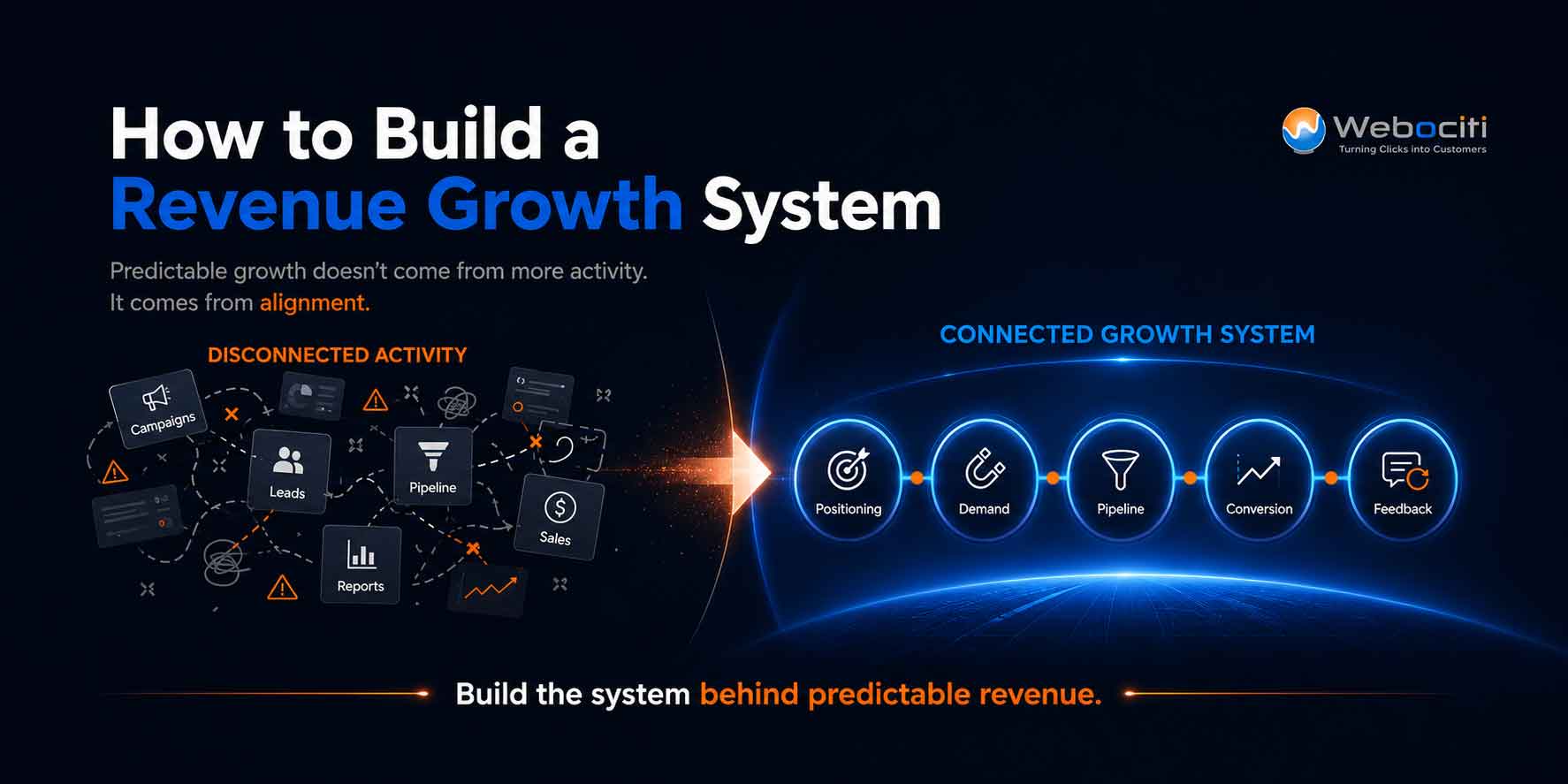
A revenue growth system connects positioning, demand generation, pipeline quality, conversion, and revenue feedback into one operating framework so leadership can diagnose where growth is working, where it is breaking, and what needs to improve next.

In Summary

A revenue growth system is the structure that connects how a business attracts the right buyers, qualifies opportunities, advances pipeline, converts revenue, and learns from market feedback.

Instead of treating marketing, sales, and revenue as separate functions, a revenue growth system aligns them around the same buyer, the same message, the same pipeline definitions, and the same growth outcomes.

The goal is not more activity. The goal is better-fit opportunities, stronger conversion, cleaner pipeline, and more predictable revenue.

Part of the Webociti Revenue System Series

This guide is part of a larger series on how businesses can move from disconnected marketing and sales activity to a connected revenue growth system.

Predictable revenue is not built from disconnected tactics. It is built from a connected system.

What Is a Revenue Growth System?

A revenue growth system is the connected structure behind how a company attracts the right buyers, qualifies opportunities, advances pipeline, converts revenue, and learns from market feedback.

It is not one campaign. It is not one sales process. It is not one CRM dashboard.

It is the operating system behind predictable growth.

A strong revenue growth system connects five core parts:

Positioning → Demand → Pipeline → Conversion → Revenue Feedback

Each stage feeds the next. When one stage is weak, everything downstream becomes harder. When the stages are connected, the business can diagnose growth more clearly and improve the system over time.

This is the difference between companies that create activity and companies that create momentum.

Activity is easy to generate. Momentum requires alignment.

For a deeper look at the full framework, read: What a Real Revenue System Actually Looks Like.

Why Most Growth Systems Break

Most companies do not intentionally design their revenue system.

They add pieces over time.

  • A website gets built.
  • Marketing campaigns get launched.
  • Sales tools get added.
  • CRM stages get created.
  • Reporting dashboards get reviewed.
  • New people join the team.

Each piece may make sense on its own. But if those pieces are not connected, the company ends up with growth activity instead of a growth system.

That is where the breakdown starts.

  • Marketing attracts the wrong audience.
  • Sales questions lead quality.
  • Pipeline looks active but does not convert.
  • Leadership pushes for more leads instead of better-fit opportunities.
  • Revenue remains inconsistent.
Most growth problems are not caused by one broken tactic. They are caused by disconnected parts of the revenue system.

When marketing, sales, pipeline, and conversion are not aligned, activity can increase while revenue stays unpredictable.

If your marketing is creating activity but not qualified opportunities, this is likely part of the problem: Why Your Marketing Isn’t Generating Qualified Leads.

Step 1: Start With Positioning

Every revenue growth system starts with positioning.

Positioning defines who you serve, what problem you solve, why that problem matters, and why buyers should choose you instead of another option.

If positioning is weak, everything downstream becomes harder.

  • Marketing becomes too broad.
  • Content attracts the wrong audience.
  • Sales conversations require too much explanation.
  • Pipeline quality suffers.
  • Conversion becomes inconsistent.

Strong positioning creates clarity before the buyer ever talks to sales.

It helps answer the questions buyers are already asking:

  • Is this for me?
  • Do they understand my problem?
  • Can they solve the issue I care about?
  • Why should I act now?
  • Why should I choose this company?

Without those answers, marketing becomes noise and sales becomes education.

Weak positioning attracts weak-fit opportunities. Strong positioning creates the foundation for qualified demand.

That is why positioning is not just a branding exercise. It is the first operating decision in a revenue growth system.

Step 2: Define the Right Buyer

A revenue growth system cannot work if the company is unclear about who it is trying to attract.

Many companies define their market too broadly. They focus on everyone who could buy instead of the buyers most likely to convert, stay, grow, and create long-term value.

That creates noise in the system.

The right buyer should be defined by more than basic demographics, company size, or industry category.

Look at:

  • Fit — Does this buyer match your ideal customer profile?
  • Need — Do they have a real problem you can solve?
  • Urgency — Is there a reason to act?
  • Authority — Can they influence or make a decision?
  • Value — Is the opportunity worth pursuing?
  • Conversion potential — Can this buyer realistically move through your process?

This step matters because the wrong buyer can make every part of the revenue system look weaker than it actually is.

A poor-fit lead may engage with your marketing, book a call, and enter the pipeline, but that does not mean they are a real revenue opportunity.

If they lack urgency, budget, authority, need, or strategic fit, they slow the system down. Sales spends more time educating, qualifying, and chasing instead of advancing real opportunities.

The goal is not to attract everyone who could possibly buy.

The goal is to attract the buyers most likely to understand the value, move through the process, and convert into profitable revenue.

The clearer the buyer definition, the cleaner the pipeline becomes.

When the right buyer is clearly defined, campaigns improve, messaging sharpens, pipeline quality increases, and the sales team spends more time with better-fit opportunities.

Step 3: Build Demand Around Buyer Problems

Demand generation should not start with what you want to sell.

It should start with what the buyer needs to solve.

Many companies build marketing around services, features, internal priorities, or whatever campaign they want to push next.

But buyers respond to problems, outcomes, risks, and opportunities.

A strong revenue growth system turns positioning into demand by connecting the company’s message to real buyer pain.

That means your content, ads, email campaigns, social posts, landing pages, and offers should all answer one question:

Why should the right buyer care now?

If your marketing creates traffic, clicks, and form fills but not qualified opportunities, you are not building demand. You are building activity.

The goal is not attention alone.

The goal is qualified demand from buyers who understand the problem, see the value, and have a reason to take the next step.

Demand generation should create interest from the right buyers, not just more movement at the top of the funnel.

When demand is built around real buyer problems, marketing becomes more relevant, lead quality improves, and the pipeline has a better chance of turning into revenue.

Step 4: Design the Pipeline Around Quality

A pipeline should not be a dumping ground for every inquiry.

It should be a structured system for identifying, qualifying, advancing, and converting real opportunities.

This is where many companies lose control of growth.

They treat every lead like an opportunity. They allow low-fit prospects to move too far into the process. They measure pipeline volume instead of pipeline quality.

The result is predictable:

  • Sales gets buried in weak conversations.
  • Deals stall.
  • Forecasts become unreliable.
  • Leadership sees pipeline activity but not revenue momentum.

A strong revenue growth system defines what belongs in the pipeline and what does not.

That requires clear qualification criteria:

  • Who is a real fit?
  • What problem are they trying to solve?
  • What stage of awareness are they in?
  • What action should happen next?
  • What disqualifies an opportunity?
  • What signals real buying intent?

A quality-focused pipeline gives your team a cleaner view of what is real.

Instead of measuring success by the number of opportunities in the CRM, the company can evaluate whether those opportunities match the buyer profile, have a clear business need, and show enough momentum to justify continued sales effort.

This changes how the team manages growth.

Sales can focus on better conversations. Marketing can see which sources create real opportunities. Leadership gets a more accurate view of future revenue.

A full pipeline does not always mean a healthy pipeline. Pipeline quality matters more than pipeline volume.

If your pipeline looks full but deals are not moving, read:
Why Your Pipeline Isn’t Converting.

Step 5: Align Marketing and Sales Around Revenue

Marketing and sales cannot operate from different definitions of success.

If marketing is optimizing for lead volume while sales is responsible for revenue, the system will eventually break.

Marketing may celebrate activity while sales questions lead quality. Sales may blame marketing while marketing argues the leads were delivered. Leadership may see motion but not know where the real breakdown is happening.

The fix is alignment around shared revenue outcomes.

Both teams should agree on:

  • Who the ideal buyer is
  • What makes a lead qualified
  • What pipeline stages mean
  • What messages are resonating
  • Where opportunities are stalling
  • Which channels create real revenue

This alignment changes the conversation from blame to diagnosis.

Instead of asking whether marketing produced enough leads or whether sales followed up fast enough, the team can look at the full system and identify where revenue is actually breaking.

That might be a targeting issue. It might be a messaging issue. It might be a qualification issue. It might be a conversion issue.

But until marketing and sales share the same definitions, the business cannot diagnose the problem clearly.

Alignment gives leadership one shared view of growth instead of separate marketing, sales, and revenue opinions.

When marketing and sales are aligned, demand improves, pipeline gets cleaner, and conversion becomes more predictable.

When they are disconnected, revenue becomes a guessing game.

Step 6: Improve Conversion as a System Outcome

Conversion is often treated as a sales issue.

But conversion is usually the result of everything that happened before the sales conversation.

Clear positioning improves conversion. Better-fit demand improves conversion. Stronger qualification improves conversion. Sharper messaging improves conversion. Better handoffs improve conversion.

That is why companies should not look at conversion in isolation.

If close rates are weak, the answer may not be to pressure sales harder. The better question is:

What is happening upstream that makes conversion harder than it should be?

A revenue growth system makes conversion a shared outcome across positioning, marketing, sales, and leadership.

Conversion improves when the full system improves — not when sales is forced to work harder around weak-fit opportunities.

When the right buyers enter the pipeline with clearer expectations, stronger intent, and better alignment around the problem, sales conversations become easier to advance and easier to close.

Step 7: Use Revenue Feedback to Improve the System

A real revenue growth system learns from the market.

Revenue feedback should not stay trapped in reports, sales calls, CRM notes, or leadership meetings. It should be used to improve the entire system.

Look at:

  • Which buyers convert fastest?
  • Which deals stall?
  • Which messages create real engagement?
  • Which campaigns produce qualified opportunities?
  • Which objections keep appearing?
  • Which customer segments produce the most value?
  • Which offers lead to real conversations?

This feedback loop is what makes a revenue growth system stronger over time.

Every closed deal, stalled opportunity, lost proposal, and customer conversation contains useful information. The best companies use that information to refine positioning, sharpen messaging, improve qualification, adjust sales conversations, and strengthen the growth strategy.

Without this loop, companies keep repeating the same campaigns, the same sales motions, and the same mistakes without learning from the market.

Revenue feedback should not sit in reports. It should change how the system works.

Revenue feedback turns growth from a linear funnel into a learning system.

This is also why companies eventually outgrow traditional funnel thinking:
Revenue System vs Sales Funnel.

The Revenue Growth System Framework

A revenue growth system is not a collection of disconnected tactics.

It is a connected operating framework that helps leadership understand how growth is created, where it is breaking, and what needs to be improved.

Viewed as a whole, the system works when each stage feeds the next and revenue feedback improves everything over time.

This is what a revenue growth system looks like:

Revenue growth system framework showing positioning, demand generation, pipeline design, conversion, and revenue feedback connected as one growth system

The Five Parts of a Revenue Growth System

1. Positioning

Clarify who you serve, what problem you solve, why your solution matters, and why buyers should choose you.

2. Demand Generation

Create interest from the right buyers by connecting your message to real business problems, not just promoting services or features.

3. Pipeline Design

Filter, qualify, and advance real opportunities instead of allowing every inquiry to become a sales priority.

4. Conversion

Turn buyer fit into revenue through clear messaging, strong handoffs, defined next steps, and a repeatable sales process.

5. Revenue Feedback

Use market data, sales conversations, stalled deals, wins, losses, and customer insights to improve the system over time.

Each part affects the next.

If positioning is unclear, demand becomes weak. If demand is weak, pipeline quality suffers. If pipeline quality suffers, conversion becomes inconsistent. If conversion is inconsistent, revenue becomes unpredictable.

The framework gives leadership a way to diagnose growth as a system instead of reacting to symptoms one tactic at a time.

How to Know Your Revenue Growth System Is Broken

Once you look at growth through this system, the warning signs become much easier to see.

You may need to redesign your revenue growth system if the business is producing activity, but that activity is not turning into predictable revenue.

  • Your marketing is generating leads, but sales says they are not qualified.
  • Your pipeline looks full, but deals are not moving.
  • Your close rate is inconsistent.
  • Your sales cycle is getting longer.
  • Your messaging feels unclear or too broad.
  • Your team is doing more activity without better results.
  • Your revenue forecast is difficult to trust.
  • Your growth depends too heavily on individual effort.
  • Your marketing and sales teams are not aligned.

These are not random issues. They are symptoms of a system that is creating motion without enough momentum.

The solution is not always another campaign, another salesperson, or another dashboard. The solution is to identify where the system is breaking and fix the connection between positioning, demand, pipeline, conversion, and feedback.

If the business is busy but revenue still feels unpredictable, the problem is usually not effort. It is system design.

A revenue growth system gives leadership a way to diagnose the real constraint instead of reacting to surface-level symptoms.

Why This Matters for Founders and Leadership Teams

For founders, CEOs, and leadership teams, the revenue growth system matters because it changes how growth is managed.

Instead of reacting to symptoms, leadership can diagnose where the system is breaking and make better decisions about strategy, marketing, sales, pipeline, and investment.

  • If lead quality is weak, look at positioning and demand.
  • If pipeline is inflated, look at qualification and buyer fit.
  • If deals stall, look at urgency, messaging, and the sales process.
  • If revenue is inconsistent, look at the system, not just the team.

This creates better decisions.

It also makes the business more scalable.

A company with a clear revenue growth system is easier to manage, easier to measure, easier to improve, and more valuable over time.

That matters whether the goal is scaling, improving profitability, attracting investment, preparing for acquisition, or reducing the company’s dependence on individual effort.

A revenue growth system gives leadership a clearer way to manage growth instead of constantly reacting to disconnected marketing and sales activity.

For companies that need senior-level guidance, this is where a structured growth strategy or fractional marketing leadership model can help align the system and keep execution accountable.

Learn more about Webociti’s
Growth Strategy Program
and
Marketing Leadership Program.

The Bottom Line

Growth does not become predictable by doing more of everything.

More campaigns, more leads, more outreach, more pressure, and more reporting will not fix a disconnected revenue system.

Predictable growth comes from alignment.

That means the right positioning, the right buyers, the right demand, the right pipeline, the right conversion process, and the right feedback loop all working together.

When those pieces are disconnected, growth becomes reactive. When they are connected, the business has a system it can measure, improve, and scale.

A revenue growth system is not more activity. It is a better operating system for growth.

That is how companies move from scattered marketing and inconsistent pipeline to clearer strategy, cleaner opportunities, and more predictable revenue.

Continue the Revenue System Series

Explore the related articles in this series to better understand how positioning, qualified demand, pipeline quality, conversion, and revenue leadership work together.

Turn the Framework Into a Growth Plan

If your business needs help connecting strategy, lead generation, marketing leadership, and pipeline performance, Webociti’s growth programs are designed to help you build the system behind sustainable growth.

Build a Better Growth System

You Don’t Need More Growth Activity. You Need a Revenue Growth System.

If your marketing, sales, and pipeline are not working together, it may be time to diagnose the system behind your growth and identify the next move with more clarity.

Real Estate Marketing • Positioning & Strategy

Real estate marketing strategy has changed. Listings aren’t the advantage anymore — strategy is. Here’s how top agents differentiate, build local authority, and win more listings through insight, not inventory.

AI TL;DR:

  • Listings are no longer the competitive advantage in real estate.
  • Consumers already have access — they need strategic guidance.
  • Agents who position themselves as decision-making advisors win more listings.
  • Marketing must shift from promotion to positioning.

As featured in Redfin

Redfin featured Webociti’s perspective on how top agents differentiate through strategy — not listings.


Read the Redfin article →

“Most buyers and sellers don’t need an agent to find listings anymore. What they really need is someone who helps them make smart decisions in a crowded market.”

— Joe Mediate, Webociti, quoted by Redfin

For years, real estate marketing revolved around one thing: listings. More exposure. More portals. More visibility.

Today, buyers and sellers do not need an agent to find homes. Inventory is accessible. The advantage has shifted.

The new differentiator is not access. It is guidance. Agents who win today position themselves as strategic advisors before the first conversation ever happens.

If your website and messaging still lead with listings, it may be time to rethink your positioning. Webociti helps agents, brokers, and teams build stronger real estate marketing services that combine positioning, local authority, lead generation, and local SEO for small business.

Listings Are No Longer the Advantage

Ten years ago, access to listings was leverage. Today, it is commoditized. Consumers do not hire agents because they cannot find homes. They hire agents because they:

  • Need pricing strategy
  • Want neighborhood context and local nuance
  • Need negotiation confidence
  • Want to avoid expensive mistakes

Information is everywhere. Interpretation is rare. That is why your marketing should reinforce the one thing portals cannot replicate: clear, strategic guidance.

Why Most Real Estate Marketing Is Broken

Most real estate marketing still looks like “post listings and boost them.” Agents end up stuck in:

  • Over-reliance on third-party portals
  • No local differentiation
  • Inconsistent lead flow
  • Websites with generic messaging
  • Random tactics with no compounding system

Marketing without strategy creates activity, not predictable growth.

That is why we build strategy-first real estate marketing systems designed to create consistent visibility, stronger positioning, and a more predictable pipeline — often starting with our Growth Strategy Program.

If your real estate website still relies on listings as the main message, it may be time to reposition your marketing around expertise, trust, and local authority. Webociti’s real estate marketing services help agents, brokers, and teams build a stronger strategy for visibility, listing growth, and lead generation.

Strategic Takeaway

Real estate marketing has shifted. Access to listings is no longer enough to differentiate an agent, broker, or team. What matters now is strategic guidance: pricing insight, negotiation clarity, local authority, and risk reduction.

Agents who position themselves as trusted advisors — not just inventory promoters — are better positioned to attract higher-quality listings, build local visibility, and reduce dependence on third-party portals.

Real Estate Marketing FAQs

Quick answers to common questions agents ask as real estate marketing shifts from promoting listings to positioning expertise.

What is strategy-first real estate marketing?

Strategy-first real estate marketing starts with positioning why someone should choose you, then builds the marketing system around that message. This includes local SEO visibility, authority content, conversion-focused pages, and campaigns that support predictable listing growth.

Do listings still matter for real estate marketing?

Listings still matter, but they are no longer the primary differentiator. Buyers and sellers can find inventory almost anywhere. What they need from an agent is clarity, pricing insight, neighborhood nuance, negotiation confidence, and risk reduction.

How can agents win more listings without relying on portals?

Agents can win more listings by building owned visibility through local SEO, Google Business visibility, neighborhood-specific content, seller-focused landing pages, retargeting, and follow-up systems that turn interest into conversations.

How long does real estate marketing take to show results?

Real estate agents may see early activity within weeks from paid campaigns and stronger positioning. Sustainable growth typically builds over 60 to 120 days as SEO, local authority, content, and conversion systems compound.

What should an agent’s website say if listings are not the hook?

An agent’s website should lead with guidance and show how the agent helps clients make smarter decisions. It should explain the local market, the agent’s process, the mistakes clients should avoid, and the outcomes the agent helps deliver, such as confidence, clarity, and fewer costly surprises.

Want Predictable Listing Growth Without Portal Dependence?

Webociti builds strategy-first marketing systems for agents, brokers, and teams who want to win more listings by strengthening positioning, owning local authority, and improving lead generation.


Explore Real Estate Marketing Services →

TL;DR: If you’re comparing internet marketing companies in Atlanta, don’t start with tactics.
Start with strategy, measurement, and proof they can drive qualified leads (not just traffic). This guide shows what to look for in SEO, PPC, content, and conversion plus the red flags to avoid.

In Summary

Most Atlanta businesses don’t need “more marketing.” They need a system that turns visibility into revenue: the right traffic, the right message, and a conversion path that works. This page explains how to evaluate an internet marketing company in Atlanta, what services matter, how to assess strategy and reporting, and how to avoid agencies that sell activity instead of outcomes.

How to Choose an Internet Marketing Company in Atlanta (2026 Guide)

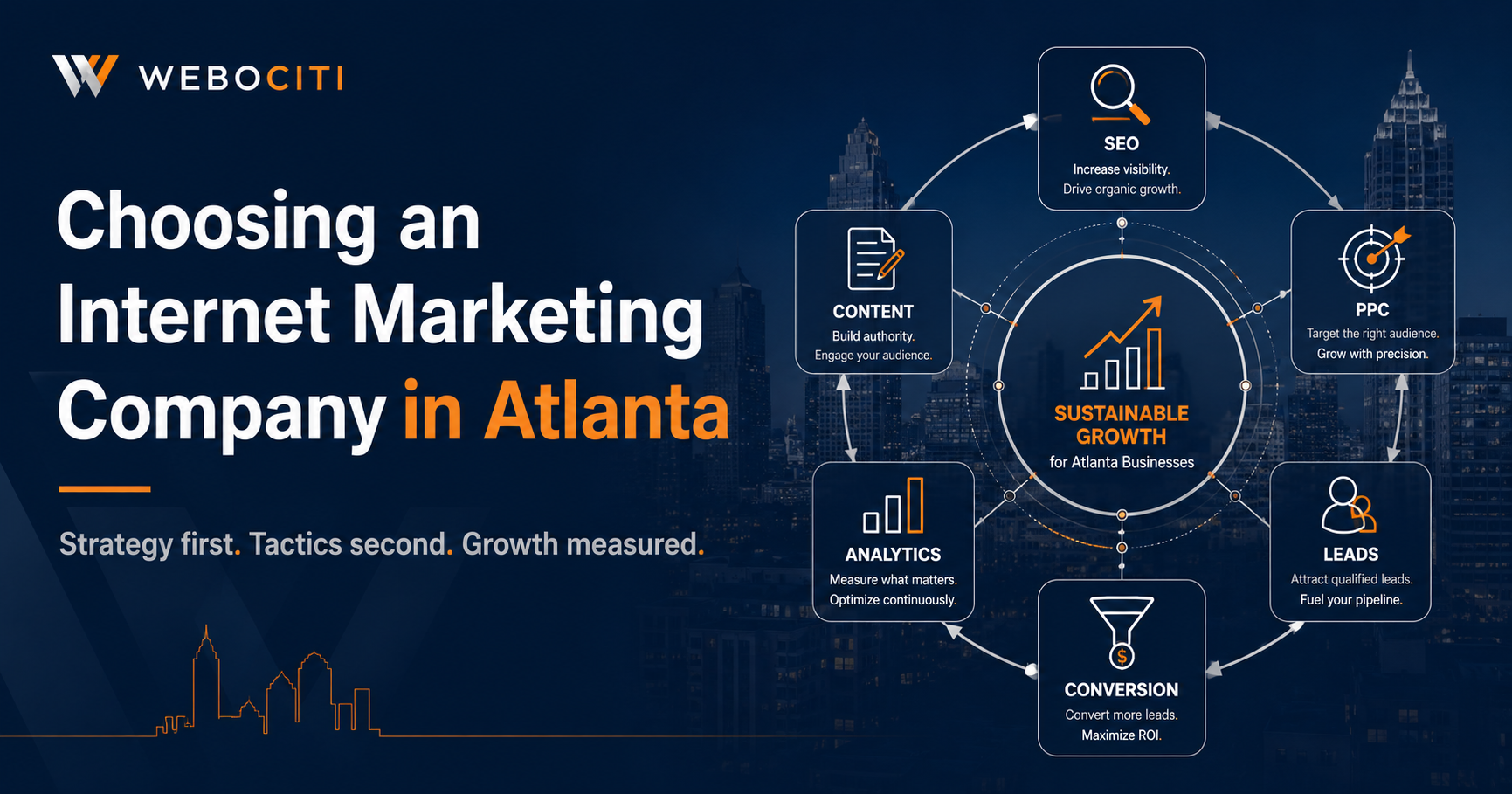
If you’re evaluating internet marketing companies in Atlanta, the most important factor is alignment, not just services. The right marketing partner should integrate SEO, PPC, content, analytics, and conversion strategy into one measurable growth system. In a competitive market like Atlanta, disconnected tactics waste budget quickly. If you want to understand what modern search strategy actually requires, this explains what makes SEO work today.

This guide explains how to compare agencies, evaluate pricing models, identify red flags, and determine whether an SEO-focused firm or a full-service marketing company is the better fit for your business.

What Is an Internet Marketing Company?

An internet marketing company in Atlanta typically provides services such as search engine optimization (SEO), paid advertising (PPC), content marketing, website optimization, and analytics tracking. Some firms specialize in a single channel, while others build integrated growth systems across multiple digital platforms.


Types of Internet Marketing Companies in Atlanta

The phrase internet marketing company is broad. Two agencies can use the same label and deliver completely different outcomes. Before you compare proposals, clarify what kind of partner you’re actually hiring:

  • SEO-focused agency: organic visibility, content strategy, technical SEO, local search performance
  • PPC / media buying firm: paid search, paid social, YouTube, programmatic, landing page testing
  • Content-led growth team: blogs, thought leadership, authority-building, conversion content
  • Web/creative shop: design and build work sometimes with light SEO, often without growth strategy
  • Full-funnel growth partner: messaging, strategy, channel mix, measurement, CRO, compounding systems

Executive takeaway: You’re not hiring “marketing.” You’re hiring a growth system or a set of disconnected tasks.


How Atlanta Businesses Should Evaluate a Marketing Company

If you want outcomes, evaluate agencies on the things that actually drive outcomes. Here’s the practical checklist.

1) Strategy Before Tactics

A strong Atlanta marketing partner should be able to explain why specific channels will work for your business not just list services. They should ask about your ideal customers, sales cycle, margin, and competitive density. That alignment only works when you understand how search engines drive business growth and how intent translates into revenue.

  • Do they understand your ICP and buyer journey?
  • Can they prioritize channels based on intent and economics?
  • Do they talk about positioning and conversion not just traffic?

2) Measurement, Attribution, and Accountability

Many agencies report on activity (posts, clicks, impressions). You want a partner who reports on outcomes (leads, booked calls, pipeline, revenue contribution where possible).

  • What KPIs define success for your business?
  • How do they track lead quality — not just lead volume?
  • How often do you review results and adjust strategy?
  • Do you own the accounts, data, and tracking infrastructure?

3) Ability to Compete in a Dense Market

Atlanta is crowded. If your category has strong incumbents, local competitors, and aggressive ad spend, the agency must know how to build a realistic plan that wins over time.

  • Can they show examples from competitive markets?
  • Do they understand local search dynamics (maps, reviews, proximity signals)?
  • Can they improve conversion rate so traffic turns into revenue?

SEO vs PPC vs Content vs Social: What Should You Invest In?

Most businesses don’t fail because they “picked the wrong channel.” They fail because they treat channels as separate tactics instead of building a connected system.

SEO (Long-Term Demand Capture)

SEO works best when you want compounding visibility for searches with real intent — especially in service categories where buyers research options before they call. If you’re questioning whether SEO still matters, this explains why search engine optimization still matters for serious growth businesses.

If you’re specifically evaluating SEO help in Atlanta, this is the most direct resource:
Atlanta SEO Services.

If you want the “why this matters” view — and how SEO compounds — this guide explains it clearly:
Why SEO Is Still the Most Reliable Long-Term Growth Channel.

For businesses with multiple service lines or product categories, structure matters. This guide explains how category page SEO improves search visibility. If you’re selling products or service packages, this explains how product page SEO directly impacts revenue.

PPC (Speed + Control)

Paid campaigns can generate demand quickly but only if conversion tracking is correct, landing pages match intent, and the offer is strong.

Content (Authority + Trust)

Content is not “blogging.” In competitive markets, it’s how you become the obvious choice.

Social (Support, Not the Foundation)

Social is valuable for trust and visibility, but it’s rarely the primary growth engine.

Rule: Your channel mix should match your buyer’s intent and your tracking should prove what’s working.


Red Flags When Hiring a Marketing Agency in Atlanta

  • Guaranteed rankings or “#1 on Google” promises
  • No questions about your buyer
  • Reporting focused on impressions and clicks
  • No plan for conversion
  • Everything is “content” with no technical SEO or internal linking
  • You don’t own your accounts

When Should an Atlanta Business Hire an Internet Marketing Company?

Hiring a marketing partner becomes high-leverage when:

  • You’ve plateaued and need a clearer strategy to break through
  • You’re spending on ads but don’t have consistent lead quality
  • Your website gets traffic but doesn’t convert into calls or purchases
  • You want predictable growth without relying only on referrals
  • You need senior-level marketing leadership without a full-time CMO hire

If you need more than a single marketing service, review Webociti’s
Digital Marketing Programs to see how strategy, execution, lead generation, and marketing leadership can work together as a connected growth system.

If you’re still unsure where to start, this framework connects the full system (SEO + ads + messaging + conversion):
Internet Marketing for Business Growth.


Questions to Ask Before You Sign an Agency Agreement

  • What does success look like in 90 days, 6 months, and 12 months?
  • Which KPIs do you report on — and how do you define lead quality?
  • What is your strategy for improving conversion rate?
  • How do you decide what to prioritize each month?
  • What access do we have to accounts, tracking, and data?
  • How do you handle competitive markets and rising ad costs?

What to Do Next

If you’re evaluating internet marketing companies in Atlanta, the winning move is to hire a partner that builds a measurable growth system not one that sells disconnected deliverables.

If your priority is search visibility and qualified inbound demand, start here:
Atlanta SEO Services.

And if you want a broader strategy-first view of how all channels connect into one growth engine, use this guide as your reference point:
Internet Marketing for Business Growth.

Not sure what kind of marketing support your business needs? Take the Webociti Growth Program Assessment to see whether your business is a better fit for Smart Start, Growth Strategy, Lead Generation, Marketing Leadership, or Acquisition Ready support.


Internet Marketing Companies in Atlanta: Quick FAQs

Below are the most common questions businesses ask when comparing internet marketing companies in Atlanta.

How much do marketing companies in Atlanta typically cost?
Pricing varies by scope and accountability. Strategy-led retainers are usually higher than “task-based” packages because they include planning, measurement, and optimization not just deliverables.
Should I hire an SEO agency or a full-service marketing company?
If SEO is your primary growth lever, hire an SEO-focused partner with technical depth and conversion alignment. If you need a connected multi-channel system, a strategy-led partner is usually a better fit.
How long does it take to see results?
PPC can generate results in weeks. SEO usually compounds over 3–6 months and becomes a durable growth asset over 6–12 months.