08 Jun Social Media Marketing vs Search Engine Marketing: Which Is Right for Your Business?
Digital Marketing • Social Media • Search Marketing
Social media marketing and search engine marketing both help businesses reach potential customers, but they work in different ways. Social media builds awareness, trust, and engagement. Search marketing captures people who are already looking for answers, products, or services.
Social media marketing is best for building awareness, trust, community, and ongoing engagement.
Search engine marketing is best for capturing demand from people actively searching for solutions.
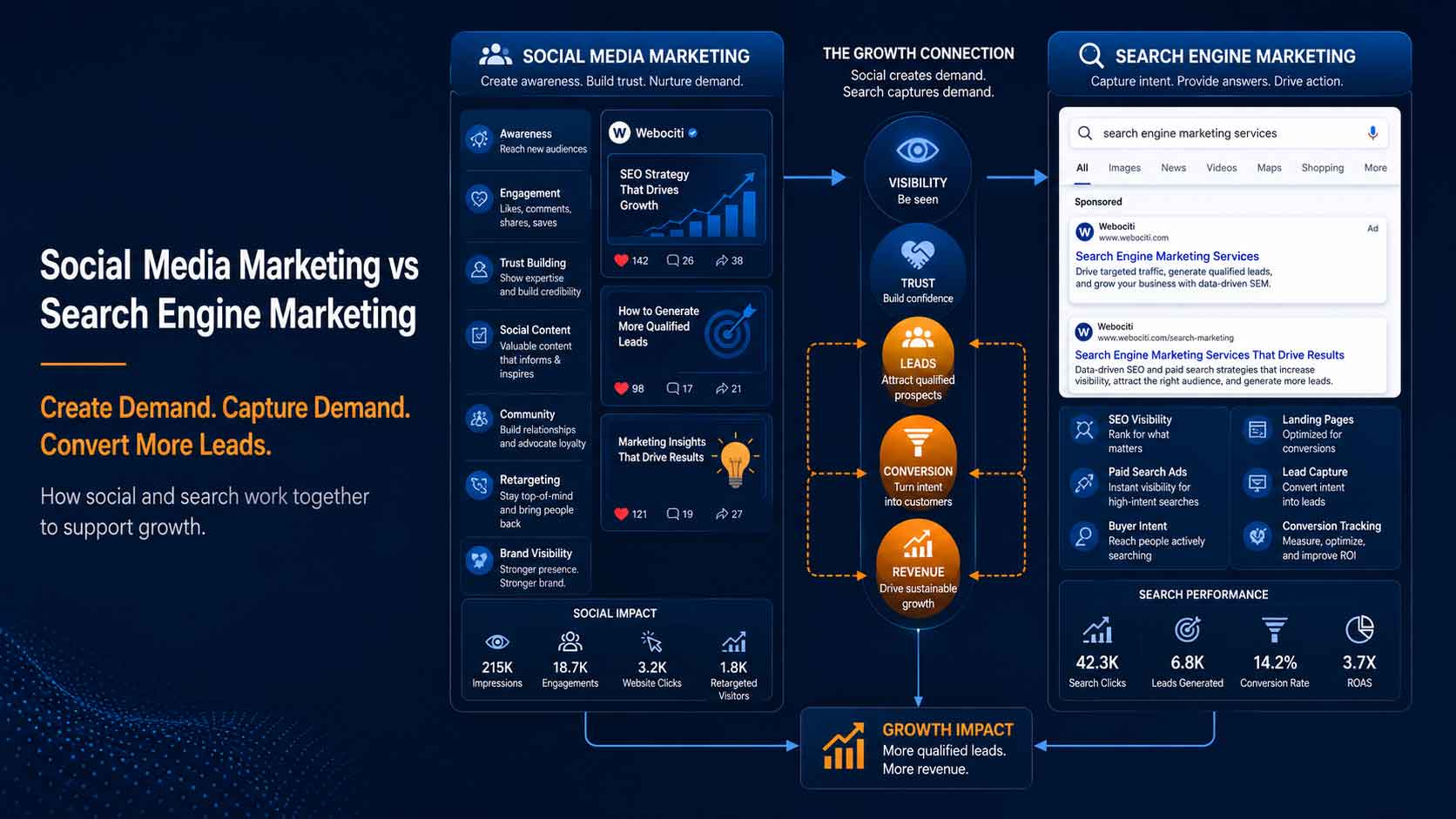
Most businesses should not treat social media and search as competing strategies. Social media helps create and nurture demand. Search marketing captures demand. A stronger growth system connects both to lead generation, conversion, and revenue.
Originally published in May 2024. Updated for 2026 with new guidance on social media marketing, search engine marketing, demand creation, demand capture, and revenue growth strategy.
Businesses often ask whether they should invest more in social media marketing or search engine marketing.
It is the wrong question if you treat the answer as either-or.
Social media and search marketing solve different problems. Social media helps people discover, remember, and trust your brand. Search marketing helps your business show up when people are actively looking for information, comparisons, products, services, or providers.
The better question is: where does your business need the most help right now?
- Do you need more visibility and awareness?
- Do you need more high-intent website traffic?
- Do you need stronger trust before people contact you?
- Do you need better lead generation?
- Do you need a complete system that connects awareness, search, conversion, and revenue?
This guide compares social media marketing vs search engine marketing so you can decide how each channel should fit into your growth strategy.
What Is Social Media Marketing?
Social media marketing uses platforms such as Facebook, Instagram, LinkedIn, YouTube, TikTok, and other social channels to reach, engage, and influence an audience.
Social media can include organic posts, short-form video, community engagement, paid social advertising, retargeting, thought leadership, brand storytelling, customer education, and reputation building.
Social media works best when your business needs to build visibility and trust before someone is ready to buy. It keeps your brand in front of prospects, referral sources, customers, and people who may not be actively searching yet.
If your business needs stronger visibility and engagement across social channels, explore Webociti’s
social media marketing services.
What Is Search Engine Marketing?
Search engine marketing focuses on increasing visibility in search engines when people are actively looking for information, products, services, or solutions.
SEM can include paid search advertising, SEO, content strategy, landing page optimization, technical SEO, conversion tracking, and other tactics designed to help a business appear when buyer intent is high.
Search marketing is powerful because it reaches people at the moment they are searching. Instead of interrupting someone, search marketing meets demand that already exists.
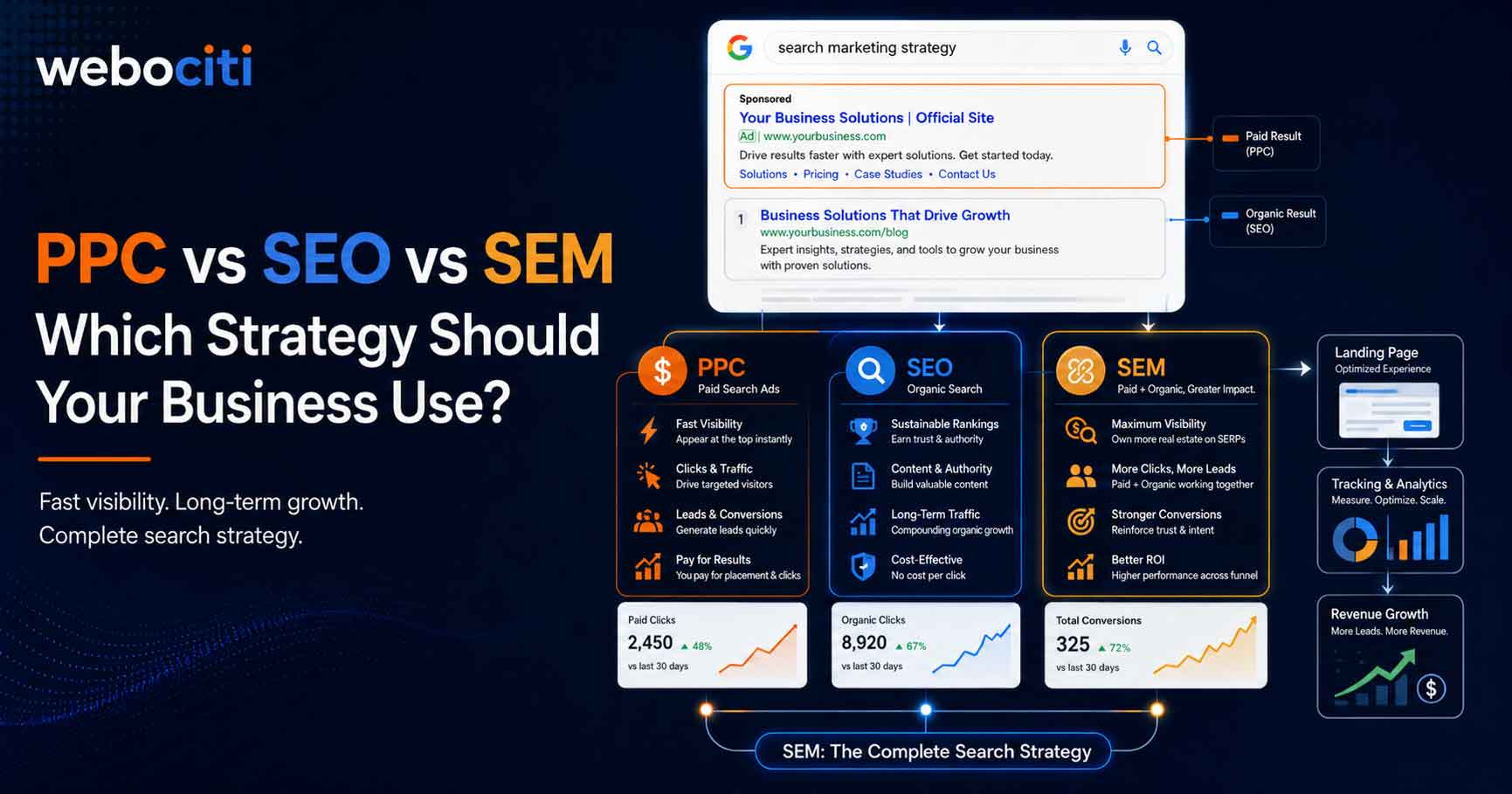
For businesses comparing paid search, SEO, and SEM, read our related guide:
PPC vs SEO vs SEM: Which Strategy Should Your Business Use?.
Social Media Marketing vs Search Engine Marketing: Key Differences
| Factor | Social Media Marketing | Search Engine Marketing |
|---|---|---|
| Primary Role | Builds awareness, trust, and engagement | Captures people actively searching |
| Audience Intent | Often passive or early-stage | Often active and intent-driven |
| Best For | Demand creation, brand visibility, community, retargeting | Demand capture, lead generation, SEO, paid search |
| Timeline | Builds influence over time | Can create faster traffic through paid search and long-term visibility through SEO |
| Measurement | Reach, engagement, clicks, followers, assisted conversions | Rankings, traffic, paid clicks, conversions, calls, leads |
When Social Media Marketing Makes Sense
Social media marketing makes sense when your business needs to stay visible, build trust, educate prospects, and create ongoing engagement.
Social media is especially useful when:
- Your audience needs to see your brand multiple times before taking action
- You want to build trust and authority
- You need to educate prospects before they are ready to buy
- You rely on referrals, reputation, or relationship-building
- You want to retarget people who visited your website
- You have visual, educational, or story-driven content
- You want to stay top of mind with customers and prospects
The mistake many businesses make is treating social media as random posting. Social media should support positioning, trust-building, lead nurturing, and conversion.
When Search Engine Marketing Makes Sense
Search engine marketing makes sense when your business wants to reach people who are already looking for answers, providers, services, or solutions.
Search marketing is especially useful when:
- People already search for what you sell
- You need high-intent website traffic
- You want to generate leads from Google
- You want to improve organic visibility through SEO
- You want to use paid search for faster visibility
- You need landing pages that convert search traffic
- You want to track calls, forms, and booked appointments
If your business needs long-term organic visibility, stronger rankings, and content-driven lead generation, explore Webociti’s
SEO services for small business.
If your business needs faster visibility through paid campaigns, explore our
digital advertising services.
Demand Creation vs Demand Capture
The real difference between social media marketing and search engine marketing comes down to demand creation and demand capture.
Social media often helps create demand. It puts ideas, stories, insights, offers, and proof in front of people before they are actively searching. It can make people aware of a problem, remember your brand, and trust your point of view.
Search marketing captures demand. It reaches people when they are already searching for information, comparisons, services, products, or providers.
Simple rule: Social media helps people discover and trust you. Search marketing helps people find you when they are ready to act.
Strong marketing does both. It creates awareness before someone is searching and captures demand when that person begins looking for solutions.
Why Most Businesses Need Both
Choosing between social media marketing and search engine marketing is often too narrow.
Most businesses need both, but not always in the same proportion.
Social media can help build familiarity, trust, and engagement. Search marketing can help capture high-intent traffic. Together, they can support the full buyer journey.
For example:
- A prospect sees your insight on LinkedIn
- They later search for a solution on Google
- Your SEO page or paid ad appears in search
- They visit your website
- Retargeting keeps your brand visible
- A strong landing page converts them into a lead
That is not social media or search working alone. That is a connected growth system.
How Social Media and Search Fit Into a Revenue Growth System
Social media marketing and search engine marketing should not operate as disconnected channels.
They should connect to positioning, messaging, content, lead generation, conversion tracking, and sales follow-up.
A social post may create awareness, but if the website is unclear, the opportunity is lost. A search campaign may drive traffic, but if the landing page does not convert, the traffic is wasted. SEO may generate organic visits, but if there is no follow-up process, those visits may never become pipeline.
That is why Webociti views marketing through a broader
revenue growth system.
The goal is not more activity. The goal is a connected system that turns visibility into trust, leads, conversations, and revenue.
How to Choose Based on Goals, Timeline, and Budget
Use your goals, timeline, and budget to decide where to focus first.
- Need awareness and trust? Strengthen social media marketing.
- Need high-intent traffic? Invest in search engine marketing.
- Need faster leads? Consider paid search or paid social campaigns.
- Need long-term visibility? Invest in SEO and content.
- Need better conversion? Improve landing pages, messaging, and calls to action.
- Need predictable growth? Connect social, search, content, tracking, and follow-up into one system.
The right answer depends on your current bottleneck. Some businesses need more visibility. Others need better lead quality. Others need stronger conversion before spending more on traffic.
Social Media Marketing vs Search Engine Marketing: Which Is Better?
Neither is universally better.
Social media marketing is better when your business needs awareness, engagement, trust, reputation, and ongoing visibility.
Search engine marketing is better when your business needs to reach people with active intent who are already looking for solutions.
The strongest strategy often combines both. Social media helps shape demand and build trust. Search marketing captures demand and turns intent into traffic. Your website, landing pages, content, and follow-up process turn that attention into measurable growth.
Related guide:
If you are comparing paid search, organic search, and broader search strategy, read
PPC vs SEO vs SEM: Which Strategy Should Your Business Use?
.
Digital Marketing Strategy
Need a Marketing Strategy That Connects Social, Search, and Revenue?
Webociti helps businesses connect social media, search marketing, SEO, paid advertising, lead generation, and conversion into a smarter growth system.
Social Media Marketing vs Search Engine Marketing FAQs
Quick answers to common questions about social media marketing, search engine marketing, SEO, paid search, and choosing the right strategy.
What is the difference between social media marketing and search engine marketing?
Social media marketing focuses on awareness, engagement, trust, and community. Search engine marketing focuses on reaching people who are actively searching for information, products, services, or providers.
Is social media marketing better than search engine marketing?
Social media marketing is better for awareness, trust-building, and engagement. Search engine marketing is better for capturing active buyer intent. Most businesses benefit from using both strategically.
Should small businesses use social media or search marketing first?
It depends on the goal. If the business needs awareness and trust, social media may be a strong starting point. If people are already searching for the service, search marketing may create more immediate lead opportunities.
Can social media help SEO?
Social media does not directly replace SEO, but it can support visibility, content distribution, brand awareness, engagement, and traffic. These signals can help more people discover, share, and interact with your content.
Should social media and search marketing be managed together?
Yes. Social media and search marketing work best when they share the same positioning, messaging, offers, landing pages, tracking, and lead follow-up strategy.