
08 Jun PPC vs SEO vs SEM: Which Strategy Should Your Business Use?
Search Marketing • PPC • SEO • SEM
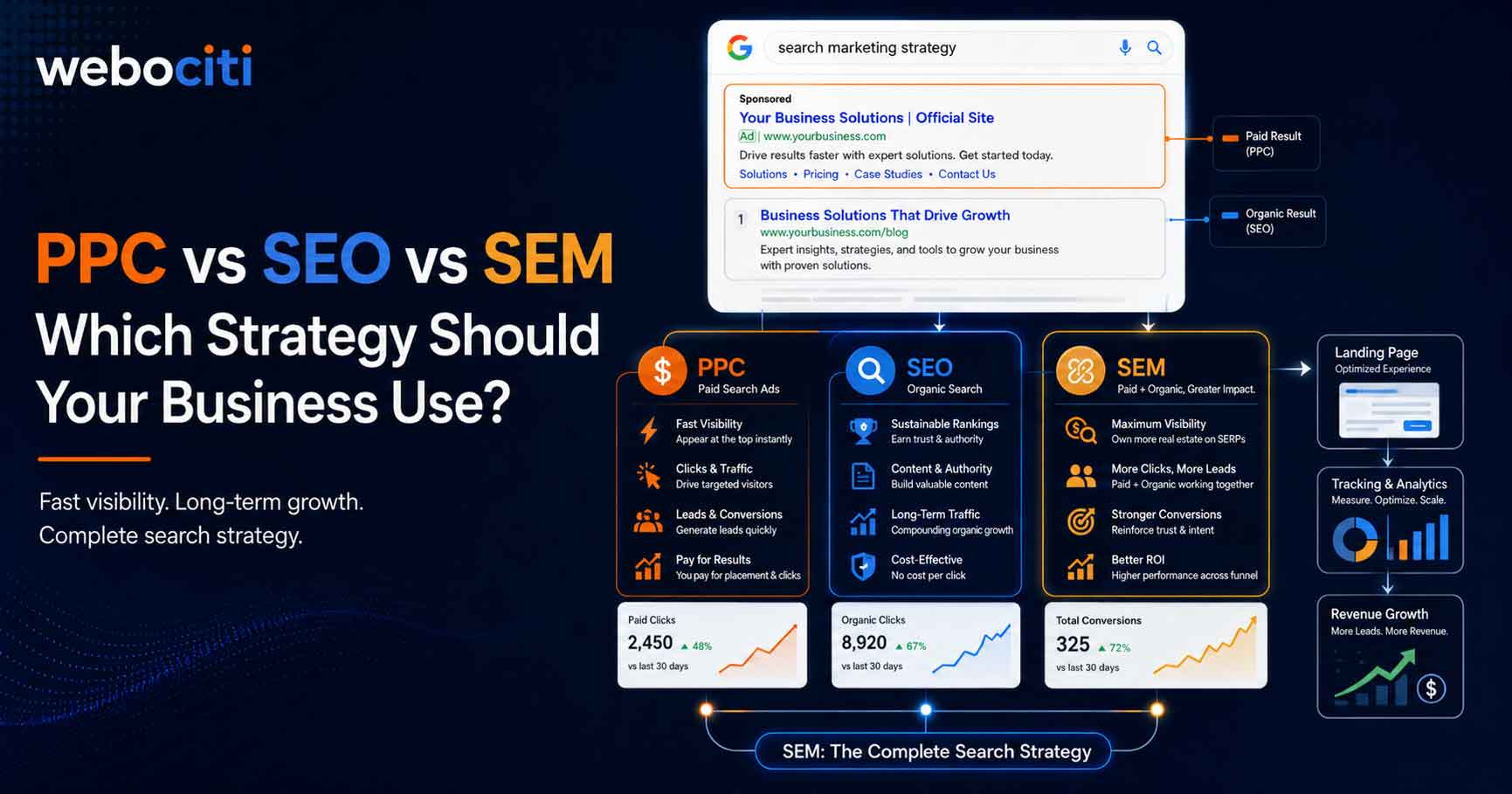
PPC, SEO, and SEM all help businesses increase visibility in search, but they work in different ways. The right strategy depends on your goals, timeline, budget, and how quickly you need leads.
PPC is paid advertising that can generate traffic and leads quickly.
SEO builds long-term organic visibility through content, technical optimization, and authority.
SEM is the broader search marketing strategy that can include both PPC and SEO.
For most growth-focused businesses, the strongest approach is not choosing one tactic in isolation. It is building a search strategy where paid ads, organic visibility, landing pages, lead capture, and conversion tracking work together.
Originally published in May 2023. Updated for 2026 with new guidance on PPC, SEO, SEM, search visibility, and revenue growth strategy.
Many businesses start with a simple question: should we invest in paid ads, SEO, or a broader search marketing strategy?
The answer depends on what you need most. If you need immediate visibility, PPC can help. If you want to build long-term organic traffic, SEO is usually the better foundation. If you want a coordinated search strategy that uses both paid and organic channels, SEM may be the right approach.
The mistake many companies make is treating PPC, SEO, and SEM as separate tactics instead of connected parts of a growth system. Search visibility only matters if it turns into qualified traffic, leads, conversations, and revenue.
For a deeper definition of PPC and SEM, read our related guide:
PPC vs SEM: What’s the Difference?
What Is PPC?
PPC stands for pay-per-click. It is a paid advertising model where businesses pay when someone clicks on an ad.
PPC ads often appear at the top of search engine results pages, on social media platforms, across display networks, and in video or streaming environments. Google Ads is one of the most common examples of PPC advertising.
PPC is often useful when a business wants faster visibility, wants to test offers, or needs to generate leads in a shorter period of time.
What Is SEO?
SEO stands for search engine optimization. SEO focuses on improving a website’s organic visibility in search results.
SEO includes content strategy, technical optimization, page structure, internal linking, local search visibility, authority building, and improving the user experience on your website.
SEO usually takes longer than PPC, but it can build more sustainable search visibility over time. When done correctly, SEO can help reduce long-term dependence on paid traffic.
If your business needs long-term organic visibility, stronger rankings, and content-driven lead generation, explore Webociti’s
SEO services for small business.
What Is SEM?
SEM stands for search engine marketing. SEM is the broader strategy of increasing visibility in search engines through paid and organic tactics.
SEM can include PPC, SEO, content marketing, landing page optimization, conversion tracking, and other strategies designed to turn search visibility into leads and revenue.
In simple terms, PPC and SEO are tactics. SEM is the larger search marketing strategy that can bring those tactics together.
PPC vs SEO vs SEM: Key Differences
| Strategy | Best For | Timeline | Main Limitation |
|---|---|---|---|
| PPC | Fast visibility, paid leads, offer testing | Short-term | Traffic stops when the budget stops |
| SEO | Organic traffic, authority, long-term visibility | Longer-term | Takes time to build momentum |
| SEM | Coordinated paid and organic search strategy | Short-term and long-term | Requires strategy, tracking, and coordination |
When PPC Makes Sense
PPC can be a good fit when your business needs immediate visibility or wants to generate leads quickly.
- You are launching a new product or service
- You need leads quickly
- You want to test an offer or message
- You are entering a competitive market
- You want to retarget website visitors
- You need visibility while SEO is still building
PPC works best when the ads are connected to strong landing pages, clear messaging, conversion tracking, and a defined follow-up process.
If your business needs faster visibility, paid traffic, or campaign support, explore Webociti’s
digital advertising services.
When SEO Makes Sense
SEO makes sense when your business wants to build long-term organic visibility and attract people who are actively searching for solutions.
- You want to reduce dependence on paid traffic
- You want more organic leads over time
- You have useful expertise to publish
- You want to rank for service, industry, or local search terms
- You want to build authority and trust
- You are willing to invest consistently over time
SEO is not instant, but it can become one of the most valuable long-term marketing assets for a business.
If your business needs long-term organic visibility, stronger rankings, and content-driven lead generation, explore Webociti’s
SEO services for small business.
When SEM Makes Sense
SEM makes sense when your business needs a more complete search strategy that combines the speed of paid search with the long-term value of organic search.
A strong SEM strategy may include:
- Paid search campaigns
- SEO strategy
- Landing page optimization
- Keyword and intent research
- Content creation
- Conversion tracking
- Lead follow-up and reporting
SEM works best when PPC and SEO are not managed in isolation. Paid search can create speed, while SEO builds authority and long-term visibility.
Why Most Businesses Need a Combination
For many businesses, the best answer is not PPC or SEO. It is both, used at the right time and connected to the right strategy.
PPC can help generate leads while SEO is building. SEO can reduce long-term dependence on paid traffic. SEM can bring both together so the business is not relying on one channel alone.
The real goal is not just traffic. The goal is qualified traffic that turns into leads, opportunities, and revenue.
How to Choose Based on Timeline, Budget, and Goals
Use your timeline, budget, and business goals to decide where to focus first.
- Need leads fast? Start with PPC and strong landing pages.
- Need long-term visibility? Invest in SEO and content.
- Need both speed and sustainability? Build an SEM strategy that combines PPC and SEO.
- Not sure where to start? Look at your website, conversion paths, tracking, and current lead sources first.
The right choice depends on where your growth system is weakest. Some businesses need traffic. Others need better conversion. Others need stronger messaging before spending more on ads or SEO.
How PPC, SEO, and SEM Fit Into a Revenue Growth System
PPC, SEO, and SEM can all generate visibility, but visibility alone does not create growth.
Search marketing needs to connect to the full customer journey, including positioning, messaging, landing pages, lead capture, sales follow-up, and conversion tracking.
A PPC campaign may generate clicks, but if the offer is unclear, those clicks may not become qualified leads. SEO may generate organic traffic, but if the website lacks strong calls to action, that traffic may not turn into revenue.
That is why PPC, SEO, and SEM should be planned as part of a larger
revenue growth system.
Related guide:
For a deeper explanation of the relationship between paid search and search engine marketing, read
PPC vs SEM: What’s the Difference?
.
PPC vs SEO vs SEM Frequently Asked Questions
Which is better, PPC, SEO, or SEM?
PPC is best for immediate paid visibility. SEO is best for long-term organic growth. SEM is best when a business wants a complete search strategy that combines paid and organic visibility.
Should small businesses use PPC or SEO first?
It depends on the business goal. If a company needs leads quickly, PPC may be the better starting point. If the goal is sustainable organic traffic, SEO may be the better long-term investment.
Can PPC and SEO work together?
Yes. PPC and SEO often work best together. PPC can test keywords, offers, and landing pages quickly, while SEO can build long-term visibility around the topics and searches that matter most.
Is SEM the same as PPC?
No. PPC is a paid advertising model. SEM is a broader search marketing strategy that can include PPC, SEO, content, landing pages, and conversion tracking.
How long does SEO take compared to PPC?
PPC can begin generating traffic shortly after launch. SEO usually takes longer, often several months, because search engines need time to crawl, index, and evaluate content, authority, and technical improvements.
Need Help Choosing the Right Search Marketing Strategy?
PPC, SEO, and SEM can all help your business grow, but only when they are connected to the right message, offer, landing pages, tracking, and follow-up process.
Webociti helps businesses align paid search, SEO, lead generation, and conversion strategy into a smarter revenue growth system.
Need help deciding between paid search and organic growth? Explore our digital advertising services
or learn more about our SEO services for small business.
Not sure whether your business needs SEO, paid advertising, lead generation, or a broader growth strategy? Take the Webociti Growth Program Assessment to find the right next step.

Joe Mediate
Fractional CMO & Growth Strategist
Joe helps companies build more predictable growth by connecting positioning, demand generation, pipeline, conversion, and execution into one accountable revenue system.
If your pipeline is not converting, it may not be a sales problem. It may be a system problem.
A serial entrepreneur and experienced growth operator, Joe has launched and scaled multiple companies, helped businesses secure growth capital, and led a technology company from concept through acquisition. His experience spans marketing strategy, revenue systems, and operational growth.
Joe was nominated for Ernst & Young’s Entrepreneur of the Year award and served as an instructor and program mentor at The Wharton School.
Diagnose Your Revenue System →
Learn more on the About page or connect with Joe on LinkedIn.