Digital Marketing • Social Media • Search Marketing

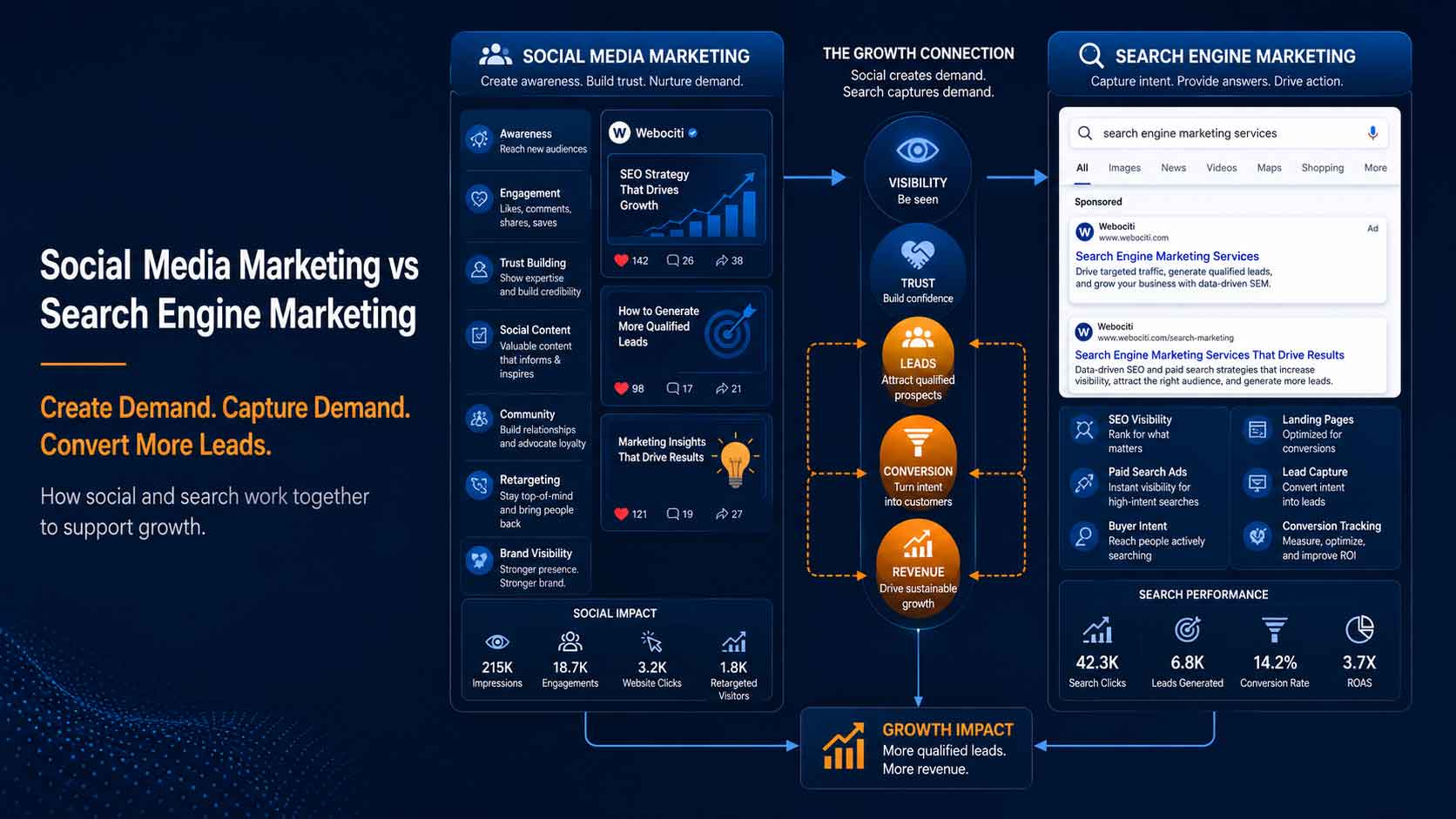
Social media marketing and search engine marketing both help businesses reach potential customers, but they work in different ways. Social media builds awareness, trust, and engagement. Search marketing captures people who are already looking for answers, products, or services.

AI TL;DR:

Social media marketing is best for building awareness, trust, community, and ongoing engagement.
Search engine marketing is best for capturing demand from people actively searching for solutions.

Most businesses should not treat social media and search as competing strategies. Social media helps create and nurture demand. Search marketing captures demand. A stronger growth system connects both to lead generation, conversion, and revenue.

Originally published in May 2024. Updated for 2026 with new guidance on social media marketing, search engine marketing, demand creation, demand capture, and revenue growth strategy.

Businesses often ask whether they should invest more in social media marketing or search engine marketing.

It is the wrong question if you treat the answer as either-or.

Social media and search marketing solve different problems. Social media helps people discover, remember, and trust your brand. Search marketing helps your business show up when people are actively looking for information, comparisons, products, services, or providers.

The better question is: where does your business need the most help right now?

  • Do you need more visibility and awareness?
  • Do you need more high-intent website traffic?
  • Do you need stronger trust before people contact you?
  • Do you need better lead generation?
  • Do you need a complete system that connects awareness, search, conversion, and revenue?

This guide compares social media marketing vs search engine marketing so you can decide how each channel should fit into your growth strategy.

What Is Social Media Marketing?

Social media marketing uses platforms such as Facebook, Instagram, LinkedIn, YouTube, TikTok, and other social channels to reach, engage, and influence an audience.

Social media can include organic posts, short-form video, community engagement, paid social advertising, retargeting, thought leadership, brand storytelling, customer education, and reputation building.

Social media works best when your business needs to build visibility and trust before someone is ready to buy. It keeps your brand in front of prospects, referral sources, customers, and people who may not be actively searching yet.

If your business needs stronger visibility and engagement across social channels, explore Webociti’s
social media marketing services.

What Is Search Engine Marketing?

Search engine marketing focuses on increasing visibility in search engines when people are actively looking for information, products, services, or solutions.

SEM can include paid search advertising, SEO, content strategy, landing page optimization, technical SEO, conversion tracking, and other tactics designed to help a business appear when buyer intent is high.

Search marketing is powerful because it reaches people at the moment they are searching. Instead of interrupting someone, search marketing meets demand that already exists.

For businesses comparing paid search, SEO, and SEM, read our related guide:
PPC vs SEO vs SEM: Which Strategy Should Your Business Use?.

Social Media Marketing vs Search Engine Marketing: Key Differences

Factor Social Media Marketing Search Engine Marketing
Primary Role Builds awareness, trust, and engagement Captures people actively searching
Audience Intent Often passive or early-stage Often active and intent-driven
Best For Demand creation, brand visibility, community, retargeting Demand capture, lead generation, SEO, paid search
Timeline Builds influence over time Can create faster traffic through paid search and long-term visibility through SEO
Measurement Reach, engagement, clicks, followers, assisted conversions Rankings, traffic, paid clicks, conversions, calls, leads

When Social Media Marketing Makes Sense

Social media marketing makes sense when your business needs to stay visible, build trust, educate prospects, and create ongoing engagement.

Social media is especially useful when:

  • Your audience needs to see your brand multiple times before taking action
  • You want to build trust and authority
  • You need to educate prospects before they are ready to buy
  • You rely on referrals, reputation, or relationship-building
  • You want to retarget people who visited your website
  • You have visual, educational, or story-driven content
  • You want to stay top of mind with customers and prospects

The mistake many businesses make is treating social media as random posting. Social media should support positioning, trust-building, lead nurturing, and conversion.

When Search Engine Marketing Makes Sense

Search engine marketing makes sense when your business wants to reach people who are already looking for answers, providers, services, or solutions.

Search marketing is especially useful when:

  • People already search for what you sell
  • You need high-intent website traffic
  • You want to generate leads from Google
  • You want to improve organic visibility through SEO
  • You want to use paid search for faster visibility
  • You need landing pages that convert search traffic
  • You want to track calls, forms, and booked appointments

If your business needs long-term organic visibility, stronger rankings, and content-driven lead generation, explore Webociti’s
SEO services for small business.

If your business needs faster visibility through paid campaigns, explore our
digital advertising services.

Demand Creation vs Demand Capture

The real difference between social media marketing and search engine marketing comes down to demand creation and demand capture.

Social media often helps create demand. It puts ideas, stories, insights, offers, and proof in front of people before they are actively searching. It can make people aware of a problem, remember your brand, and trust your point of view.

Search marketing captures demand. It reaches people when they are already searching for information, comparisons, services, products, or providers.

Simple rule: Social media helps people discover and trust you. Search marketing helps people find you when they are ready to act.

Strong marketing does both. It creates awareness before someone is searching and captures demand when that person begins looking for solutions.

Why Most Businesses Need Both

Choosing between social media marketing and search engine marketing is often too narrow.

Most businesses need both, but not always in the same proportion.

Social media can help build familiarity, trust, and engagement. Search marketing can help capture high-intent traffic. Together, they can support the full buyer journey.

For example:

  • A prospect sees your insight on LinkedIn
  • They later search for a solution on Google
  • Your SEO page or paid ad appears in search
  • They visit your website
  • Retargeting keeps your brand visible
  • A strong landing page converts them into a lead

That is not social media or search working alone. That is a connected growth system.

How Social Media and Search Fit Into a Revenue Growth System

Social media marketing and search engine marketing should not operate as disconnected channels.

They should connect to positioning, messaging, content, lead generation, conversion tracking, and sales follow-up.

A social post may create awareness, but if the website is unclear, the opportunity is lost. A search campaign may drive traffic, but if the landing page does not convert, the traffic is wasted. SEO may generate organic visits, but if there is no follow-up process, those visits may never become pipeline.

That is why Webociti views marketing through a broader
revenue growth system.

The goal is not more activity. The goal is a connected system that turns visibility into trust, leads, conversations, and revenue.

How to Choose Based on Goals, Timeline, and Budget

Use your goals, timeline, and budget to decide where to focus first.

  • Need awareness and trust? Strengthen social media marketing.
  • Need high-intent traffic? Invest in search engine marketing.
  • Need faster leads? Consider paid search or paid social campaigns.
  • Need long-term visibility? Invest in SEO and content.
  • Need better conversion? Improve landing pages, messaging, and calls to action.
  • Need predictable growth? Connect social, search, content, tracking, and follow-up into one system.

The right answer depends on your current bottleneck. Some businesses need more visibility. Others need better lead quality. Others need stronger conversion before spending more on traffic.

Social Media Marketing vs Search Engine Marketing: Which Is Better?

Neither is universally better.

Social media marketing is better when your business needs awareness, engagement, trust, reputation, and ongoing visibility.

Search engine marketing is better when your business needs to reach people with active intent who are already looking for solutions.

The strongest strategy often combines both. Social media helps shape demand and build trust. Search marketing captures demand and turns intent into traffic. Your website, landing pages, content, and follow-up process turn that attention into measurable growth.

Related guide:
If you are comparing paid search, organic search, and broader search strategy, read

PPC vs SEO vs SEM: Which Strategy Should Your Business Use?
.

Digital Marketing Strategy

Need a Marketing Strategy That Connects Social, Search, and Revenue?

Webociti helps businesses connect social media, search marketing, SEO, paid advertising, lead generation, and conversion into a smarter growth system.


Take the Growth Program Assessment

Social Media Marketing vs Search Engine Marketing FAQs

Quick answers to common questions about social media marketing, search engine marketing, SEO, paid search, and choosing the right strategy.

What is the difference between social media marketing and search engine marketing?

Social media marketing focuses on awareness, engagement, trust, and community. Search engine marketing focuses on reaching people who are actively searching for information, products, services, or providers.

Is social media marketing better than search engine marketing?

Social media marketing is better for awareness, trust-building, and engagement. Search engine marketing is better for capturing active buyer intent. Most businesses benefit from using both strategically.

Should small businesses use social media or search marketing first?

It depends on the goal. If the business needs awareness and trust, social media may be a strong starting point. If people are already searching for the service, search marketing may create more immediate lead opportunities.

Can social media help SEO?

Social media does not directly replace SEO, but it can support visibility, content distribution, brand awareness, engagement, and traffic. These signals can help more people discover, share, and interact with your content.

Should social media and search marketing be managed together?

Yes. Social media and search marketing work best when they share the same positioning, messaging, offers, landing pages, tracking, and lead follow-up strategy.

Originally published May 28, 2015. Updated June 4, 2026.

Most businesses are creating more content than ever. Blog posts. Emails. Social media updates. Landing pages. Videos. Sales materials. Lead magnets. Website copy.

The problem is not always a lack of content.

The problem is that much of the content is created once, published once, and then forgotten.

That is where adaptive content becomes valuable.

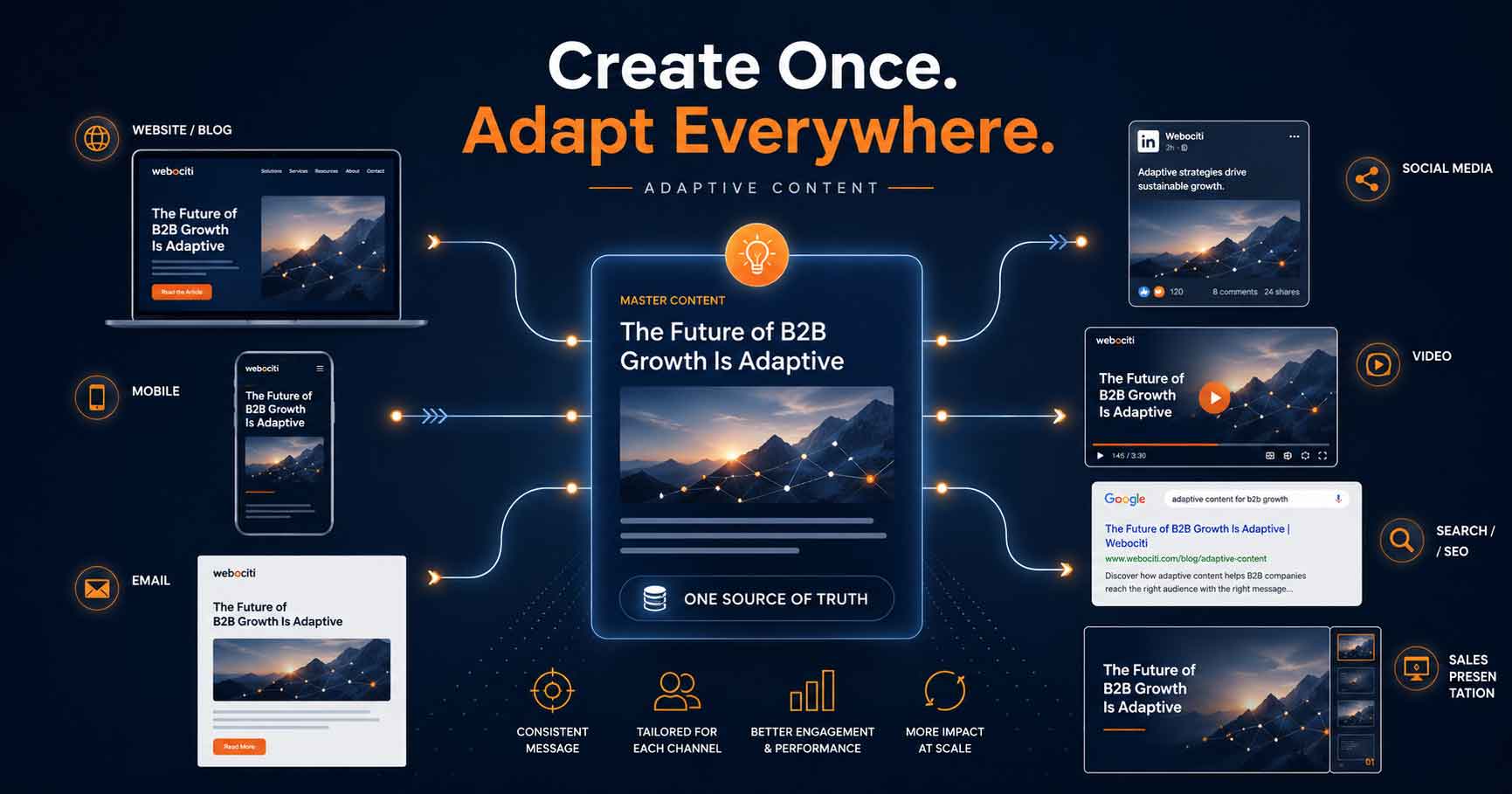
Adaptive content is content designed to work across multiple channels, formats, devices, and customer situations. Instead of creating one blog post for one purpose, adaptive content gives you a smarter way to reuse, reformat, personalize, and distribute your message wherever your customers are paying attention.

In a digital world where buyers move between Google, social media, email, websites, mobile devices, AI search tools, and sales conversations, content needs to do more than exist. It needs to adapt.

What Is Adaptive Content?

Adaptive content is content created with flexibility in mind.

It is structured so it can be reused across different platforms, personalized for different audiences, and delivered in different formats without starting from scratch every time.

A strong piece of adaptive content may begin as a blog post, but it can also become:

  • A short email newsletter
  • A LinkedIn post
  • A sales follow-up resource
  • A downloadable guide
  • A video script
  • A social media carousel
  • A landing page section
  • A frequently asked question
  • A talking point for your sales team

That is the power of adaptive content. It helps your message travel further without forcing your team to recreate everything from the beginning.

Adaptive Content Is More Than Evergreen Content

Adaptive content and evergreen content are related, but they are not the same thing.

Evergreen content is designed to stay useful over time. It does not rely heavily on short-term news, trends, or seasonal events. A strong evergreen article can continue attracting traffic months or years after it is published.

Adaptive content goes a step further.

Adaptive content is not only built to last. It is built to move.

It can be adjusted for different audiences, different buying stages, different channels, and different formats. A blog post on your website may serve an early-stage buyer who is researching a problem. A shorter version of that same content may help a prospect understand your approach in an email. A simplified version may become a social media post. A more detailed version may become part of a sales presentation or lead magnet.

Evergreen content lasts. Adaptive content travels.

Why Adaptive Content Matters for Modern Marketing

Buyers rarely move in a straight line.

They may discover your business through Google, visit your website on a phone, follow your company on LinkedIn, read a blog post, watch a video, sign up for an email, and then speak with your team weeks later.

That means your message needs to remain clear and consistent across every touchpoint.

Adaptive content helps your business:

  • Maintain a consistent message across channels
  • Reach buyers at different stages of the decision process
  • Improve the return on every piece of content you create
  • Support SEO, email, social media, advertising, and sales enablement
  • Reduce wasted effort from one-off content creation
  • Create a better experience for mobile users

Mobile matters because Google uses the mobile version of a site’s content for indexing and ranking. That makes mobile-ready content structure an important part of modern search visibility.

The Five Essentials of Adaptive Content

Adaptive content works best when it is planned before it is written.

Here are five essential characteristics.

1. It Is Built Around the Customer

Adaptive content starts with the audience.

Before creating content, ask:

  • Who is this for?
  • What problem are they trying to solve?
  • What do they already understand?
  • What questions do they need answered?
  • What action should they take next?

Content becomes more useful when it is connected to the customer’s actual situation.

For example, a founder of an early-stage company may need basic messaging and website structure. A CEO of a growing company may need stronger lead generation or fractional marketing leadership. A business owner preparing for acquisition may need a clearer value story.

The topic may be similar, but the content should adapt to the reader’s stage and need.

2. It Is Structured for Reuse

A long, unorganized page is harder to reuse.

Adaptive content should be structured in clear sections so pieces can stand on their own. That means using strong headings, short paragraphs, focused sections, lists, FAQs, and clear takeaways.

When content is well structured, you can easily turn one article into multiple assets.

For example, one blog post can become:

  • Five social posts
  • One email newsletter
  • Three short videos
  • A sales handout
  • A landing page section
  • A downloadable checklist

That is not just efficient. It creates consistency.

Your audience hears the same core message in different ways across different channels.

3. It Uses Meaningful Metadata

Metadata helps search engines and platforms understand your content.

This includes your SEO title, meta description, headings, image alt text, categories, tags, internal links, and structured data where appropriate.

That does not mean metadata alone will make content successful. It will not.

But when strong content is paired with clear structure and helpful metadata, it becomes easier for search engines and users to understand what the page is about.

For adaptive content, metadata should answer three questions:

  • What is this content about?
  • Who is it for?
  • What problem does it help solve?

4. It Is Mobile-Friendly

Adaptive content must work well on mobile devices.

That means more than fitting on a smaller screen. It means the content must be easy to scan, easy to read, and easy to act on.

Mobile-friendly adaptive content usually includes:

  • Shorter paragraphs
  • Clear subheadings
  • Simple formatting
  • Fast-loading images
  • Readable font sizes
  • Clear calls to action
  • Buttons that are easy to tap

If a visitor lands on your page from a phone and has to pinch, zoom, scroll endlessly, or hunt for the next step, the content is not really adaptive.

It may be published online, but it is not built for how people actually consume information.

5. It Supports the Next Step

The best adaptive content is not just informative. It is useful.

Every piece of content should help the visitor move forward.

That next step might be:

  • Reading a related article
  • Downloading a guide
  • Taking an assessment
  • Exploring a service page
  • Scheduling a strategy call
  • Sharing the content with someone else on their team

This is where many businesses miss the opportunity. They publish helpful content, but they do not connect it to a larger growth system.

Adaptive content should support the buyer journey, not just fill a blog.

Adaptive Content and AI Search

Adaptive content is becoming even more important as search behavior changes.

People still use Google, but they also ask questions inside AI tools, scan summaries, compare options across platforms, and expect faster answers.

That does not mean businesses should write for algorithms instead of people.

It means content needs to be clearer, more useful, and better structured.

Helpful adaptive content should include:

  • Clear definitions
  • Direct answers to common questions
  • Practical examples
  • Original insights based on real experience
  • Logical headings
  • Internal links to deeper resources

Content that is vague, thin, outdated, or overly promotional is easier to ignore.

Content that explains a problem clearly and gives the reader a practical next step is more likely to remain useful across traditional search, AI-assisted search, social sharing, and sales conversations.

Examples of Adaptive Content in Action

Here is what adaptive content can look like in practice.

Example 1: A Blog Post Becomes a Campaign

A company writes a detailed blog post explaining how to improve lead quality.

That post can become:

  • A LinkedIn post about why more leads are not always better
  • An email to prospects struggling with inconsistent pipeline
  • A short video explaining qualified pipeline
  • A landing page section for lead generation services
  • A sales follow-up resource after discovery calls

The original content becomes the foundation for a larger campaign.

Example 2: A Service Page Becomes Sales Enablement

A fractional CMO service page can also become adaptive content.

Sections from the page can be reused as:

  • A one-page PDF for prospects
  • A proposal introduction
  • A discovery call talking point
  • A nurture email
  • A comparison article about hiring a CMO vs. using a fractional CMO

That helps marketing and sales tell the same story.

Example 3: A Customer Question Becomes Search Content

If prospects keep asking the same question, that question may deserve its own article, FAQ, video, or email.

For example:

  • Do we need SEO or lead generation first?
  • When should we hire a fractional CMO?
  • How do we know if our messaging is holding back growth?
  • What should we fix before spending more on ads?

These questions are not just support issues. They are content opportunities.

How to Start Building an Adaptive Content System

You do not need to start from scratch.

A practical adaptive content process can look like this:

  1. Start with one core topic. Choose a topic connected to a real customer problem.
  2. Write the main article or page. Make it useful, structured, and easy to scan.
  3. Break it into smaller pieces. Pull out key ideas, examples, questions, and takeaways.
  4. Adapt each piece by channel. Turn sections into social posts, emails, videos, or sales assets.
  5. Connect everything with internal links. Guide readers to related services, programs, assessments, and next steps.
  6. Review and refresh over time. Update outdated examples, improve structure, and add new insights as your market changes.

The goal is not to create more random content.

The goal is to create content that can support visibility, trust, lead generation, sales conversations, and growth.

Adaptive Content Turns Marketing Into a System

Adaptive content works because it connects strategy and execution.

It helps your business move away from disconnected marketing activity and toward a more structured growth system.

Instead of asking, “What should we post this week?” you begin asking better questions:

  • What does our audience need to understand?
  • Where are buyers getting stuck?
  • Which messages should show up across multiple channels?
  • How can one strong idea support search, social, email, and sales?
  • What next step should this content support?

That shift matters.

Adaptive content is not just a content marketing tactic. It is a smarter way to make your message work harder across the entire buyer journey.

Need Help Turning Content Into a Growth System?

Adaptive content works best when it is connected to a larger growth strategy.

Webociti helps businesses clarify their message, improve their digital presence, and build content systems that support search visibility, lead generation, and revenue growth.

If your content feels scattered or disconnected from growth, start here:

Content should do more than fill your website. It should help your business attract the right audience, answer better questions, and move qualified prospects closer to action.

What Google Expects From Your Website in 2025 (And What Customers Want Too)

In this post: Discover exactly what Google and your visitors expect from your website in 2025—and how to meet those expectations to increase traffic, trust, and conversions.

What Google Expects From Your Website: A 2025 Wake-Up Call

If your website isn’t generating leads, building trust, or delivering a great user experience, it’s falling behind. As we head into 2025, both Google and your potential customers expect more than just a pretty homepage. They want speed, clarity, security, and usefulness—all from the first click. In this post, we’ll break down what Google expects from your website and how to exceed those expectations.

Why What Google Expects From Your Website Matters

Google remains the gatekeeper to online visibility. Its ranking algorithm grows more sophisticated each year, increasingly focused on user experience and content quality. In 2025, Google’s What Google expects from your website in 2025 – website performance, user experience, and trust signalsexpectations will include:

  • Core Web Vitals: Measuring page load speed, interactivity, and visual stability
  • Mobile-first indexing: Prioritizing mobile usability and responsive design
  • Helpful content: Rewarding content that genuinely solves problems and demonstrates expertise
  • AI-generated content detection: Ensuring your website adds human value beyond automation
  • EEAT: Experience, Expertise, Authoritativeness, and Trustworthiness—Google’s trust metrics for ranking

For a deeper look at these priorities, check out Google’s Page Experience guidelines.

What Customers Expect From Your Website in 2025

It’s not just Google’s bots evaluating your site—your visitors are, too. In 2025, your customers expect your website to deliver fast, helpful, and secure experiences. That means your site must:

  • Load fast: 2 seconds or less is the new standard
  • Be mobile-optimized: More than 70% of browsing is now on smartphones
  • Provide instant clarity: Who you are, what you offer, and how it helps them—within 5 seconds
  • Offer social proof: Testimonials, reviews, and case studies
  • Feel personal: Content and calls to action tailored to their intent
  • Be secure and trustworthy: SSL encryption, transparent policies, and fast support

Today’s online audiences have shorter attention spans and higher expectations. A poorly optimized site isn’t just an inconvenience—it’s a dealbreaker. Your website is often the first impression of your business, and visitors will judge your professionalism, credibility, and capability based on it within seconds. Meeting these expectations isn’t a luxury—it’s a necessity for competing online.

1. Core Web Vitals: What Google Expects From Your Website Speed

Google’s Core Web Vitals will continue to shape rankings. These metrics include:

  • Largest Contentful Paint (LCP): How fast the main content loads
  • First Input Delay (FID): How quickly users can interact
  • Cumulative Layout Shift (CLS): How stable the page layout is while loading

If your site takes more than 2.5 seconds to load or jumps around as it loads, you’re likely losing both rankings and visitors. Optimizing images, enabling caching, and reducing unnecessary code are crucial.

Simple updates like choosing faster hosting, compressing files, or using a content delivery network (CDN) can significantly improve your scores and enhance both SEO and UX. Test your site regularly with tools like Google PageSpeed Insights or GTmetrix to ensure optimal performance.

2. Mobile Optimization: Critical to What Google Expects From Your Website

With Google using mobile-first indexing, your mobile site is now your primary site. That means navigation, tap targets, image loading, and copy readability must all be optimized for smaller screens. In 2025, visitors will leave quickly if your mobile experience feels cramped, confusing, or slow.

Focus on mobile menus that are easy to access, avoid intrusive pop-ups, and make sure buttons are easy to click with a thumb. Clean, simple designs and mobile-first layouts ensure you won’t alienate over half your audience.

3. Content That Actually Helps (and Meets Google’s Expectations)

Google’s Helpful Content Update puts the user first. Gone are the days of keyword stuffing or shallow blog posts. Your content must answer real questions and show real expertise. Blogs, FAQs, landing pages, and even product pages should be written with clarity and helpful intent.

Use structured data, include FAQs, add video summaries, and link to authoritative sources like Google’s SEO Starter Guide and Moz’s Beginner’s Guide to SEO. Keep content skimmable, but detailed.

Also consider using long-form blog content that answers related questions in depth. This not only satisfies your audience but improves dwell time and signals quality to search engines.

4. EEAT: What Google Expects From Your Website’s Trust Signals

Google is pushing hard on “EEAT” (Experience, Expertise, Authoritativeness, and Trustworthiness). To compete, your site should:

  • Feature expert authors or real company leadership
  • Include detailed “About” and “Team” pages
  • Display client logos, case studies, and testimonials
  • Link out to credible sources
  • Maintain an active blog that demonstrates thought leadership

These trust signals assure both Google and your visitors that your brand is knowledgeable, legitimate, and worth doing business with. The more transparent and informative you are, the more likely people are to engage and convert.


🚀 Let’s Improve Your Website Today

5. Human Over AI: Why Originality Matters More Than Ever

As AI content becomes more common, Google is prioritizing human insight and experience. Repurposing generic content will lower your visibility. Use storytelling, personal examples, and real case studies to stand out. Voice and tone that reflects your brand’s personality are also key.

Think of content as a conversation. Speak directly to your audience’s problems, and don’t be afraid to inject personality. In 2025, people won’t just be searching for information—they’ll be seeking connection and credibility.

6. Design That Supports What Google and Customers Expect

Good design isn’t about bells and whistles. It’s about guiding visitors toward action. In 2025, effective website design will:

  • Use a clear visual hierarchy and whitespace
  • Feature short headlines and action-oriented CTAs
  • Balance images with copy (and use real photography when possible)
  • Keep forms short and user-friendly

Your website is your #1 sales rep. Make sure it looks and behaves like one. If users get lost, overwhelmed, or distracted—they won’t convert. Simplicity is more effective than complexity when your goal is action.

7. Conversion-Ready: What Google Expects From Your Website’s Engagement

Traffic means nothing without conversion. Your website should be optimized to capture leads, guide inquiries, and support sales follow-up. Essentials include:

  • Sticky call-to-action buttons
  • Live chat or contact widgets
  • Lead magnets (eBooks, free consultations)
  • Exit-intent popups or reminders

In 2025, people expect to interact on their terms. Give them multiple ways to raise their hand. And make your conversion actions feel seamless and rewarding, not like a sales trap.

Key Takeaways: How to Future-Proof Your Website

  • Meet Core Web Vitals benchmarks: fast, stable, and interactive
  • Design mobile-first with intuitive navigation
  • Create human-first content with real value
  • Showcase trust signals: reviews, credentials, partnerships
  • Optimize for conversions: clear CTAs and interactive elements

Is Your Website Ready for What Google Expects in 2025?

Chances are, your website could be doing more to meet what Google expects from your website and your customers’ expectations. At Webociti, we help businesses transform outdated websites into modern growth engines that rank better, convert more, and build trust with every click.


🚀 Let’s Improve Your Website Today

Customer Journey Marketing Strategy: How to Make Your Brand Story Resonate

A well-crafted customer journey marketing strategy ensures that your brand storytelling connects with your audience and leads to conversions.

Most brands make one crucial mistake:

  • They talk too much about themselves—their history, their features, their success.
  • But customers only care about how you can help them solve their problem.

The best brands don’t position themselves as the hero of the story. They position themselves as the trusted guide helping the customer succeed.

In this post, we’ll show you how to shift your messaging to focus on your customers, tell a compelling brand story, and start converting more leads using a customer journey marketing strategy.

Internal Resource: Check out our Customer Journey Marketing Strategy Guide
to dive deeper into this concept.


Why Customers Ignore Self-Centered Marketing

  • People are bombarded with thousands of marketing messages daily—and they filter out anything that doesn’t feel relevant to them.
  • Customers are constantly looking for solutions, not company backstories.
  • A brand that talks about itself too much comes off as self-promotional, unrelatable, and forgettable.

Example:

  • Brand A: “We’ve been in business for 25 years, serving thousands of satisfied clients.”
  • Brand B: “Struggling with [Problem]? We help businesses like yours solve it with [Solution].”

Which one grabs your attention?


How a Customer Journey Marketing Strategy Improves Storytelling

Instead of focusing on what you do, focus on who you help and how you help them.

The StoryBrand Framework is a great way to structure your brand message:

customer journey map

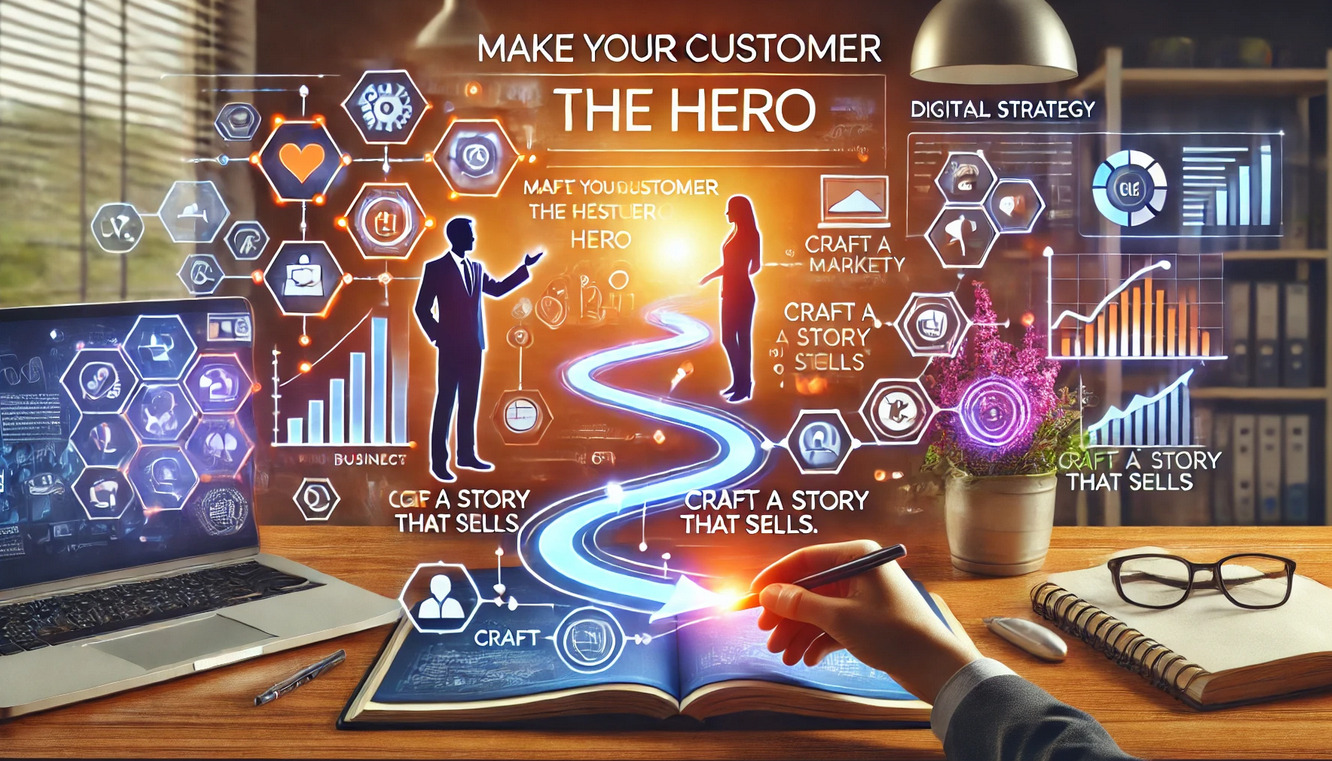
  • The Customer = The Hero (They have a challenge they need to overcome)
  • Your Brand = The Guide (You provide the solution and expertise)
  • A Clear Plan (You show them exactly how you’ll help them succeed)
  • A Call to Action (Encourage them to take the next step)
  • The Transformation (How their life/business improves after working with you)

Example of a Story Shift:

  • Old Message: “We create cutting-edge software for business automation.”
  • New Message: “Struggling with wasted time and inefficient processes? We help businesses streamline operations with easy-to-use automation tools.”

See the difference? The second one speaks directly to the customer’s pain point.


How to Rewrite Your Brand Story to Focus on the Customer

Step 1: Identify Your Customer’s Biggest Pain Points

  • What keeps them up at night?
  • What problem are they actively trying to solve?
  • How does your solution fit into their journey?

Step 2: Speak Their Language, Not Yours

  • Avoid industry jargon. Use simple, relatable language.
  • Talk about outcomes and benefits, not just features.

Step 3: Show Empathy & Authority

  • Let them know you understand their struggle and have the experience to guide them.
  • Use case studies, testimonials, or success stories to prove it.

Internal Resource: Explore our Case Study on Customer-Centric Branding to see this strategy in action.


It’s Time to Optimize Your Customer Journey Marketing Strategy

Watch the Video: How to Make Your Customer the Hero

  • If your marketing isn’t getting the engagement or conversions you expect, it’s time to rethink your messaging.
  • Make your customer the hero and position your brand as the trusted guide.
  • Speak to their problems, desires, and goals—not just about what you offer.

Learn More About Storytelling in Marketing

Need help crafting a compelling brand story?

Contact Webociti today for a free consultation!

Read more marketing insights on our blog: https://www.webociti.com/blog/

SEO Strategies Guide 2025

1. Introduction to SEO

SEO Basics

Search Engine Optimization (SEO) is the process of improving your website’s visibility on search engines like Google. Learn more about Webociti’s SEO services to see how we can help. For additional insights, check out Google’s SEO Starter Guide.

For example, a local bakery that optimized its website saw a 50% increase in online orders within three months, thanks to improved search rankings and targeted content. Similarly, a small tech startup that revamped its SEO strategy achieved a 40% increase in organic traffic by focusing on long-tail keywords and creating high-quality blog content. When done correctly, SEO drives organic traffic, increases conversions, and enhances your brand’s credibility. In today’s competitive online landscape, a strong SEO strategy is essential to ensure your website stands out.

Did you know? Websites on the first page of Google receive over 90% of traffic. This is because users tend to trust and click on the top results, assuming they are the most relevant. Failing to make it to the first page means losing out on significant click-through opportunities, which could dramatically impact your website’s visibility and conversions. Without an effective SEO strategy, your site may go unnoticed. This guide is designed to provide actionable steps and strategies that will help you optimize your website for 2025.

2. Core Components of SEO

Core Components of SEO

On-Page SEO

  • Title Tags & Meta Descriptions: Craft compelling, keyword-rich titles and meta descriptions to attract clicks.
  • Header Tags: Use H1, H2, and H3 tags to structure content clearly for readers and search engines.
  • Content Quality: Write content that provides real value, answers user questions, and incorporates keywords naturally.
  • Internal Linking: Link to relevant pages within your site to improve navigation and SEO.
  • Schema Markup: Use structured data to help search engines understand your content and improve search results.

Off-Page SEO

  • Link Building: Earn high-quality backlinks from reputable websites.
  • Social Media Signals: Share your content on social media to increase brand visibility.
  • Influencer Outreach: Collaborate with influencers in your niche to boost credibility and traffic.

Technical SEO

  • Mobile Optimization: Make sure your site is responsive and mobile-friendly.
  • Page Speed: Compress images, enable caching, and minimize code to improve loading times.
  • Site Health: Use tools like Google Search Console to fix crawl errors, broken links, and duplicate content.

3. Content Strategies

Content Strategies Illustration

When creating content for SEO, it’s essential to go beyond simply listing features and benefits. Instead, focus on telling a compelling story that resonates with your audience. Great storytelling engages readers emotionally, making your content more memorable and impactful. Think about your audience’s challenges and craft narratives that position your brand as the solution.

For example, a travel agency might share the story of a family who had a life-changing experience on one of their vacation packages. By framing the trip as a journey filled with discovery and connection, they not only highlight the benefits of their service but also create an emotional connection with potential customers. Metrics tied to storytelling, such as reduced bounce rates and increased time on page, further emphasize its effectiveness in keeping readers engaged and boosting rankings.

  • Engaging Formats: Mix articles, videos, infographics, and podcasts to keep your audience interested.
  • Topic Clusters: Create pillar content supported by related articles to establish topical authority.
  • Content Refreshing: Regularly update existing content to maintain relevance and improve rankings.
  • Multimedia Integration: Add high-quality images, charts, and videos to increase user engagement and time on page.

4. Keyword Research

Keyword Research Tools

Keyword research is one of the most critical steps in any SEO strategy. It lays the foundation for your entire campaign, ensuring that you’re targeting the right audience with the right content. Without proper keyword research, your SEO efforts could fall flat, wasting time and resources. Taking the time to get it right can mean the difference between success and obscurity.

  • Start with Tools: Use tools like Google Keyword Planner, SEMrush, and Ahrefs to identify relevant keywords.
  • Long-Tail Keywords: Target phrases with lower competition but high search intent.
  • Competitor Analysis: Evaluate which keywords your competitors are ranking for, analyze the content that ranks, and identify gaps or opportunities you can exploit.
  • Search Intent: Understand whether the keyword indicates informational, transactional, or navigational intent.

5. Local SEO

Local SEO and Google Maps

For businesses that depend on local customers, local SEO is a game-changer. A critical element of local SEO is leveraging Google Maps, as it plays a significant role in helping customers find your business easily. To optimize your Google Maps listing, ensure that your business profile is complete with accurate information such as your address, phone number, and business hours. Use high-quality photos of your storefront, products, or services to create an engaging visual presence. Additionally, incorporate local keywords in your business description and encourage customers to leave reviews, as these factors can significantly improve your ranking on Google Maps.

  • Google Business Profile: Ensure your listing is complete with accurate NAP (Name, Address, Phone).
  • Local Keywords: Include city or neighborhood-specific keywords in your content. Discover more tips in our Local SEO guide.
  • Online Reviews: Encourage satisfied customers to leave reviews on platforms like Google and Yelp.
  • Local Backlinks: Partner with local directories and businesses for backlinks.

6. Measuring Success

SEO Metrics Dashboard

Knowing whether your SEO strategy is working requires tracking key metrics. Use these tools and metrics:

  • Organic Traffic: The number of visitors coming from search engines. High organic traffic indicates your keywords and content are attracting the right audience.
  • Bounce Rate: How often visitors leave after viewing one page. A high bounce rate may suggest your content isn’t meeting user expectations.
  • Time on Page: How long users stay on a specific page. Longer times indicate that your content is engaging and informative.
  • Conversion Rate: Percentage of visitors completing desired actions, like filling out a form or making a purchase.
  • Click-Through Rate (CTR): The percentage of users who click on your link after seeing it in search results.
  • Keyword Rankings: Monitor how your targeted keywords are performing over time.

7. Advanced SEO Techniques

Advanced SEO Tools

Advanced SEO isn’t just about technical tweaks; it’s also about weaving storytelling into your strategy. To implement these techniques effectively, you need the right tools:

  • Beginner-Friendly Tools: Yoast SEO (for WordPress), AnswerThePublic.
  • Advanced Tools: SEMrush, Ahrefs, Screaming Frog SEO Spider, Moz Pro, Google Analytics, and Search Console. Explore how these tools integrate with Webociti’s Digital Marketing services.
  • Core Web Vitals: Prioritize user experience metrics like loading speed, interactivity, and visual stability.
  • Video SEO: Optimize video content with transcripts, captions, and proper metadata.
  • Content Personalization: Tailor content to individual user preferences and behaviors.

9. Common SEO Mistakes to Avoid

  • Keyword Stuffing: Overusing keywords can lead to penalties and lower rankings.
  • Ignoring Mobile Optimization: A poor mobile experience can drive users away.
  • Neglecting Analytics: Without data, you’re flying blind.

10. Ready to Boost Your SEO in 2025?

Next Steps

  • Identify Your Priorities: Focus on areas that need immediate attention, like page speed or local SEO.
  • Consult with Experts: Work with professionals to develop a tailored strategy.

Frequently Asked Questions (FAQ)

  • What is the first step in implementing an SEO strategy? The first step is conducting thorough keyword research to target the right audience effectively.
  • How long does it take to see results from SEO? SEO is a long-term strategy, and it can take weeks to months to see significant results.
  • What tools are essential for beginners in SEO? Tools like Google Analytics, Google Search Console, and Yoast SEO are beginner-friendly and effective.

Transform Your SEO Strategy Today

Are you ready to take your SEO strategy to the next level? Webociti specializes in creating tailored SEO solutions that drive results. Whether you need help with keyword research, content optimization, or technical SEO, our team of experts is here to assist.

Contact us today for a free consultation and let’s discuss how we can help you achieve your digital marketing goals. Call us at 678-892-7157 or visit our website to learn more!

Schedule a Consultation


Are you wasting money on the wrong marketing channels? Discover which ones give small businesses the best ROI this year.

As a small business owner, you’ve got to make every dollar count, especially when it comes to marketing. With so many channels to choose from, it can be overwhelming to figure out where your hard-earned money will get the best return on investment (ROI). Some strategies work like magic, while others drain your budget without delivering the results you need.

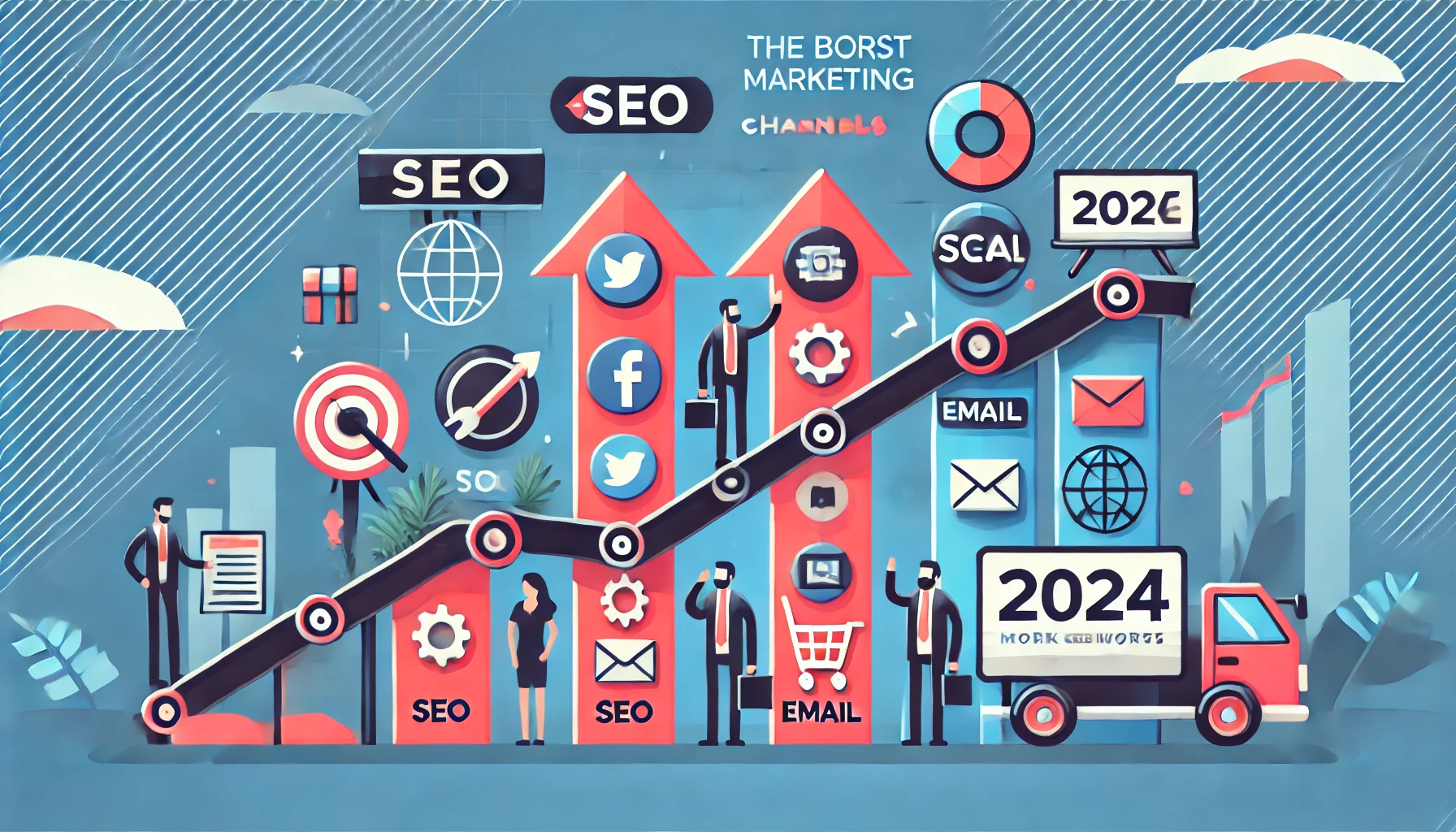
In 2024, the marketing landscape continues to evolve, and staying ahead means understanding which channels are thriving—and which ones are falling behind. Let’s break down the best (and worst) marketing channels for small businesses this year.


The Best Marketing Channels for Small Businesses in 2024

1. Search Engine Optimization (SEO)

Why It Works: SEO is still one of the most effective long-term strategies for attracting potential customers. Ranking high on Google means getting in front of people actively Top marketing channels for small businesses in 2024searching for what you offer. By optimizing your website for relevant keywords, creating high-quality content, and ensuring a user-friendly experience, you can drive organic traffic without paying for each click.

2024 Tip: Focus on local SEO if you have a brick-and-mortar business. Claim your Google My Business profile, optimize for location-based keywords, and encourage positive reviews from satisfied customers.

For more insights on improving your SEO strategy How SEO Can Boost Your Small Business in 2024.

2. Social Media Advertising (Facebook, Instagram, TikTok)

Why It Works: With billions of active users, social media platforms offer highly targeted advertising opportunities. You can narrow down your audience based on demographics, interests, behaviors, and more. Instagram and TikTok, in particular, have seen a surge in engagement, making them great platforms for brand awareness and lead generation.

2024 Tip: Leverage short-form video content, like Reels and TikToks, to boost engagement and visibility. These formats are gaining more traction and offer a cost-effective way to capture attention.

3. Email Marketing

Why It Works: Email marketing remains a goldmine for small businesses. It’s one of the few channels where you can directly communicate with your audience, build relationships, and drive sales. By segmenting your list and delivering personalized, valuable content, email marketing can deliver some of the highest ROI of any channel.

2024 Tip: Automate your email marketing campaigns to nurture leads and re-engage inactive customers. Triggered emails, like cart abandonment reminders or personalized recommendations, can significantly boost conversions.

4. Pay-Per-Click (PPC) Advertising

Why It Works: PPC, through platforms like Google Ads, allows you to bid on keywords relevant to your business. It’s a fast way to get in front of potential customers. The key benefit is that you only pay when someone clicks on your ad, making it easy to track ROI and optimize your campaigns in real time.

2024 Tip: Use PPC for highly targeted campaigns, especially when testing new markets or promoting seasonal offers. Focus on optimizing ad copy and landing pages for conversions, not just clicks.

5. Content Marketing (Blogs, Videos, Podcasts)

Why It Works: Content marketing builds trust, educates your audience, and improves your SEO. Whether through blog posts, videos, or podcasts, creating valuable content positions your business as an authority in your industry. It’s a powerful way to engage with your audience over time and drive traffic to your website.

2024 Tip: Repurpose your content across multiple platforms. For example, turn a blog post into a video or break down a podcast episode into social media snippets to maximize your content’s reach.

The Worst Marketing Channels for Small Businesses in 2024

1. Print Advertising

Why It’s Failing: While print advertising might still work for some niche industries, its overall effectiveness has been steadily declining. In 2024, digital marketing channels Worst marketing channels for small businesses in 2024offer far more targeting and tracking capabilities, which means better ROI. Print ads are also more expensive and harder to measure in terms of results.

2024 Tip: If you’re set on traditional advertising, consider hybrid options like direct mail with digital tracking (such as QR codes or personalized URLs) to measure engagement.

2. Television Ads

Why It’s Failing: Unless you have a massive budget, television ads aren’t the best use of your marketing dollars. They’re expensive, hard to target, and don’t offer the granular analytics that digital channels provide. In an era where viewers are increasingly cutting the cord and opting for ad-free streaming services, TV ads are losing their influence.

2024 Tip: If video is your focus, try YouTube ads or video marketing on social platforms instead, where targeting is more precise, and budgets are flexible.

3. Billboard Advertising

Why It’s Failing: Like TV and print, billboard advertising can reach a large audience, but it’s a broad approach that doesn’t offer much targeting. With so much focus on digital channels, it’s difficult to measure the direct impact of billboard ads on your business. Additionally, as people spend more time on their phones, they may not even notice billboards anymore.

2024 Tip: If outdoor advertising appeals to your business, consider geofencing ads, which use location data to deliver ads to mobile devices when potential customers are in a specific area.

4. Cold Calling

Why It’s Failing: Cold calling used to be a staple for lead generation, but it’s increasingly seen as intrusive. Most people prefer to research products and services online before engaging with a business. In fact, many people ignore unsolicited calls, and the success rate of cold calling continues to plummet.

2024 Tip: Focus on inbound marketing strategies that encourage potential customers to come to you through valuable content, SEO, and targeted ads, rather than relying on outdated cold calling tactics.

Wrapping It Up

In 2024, the best marketing channels for small businesses are those that offer precise targeting, measurable results, and the ability to adapt to customer behaviors. Digital marketing continues to outperform traditional channels in terms of ROI, especially with the rise of data-driven strategies like SEO, social media advertising, and PPC.

Don’t waste your budget on outdated, ineffective methods. Instead, invest in the channels that are proven to deliver results for your business. With the right approach, you can attract more customers, increase your visibility, and boost your bottom line—all without breaking the bank.

Studies show that small businesses with optimized digital marketing strategies see a higher ROI than those relying on outdated methods (Business News Daily).

Ready to optimize your marketing channels? Let Webociti help you craft a strategy that brings the best ROI in 2024. Contact us today for a free consultation.

Unlocking Growth: Content Marketing Strategies for Small Businesses

In this post: Learn 8 actionable content marketing strategies that helped a small business drive real growth—and how you can apply them too.

Want to grow your small business without spending a fortune? These content marketing strategies for small businesses helped one boutique double its customer base—and you can use them too.

That’s exactly what happened to Eliza’s Designs, a small boutique that leveraged targeted content marketing to skyrocket visibility and sales. In today’s digital-driven market, this is not just possible but increasingly common. Content marketing offers a powerful way for small businesses to build brand awareness, drive engagement, and grow efficiently. Let’s explore how you can replicate that success.

1. Define Your Audience and Goals

Before diving into content creation, define who your target audience is and what you want your content to achieve—brand awareness, leads, or engagement. Having clear goals ensures you create purposeful content.

Action Tip: Create buyer personas to detail demographics, interests, and pain points for laser-focused messaging.

2. Leverage the Power of Storytelling

Share stories about your brand’s origin, challenges overcome, and the mission that drives your business. Emotional connection builds stronger loyalty.

Action Tip: Include testimonials and customer case studies to tell authentic stories and provide social proof.

3. Optimize Content for SEO

Make your content discoverable through search engines by targeting the right keywords and structuring your pages well.

Action Tip: Use tools like Google Keyword Planner or SEMrush to identify relevant terms. Optimize titles, headers, and descriptions.

4. Diversify Your Content Formats

Different formats appeal to different segments of your audience. Go beyond blogs by using video, infographics, podcasts, and carousels.

Action Tip: Track engagement trends to see which formats work best—then invest accordingly.

5. Utilize Content Calendars

Planning content in advance helps you stay consistent and relevant. It’s also essential for seasonal and campaign timing.

Action Tip: Use Trello or Google Calendar to schedule themes, channels, and publishing dates.

6. Promote Your Content Across Channels

Content promotion is just as important as creation. Use email, social media, and partnerships to expand your reach.

Action Tip: Repurpose posts into LinkedIn articles, Instagram carousels, or newsletter segments.

7.Analyze and Adapt Your Content Marketing Strategies

Monitor performance regularly to improve results. Data should inform your strategy moving forward.

Action Tip: Review Google Analytics each month—track page views, bounce rate, and conversions.

8. Encourage User-Generated Content

Let your audience be your best advocates. UGC is authentic and adds credibility to your marketing.

Action Tip: Launch campaigns asking for photos, videos, or testimonials you can share.

Conclusion

Eliza’s Designs is just one of many success stories that show how effective content marketing can drive ROI. Strategic storytelling, SEO, and consistency are the backbone of growth in today’s digital economy.

Ready to see results? Schedule a free consultation today and discover how Webociti’s proven content marketing strategies can help grow your business.


📞 Let’s Get Started

Customer-Centric Marketing: How Top Brands Solve Real Problems

Setting the Scene: A Shift in Strategy

Consumers are tuning out product pitches—but they’re leaning in when brands talk about their struggles, dreams, and daily frustrations. That’s why today’s smartest marketers are turning to customer-centric marketing strategies that focus on solving real problems—not just selling features.

Traditional marketing often highlights a product’s features or superiority—but that alone doesn’t cut it anymore. Today’s customers expect brands to understand their needs and provide real solutions. The shift from product-focused to problem-solving marketing isn’t just a trend; it’s a fundamental change in how companies connect with their customers.


Marketing experts discussing strategies on a digital display

Marketing experts discussing strategies on a digital display


Problem-Solving at the Core of Customer-Centric Marketing Strategies

The heart of customer-centric marketing strategies lies in identifying real problems your audience faces—and positioning your product as the solution. This approach builds deeper trust, boosts engagement, and strengthens long-term loyalty.

For instance, instead of promoting a cleaning product based on ingredients, emphasize how it creates a safer home by eliminating 99.9% of germs, offering peace of mind to busy families. The product becomes the solution to a real-life concern—not just a commodity.


Creating Curiosity and Engagement

Curiosity drives engagement. When your marketing sparks curiosity, it turns passive readers into active seekers of information. Storytelling is a powerful tool here. Use scenarios that reflect your audience’s daily lives and position your product as the hero.

For example, when marketing a financial app, tell a story about a couple navigating unexpected expenses and how the app helps them plan for a dream vacation. The emotional payoff makes the product relevant and memorable. This is just one of many ways customer-centric marketing strategies can create powerful engagement moments.


Learning from the Best: Case Studies

Some of the most successful brands today didn’t get there by pushing features—they did it by solving problems their customers care about.

Take Slack, for instance. Instead of advertising itself as just a chat app, Slack focused on solving workplace chaos. Their messaging positioned the tool as a way to simplify communication, reduce email clutter, and streamline teamwork. That real-world benefit helped Slack explode in popularity.

Another great example is Dove. Rather than selling soap, Dove launched its “Real Beauty” campaign to address self-esteem and confidence issues among women—turning the product into a symbol of empowerment. Sales soared, and the brand built deep emotional connections with its audience.

These real-life case studies show how customer-centric marketing strategies can generate emotional impact, loyalty, and measurable business growth. Learn more about this approach from this HubSpot guide to customer-centric marketing.


5 Ways to Apply Customer-Centric Marketing Strategies Today

  • Talk to your customers: Conduct surveys, interviews, or use social listening to uncover the problems they care most about.
  • Mirror their language: Use copy that reflects the way your audience talks about their challenges and desires.
  • Position your product as the guide: Don’t make it the hero. Instead, show how it helps your audience overcome obstacles.
  • Share transformation stories: Showcase real customers and how your product changed their situation for the better.
  • Focus on benefits over features: Shift your messaging from “what it does” to “how it improves life or work.” This is one of the most effective customer-centric marketing strategies you can implement today.


Common Pitfalls to Avoid

Even with the best intentions, brands can fall into traps. Here are a few mistakes to watch out for when applying customer-centric marketing strategies:

  • Talking too much about yourself: If your marketing starts with “we” or “our product,” flip it to focus on the customer instead.
  • Overloading on features: Don’t list features without explaining their value. Tie every feature to a customer problem it solves.
  • Neglecting emotion: Facts tell, but stories sell. Make sure your messaging connects emotionally, not just logically.


Trends in Customer-Centric Marketing Strategies

As digital transformation accelerates, customers expect more personalized, value-driven interactions. Forward-thinking companies are investing in AI-driven personalization, predictive analytics, and omnichannel experiences to stay ahead. According to Gartner, businesses that integrate personalization into their customer-centric marketing strategies see significantly higher engagement and conversion rates.

Another key trend is the rise of interactive content—from quizzes and polls to calculators and assessments. These tools don’t just entertain; they offer valuable insights into customer needs while showcasing how your product or service fits into their journey. Embedding these into your customer-centric marketing strategies can elevate engagement and increase lead quality.


Start Using Customer-Centric Marketing Strategies Today

Want a marketing strategy that speaks directly to your customers’ pain points—and earns their trust? At Webociti, we help businesses like yours turn problems into growth opportunities through proven customer-centric marketing strategies.

📞 Schedule Your Free Consultation or call us at 678-892-7157.

Implementing customer-centric marketing strategies doesn’t happen overnight—but small changes add up. Start by rethinking your email campaigns, website copy, or ad messaging. Focus each piece of content on how your brand improves your customer’s life, not just what you sell. Over time, this shift will reshape how people connect with your business.


Conclusion

In today’s crowded digital space, products alone don’t stand out. Brands that win are those that offer solutions, tell authentic stories, and put the customer first. By embracing customer-centric marketing strategies, you move from pitching products to building meaningful relationships—and that’s where real growth begins.


Your Brand, Their Story: Why Making Customers the Hero Wins Every Time

Have you ever stopped to think about who really should be the hero of your brand story? Is it your brand itself, or is it the customers whose lives you aim to transform? In today’s marketplace, understanding the answer can revolutionize your marketing strategy.

In the realm of marketing, storytelling is not just a tool; it’s a powerful conduit for connecting with your audience on a deeply personal level. However, a common misstep for many businesses is casting themselves as the hero of the story, rather than the customer. By flipping this script and positioning your customer as the main character, you can transform the effectiveness of your marketing strategy.

Understanding the Hero’s Journey in Marketing

The Hero’s Journey, conceptualized by Joseph Campbell, outlines a universal narrative arc that resonates across cultures and time. This journey isn’t just for epic tales and blockbuster movies; it’s incredibly applicable to marketing. In this framework, the customer is the hero, facing challenges and seeking solutions—your products or services are the tools or allies they encounter on their quest.

Examples of Customer as Hero

Companies like Apple and Nike have masterfully made their customers the heroes. Apple’s marketing often shows how its products enable customers to be more creative, productive, or connected, rather than merely showcasing the technical features of those products. Similarly, Nike positions its products within the narrative of personal achievement and overcoming obstacles, making the customer the athlete-hero in their own sports story.

Benefits of Customer-Centric Storytelling

The benefits of positioning your customers as the main characters in your brand’s story are profound and numerous. Here are a few key advantages:

  • Increased Engagement: When customers see themselves as the main characters in your brand’s story, they connect more deeply with your message, fostering stronger loyalty and more meaningful interactions.
  • Enhanced Loyalty: Recognizing and addressing your customers’ needs and triumphs helps cultivate a lasting relationship, as customers tend to stick with brands that they feel understand and value them.
  • Greater Conversions: A relatable and resonant narrative is far more compelling than a straightforward sales pitch. When customers can see their own aspirations and challenges reflected in your offerings, they are more likely to invest in your products or services.

How to Craft Your Marketing to Make the Customer the Hero

Listen and Understand:

Truly effective marketing begins with listening. Start by engaging directly with your customers through surveys, social media interactions, and direct feedback. Use these insights to understand their unique challenges, desires, and aspirations. This deep understanding forms the foundation of a marketing strategy that genuinely resonates with your audience.

Craft Relatable Messages:

Once you have a clear grasp of your customers’ needs, develop marketing messages that directly address these. Frame your product or service as the supporting character in their story, providing solutions and aiding their journey. This approach helps to create a narrative where the customer sees themselves as the hero, empowered by what you offer.

Leverage Customer Stories:

There’s no better way to demonstrate your product’s impact than showcasing real-life examples. Encourage your customers to share their success stories and highlight how they have overcome challenges using your products or services. These testimonials not only serve as powerful endorsements but also solidify the role of your offerings as essential tools in the customer’s journey.

Highlight the Journey:

Emphasize the transformation customers can expect by using your product or service. Describe the before and after, detailing how your offerings facilitate this change. This not only helps potential customers visualize the benefits but also cements your brand’s role in their success story.

Avoiding Common Pitfalls

While shifting the narrative focus to the customer is a powerful approach, there are common mistakes that can undermine its effectiveness. Being aware of these pitfalls can help ensure your strategy remains authentic and impactful:

Over-Branding the Story

Many brands make the mistake of inserting too much of their own voice and branding into what should be the customer’s story. The result can feel more like a sales pitch than a genuine narrative that centers around the customer’s experiences. For instance, a tech company might focus too much on the specifications and features of a product rather than how it solves real-life problems for users.

Solution: Always frame your content to reflect the customer’s perspective. Instead of focusing on product features, highlight how these features transform the customer’s daily life or business operations.

Ignoring Customer Feedback

Ignoring or not seeking customer feedback is another significant pitfall. This feedback is crucial not only for product development but also for crafting messages that resonate with your audience.

Solution: Regularly engage with your customers through surveys, social media, and direct communication to gather insights about their needs and how they perceive your brand. Use this data to adjust your narratives and strategies.

Lack of Authenticity

Customers are quick to spot inauthentic narratives, which can severely damage trust and brand loyalty. An example of this could be a brand claiming environmental responsibility without substantive actions to back it up, which can lead to accusations of greenwashing.

Solution: Ensure that every story or message shared is backed by genuine actions and experiences. Transparency about your processes and admitting shortcomings can actually strengthen trust.

Exaggerating Benefits

Over-promising and under-delivering can disillusion customers and lead to higher churn rates. A common example is software companies promising seamless integration and user-friendliness without addressing potential challenges users may encounter.

Solution: Maintain realistic expectations in your marketing. It’s better to be honest about potential challenges and discuss how your company supports customers in overcoming them.

Failing to Evolve With Customer Needs

A static story or value proposition can become irrelevant as customer needs and market dynamics evolve. For example, during the COVID-19 pandemic, many brands had to quickly adjust their narratives to stay relevant to the new challenges their customers faced.

Solution: Continuously revisit and revise your customer personas and journey maps. Stay flexible in your marketing to adapt quickly to changing circumstances and customer feedback.

Conclusion: Empower Your Customer, Transform Your Brand

In every story worth telling, there is a hero that rises to meet their challenges. In the story of your brand, shouldn’t that hero be your customer? This shift in perspective from brand-centric to customer-centric storytelling not only enhances the effectiveness of your marketing efforts but also fosters a more heartfelt and enduring connection with your audience.

Reflect on your current marketing strategy: Is it truly customer-centric? Are you allowing your customers to be the heroes, or are they merely extras in the story of your brand? Making this shift might require rethinking how you communicate, how you engage with your audience, and how you view your products or services within the lives of those you serve.

Embracing your customers as the heroes of your narrative is not just about changing your marketing messages; it’s about transforming your entire approach to business. It involves genuine commitment, continual feedback, and an ongoing dialogue with the very people who use your services or products.

Are you ready to rewrite the script and let your customers lead the story? If so, you’re on the path to not just telling better stories but creating a brand that lives and breathes customer success.

Ready to transform your marketing narrative? If you’re looking to make your customers the center of your marketing story and need guidance on how to do it effectively, Webociti is here to help. Our team of experts specializes in crafting marketing strategies that resonate deeply with target audiences, turning your brand story into their success story. Contact us today to learn more about how we can assist you in elevating your brand narrative. Schedule a Strategy Call

10 Digital Marketing Strategies to Skyrocket Your Business Growth

In the modern business landscape, digital marketing transcends traditional advertising; it’s a pivotal strategy that can catapult your business to new heights. From amplifying brand visibility to enhancing customer engagement, a well-crafted digital marketing strategy can propel growth and cultivate enduring relationships with your audience. Here are ten essential digital marketing tactics every business should employ to guarantee success in today’s competitive market.


1. Optimize Your Website for Search Engines

SEO (Search Engine Optimization) forms the backbone of an effective digital presence. By optimizing your website with relevant keywords, high-quality content, and a mobile-friendly design, you ensure higher visibility in search engine results. This strategic visibility means that when potential customers search for products or services related to your business, your website ranks prominently, driving more organic traffic. Regular SEO audits are crucial to adjust to changing algorithms and maintain a competitive edge.

2. Leverage the Power of Content Marketing

In the realm of digital marketing, content reigns supreme. Developing a robust content marketing strategy that includes blogs, videos, infographics, and podcasts can engage your audience and position your brand as a thought leader in your industry. This strategy not only attracts and retains customers by enhancing site engagement but also drives significant traffic through valuable, high-quality content.

3. Utilize Social Media Effectively

Social media platforms present a vast arena for businesses to amplify their brand exposure. By regularly updating your profiles, engaging with followers, and deploying targeted ads to reach specific demographics, you significantly enhance your online presence and foster direct interactions with your customers.

4. Implement Email Marketing

Email marketing remains one of the most cost-effective digital marketing strategies. By collecting emails from website visitors and sending them tailored offers, news, and personalized content, you can help convert leads into customers and enhance repeat business. Incorporating A/B testing in your email campaigns can optimize effectiveness and increase conversion rates.

5. Invest in Paid Advertising

PPC (Pay-Per-Click) advertising allows you to reach Internet users on numerous digital platforms through paid ads. These ads can target specific demographics, interests, and behaviors, offering a high ROI by driving targeted traffic to your site.

6. Enhance User Experience

User experience (UX) significantly influences how visitors perceive your website and, by extension, your brand. A website with intuitive navigation, fast loading times, and compelling call-to-action buttons markedly improves user engagement and conversion rates.

7. Use Data Analytics

Data-driven marketing is essential for understanding the effectiveness of your digital marketing strategies. Tools like Google Analytics provide valuable insights into your audience’s behavior, campaign performance, and more, allowing you to make informed decisions and optimize your marketing efforts.

8. Engage in Community Building

Creating a community around your brand can foster lasting customer loyalty. Engaging with your audience through forums, webinars, and live Q&A sessions provides direct support and gathers valuable feedback, which can be used to enhance your products and services.

9. Mobile Optimization

With the rising number of users accessing the internet via smartphones, having a mobile-optimized website is crucial. This ensures that your site delivers a good user experience on any device, improving both reach and effectiveness of your online content.

10. Continuous Learning and Adaptation

The digital marketing landscape is perpetually evolving. Staying ahead requires keeping up with the latest trends, technologies, and changes in consumer behavior. Regular training for your team and adapting your strategies based on market dynamics are vital for sustained success.

Digital marketing offers myriad opportunities to grow and refine your business strategy. By implementing these ten essential tactics, your business can not only enhance its online presence but also achieve significant growth in an increasingly digital world.

Ready to transform your digital marketing strategy and take your business to new heights?

Contact Webociti today for a free consultation and discover how our expertise can help you succeed. Don’t wait—start shaping the future of your business with effective digital marketing solutions. Call us at 678-892-7157 or click here to get started.

#DigitalMarketing #BusinessGrowth #SEO #SocialMediaTips #ContentMarketing #EmailMarketing #OnlineAds #MarketingAutomation #WebAnalytics #CustomerEngagement