08 May How to Build a Revenue Growth System
Revenue System Strategy
How to Build a Revenue Growth System
Growth does not become predictable because a company does more marketing, adds more sales activity, or reviews more dashboards. It becomes predictable when the pieces behind revenue are connected.
A revenue growth system connects positioning, demand generation, pipeline quality, conversion, and revenue feedback into one operating framework so leadership can diagnose where growth is working, where it is breaking, and what needs to improve next.
In Summary
A revenue growth system is the structure that connects how a business attracts the right buyers, qualifies opportunities, advances pipeline, converts revenue, and learns from market feedback.
Instead of treating marketing, sales, and revenue as separate functions, a revenue growth system aligns them around the same buyer, the same message, the same pipeline definitions, and the same growth outcomes.
The goal is not more activity. The goal is better-fit opportunities, stronger conversion, cleaner pipeline, and more predictable revenue.
Part of the Webociti Revenue System Series
This guide is part of a larger series on how businesses can move from disconnected marketing and sales activity to a connected revenue growth system.
Predictable revenue is not built from disconnected tactics. It is built from a connected system.
What Is a Revenue Growth System?
A revenue growth system is the connected structure behind how a company attracts the right buyers, qualifies opportunities, advances pipeline, converts revenue, and learns from market feedback.
It is not one campaign. It is not one sales process. It is not one CRM dashboard.
It is the operating system behind predictable growth.
A strong revenue growth system connects five core parts:
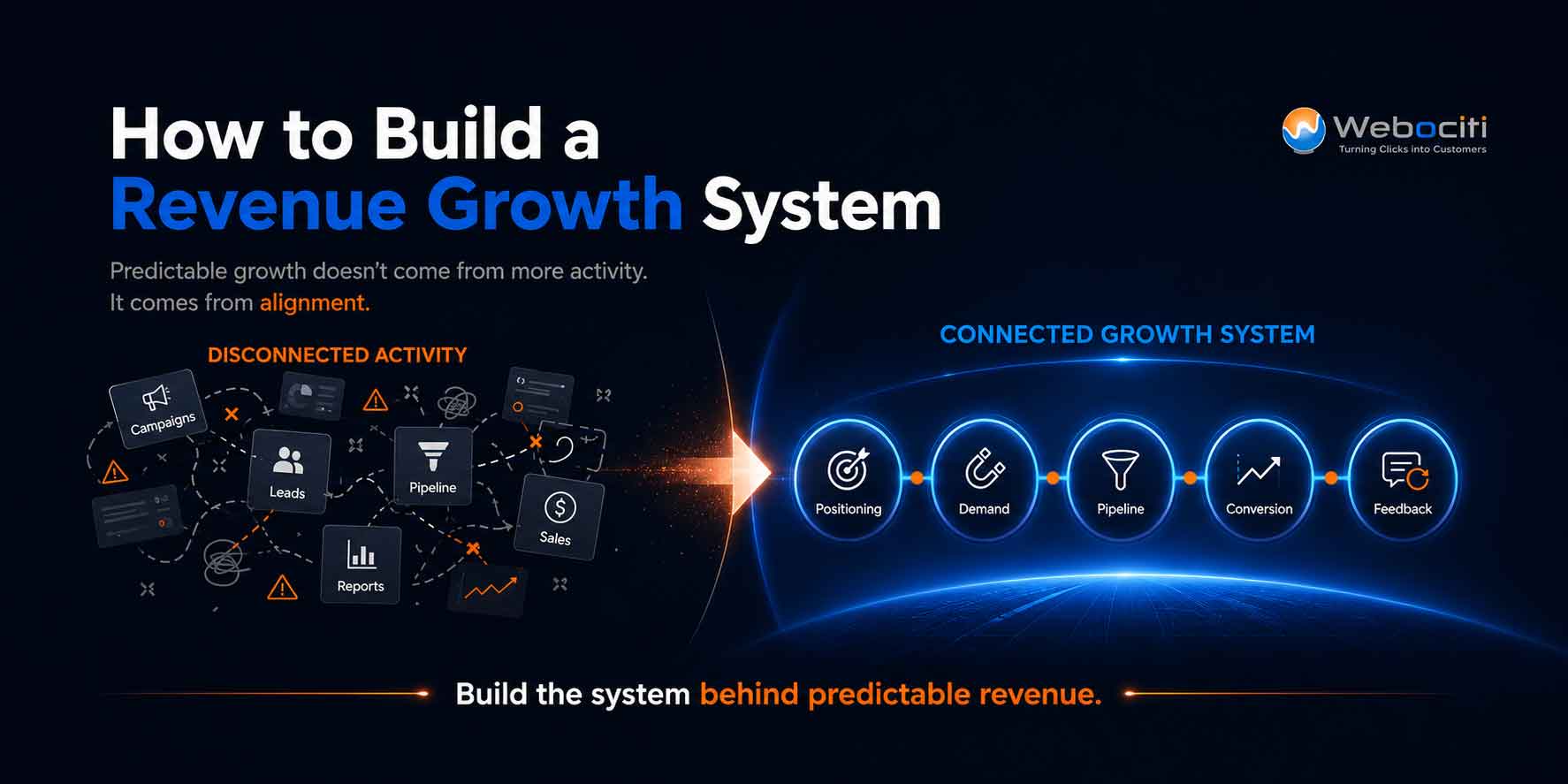
Positioning → Demand → Pipeline → Conversion → Revenue Feedback
Each stage feeds the next. When one stage is weak, everything downstream becomes harder. When the stages are connected, the business can diagnose growth more clearly and improve the system over time.
This is the difference between companies that create activity and companies that create momentum.
Activity is easy to generate. Momentum requires alignment.
For a deeper look at the full framework, read: What a Real Revenue System Actually Looks Like.
Why Most Growth Systems Break
Most companies do not intentionally design their revenue system.
They add pieces over time.
- A website gets built.
- Marketing campaigns get launched.
- Sales tools get added.
- CRM stages get created.
- Reporting dashboards get reviewed.
- New people join the team.
Each piece may make sense on its own. But if those pieces are not connected, the company ends up with growth activity instead of a growth system.
That is where the breakdown starts.
- Marketing attracts the wrong audience.
- Sales questions lead quality.
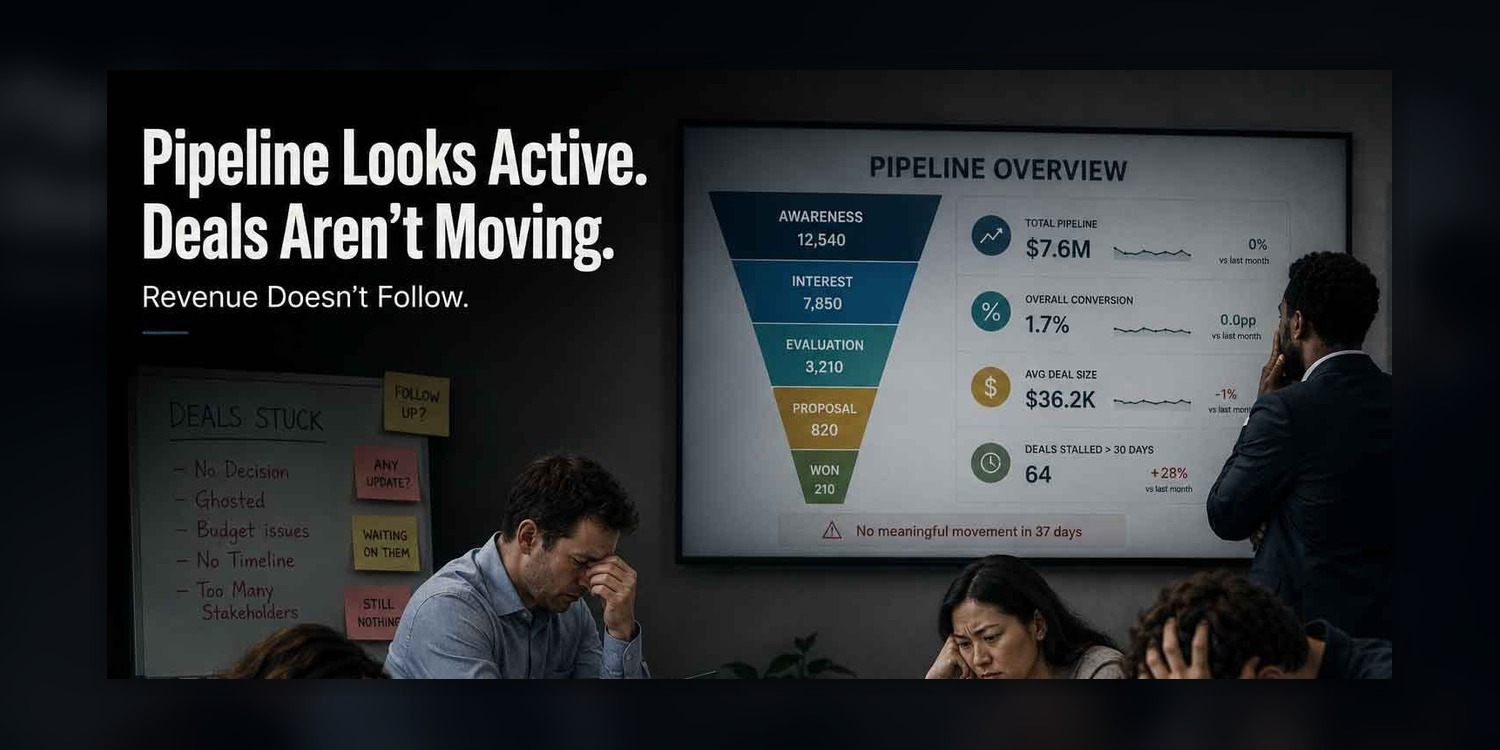
- Pipeline looks active but does not convert.
- Leadership pushes for more leads instead of better-fit opportunities.
- Revenue remains inconsistent.
When marketing, sales, pipeline, and conversion are not aligned, activity can increase while revenue stays unpredictable.
If your marketing is creating activity but not qualified opportunities, this is likely part of the problem: Why Your Marketing Isn’t Generating Qualified Leads.
Step 1: Start With Positioning
Every revenue growth system starts with positioning.
Positioning defines who you serve, what problem you solve, why that problem matters, and why buyers should choose you instead of another option.
If positioning is weak, everything downstream becomes harder.
- Marketing becomes too broad.
- Content attracts the wrong audience.
- Sales conversations require too much explanation.
- Pipeline quality suffers.
- Conversion becomes inconsistent.
Strong positioning creates clarity before the buyer ever talks to sales.
It helps answer the questions buyers are already asking:
- Is this for me?
- Do they understand my problem?
- Can they solve the issue I care about?
- Why should I act now?
- Why should I choose this company?
Without those answers, marketing becomes noise and sales becomes education.
Weak positioning attracts weak-fit opportunities. Strong positioning creates the foundation for qualified demand.
That is why positioning is not just a branding exercise. It is the first operating decision in a revenue growth system.
Step 2: Define the Right Buyer
A revenue growth system cannot work if the company is unclear about who it is trying to attract.
Many companies define their market too broadly. They focus on everyone who could buy instead of the buyers most likely to convert, stay, grow, and create long-term value.
That creates noise in the system.
The right buyer should be defined by more than basic demographics, company size, or industry category.
Look at:
- Fit — Does this buyer match your ideal customer profile?
- Need — Do they have a real problem you can solve?
- Urgency — Is there a reason to act?
- Authority — Can they influence or make a decision?
- Value — Is the opportunity worth pursuing?
- Conversion potential — Can this buyer realistically move through your process?
This step matters because the wrong buyer can make every part of the revenue system look weaker than it actually is.
A poor-fit lead may engage with your marketing, book a call, and enter the pipeline, but that does not mean they are a real revenue opportunity.
If they lack urgency, budget, authority, need, or strategic fit, they slow the system down. Sales spends more time educating, qualifying, and chasing instead of advancing real opportunities.
The goal is not to attract everyone who could possibly buy.
The goal is to attract the buyers most likely to understand the value, move through the process, and convert into profitable revenue.
The clearer the buyer definition, the cleaner the pipeline becomes.
When the right buyer is clearly defined, campaigns improve, messaging sharpens, pipeline quality increases, and the sales team spends more time with better-fit opportunities.
Step 3: Build Demand Around Buyer Problems
Demand generation should not start with what you want to sell.
It should start with what the buyer needs to solve.
Many companies build marketing around services, features, internal priorities, or whatever campaign they want to push next.
But buyers respond to problems, outcomes, risks, and opportunities.
A strong revenue growth system turns positioning into demand by connecting the company’s message to real buyer pain.
That means your content, ads, email campaigns, social posts, landing pages, and offers should all answer one question:
Why should the right buyer care now?
If your marketing creates traffic, clicks, and form fills but not qualified opportunities, you are not building demand. You are building activity.
The goal is not attention alone.
The goal is qualified demand from buyers who understand the problem, see the value, and have a reason to take the next step.
Demand generation should create interest from the right buyers, not just more movement at the top of the funnel.
When demand is built around real buyer problems, marketing becomes more relevant, lead quality improves, and the pipeline has a better chance of turning into revenue.
Step 4: Design the Pipeline Around Quality
A pipeline should not be a dumping ground for every inquiry.
It should be a structured system for identifying, qualifying, advancing, and converting real opportunities.
This is where many companies lose control of growth.
They treat every lead like an opportunity. They allow low-fit prospects to move too far into the process. They measure pipeline volume instead of pipeline quality.
The result is predictable:
- Sales gets buried in weak conversations.
- Deals stall.
- Forecasts become unreliable.
- Leadership sees pipeline activity but not revenue momentum.
A strong revenue growth system defines what belongs in the pipeline and what does not.
That requires clear qualification criteria:
- Who is a real fit?
- What problem are they trying to solve?
- What stage of awareness are they in?
- What action should happen next?
- What disqualifies an opportunity?
- What signals real buying intent?
A quality-focused pipeline gives your team a cleaner view of what is real.
Instead of measuring success by the number of opportunities in the CRM, the company can evaluate whether those opportunities match the buyer profile, have a clear business need, and show enough momentum to justify continued sales effort.
This changes how the team manages growth.
Sales can focus on better conversations. Marketing can see which sources create real opportunities. Leadership gets a more accurate view of future revenue.
A full pipeline does not always mean a healthy pipeline. Pipeline quality matters more than pipeline volume.
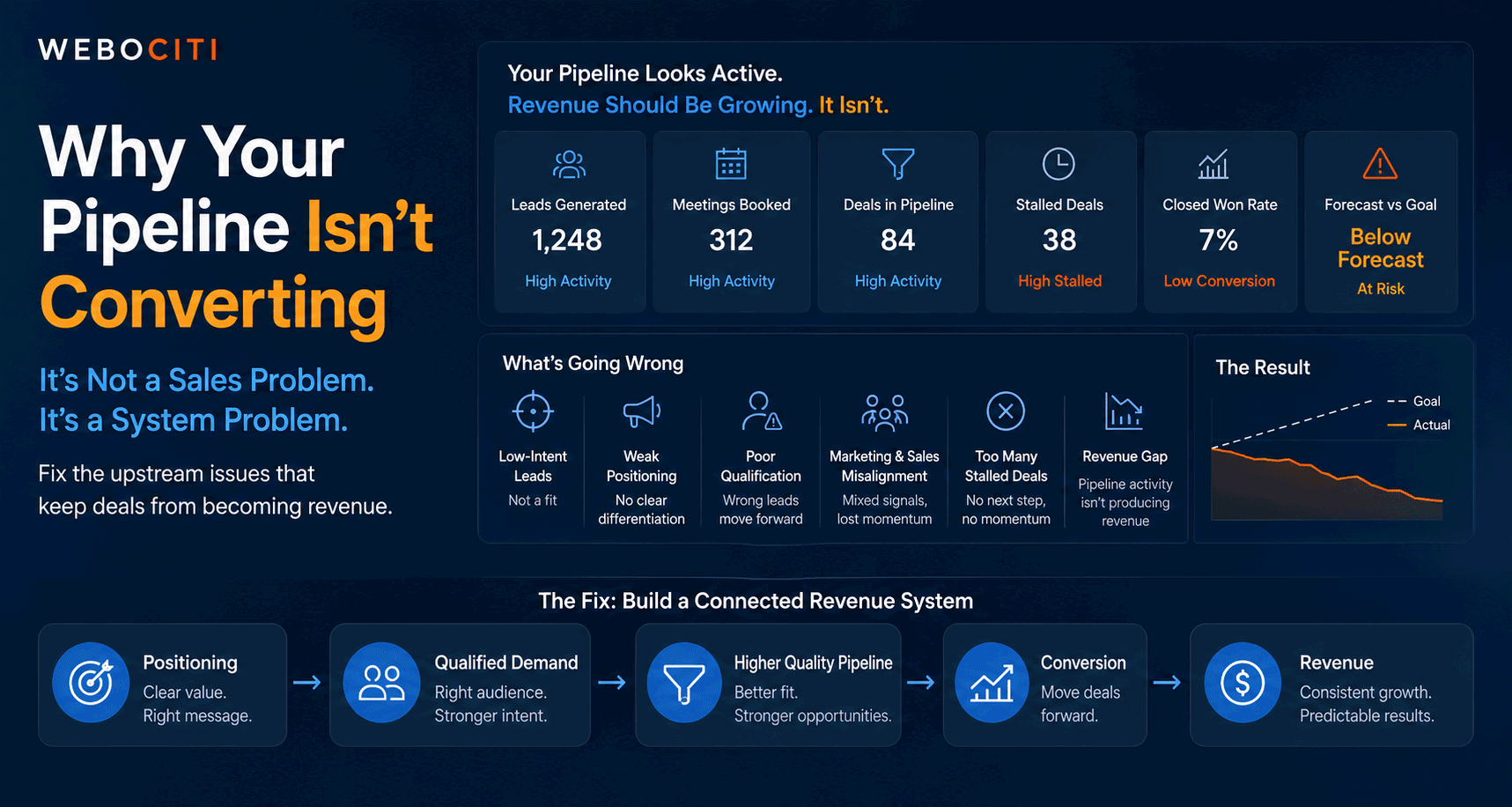
If your pipeline looks full but deals are not moving, read:
Why Your Pipeline Isn’t Converting.
Step 5: Align Marketing and Sales Around Revenue
Marketing and sales cannot operate from different definitions of success.
If marketing is optimizing for lead volume while sales is responsible for revenue, the system will eventually break.
Marketing may celebrate activity while sales questions lead quality. Sales may blame marketing while marketing argues the leads were delivered. Leadership may see motion but not know where the real breakdown is happening.
The fix is alignment around shared revenue outcomes.
Both teams should agree on:
- Who the ideal buyer is
- What makes a lead qualified
- What pipeline stages mean
- What messages are resonating
- Where opportunities are stalling
- Which channels create real revenue
This alignment changes the conversation from blame to diagnosis.
Instead of asking whether marketing produced enough leads or whether sales followed up fast enough, the team can look at the full system and identify where revenue is actually breaking.
That might be a targeting issue. It might be a messaging issue. It might be a qualification issue. It might be a conversion issue.
But until marketing and sales share the same definitions, the business cannot diagnose the problem clearly.
Alignment gives leadership one shared view of growth instead of separate marketing, sales, and revenue opinions.
When marketing and sales are aligned, demand improves, pipeline gets cleaner, and conversion becomes more predictable.
When they are disconnected, revenue becomes a guessing game.
Step 6: Improve Conversion as a System Outcome
Conversion is often treated as a sales issue.
But conversion is usually the result of everything that happened before the sales conversation.
Clear positioning improves conversion. Better-fit demand improves conversion. Stronger qualification improves conversion. Sharper messaging improves conversion. Better handoffs improve conversion.
That is why companies should not look at conversion in isolation.
If close rates are weak, the answer may not be to pressure sales harder. The better question is:
What is happening upstream that makes conversion harder than it should be?
A revenue growth system makes conversion a shared outcome across positioning, marketing, sales, and leadership.
Conversion improves when the full system improves — not when sales is forced to work harder around weak-fit opportunities.
When the right buyers enter the pipeline with clearer expectations, stronger intent, and better alignment around the problem, sales conversations become easier to advance and easier to close.
Step 7: Use Revenue Feedback to Improve the System
A real revenue growth system learns from the market.
Revenue feedback should not stay trapped in reports, sales calls, CRM notes, or leadership meetings. It should be used to improve the entire system.
Look at:
- Which buyers convert fastest?
- Which deals stall?
- Which messages create real engagement?
- Which campaigns produce qualified opportunities?
- Which objections keep appearing?
- Which customer segments produce the most value?
- Which offers lead to real conversations?
This feedback loop is what makes a revenue growth system stronger over time.
Every closed deal, stalled opportunity, lost proposal, and customer conversation contains useful information. The best companies use that information to refine positioning, sharpen messaging, improve qualification, adjust sales conversations, and strengthen the growth strategy.
Without this loop, companies keep repeating the same campaigns, the same sales motions, and the same mistakes without learning from the market.
Revenue feedback should not sit in reports. It should change how the system works.
Revenue feedback turns growth from a linear funnel into a learning system.
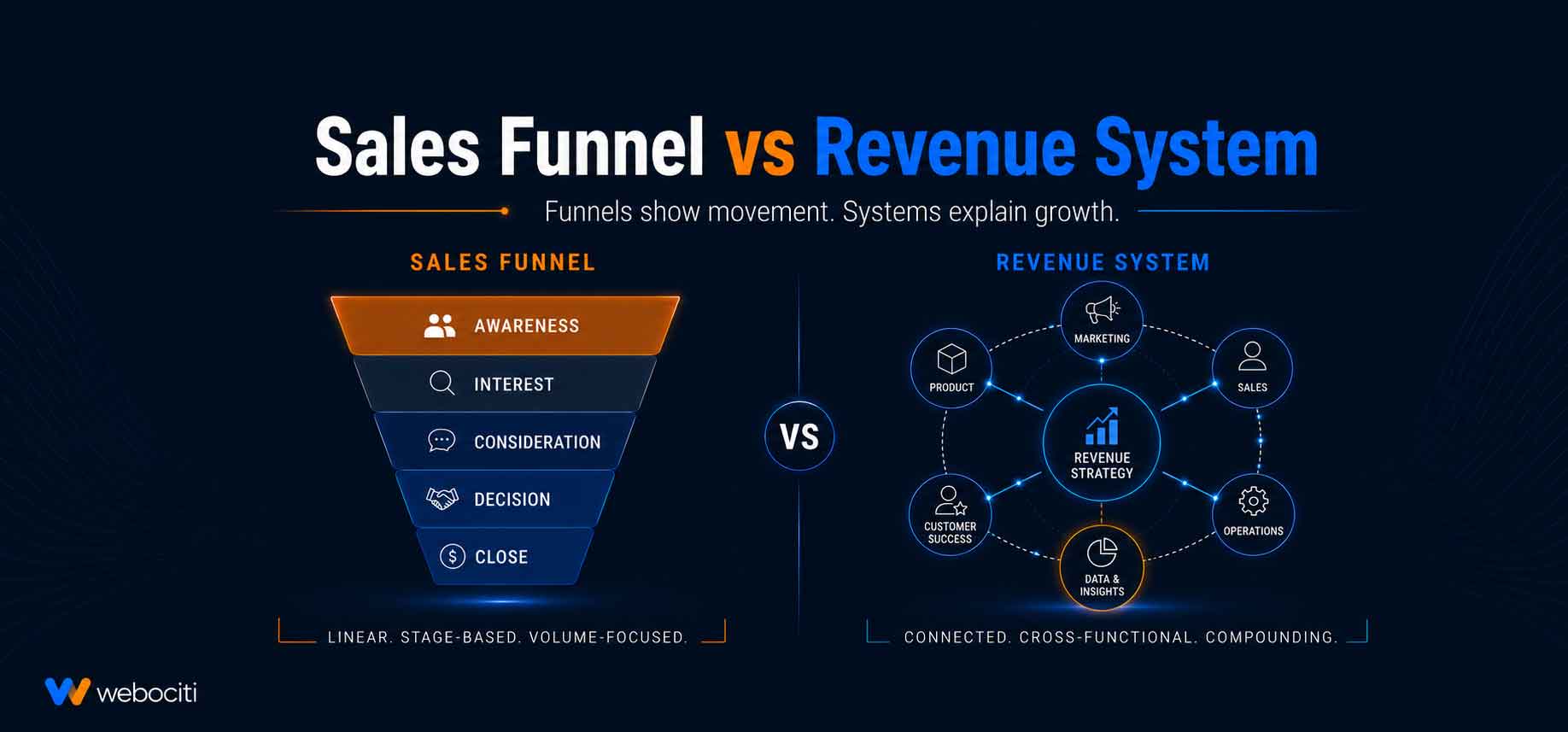
This is also why companies eventually outgrow traditional funnel thinking:
Revenue System vs Sales Funnel.
The Revenue Growth System Framework
A revenue growth system is not a collection of disconnected tactics.
It is a connected operating framework that helps leadership understand how growth is created, where it is breaking, and what needs to be improved.
Viewed as a whole, the system works when each stage feeds the next and revenue feedback improves everything over time.
This is what a revenue growth system looks like:
The Five Parts of a Revenue Growth System
1. Positioning
Clarify who you serve, what problem you solve, why your solution matters, and why buyers should choose you.
2. Demand Generation
Create interest from the right buyers by connecting your message to real business problems, not just promoting services or features.
3. Pipeline Design
Filter, qualify, and advance real opportunities instead of allowing every inquiry to become a sales priority.
4. Conversion
Turn buyer fit into revenue through clear messaging, strong handoffs, defined next steps, and a repeatable sales process.
5. Revenue Feedback
Use market data, sales conversations, stalled deals, wins, losses, and customer insights to improve the system over time.
Each part affects the next.
If positioning is unclear, demand becomes weak. If demand is weak, pipeline quality suffers. If pipeline quality suffers, conversion becomes inconsistent. If conversion is inconsistent, revenue becomes unpredictable.
The framework gives leadership a way to diagnose growth as a system instead of reacting to symptoms one tactic at a time.
How to Know Your Revenue Growth System Is Broken
Once you look at growth through this system, the warning signs become much easier to see.
You may need to redesign your revenue growth system if the business is producing activity, but that activity is not turning into predictable revenue.
- Your marketing is generating leads, but sales says they are not qualified.
- Your pipeline looks full, but deals are not moving.
- Your close rate is inconsistent.
- Your sales cycle is getting longer.
- Your messaging feels unclear or too broad.
- Your team is doing more activity without better results.
- Your revenue forecast is difficult to trust.
- Your growth depends too heavily on individual effort.
- Your marketing and sales teams are not aligned.
These are not random issues. They are symptoms of a system that is creating motion without enough momentum.
The solution is not always another campaign, another salesperson, or another dashboard. The solution is to identify where the system is breaking and fix the connection between positioning, demand, pipeline, conversion, and feedback.
If the business is busy but revenue still feels unpredictable, the problem is usually not effort. It is system design.
A revenue growth system gives leadership a way to diagnose the real constraint instead of reacting to surface-level symptoms.
Why This Matters for Founders and Leadership Teams
For founders, CEOs, and leadership teams, the revenue growth system matters because it changes how growth is managed.
Instead of reacting to symptoms, leadership can diagnose where the system is breaking and make better decisions about strategy, marketing, sales, pipeline, and investment.
- If lead quality is weak, look at positioning and demand.
- If pipeline is inflated, look at qualification and buyer fit.
- If deals stall, look at urgency, messaging, and the sales process.
- If revenue is inconsistent, look at the system, not just the team.
This creates better decisions.
It also makes the business more scalable.
A company with a clear revenue growth system is easier to manage, easier to measure, easier to improve, and more valuable over time.
That matters whether the goal is scaling, improving profitability, attracting investment, preparing for acquisition, or reducing the company’s dependence on individual effort.
A revenue growth system gives leadership a clearer way to manage growth instead of constantly reacting to disconnected marketing and sales activity.
For companies that need senior-level guidance, this is where a structured growth strategy or fractional marketing leadership model can help align the system and keep execution accountable.
Learn more about Webociti’s
Growth Strategy Program
and
Marketing Leadership Program.
The Bottom Line
Growth does not become predictable by doing more of everything.
More campaigns, more leads, more outreach, more pressure, and more reporting will not fix a disconnected revenue system.
Predictable growth comes from alignment.
That means the right positioning, the right buyers, the right demand, the right pipeline, the right conversion process, and the right feedback loop all working together.
When those pieces are disconnected, growth becomes reactive. When they are connected, the business has a system it can measure, improve, and scale.
A revenue growth system is not more activity. It is a better operating system for growth.
That is how companies move from scattered marketing and inconsistent pipeline to clearer strategy, cleaner opportunities, and more predictable revenue.
Continue the Revenue System Series
Explore the related articles in this series to better understand how positioning, qualified demand, pipeline quality, conversion, and revenue leadership work together.
Turn the Framework Into a Growth Plan
If your business needs help connecting strategy, lead generation, marketing leadership, and pipeline performance, Webociti’s growth programs are designed to help you build the system behind sustainable growth.
Build a Better Growth System
You Don’t Need More Growth Activity. You Need a Revenue Growth System.
If your marketing, sales, and pipeline are not working together, it may be time to diagnose the system behind your growth and identify the next move with more clarity.