
07 May Revenue System vs Sales Funnel: Why Growth Needs More Than a Funnel
Most companies still think about growth like a funnel.
Leads enter at the top. Prospects move through the middle. Customers come out at the bottom.
It’s clean. It’s simple. It’s easy to explain.
It’s also incomplete.
A sales funnel can show where buyers are in the process, but it does not explain why growth is inconsistent, why pipeline stalls, why leads don’t convert, or why revenue feels unpredictable.
That’s why companies need more than a funnel.
They need a revenue system.
In Summary
A sales funnel shows the stages buyers move through. A revenue system shows how positioning, demand generation, pipeline design, conversion, and revenue performance work together.
Funnels are useful for tracking movement, but they do not explain why growth breaks. A real revenue system connects the full growth engine so companies can improve pipeline quality, conversion, and revenue predictability.
A funnel tracks movement. A revenue system explains performance.
What a Sales Funnel Actually Does
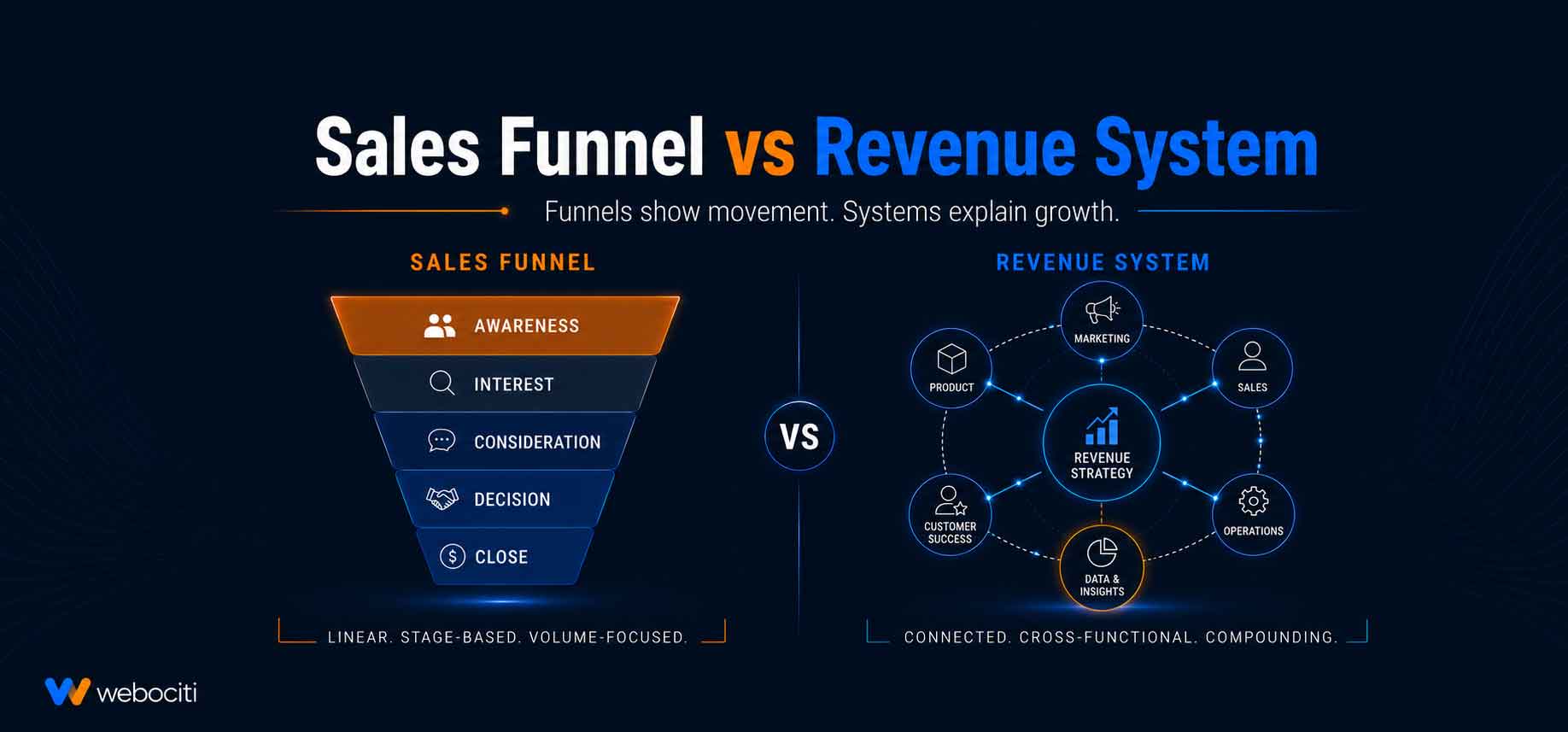
A sales funnel is a visual model that shows how prospects move from awareness to consideration to decision.
At its best, a funnel helps teams understand where buyers are in the customer journey and what actions should happen at each stage.
That is useful.
Funnels can help companies organize marketing campaigns, sales follow-up, lead nurturing, and conversion activity.
But the funnel is only a map of movement.
It does not tell you whether the right buyers are entering the system. It does not tell you whether your positioning is clear. It does not explain why pipeline quality is weak, why deals stall, or why revenue is inconsistent.
That is where funnel thinking starts to break down.
Where the Funnel Model Breaks Down
The funnel model assumes that if you put more leads into the top, more revenue will come out the bottom.
That sounds logical.
But in real companies, growth rarely breaks that cleanly.
Revenue problems usually happen because the pieces around the funnel are disconnected.
- Positioning is unclear, so the wrong buyers enter the funnel.
- Demand generation is misaligned, so marketing creates activity instead of qualified opportunities.
- Pipeline is poorly designed, so low-fit prospects move too far into the sales process.
- Conversion depends on individual effort, instead of a clear, repeatable system.
When that happens, the funnel may still look active.
Leads are coming in. Meetings are happening. The CRM has opportunities. The dashboard looks busy.
But revenue does not follow.
If your sales pipeline looks full but deals are not moving, this is often the deeper issue:
Why Your Pipeline Isn’t Converting.
What a Revenue System Does Differently
A revenue system looks beyond the funnel.
It connects the full growth engine: positioning, demand, pipeline, conversion, and revenue.
Instead of asking, “How do we get more leads?” a revenue system asks better questions:
- Are we attracting the right buyers?
- Is our positioning clear enough to create demand?
- Are marketing and sales aligned around the same buyer and outcome?
- Is our pipeline filtering real opportunities or just collecting activity?
- Do we have a repeatable conversion process?
- Can revenue performance be improved systematically?
That shift matters.
Because predictable growth does not come from simply pushing more volume through a funnel.
It comes from designing the system that makes revenue more consistent.
For a deeper breakdown of that model, read:
What a Real Revenue System Actually Looks Like.
Revenue System vs Sales Funnel: The Real Difference
A sales funnel and a revenue system are not the same thing.
A funnel is a model for tracking buyer progression.
A revenue system is a framework for managing growth performance.
Sales Funnel vs Revenue System
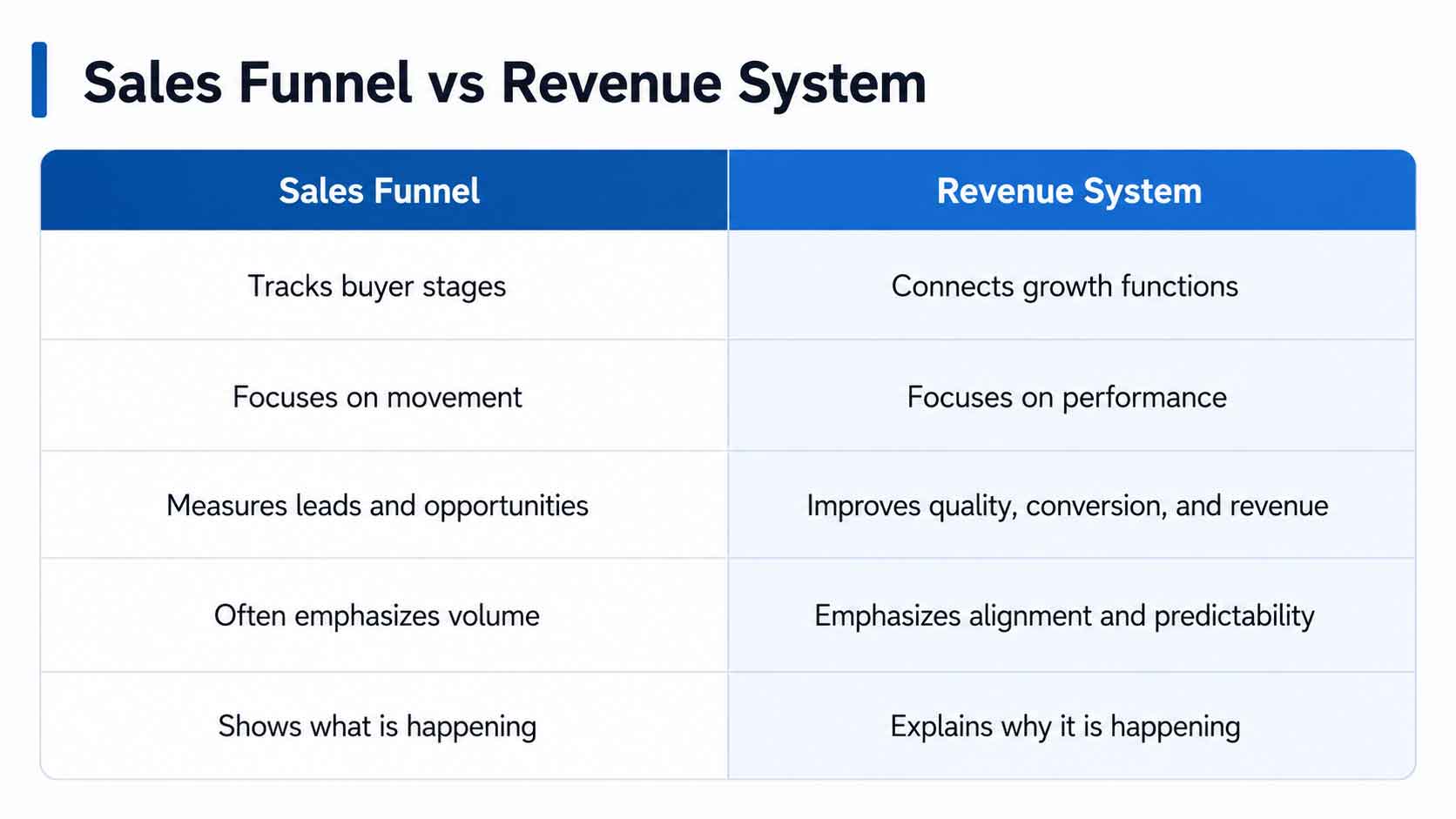
The funnel helps you see where prospects are.
The revenue system helps you understand why prospects are or are not converting.
That is the difference.
Why Companies Outgrow Funnel Thinking
Funnel thinking works when growth is simple.
But as companies scale, the funnel alone becomes too limited.
More channels get added. More people get involved. More campaigns launch. More data enters the system. More handoffs happen between marketing, sales, operations, and leadership.
At that point, growth can no longer be managed as a simple top-to-bottom flow.
It becomes a connected operating system.
That is where many companies start to struggle.
- Marketing generates leads, but sales questions the quality.
- Sales works opportunities, but deals stall late in the process.
- Leadership pushes for more pipeline, but conversion does not improve.
- Teams debate tactics, but no one fixes the underlying system.
The company keeps feeding the funnel.
But the system underneath it is broken.
How to Shift From Funnel Management to Revenue System Design
The goal is not to abandon the funnel.
The goal is to stop treating the funnel as the entire growth strategy.
A better approach is to use the funnel as one part of a larger revenue system.
1. Start With Positioning
Before you fix campaigns, pipeline, or sales execution, clarify who you serve and why your solution matters.
Weak positioning attracts the wrong audience. And once the wrong buyers enter the system, everything downstream becomes harder.
2. Align Demand Generation With Buyer Fit
Demand generation should not be judged by volume alone.
It should be judged by whether it creates interest from the right buyers.
Traffic, impressions, clicks, and leads matter only if they move the company closer to qualified revenue.
3. Redesign the Pipeline Around Quality
A healthy pipeline is not just full.
It is filtered.
Pipeline should help your team separate real opportunities from noise. If low-fit prospects move too far into the process, sales gets buried in conversations that were never likely to convert.
4. Improve Conversion as a System
Conversion is not just a sales skill.
It is the result of everything that came before it.
Clear positioning improves conversion. Better demand improves conversion. Stronger qualification improves conversion. Better handoffs improve conversion.
When conversion is treated as a system outcome, companies stop blaming sales for problems that started upstream.
5. Use Revenue Feedback to Improve the System
Revenue performance should feed back into the system.
Which buyers converted? Which deals stalled? Which messages worked? Which channels produced real opportunities? Which objections slowed down momentum?
That feedback should refine positioning, demand generation, pipeline structure, and conversion strategy.
That is how growth compounds.
The Revenue System Framework
A real revenue system connects five core parts:
Positioning → Demand → Pipeline → Conversion → Revenue
Each stage feeds the next. When one stage breaks, everything downstream becomes inconsistent.
This is why funnel metrics alone can be misleading.
You may have leads, but not the right buyers.
You may have pipeline, but not real opportunities.
You may have meetings, but not momentum.
You may have activity, but not revenue.
The funnel shows movement.
The system explains whether that movement is creating value.
How to Know You Need a Revenue System
You may need to move beyond funnel thinking if:
- Your pipeline looks active, but revenue is inconsistent.
- You are generating leads, but sales says they are not qualified.
- Your team keeps asking for more volume, but close rates are not improving.
- Your sales cycle is getting longer.
- Your messaging feels unclear or too broad.
- You are investing in marketing, but cannot clearly connect it to revenue outcomes.
- Your growth depends too heavily on individual effort instead of a repeatable process.
These are not isolated problems.
They are signs that the system is not aligned.
Why This Matters for Founders and Leadership Teams
For founders, CEOs, and leadership teams, this distinction matters because the wrong diagnosis leads to the wrong fix.
If you think the funnel is the problem, you will usually try to add more activity.
- More campaigns
- More leads
- More outreach
- More sales pressure
- More reporting
But if the real problem is the system, more activity only creates more noise.
You do not fix a broken revenue system by pushing harder.
You fix it by redesigning how growth works.
The Bottom Line
A sales funnel is still useful.
But it is not enough.
Funnels help companies track buyer movement. Revenue systems help companies understand and improve growth performance.
If your company is generating activity but revenue still feels inconsistent, the funnel may not be the issue.
The system behind the funnel may be broken.
And until that system is fixed, more leads, more campaigns, and more pressure will not create predictable growth.
Growth needs more than a funnel.
It needs a system.
Related Insights on Revenue Growth
Your Funnel May Not Be the Problem. Your Revenue System Might Be.
If growth feels inconsistent, the answer is not always more leads. It may be time to diagnose the system behind your revenue.

Joe Mediate
Fractional CMO & Growth Strategist
Joe helps companies build more predictable growth by connecting positioning, demand generation, pipeline, conversion, and execution into one accountable revenue system.
If your pipeline is not converting, it may not be a sales problem. It may be a system problem.
A serial entrepreneur and experienced growth operator, Joe has launched and scaled multiple companies, helped businesses secure growth capital, and led a technology company from concept through acquisition. His experience spans marketing strategy, revenue systems, and operational growth.
Joe was nominated for Ernst & Young’s Entrepreneur of the Year award and served as an instructor and program mentor at The Wharton School.
Diagnose Your Revenue System →
Learn more on the About page or connect with Joe on LinkedIn.