

06 May What Is a Revenue System? Build Predictable Growth
Revenue doesn’t break in one place. It breaks across a system.
Most companies do not struggle because one campaign failed or one sales rep underperformed. They struggle because positioning, demand generation, pipeline quality, and conversion are not working together.
That is not a marketing problem. It is a revenue system problem.
In Summary
A real revenue system connects positioning, demand generation, pipeline design, and conversion into one cohesive growth engine.
When those elements are disconnected, growth becomes inconsistent. When they are aligned, revenue becomes more predictable.
At Webociti, we help founders, CEOs, and leadership teams identify where growth is breaking down across positioning, demand generation, pipeline quality, and conversion, then build the structure needed to create more predictable revenue.
This is how a real revenue system actually works:
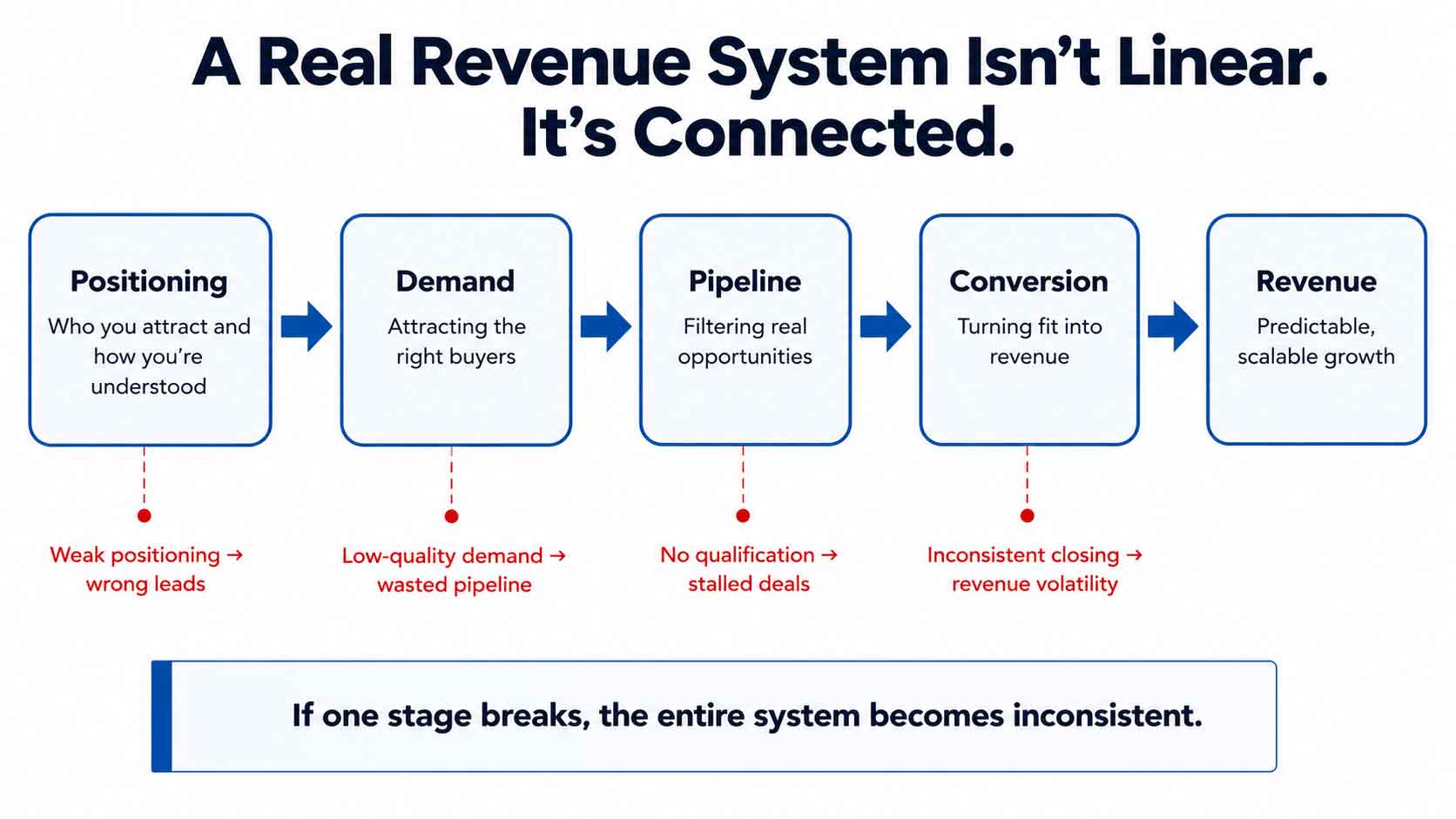
Most companies are not missing activity. They are missing alignment.
If one stage breaks, everything downstream becomes inconsistent.
What a Revenue System Is Not
A revenue system is not a CRM.
It is not a sales team. It is not a marketing campaign.
It is not a dashboard full of metrics that do not connect.
Most companies confuse tools and activity for a system. They invest in platforms, hire more people, and increase output, but nothing fundamentally changes.
Because the system was never designed.
If your pipeline looks active but opportunities are not converting into revenue, start here:
Why Your Pipeline Isn’t Converting
The Four Operating Layers of a Revenue System
A real revenue system is built across four connected operating layers. Revenue is the outcome when those layers work together.
- Positioning defines who you attract and how your value is understood.
- Demand Generation creates interest from the right buyers.
- Pipeline Design filters and structures real opportunities.
- Conversion turns qualified opportunities into revenue.
Each layer feeds the next. Break one, and the entire system becomes unstable.
The Revenue System, Simplified
Positioning → Demand → Pipeline → Conversion → Revenue
1. Positioning: The Starting Point of Revenue
Positioning determines who you attract and how buyers interpret your value.
Most companies try to fix this with better sales execution. That is backwards.
Strong positioning aligns your message with real buyer problems and creates clarity before the sales conversation ever begins.
2. Demand Generation: Attracting the Right Buyers
Demand generation is not about volume. It is about relevance.
Most companies generate traffic, but not qualified demand. The result is activity without outcomes.
When demand aligns with positioning, you do not just get more leads. You get the right leads, buyers who are already a fit.
If your marketing is producing activity but not qualified opportunities, read:
Why Your Marketing Isn’t Generating Qualified Leads
3. Pipeline Design: Filtering for Real Opportunities
Your pipeline should not be a holding area for conversations.
It should be a structured system that qualifies, filters, and advances opportunities based on fit.
If everything enters your pipeline, nothing moves through it efficiently.
If your pipeline is full but deals are not closing, the problem may not be sales execution. It may be
how the pipeline was designed.
4. Conversion: Turning Fit Into Revenue
Conversion is where alignment is tested.
If positioning, demand, and pipeline are working, conversion becomes more predictable.
If they are not, conversion becomes inconsistent, and sales gets blamed.
But sales operates at the end of the system, not the beginning.
What Most Companies Actually Have
-
Disconnected marketing campaigns
Activity increases, but it is not tied to a clear revenue outcome. -
Unqualified leads entering the pipeline
Sales spends time filtering instead of closing. -
Sales teams chasing low-fit opportunities
Effort is wasted on deals that were never going to convert. -
Metrics that measure activity instead of outcomes
Dashboards look strong, but revenue does not follow.
Everything looks active. Nothing compounds.
This is exactly why pipelines feel full but fail to convert:
Why Your Pipeline Isn’t Converting
How Revenue Systems Break
- Positioning attracts the wrong audience
- Demand generation produces low-quality leads
- Pipeline lacks qualification structure
- Conversion depends on individual performance
This creates inconsistency. And inconsistency kills growth.
What Changes When the System Works
- Leads are more qualified
- Sales cycles shorten
- Close rates improve
- Revenue becomes more consistent
This is not about working harder. It is about fixing the system.
For a deeper look at how to build this kind of structure, read:
How to Build a Revenue Growth System
How To Know Your Revenue System Is Broken
- High pipeline volume with low close rates
- Inconsistent revenue performance
- Marketing and sales misalignment
- Constant pressure to generate more leads
- Unclear messaging that fails to differentiate
- Revenue forecasts that are unreliable or difficult to defend
If you are still thinking about marketing, sales, and pipeline as separate functions, you are not managing growth. You are reacting to it.
Who Needs a Revenue System?
A revenue system becomes necessary when growth can no longer depend on disconnected campaigns, individual sales performance, or founder-led relationships.
It is especially valuable for:
- Founder-led companies that have outgrown an informal approach to growth
- Businesses generating leads but struggling to convert them into qualified opportunities
- Leadership teams with disconnected marketing and sales functions
- Companies with active pipelines but inconsistent revenue
- Organizations that need senior revenue leadership but are not ready for a full-time CRO
The common problem is not a lack of activity. It is the absence of one accountable system connecting positioning, demand, pipeline, conversion, and revenue.
The Bottom Line
Revenue does not come from effort alone. It comes from alignment.
If your system is broken, more activity will not fix it.
Most companies do not need more campaigns, more dashboards, or more disconnected sales activity.
They need a better revenue system.
Most Companies Don’t Need a VP of Sales. They Need a Revenue System.
Still thinking in funnels instead of systems?
Revenue System vs Sales Funnel
If your company needs senior-level guidance to diagnose and fix these gaps, learn more about
Webociti’s revenue systems approach.
Revenue System FAQs
What is a revenue system?
A revenue system is the connected structure that aligns positioning, demand generation, pipeline design, and conversion around a shared revenue outcome. It helps leadership identify where growth is working, where it is breaking, and what should improve next.
What are the main components of a revenue system?
The core components are positioning, qualified demand generation, pipeline design, conversion, and revenue measurement. Each component should support the next rather than operate as a separate function.
How is a revenue system different from a sales funnel?
A sales funnel usually tracks how prospects move toward a purchase. A revenue system is broader. It connects the decisions and operating functions that determine who enters the funnel, how opportunities are qualified, why deals advance, and how revenue performance improves over time.
How do you build predictable revenue?
Predictable revenue begins with clear positioning, a well-defined ideal buyer, qualified demand, consistent pipeline standards, and a conversion process that can be measured and improved. Predictability comes from alignment across the system, not from increasing activity in one department.
Who is responsible for a company’s revenue system?
Responsibility typically sits with the CEO, CRO, or another senior growth leader who can align marketing, sales, pipeline management, and conversion around shared revenue outcomes.
When should a company consider a fractional CRO?
A fractional CRO can help when revenue is inconsistent, marketing and sales are disconnected, pipeline quality is weak, or the company needs senior revenue leadership without hiring a full-time executive.
Find Where Your Revenue System Is Breaking
Identify the gaps across positioning, demand, pipeline, and conversion that are making growth unpredictable.

Joe Mediate
Fractional CMO & Growth Strategist
Joe helps companies build more predictable growth by connecting positioning, demand generation, pipeline, conversion, and execution into one accountable revenue system.
If your pipeline is not converting, it may not be a sales problem. It may be a system problem.
A serial entrepreneur and experienced growth operator, Joe has launched and scaled multiple companies, helped businesses secure growth capital, and led a technology company from concept through acquisition. His experience spans marketing strategy, revenue systems, and operational growth.
Joe was nominated for Ernst & Young’s Entrepreneur of the Year award and served as an instructor and program mentor at The Wharton School.
Diagnose Your Revenue System →
Learn more on the About page or connect with Joe on LinkedIn.