Growth does not become predictable because you do more marketing.

It becomes predictable when the pieces behind revenue are connected.

Most companies are not short on activity. They have campaigns running, salespeople following up, CRM data being tracked, and reports being reviewed.

But activity alone does not create scalable growth.

If positioning is unclear, demand quality suffers. If demand quality suffers, the pipeline fills with noise. If the pipeline is weak, conversion becomes inconsistent. If conversion is inconsistent, revenue becomes unpredictable.

That is why companies need more than marketing tactics, sales pressure, or another dashboard.

They need a revenue growth system.

In Summary

A revenue growth system connects positioning, demand generation, pipeline design, conversion, and revenue feedback into one operating framework.

Instead of treating marketing, sales, and revenue as separate functions, a revenue growth system aligns them around the same buyer, the same message, the same pipeline, and the same growth outcomes.

The goal is not more activity. The goal is better-fit opportunities, stronger conversion, and more predictable revenue.

Predictable revenue is not built from disconnected tactics. It is built from a connected system.

What Is a Revenue Growth System?

A revenue growth system is the structure that connects how a company attracts, qualifies, advances, converts, and learns from buyers.

It is not one campaign. It is not one sales process. It is not one CRM dashboard.

It is the operating system behind growth.

A strong revenue growth system connects five core parts:

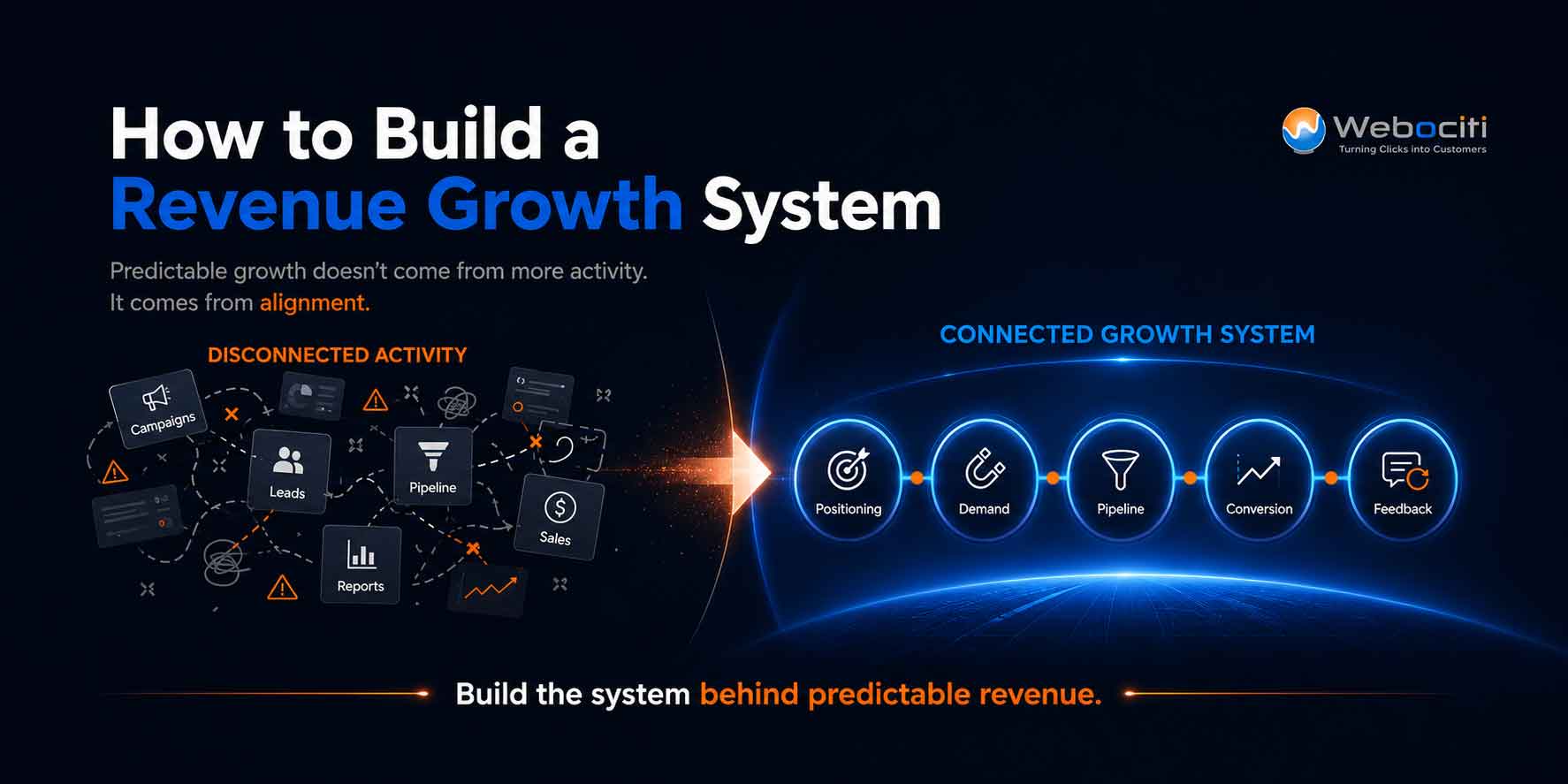
Positioning → Demand → Pipeline → Conversion → Revenue Feedback

Each stage feeds the next. When one stage is weak, everything downstream becomes harder.

This is the difference between companies that create activity and companies that create momentum.

Activity is easy to generate.

Momentum requires alignment.

For a deeper explanation of the framework, read:
What a Real Revenue System Actually Looks Like.

Why Most Growth Systems Break

Most companies do not intentionally design their revenue system.

They add pieces over time.

  • A website gets built.
  • Marketing campaigns get launched.
  • Sales tools get added.
  • CRM stages get created.
  • Reporting dashboards get reviewed.
  • New people join the team.

Each piece may make sense on its own.

But if those pieces are not connected, the company ends up with growth activity instead of a growth system.

That is where problems start.

  • Marketing attracts the wrong audience.
  • Sales questions lead quality.
  • Pipeline looks active but does not convert.
  • Leadership pushes for more leads.
  • Revenue remains inconsistent.
Most growth problems are not caused by one broken tactic. They are caused by disconnected parts of the revenue system.

If your marketing is creating activity but not qualified opportunities, this is likely part of the problem:
Why Your Marketing Isn’t Generating Qualified Leads.

Step 1: Start With Positioning

Every revenue growth system starts with positioning.

Positioning defines who you serve, what problem you solve, why your solution matters, and why buyers should choose you over another option.

If positioning is weak, everything downstream becomes harder.

  • Marketing becomes too broad.
  • Content attracts the wrong audience.
  • Sales conversations require too much explanation.
  • Pipeline quality suffers.
  • Conversion becomes inconsistent.

Strong positioning creates clarity before the buyer ever talks to sales.

It answers the questions buyers are already asking:

  • Is this for me?
  • Do they understand my problem?
  • Can they solve the issue I care about?
  • Why should I act now?
  • Why should I choose this company?

Without those answers, marketing becomes noise and sales becomes education.

Weak positioning attracts weak-fit opportunities. Strong positioning creates the foundation for qualified demand.

Step 2: Define the Right Buyer

A revenue growth system cannot work if the company is unclear about who it is trying to attract.

Many companies define their market too broadly.

They focus on everyone who could buy instead of the buyers most likely to convert, stay, grow, and create value.

That is a mistake.

The right buyer should be defined by more than basic demographics or company size.

Look at:

  • Fit — Does this buyer match your ideal customer profile?
  • Need — Do they have a real problem you can solve?
  • Urgency — Is there a reason to act?
  • Authority — Can they influence or make a decision?
  • Value — Is the opportunity worth pursuing?
  • Conversion potential — Can this buyer realistically move through your process?

This step matters because the wrong buyer can make every part of the system look weaker than it actually is.

A poor-fit lead may engage with your marketing, book a call, and enter the pipeline, but that does not mean they are a real revenue opportunity.

If they lack urgency, budget, authority, need, or strategic fit, they will slow the system down. Sales will spend more time educating, qualifying, and chasing instead of advancing real opportunities.

The goal is not to attract everyone who could possibly buy.

The goal is to attract the buyers most likely to understand the value, move through the process, and convert into profitable revenue.

The more clearly you define the right buyer, the easier it becomes to build the rest of the system.

Your campaigns improve. Your messaging sharpens. Your pipeline gets cleaner. Your sales team spends more time with better-fit opportunities.

Step 3: Build Demand Around Buyer Problems

Demand generation should not start with what you want to sell.

It should start with what the buyer needs to solve.

Many companies build marketing around services, features, or internal priorities.

But buyers respond to problems, outcomes, risks, and opportunities.

A strong revenue growth system turns positioning into demand by connecting the company’s message to real buyer pain.

That means your content, ads, email campaigns, social posts, landing pages, and offers should all answer one question:

Why should the right buyer care now?

If your marketing creates traffic, clicks, and form fills but not qualified opportunities, you are not building demand. You are building activity.

The goal is not attention alone.

The goal is qualified demand.

Demand generation should create interest from the right buyers, not just more movement at the top of the funnel.

Step 4: Design the Pipeline Around Quality

A pipeline should not be a dumping ground for every inquiry.

It should be a structured system for identifying, qualifying, advancing, and converting real opportunities.

This is where many companies lose control of growth.

They treat every lead like an opportunity. They allow low-fit prospects to move too far into the process. They measure pipeline volume instead of pipeline quality.

The result is predictable:

  • Sales gets buried in weak conversations.
  • Deals stall.
  • Forecasts become unreliable.
  • Leadership sees pipeline but not revenue.

A strong revenue growth system defines what belongs in the pipeline and what does not.

That requires clear qualification criteria:

  • Who is a real fit?
  • What problem are they trying to solve?
  • What stage of awareness are they in?
  • What action should happen next?
  • What disqualifies an opportunity?
  • What signals real buying intent?

A quality-focused pipeline gives your team a cleaner view of what is real.

Instead of measuring success by the number of opportunities in the CRM, the company can evaluate whether those opportunities match the buyer profile, have a clear business need, and show enough momentum to justify continued sales effort.

This changes how the team manages growth.

Sales can focus on better conversations. Marketing can see which sources create real opportunities. Leadership gets a more accurate view of future revenue.

Pipeline quality matters because a full pipeline does not always mean a healthy pipeline.

If your pipeline looks full but deals are not moving, read:
Why Your Pipeline Isn’t Converting.

Step 5: Align Marketing and Sales Around Revenue

Marketing and sales cannot operate from different definitions of success.

If marketing is optimizing for leads and sales is responsible for revenue, the system will eventually break.

Marketing may celebrate volume while sales complains about quality.

Sales may blame marketing while marketing argues the leads were delivered.

Leadership may see activity but not know where the real breakdown is happening.

The fix is alignment around shared revenue outcomes.

Both teams should agree on:

  • Who the ideal buyer is
  • What makes a lead qualified
  • What pipeline stages mean
  • What messages are resonating
  • Where opportunities are stalling
  • Which channels create real revenue

This alignment changes the conversation from blame to diagnosis.

Instead of asking whether marketing produced enough leads or whether sales followed up fast enough, the team can look at the full system and identify where revenue is actually breaking.

That might be a targeting issue. It might be a messaging issue. It might be a qualification issue. It might be a conversion issue.

But until marketing and sales share the same definitions, the business cannot diagnose the problem clearly.

Alignment gives the company one shared view of growth instead of separate marketing, sales, and leadership opinions.

When marketing and sales are aligned, demand improves, pipeline gets cleaner, and conversion becomes more predictable.

When they are disconnected, revenue becomes a guessing game.

Step 6: Improve Conversion as a System Outcome

Conversion is often treated as a sales issue.

But conversion is usually the result of everything that happened before the sales conversation.

Clear positioning improves conversion.

Better-fit demand improves conversion.

Stronger qualification improves conversion.

Sharper messaging improves conversion.

Better handoffs improve conversion.

That is why companies should not look at conversion in isolation.

If close rates are weak, the answer may not be to pressure sales harder.

The better question is:

What is happening upstream that makes conversion harder than it should be?

A revenue growth system makes conversion a shared outcome across positioning, marketing, sales, and leadership.

Step 7: Use Revenue Feedback to Improve the System

A real revenue growth system learns from the market.

Revenue feedback should not stay trapped in reports or sales calls.

It should be used to improve the entire system.

Look at:

  • Which buyers convert fastest?
  • Which deals stall?
  • Which messages create real engagement?
  • Which campaigns produce qualified opportunities?
  • Which objections keep appearing?
  • Which customer segments produce the most value?
  • Which offers lead to real conversations?

This feedback loop is what makes a revenue growth system stronger over time.

Every closed deal, stalled opportunity, lost proposal, and customer conversation contains useful information.

The best companies use that information to refine their positioning, sharpen their messaging, improve qualification, and adjust their growth strategy.

Without this loop, companies keep repeating the same campaigns, the same sales motions, and the same mistakes without learning from the market.

Revenue feedback should not sit in reports. It should change how the system works.

That feedback should refine positioning, demand generation, pipeline qualification, sales messaging, and conversion strategy so the system gets stronger over time.

Revenue feedback turns growth from a linear funnel into a learning system.

This is also why companies eventually outgrow traditional funnel thinking:
Revenue System vs Sales Funnel.

The Revenue Growth System Framework

A revenue growth system is not a collection of disconnected tactics.

It is a connected operating framework that helps leadership understand how growth is created, where it is breaking, and what needs to be improved.

Viewed as a whole, the system works when each stage feeds the next and revenue feedback improves everything over time.

This is what a revenue growth system looks like:

Revenue growth system framework showing positioning, demand generation, pipeline design, conversion, and revenue feedback connected as one growth system

1. Positioning

Clarify who you serve, what problem you solve, why your solution matters, and why buyers should choose you.

2. Demand Generation

Create interest from the right buyers by connecting your message to real business problems, not just promoting services or features.

3. Pipeline Design

Filter, qualify, and advance real opportunities instead of allowing every inquiry to become a sales priority.

4. Conversion

Turn buyer fit into revenue through clear messaging, strong handoffs, defined next steps, and a repeatable sales process.

5. Revenue Feedback

Use market data, sales conversations, stalled deals, wins, losses, and customer insights to improve the system over time.

Each part affects the next.

If positioning is unclear, demand becomes weak. If demand is weak, pipeline quality suffers. If pipeline quality suffers, conversion becomes inconsistent. If conversion is inconsistent, revenue becomes unpredictable.

That is why this framework matters.

It gives leadership a way to diagnose growth as a system instead of reacting to symptoms one tactic at a time.

How to Know Your Revenue Growth System Is Broken

Once you look at growth through this system, the warning signs become much easier to see.

You may need to redesign your revenue growth system if the business is producing activity, but the activity is not turning into predictable revenue.

  • Your marketing is generating leads, but sales says they are not qualified.
  • Your pipeline looks full, but deals are not moving.
  • Your close rate is inconsistent.
  • Your sales cycle is getting longer.
  • Your messaging feels unclear or too broad.
  • Your team is doing more activity without better results.
  • Your revenue forecast is difficult to trust.
  • Your growth depends too heavily on individual effort.
  • Your marketing and sales teams are not aligned.

These are not random issues. They are symptoms of a system that is creating motion without enough momentum.

The solution is not always another campaign, another salesperson, or another dashboard. The solution is to identify where the system is breaking and fix the connection between positioning, demand, pipeline, conversion, and feedback.

Why This Matters for Founders and Leadership Teams

For founders, CEOs, and leadership teams, the revenue growth system matters because it changes how growth is managed.

Instead of reacting to symptoms, leadership can diagnose where the system is breaking.

  • If lead quality is weak, look at positioning and demand.
  • If pipeline is inflated, look at qualification.
  • If deals stall, look at buyer fit, urgency, and sales process.
  • If revenue is inconsistent, look at the system, not just the team.

This creates better decisions.

It also makes the business more scalable.

A company with a clear revenue growth system is easier to manage, easier to measure, easier to improve, and more valuable over time.

That matters whether the goal is scaling, improving profitability, attracting investment, or preparing for a future acquisition.

The Bottom Line

Growth does not become predictable by doing more of everything.

More campaigns, more leads, more outreach, more pressure, and more reporting will not fix a disconnected revenue system.

Predictable growth comes from alignment.

That means the right positioning, the right buyers, the right demand, the right pipeline, the right conversion process, and the right feedback loop all working together.

When those pieces are disconnected, growth becomes reactive. When they are connected, the business has a system it can measure, improve, and scale.

That is how you build a revenue growth system.

Not more activity.

A better system.

You Don’t Need More Growth Activity. You Need a Revenue Growth System.

If your marketing, sales, and pipeline are not working together, it may be time to diagnose the system behind your growth.


Diagnose Your Revenue System →

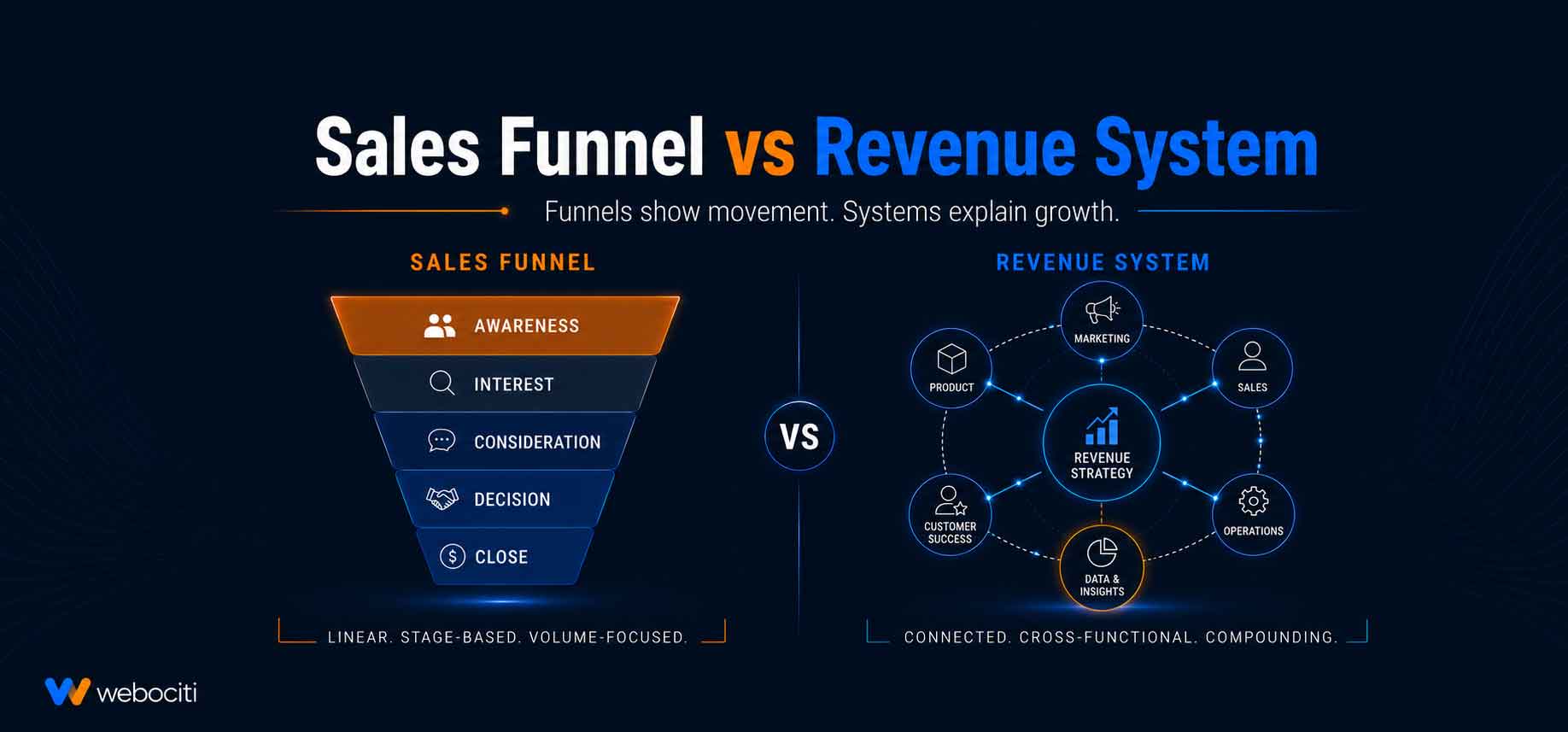
Most companies still think about growth like a funnel.

Leads enter at the top. Prospects move through the middle. Customers come out at the bottom.

It’s clean. It’s simple. It’s easy to explain.

It’s also incomplete.

A sales funnel can show where buyers are in the process, but it does not explain why growth is inconsistent, why pipeline stalls, why leads don’t convert, or why revenue feels unpredictable.

That’s why companies need more than a funnel.

They need a revenue system.

In Summary

A sales funnel shows the stages buyers move through. A revenue system shows how positioning, demand generation, pipeline design, conversion, and revenue performance work together.

Funnels are useful for tracking movement, but they do not explain why growth breaks. A real revenue system connects the full growth engine so companies can improve pipeline quality, conversion, and revenue predictability.

A funnel tracks movement. A revenue system explains performance.

What a Sales Funnel Actually Does

A sales funnel is a visual model that shows how prospects move from awareness to consideration to decision.

At its best, a funnel helps teams understand where buyers are in the customer journey and what actions should happen at each stage.

That is useful.

Funnels can help companies organize marketing campaigns, sales follow-up, lead nurturing, and conversion activity.

But the funnel is only a map of movement.

It does not tell you whether the right buyers are entering the system. It does not tell you whether your positioning is clear. It does not explain why pipeline quality is weak, why deals stall, or why revenue is inconsistent.

That is where funnel thinking starts to break down.

Where the Funnel Model Breaks Down

The funnel model assumes that if you put more leads into the top, more revenue will come out the bottom.

That sounds logical.

But in real companies, growth rarely breaks that cleanly.

Revenue problems usually happen because the pieces around the funnel are disconnected.

  • Positioning is unclear, so the wrong buyers enter the funnel.
  • Demand generation is misaligned, so marketing creates activity instead of qualified opportunities.
  • Pipeline is poorly designed, so low-fit prospects move too far into the sales process.
  • Conversion depends on individual effort, instead of a clear, repeatable system.

When that happens, the funnel may still look active.

Leads are coming in. Meetings are happening. The CRM has opportunities. The dashboard looks busy.

But revenue does not follow.

That is not a funnel problem. It is a system problem.

If your sales pipeline looks full but deals are not moving, this is often the deeper issue:
Why Your Pipeline Isn’t Converting.

What a Revenue System Does Differently

A revenue system looks beyond the funnel.

It connects the full growth engine: positioning, demand, pipeline, conversion, and revenue.

Instead of asking, “How do we get more leads?” a revenue system asks better questions:

  • Are we attracting the right buyers?
  • Is our positioning clear enough to create demand?
  • Are marketing and sales aligned around the same buyer and outcome?
  • Is our pipeline filtering real opportunities or just collecting activity?
  • Do we have a repeatable conversion process?
  • Can revenue performance be improved systematically?

That shift matters.

Because predictable growth does not come from simply pushing more volume through a funnel.

It comes from designing the system that makes revenue more consistent.

For a deeper breakdown of that model, read:
What a Real Revenue System Actually Looks Like.

Revenue System vs Sales Funnel: The Real Difference

A sales funnel and a revenue system are not the same thing.

A funnel is a model for tracking buyer progression.

A revenue system is a framework for managing growth performance.

Sales Funnel vs Revenue System

Sales Funnel vs Revenue System comparison showing a linear sales funnel beside a connected revenue system framework

The funnel helps you see where prospects are.

The revenue system helps you understand why prospects are or are not converting.

That is the difference.

Why Companies Outgrow Funnel Thinking

Funnel thinking works when growth is simple.

But as companies scale, the funnel alone becomes too limited.

More channels get added. More people get involved. More campaigns launch. More data enters the system. More handoffs happen between marketing, sales, operations, and leadership.

At that point, growth can no longer be managed as a simple top-to-bottom flow.

It becomes a connected operating system.

That is where many companies start to struggle.

  • Marketing generates leads, but sales questions the quality.
  • Sales works opportunities, but deals stall late in the process.
  • Leadership pushes for more pipeline, but conversion does not improve.
  • Teams debate tactics, but no one fixes the underlying system.

The company keeps feeding the funnel.

But the system underneath it is broken.

Most companies do not outgrow marketing. They outgrow disconnected growth activity.

How to Shift From Funnel Management to Revenue System Design

The goal is not to abandon the funnel.

The goal is to stop treating the funnel as the entire growth strategy.

A better approach is to use the funnel as one part of a larger revenue system.

1. Start With Positioning

Before you fix campaigns, pipeline, or sales execution, clarify who you serve and why your solution matters.

Weak positioning attracts the wrong audience. And once the wrong buyers enter the system, everything downstream becomes harder.

2. Align Demand Generation With Buyer Fit

Demand generation should not be judged by volume alone.

It should be judged by whether it creates interest from the right buyers.

Traffic, impressions, clicks, and leads matter only if they move the company closer to qualified revenue.

3. Redesign the Pipeline Around Quality

A healthy pipeline is not just full.

It is filtered.

Pipeline should help your team separate real opportunities from noise. If low-fit prospects move too far into the process, sales gets buried in conversations that were never likely to convert.

4. Improve Conversion as a System

Conversion is not just a sales skill.

It is the result of everything that came before it.

Clear positioning improves conversion. Better demand improves conversion. Stronger qualification improves conversion. Better handoffs improve conversion.

When conversion is treated as a system outcome, companies stop blaming sales for problems that started upstream.

5. Use Revenue Feedback to Improve the System

Revenue performance should feed back into the system.

Which buyers converted? Which deals stalled? Which messages worked? Which channels produced real opportunities? Which objections slowed down momentum?

That feedback should refine positioning, demand generation, pipeline structure, and conversion strategy.

That is how growth compounds.

The Revenue System Framework

A real revenue system connects five core parts:

Positioning → Demand → Pipeline → Conversion → Revenue

Each stage feeds the next. When one stage breaks, everything downstream becomes inconsistent.

This is why funnel metrics alone can be misleading.

You may have leads, but not the right buyers.

You may have pipeline, but not real opportunities.

You may have meetings, but not momentum.

You may have activity, but not revenue.

The funnel shows movement.

The system explains whether that movement is creating value.

How to Know You Need a Revenue System

You may need to move beyond funnel thinking if:

  • Your pipeline looks active, but revenue is inconsistent.
  • You are generating leads, but sales says they are not qualified.
  • Your team keeps asking for more volume, but close rates are not improving.
  • Your sales cycle is getting longer.
  • Your messaging feels unclear or too broad.
  • You are investing in marketing, but cannot clearly connect it to revenue outcomes.
  • Your growth depends too heavily on individual effort instead of a repeatable process.

These are not isolated problems.

They are signs that the system is not aligned.

Why This Matters for Founders and Leadership Teams

For founders, CEOs, and leadership teams, this distinction matters because the wrong diagnosis leads to the wrong fix.

If you think the funnel is the problem, you will usually try to add more activity.

  • More campaigns
  • More leads
  • More outreach
  • More sales pressure
  • More reporting

But if the real problem is the system, more activity only creates more noise.

You do not fix a broken revenue system by pushing harder.

You fix it by redesigning how growth works.

The Bottom Line

A sales funnel is still useful.

But it is not enough.

Funnels help companies track buyer movement. Revenue systems help companies understand and improve growth performance.

If your company is generating activity but revenue still feels inconsistent, the funnel may not be the issue.

The system behind the funnel may be broken.

And until that system is fixed, more leads, more campaigns, and more pressure will not create predictable growth.

Growth needs more than a funnel.

It needs a system.

Your Funnel May Not Be the Problem. Your Revenue System Might Be.

If growth feels inconsistent, the answer is not always more leads. It may be time to diagnose the system behind your revenue.


Diagnose Your Revenue System →

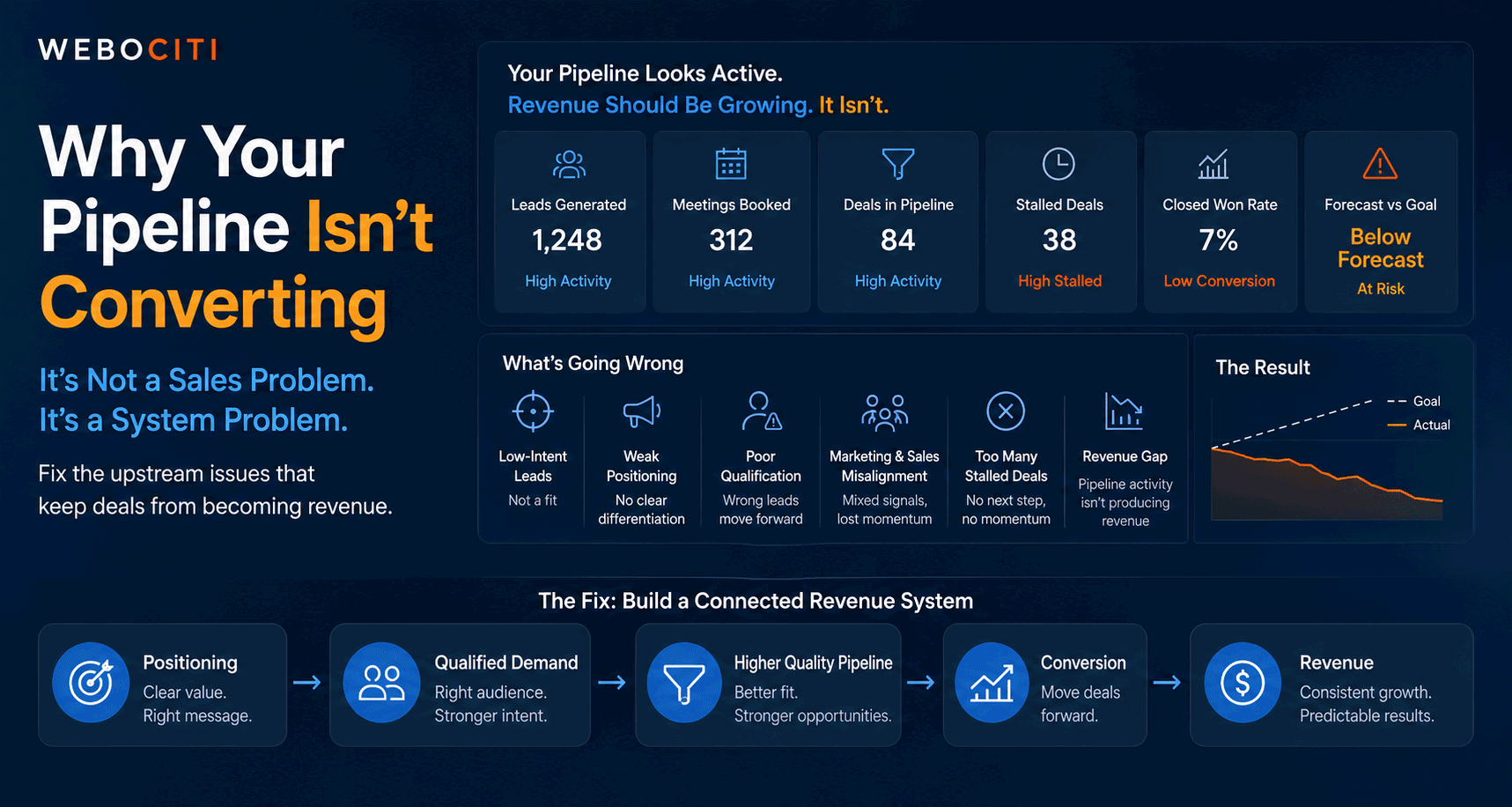
Your pipeline looks active. Revenue should be growing. It isn’t.

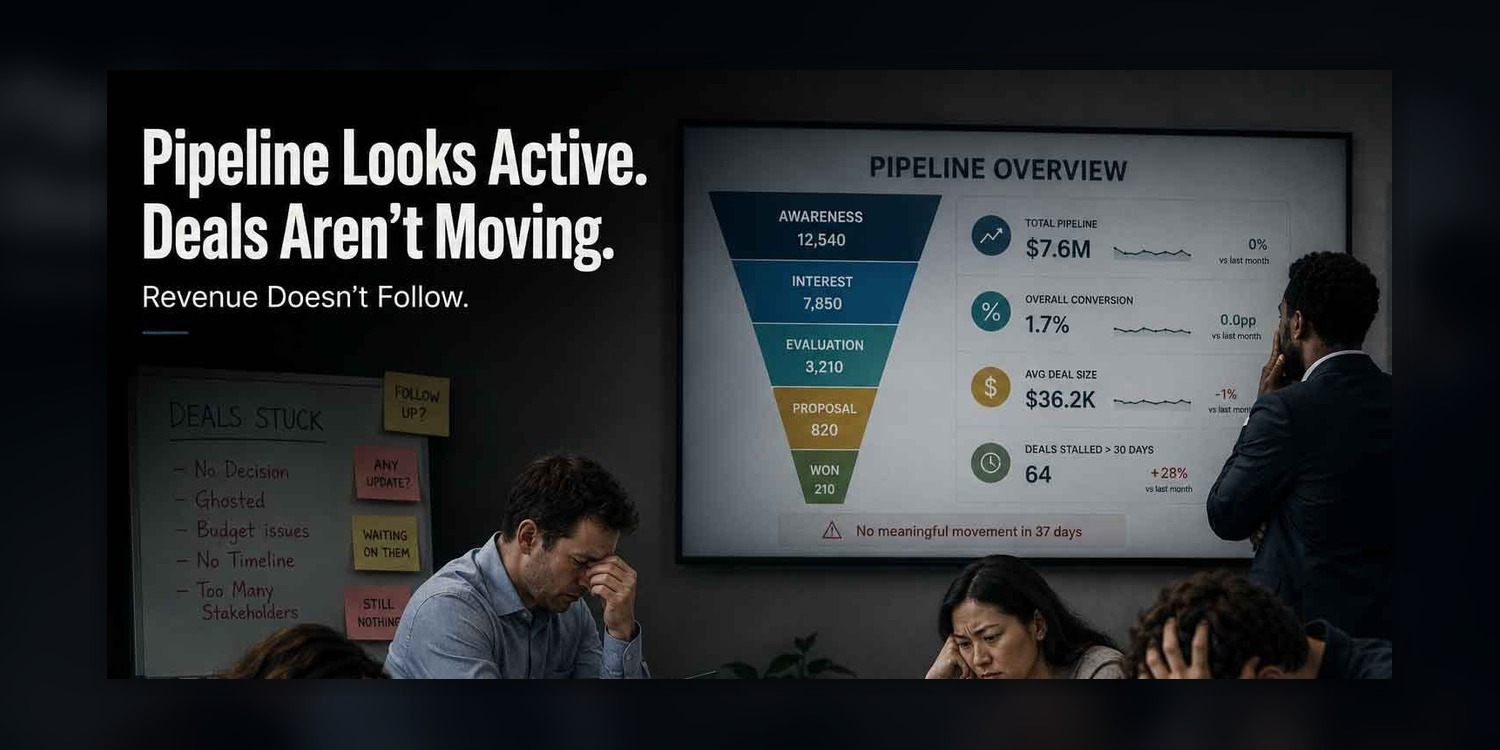
Your pipeline looks active. Deals are moving. Activity is high.

But revenue isn’t following.

That’s not a sales problem. It’s a pipeline quality problem that starts long before sales ever gets involved.

Most companies don’t have a pipeline problem.
They have a qualification problem disguised as pipeline.

Most companies think they have a pipeline problem. In reality, they have a broken revenue system.
Understanding how revenue systems actually work is the first step to fixing pipeline performance.

In Summary

Poor conversion is rarely a sales execution issue. It’s a pipeline quality issue driven by weak positioning, low-intent leads, and disconnected systems upstream.

At that point, most leadership teams look at the numbers and assume the same thing: sales isn’t performing.

So they hire a stronger VP of Sales, push harder on quotas, or bring in new tools.

But nothing really changes.

Pipeline still feels inconsistent. Deals stall. Forecasts miss.

Because the problem was never sales.


What a “Healthy Pipeline” Actually Looks Like

A pipeline only works when positioning, demand, and conversion are aligned.
This is the difference between a revenue system and a traditional sales funnel.

A healthy pipeline is defined by what happens before sales ever engages. Prospects should enter the process with a clear understanding of the problem they’re trying to solve and a belief that your company is relevant to that solution.

This is the difference between a pipeline that needs to be managed and one that needs to be fixed.

Your pipeline should consistently include:

  • Prospects who recognize the problem you solve
  • Buyers who see your positioning as differentiated
  • Leads with urgency, not curiosity
  • Opportunities that move forward without excessive education

When those conditions are met, sales conversations get shorter, more focused, and more predictable. When they’re not, pipeline becomes a holding area for stalled conversations.


If you’re seeing inconsistent pipeline performance, it’s usually a signal that your revenue system is broken.
Most companies don’t need better sales leadership. They need a connected revenue system.

Why Most Pipelines Break Before Sales Ever Starts

By the time a lead reaches sales, most of the outcome has already been shaped.

If the inputs are wrong, the output will always be inconsistent.

Here’s where things break:

1. Weak Positioning
If your messaging is generic, you attract the wrong audience. Sales ends up explaining instead of closing.

2. Low-Intent Leads
More leads does not mean better pipeline. If demand isn’t qualified, sales spends time on deals that were never viable.

3. Misaligned Marketing and Sales
Marketing optimizes for traffic. Sales needs qualified opportunities. Without alignment, pipeline quality suffers.

4. No Defined Revenue System
Most companies operate in silos. There’s no system connecting positioning, demand, pipeline, and conversion.


The Real Problem: You’re Measuring Activity, Not Outcomes

If your pipeline looks active but revenue isn’t following, something upstream is broken.


Diagnose your revenue system →

Most dashboards track:

  • Leads generated
  • Meetings booked
  • Deals in pipeline

But those metrics don’t tell you if your system actually works.

They tell you if people are busy.

Revenue doesn’t come from activity. It comes from alignment.


Why Sales Can’t Fix This

Sales converts opportunities. It doesn’t create them.

By the time a lead reaches sales, the outcome is mostly decided. The buyer either has urgency or doesn’t. They either understand the problem or they don’t. They either see you as a fit or just another option.

Sales teams inherit those conditions.

So when pipeline quality is low, even strong sales teams struggle. They spend time educating, requalifying, and chasing deals that were never viable.

More pressure doesn’t fix that. It increases activity, not effectiveness.

The real solution is owning the full revenue system, not just the sales function.


The Shift That Changes Everything

Companies that fix pipeline conversion don’t start with sales.

They fix how pipeline is created.

  • Clear, differentiated positioning
  • Demand aligned to the right audience
  • Pipeline stages tied to real buying behavior
  • Clean handoff between marketing and sales

This isn’t a sales fix.

It’s a revenue system fix.


What to Do If Your Pipeline Isn’t Converting

If your inputs are broken, no amount of sales optimization will fix conversion.
Most pipeline problems start with how leads are generated and qualified.

If you don’t understand how your pipeline is built, you don’t have a sales problem. You have a system problem.

This is where structured marketing and revenue strategy becomes critical.

If you want to fix this, audit the inputs:

  • Who you’re attracting
  • What they believe before sales
  • How clearly your positioning communicates value
  • Where deals consistently break

Patterns show up quickly. Most conversion problems are upstream consistency problems.

Fix the system, and pipeline becomes predictable.


The Bottom Line

If your pipeline isn’t converting, it’s not a performance problem.

It’s a structural problem.

Most companies don’t need better sales execution.

They need a better revenue system.


If your pipeline feels inconsistent, this is the next step:
Most Companies Don’t Need a VP of Sales. They Need a CRO →

If your pipeline feels unpredictable, it’s not a closing problem.
It’s a system problem upstream.


Your Pipeline Isn’t Broken. It Was Built Wrong.

If your pipeline isn’t converting, more effort won’t fix it. The system has to change.


Diagnose Where Your Pipeline Is Breaking →

Revenue doesn’t break in one place. It breaks across a system.

Most companies don’t have a pipeline problem. They have a system problem.

That’s not a pipeline issue. It’s a system failure.

In Summary

A real revenue system connects positioning, demand generation, pipeline design, and conversion into one cohesive engine.

When those elements are disconnected, growth becomes inconsistent. When they are aligned, revenue becomes predictable.

This is how a real revenue system actually works:

Revenue System Framework: Positioning, Demand, Pipeline, Conversion, Revenue

Most companies aren’t missing activity. They’re missing alignment.

If one stage breaks, everything downstream becomes inconsistent.

What a Revenue System Is Not

A revenue system is not a CRM.

It’s not a sales team. It’s not a marketing campaign.

It’s not a dashboard full of metrics that don’t connect.

Most companies confuse tools and activity for a system. They invest in platforms, hire more people, and increase output, but nothing fundamentally changes.

Because the system was never designed.

If your pipeline looks active but revenue isn’t converting, start here:
Why Your Pipeline Isn’t Converting

The Four Parts of a Real Revenue System

A real system is built across four connected layers:

  • Positioning defines who you attract and how you’re understood.
  • Demand Generation creates interest from the right buyers.
  • Pipeline Design filters and structures real opportunities.
  • Conversion turns fit into predictable revenue.

Each layer feeds the next. Break one, and the entire system becomes unstable.

The Revenue System (Simplified)

Positioning → Demand → Pipeline → Conversion → Revenue

Each stage feeds the next. Break one, and the entire system becomes inconsistent.

1. Positioning: The Starting Point of Revenue

Positioning determines who you attract and how buyers interpret your value.

If you attract the wrong buyers, everything downstream breaks. Pipeline quality drops, sales cycles get longer, and conversion becomes unpredictable.

Most companies try to fix this with better sales execution. That’s backwards.

Strong positioning aligns your message with real buyer problems and creates clarity before the sales conversation ever begins.

2. Demand Generation: Attracting the Right Buyers

Demand generation is not about volume. It’s about relevance.

Most companies generate traffic, but not qualified demand. The result is activity without outcomes.

When demand aligns with positioning, you don’t just get more leads, you get the right leads, buyers who are already a fit.

3. Pipeline Design: Filtering for Real Opportunities

Your pipeline should not be a holding area for conversations.

It should be a structured system that qualifies, filters, and advances opportunities based on fit.

If everything enters your pipeline, nothing moves through it efficiently.

If your pipeline is full but deals aren’t closing, it’s not a sales problem:
It’s a pipeline design problem.

4. Conversion: Turning Fit Into Revenue

Conversion is where alignment is tested.

If positioning, demand, and pipeline are working, conversion becomes predictable.

If they’re not, conversion becomes inconsistent, and sales gets blamed.

But sales operates at the end of the system, not the beginning.

What Most Companies Actually Have

  • Disconnected marketing campaigns
    Activity increases, but it isn’t tied to a clear revenue outcome.
  • Unqualified leads entering the pipeline
    Sales spends time filtering instead of closing.
  • Sales teams chasing low-fit opportunities
    Effort is wasted on deals that were never going to convert.
  • Metrics that measure activity instead of outcomes
    Dashboards look strong, but revenue doesn’t follow.

Everything looks active. Nothing compounds.

This is exactly why pipelines feel full but fail to convert:
Why Your Pipeline Isn’t Converting

How Revenue Systems Break

  • Positioning attracts the wrong audience
  • Demand generation produces low-quality leads
  • Pipeline lacks qualification structure
  • Conversion depends on individual performance

This creates inconsistency. And inconsistency kills growth.

What Changes When the System Works

  • Leads are more qualified
  • Sales cycles shorten
  • Close rates improve
  • Revenue becomes consistent

This isn’t about working harder. It’s about fixing the system.

How To Know Your Revenue System Is Broken

  • High pipeline volume with low close rates
  • Inconsistent revenue performance
  • Marketing and sales misalignment
  • Constant pressure to generate more leads
Most companies don’t have a pipeline problem. They have a system problem disguised as activity.

If you’re still thinking in marketing, sales, and pipeline as separate functions, you’re not managing growth. You’re reacting to it.

The Bottom Line

Revenue doesn’t come from effort. It comes from alignment.

If your system is broken, more activity won’t fix it.

Most companies don’t need better sales execution.

They need a better revenue system.

Why Most Companies Don’t Need a VP of Sales. They Need a CRO

Still thinking in funnels instead of systems?
Revenue System vs Sales Funnel

Your Revenue System Is Already Breaking. The Question Is Where.

If you want consistent growth, you need a system that actually works.


Diagnose Your Revenue System →

Most companies respond to stalled growth by adding sales leadership. But what looks like a sales problem is usually a system failure upstream, and that distinction is where most decisions go wrong.

In Summary

Most companies don’t need another sales leader. They need a revenue system.
Growth becomes predictable when positioning, demand, pipeline, and conversion are connected and owned as one system.

Jump to:
Where Growth Breaks |
Why Sales Fails |
Revenue System |
What a CRO Does

Most companies respond to stalled growth the same way. They hire a VP of Sales. It feels logical on the surface. Revenue is flat, pipeline is inconsistent, and deals are not closing, so the assumption becomes simple: sales is the problem.

But in most cases, that assumption is wrong. What looks like a sales issue is usually a system failure that starts much earlier in the buyer journey and compounds by the time opportunities reach the pipeline.

Growth Doesn’t Break in Sales

Growth does not break at the point of conversion. It breaks earlier, often much earlier, in ways that are harder to see but far more damaging over time.

By the time a deal reaches sales, most of the outcome has already been shaped. The quality of the lead, the clarity of the positioning, the urgency of the problem, and the alignment of expectations are all determined before a rep ever gets involved.

When those inputs are off, sales does not fail. It inherits a situation that was already misaligned. That is why teams can work harder, follow better process, and still struggle to produce consistent results.

No amount of sales leadership fixes bad inputs.

Why Hiring More Sales Leadership Often Fails

When growth slows, leadership looks at sales first because it is the most visible part of the revenue engine. But what looks like a conversion problem is usually something deeper.

Marketing generates low-quality leads.
Sales is not struggling to close. They are working opportunities that should have never entered the pipeline.

Messaging lacks clarity.
If the value proposition is not sharp, every deal becomes a negotiation instead of a decision.

Pipeline definitions are inconsistent.
Forecasting becomes unreliable, and leadership starts reacting instead of planning.

Revenue feels unpredictable.
Not because people are not working hard, but because there is no system connecting activity to outcomes.

This is not a sales problem. This is a system problem.

If you’re seeing these issues, it’s usually a signal that your growth strategy needs to be restructured. Our Growth Strategy Program is designed to identify where revenue breaks and rebuild how your pipeline actually works.

Why This Keeps Happening

Most companies are structured around functions, not revenue. Marketing generates leads, sales closes deals, and customer success handles retention. Each operates independently.

As a result, teams can perform individually while the overall system fails. That disconnect is where growth breaks.

What Companies Actually Need Is Revenue Ownership

A VP of Sales can optimize a team. But they do not control positioning, demand quality, or how pipeline is created.

What is missing is ownership of the entire revenue system.

If your organization lacks that oversight, our Marketing Leadership Program provides fractional CMO and revenue strategy support to align your entire growth engine.

Most Companies Operate Like the Left. Growth Comes From Building the Right.

Broken Growth vs Revenue System

Siloed Execution

Marketing
Sales
Leads
Pipeline

Revenue System

Positioning
Demand
Pipeline
Conversion
Retention

What a Revenue System Actually Looks Like

A revenue system connects positioning, demand, pipeline, and conversion into a measurable, repeatable model.

If your pipeline feels inconsistent, the issue is usually upstream.

Diagnose My Revenue System

What a Real CRO Actually Does

A CRO owns how revenue is created across the business. They identify breakdowns, redefine pipeline structure, and connect the full system.

It is not a coordination role. It is a system design role.

The Bottom Line

Most companies stall because their revenue system is fragmented.

You do not fix growth by adding pressure to sales.

You fix it by building a system that works.

If you’re preparing for scale or exit, explore our Acquisition Ready Program.


Frequently Asked Questions

What is the difference between a CRO and a VP of Sales?

A CRO owns the full revenue system. A VP of Sales manages the sales team.

When should a company hire a CRO?

When growth becomes inconsistent or pipeline quality declines.

Why doesn’t hiring a VP of Sales fix growth?

Because most issues originate before sales begins.

Your Revenue System Is Already Costing You Growth

If growth feels inconsistent, the issue is not effort. It is how your system is built.