Digital Marketing • Social Media • Search Marketing

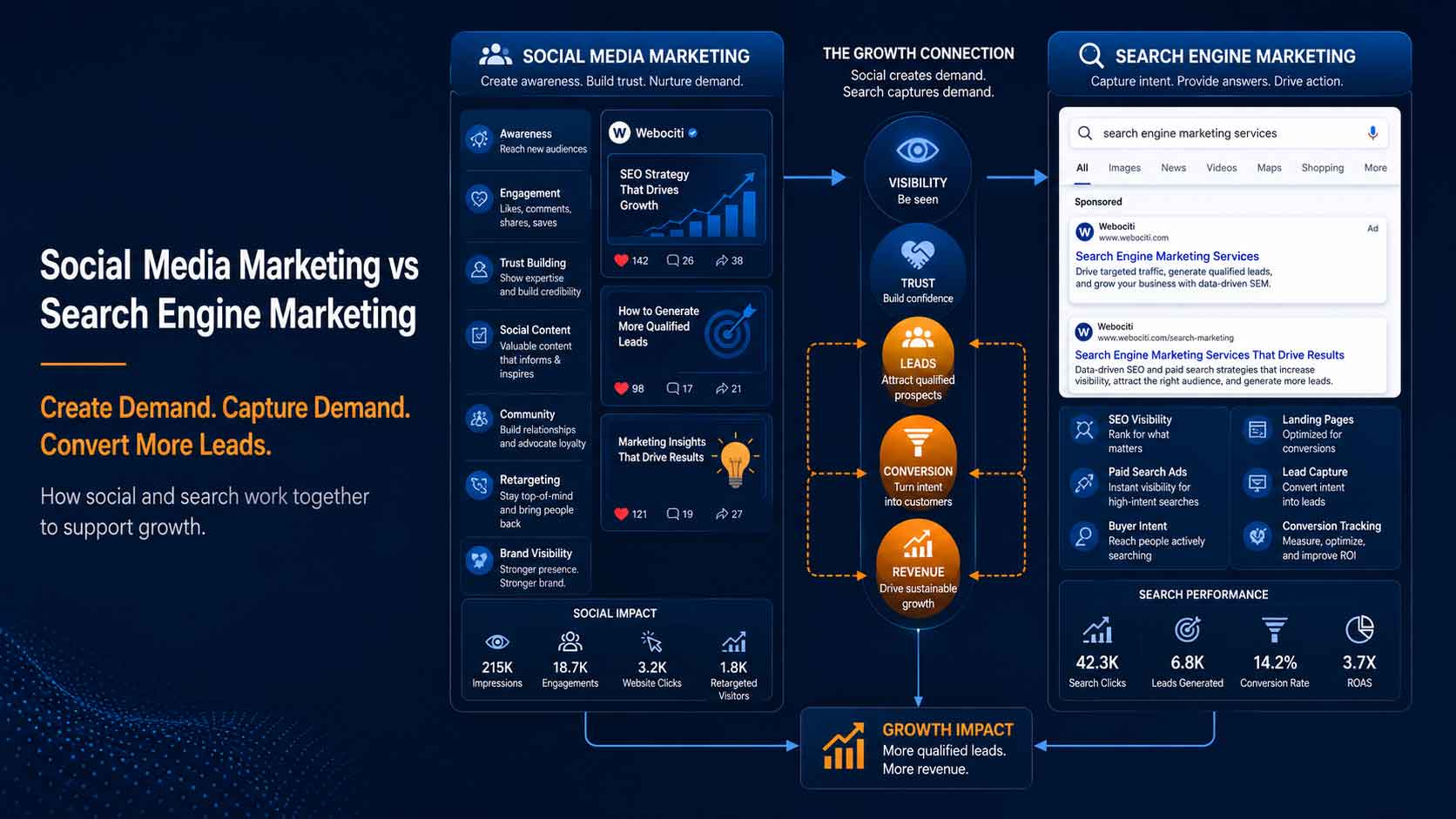
Social media marketing and search engine marketing both help businesses reach potential customers, but they work in different ways. Social media builds awareness, trust, and engagement. Search marketing captures people who are already looking for answers, products, or services.

AI TL;DR:

Social media marketing is best for building awareness, trust, community, and ongoing engagement.
Search engine marketing is best for capturing demand from people actively searching for solutions.

Most businesses should not treat social media and search as competing strategies. Social media helps create and nurture demand. Search marketing captures demand. A stronger growth system connects both to lead generation, conversion, and revenue.

Originally published in May 2024. Updated for 2026 with new guidance on social media marketing, search engine marketing, demand creation, demand capture, and revenue growth strategy.

Businesses often ask whether they should invest more in social media marketing or search engine marketing.

It is the wrong question if you treat the answer as either-or.

Social media and search marketing solve different problems. Social media helps people discover, remember, and trust your brand. Search marketing helps your business show up when people are actively looking for information, comparisons, products, services, or providers.

The better question is: where does your business need the most help right now?

  • Do you need more visibility and awareness?
  • Do you need more high-intent website traffic?
  • Do you need stronger trust before people contact you?
  • Do you need better lead generation?
  • Do you need a complete system that connects awareness, search, conversion, and revenue?

This guide compares social media marketing vs search engine marketing so you can decide how each channel should fit into your growth strategy.

What Is Social Media Marketing?

Social media marketing uses platforms such as Facebook, Instagram, LinkedIn, YouTube, TikTok, and other social channels to reach, engage, and influence an audience.

Social media can include organic posts, short-form video, community engagement, paid social advertising, retargeting, thought leadership, brand storytelling, customer education, and reputation building.

Social media works best when your business needs to build visibility and trust before someone is ready to buy. It keeps your brand in front of prospects, referral sources, customers, and people who may not be actively searching yet.

If your business needs stronger visibility and engagement across social channels, explore Webociti’s
social media marketing services.

What Is Search Engine Marketing?

Search engine marketing focuses on increasing visibility in search engines when people are actively looking for information, products, services, or solutions.

SEM can include paid search advertising, SEO, content strategy, landing page optimization, technical SEO, conversion tracking, and other tactics designed to help a business appear when buyer intent is high.

Search marketing is powerful because it reaches people at the moment they are searching. Instead of interrupting someone, search marketing meets demand that already exists.

For businesses comparing paid search, SEO, and SEM, read our related guide:
PPC vs SEO vs SEM: Which Strategy Should Your Business Use?.

Social Media Marketing vs Search Engine Marketing: Key Differences

Factor Social Media Marketing Search Engine Marketing
Primary Role Builds awareness, trust, and engagement Captures people actively searching
Audience Intent Often passive or early-stage Often active and intent-driven
Best For Demand creation, brand visibility, community, retargeting Demand capture, lead generation, SEO, paid search
Timeline Builds influence over time Can create faster traffic through paid search and long-term visibility through SEO
Measurement Reach, engagement, clicks, followers, assisted conversions Rankings, traffic, paid clicks, conversions, calls, leads

When Social Media Marketing Makes Sense

Social media marketing makes sense when your business needs to stay visible, build trust, educate prospects, and create ongoing engagement.

Social media is especially useful when:

  • Your audience needs to see your brand multiple times before taking action
  • You want to build trust and authority
  • You need to educate prospects before they are ready to buy
  • You rely on referrals, reputation, or relationship-building
  • You want to retarget people who visited your website
  • You have visual, educational, or story-driven content
  • You want to stay top of mind with customers and prospects

The mistake many businesses make is treating social media as random posting. Social media should support positioning, trust-building, lead nurturing, and conversion.

When Search Engine Marketing Makes Sense

Search engine marketing makes sense when your business wants to reach people who are already looking for answers, providers, services, or solutions.

Search marketing is especially useful when:

  • People already search for what you sell
  • You need high-intent website traffic
  • You want to generate leads from Google
  • You want to improve organic visibility through SEO
  • You want to use paid search for faster visibility
  • You need landing pages that convert search traffic
  • You want to track calls, forms, and booked appointments

If your business needs long-term organic visibility, stronger rankings, and content-driven lead generation, explore Webociti’s
SEO services for small business.

If your business needs faster visibility through paid campaigns, explore our
digital advertising services.

Demand Creation vs Demand Capture

The real difference between social media marketing and search engine marketing comes down to demand creation and demand capture.

Social media often helps create demand. It puts ideas, stories, insights, offers, and proof in front of people before they are actively searching. It can make people aware of a problem, remember your brand, and trust your point of view.

Search marketing captures demand. It reaches people when they are already searching for information, comparisons, services, products, or providers.

Simple rule: Social media helps people discover and trust you. Search marketing helps people find you when they are ready to act.

Strong marketing does both. It creates awareness before someone is searching and captures demand when that person begins looking for solutions.

Why Most Businesses Need Both

Choosing between social media marketing and search engine marketing is often too narrow.

Most businesses need both, but not always in the same proportion.

Social media can help build familiarity, trust, and engagement. Search marketing can help capture high-intent traffic. Together, they can support the full buyer journey.

For example:

  • A prospect sees your insight on LinkedIn
  • They later search for a solution on Google
  • Your SEO page or paid ad appears in search
  • They visit your website
  • Retargeting keeps your brand visible
  • A strong landing page converts them into a lead

That is not social media or search working alone. That is a connected growth system.

How Social Media and Search Fit Into a Revenue Growth System

Social media marketing and search engine marketing should not operate as disconnected channels.

They should connect to positioning, messaging, content, lead generation, conversion tracking, and sales follow-up.

A social post may create awareness, but if the website is unclear, the opportunity is lost. A search campaign may drive traffic, but if the landing page does not convert, the traffic is wasted. SEO may generate organic visits, but if there is no follow-up process, those visits may never become pipeline.

That is why Webociti views marketing through a broader
revenue growth system.

The goal is not more activity. The goal is a connected system that turns visibility into trust, leads, conversations, and revenue.

How to Choose Based on Goals, Timeline, and Budget

Use your goals, timeline, and budget to decide where to focus first.

  • Need awareness and trust? Strengthen social media marketing.
  • Need high-intent traffic? Invest in search engine marketing.
  • Need faster leads? Consider paid search or paid social campaigns.
  • Need long-term visibility? Invest in SEO and content.
  • Need better conversion? Improve landing pages, messaging, and calls to action.
  • Need predictable growth? Connect social, search, content, tracking, and follow-up into one system.

The right answer depends on your current bottleneck. Some businesses need more visibility. Others need better lead quality. Others need stronger conversion before spending more on traffic.

Social Media Marketing vs Search Engine Marketing: Which Is Better?

Neither is universally better.

Social media marketing is better when your business needs awareness, engagement, trust, reputation, and ongoing visibility.

Search engine marketing is better when your business needs to reach people with active intent who are already looking for solutions.

The strongest strategy often combines both. Social media helps shape demand and build trust. Search marketing captures demand and turns intent into traffic. Your website, landing pages, content, and follow-up process turn that attention into measurable growth.

Related guide:
If you are comparing paid search, organic search, and broader search strategy, read

PPC vs SEO vs SEM: Which Strategy Should Your Business Use?
.

Digital Marketing Strategy

Need a Marketing Strategy That Connects Social, Search, and Revenue?

Webociti helps businesses connect social media, search marketing, SEO, paid advertising, lead generation, and conversion into a smarter growth system.


Take the Growth Program Assessment

Social Media Marketing vs Search Engine Marketing FAQs

Quick answers to common questions about social media marketing, search engine marketing, SEO, paid search, and choosing the right strategy.

What is the difference between social media marketing and search engine marketing?

Social media marketing focuses on awareness, engagement, trust, and community. Search engine marketing focuses on reaching people who are actively searching for information, products, services, or providers.

Is social media marketing better than search engine marketing?

Social media marketing is better for awareness, trust-building, and engagement. Search engine marketing is better for capturing active buyer intent. Most businesses benefit from using both strategically.

Should small businesses use social media or search marketing first?

It depends on the goal. If the business needs awareness and trust, social media may be a strong starting point. If people are already searching for the service, search marketing may create more immediate lead opportunities.

Can social media help SEO?

Social media does not directly replace SEO, but it can support visibility, content distribution, brand awareness, engagement, and traffic. These signals can help more people discover, share, and interact with your content.

Should social media and search marketing be managed together?

Yes. Social media and search marketing work best when they share the same positioning, messaging, offers, landing pages, tracking, and lead follow-up strategy.

Quick Summary:

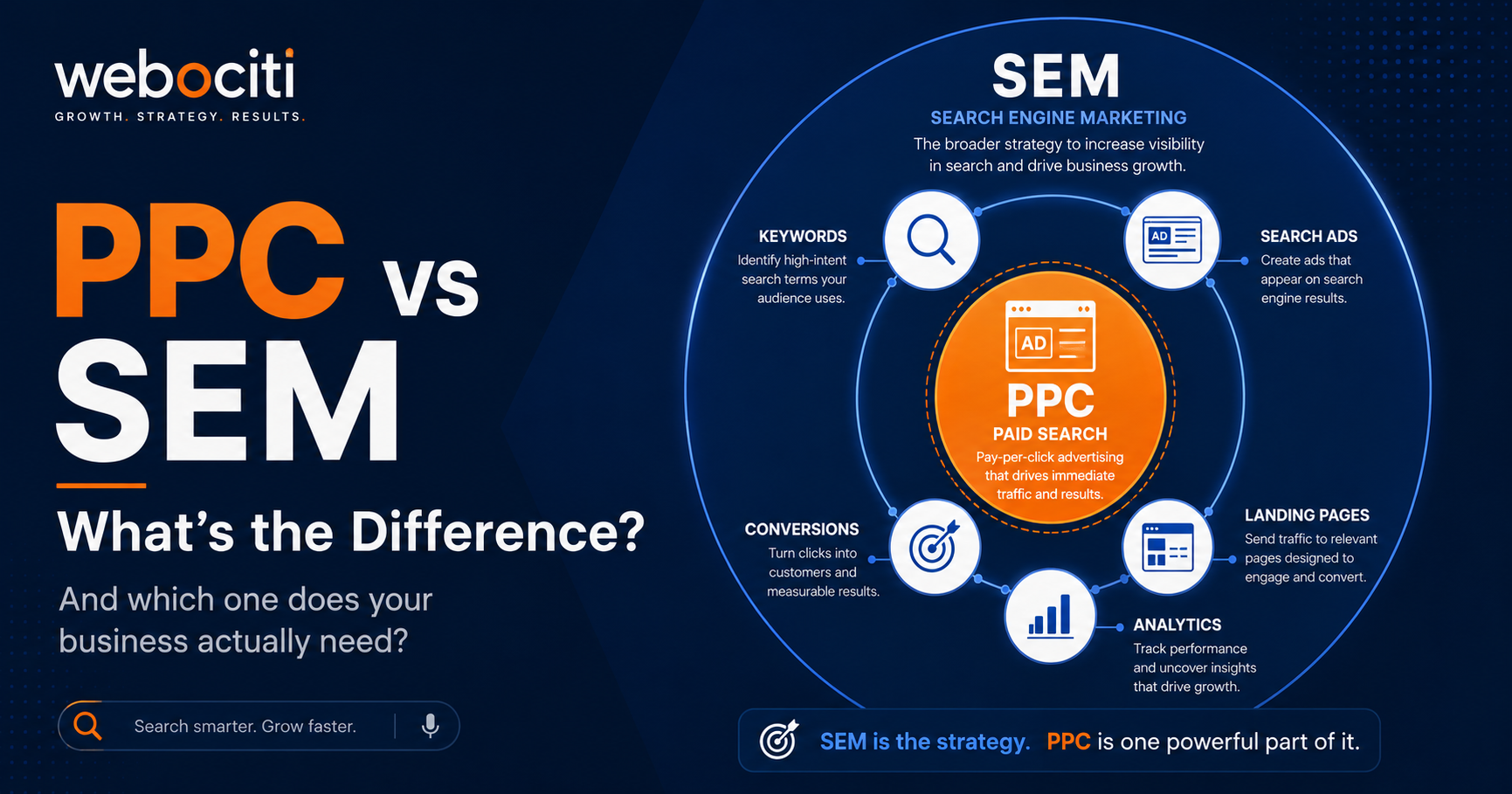
PPC is a paid advertising model where businesses pay when someone clicks on an ad.
SEM is the broader search marketing strategy that includes PPC, SEO, content, technical optimization, and conversion tracking.

PPC can generate traffic quickly. SEO builds long-term organic visibility. SEM brings both together into a more complete search marketing strategy designed to turn search visibility into leads and revenue.

Updated for 2026: This guide reflects how PPC, SEO, and SEM now work together as part of a connected revenue growth system.

Many businesses hear the terms PPC and SEM used interchangeably, but they are not the same thing.

PPC, or pay-per-click advertising, is a paid advertising model where businesses pay each time someone clicks their ad. SEM, or search engine marketing, is a broader strategy that includes both paid search advertising and organic strategies like SEO services for small businesses.

Understanding the difference between PPC and SEM helps businesses choose the right search marketing strategy to generate leads, increase website traffic, and grow revenue.

The real question is not whether PPC or SEM is better. The real question is whether your search strategy is connected to the rest of your revenue system. Paid search, SEO, landing pages, messaging, lead capture, and conversion all need to work together if you want search traffic to turn into revenue.

Businesses looking for a complete online growth strategy often combine SEO and paid advertising through structured digital marketing programs that align lead generation, search visibility, and long-term business growth.

Watch: SEM vs PPC Explained

What Is the Difference Between PPC and SEM?

PPC stands for pay-per-click. It is a paid advertising model where businesses pay for every click on their ad.

SEM stands for search engine marketing. SEM is the broader strategy of increasing visibility in search engines through paid ads, SEO, content, technical optimization, and other search-focused tactics.

In simple terms, PPC is part of SEM. PPC can drive immediate traffic, while SEM includes both paid and organic strategies designed to create short-term visibility and long-term search growth.

PPC vs SEM: Key Differences

Feature PPC SEM
Meaning Pay-per-click advertising Search engine marketing
Type Paid advertising model Overall search marketing strategy
Traffic Speed Immediate traffic after launch Short-term and long-term visibility
Cost Pay for each click Combination of paid and organic investments
Sustainability Traffic stops when ads stop Can build long-term traffic and authority
Best For Immediate leads, promotions, testing, and visibility Long-term visibility, brand authority, and search growth

Should Your Business Choose PPC, SEM, or SEO?

The right choice depends on your goals, timeline, budget, and how quickly you need results.

  • Choose PPC if you need immediate visibility, want to test offers, or need leads quickly.
  • Choose SEO if you want to build long-term organic visibility and reduce dependence on paid traffic over time.
  • Choose SEM if you want a complete search strategy that combines paid ads, SEO, content, landing pages, and conversion tracking.

For most growth-focused businesses, the best answer is not PPC or SEO. It is a coordinated SEM strategy where paid search creates speed, SEO builds compounding visibility, and conversion strategy turns traffic into qualified opportunities.

In short, PPC delivers immediate paid traffic while SEM includes both PPC and long-term strategies like SEO that build sustainable search visibility.

If your business needs long-term organic visibility, content-driven lead generation, and stronger rankings over time, explore Webociti’s
SEO services for small business.

SEM vs SEO vs PPC: What’s the Difference?

Many business owners also ask how SEM, SEO, and PPC differ. While these terms are related, they play different roles in a search marketing strategy.

  • SEO focuses on improving a website’s organic rankings in search engines through content, technical optimization, site structure, and authority building.
  • PPC is paid advertising where businesses pay each time someone clicks on an ad.
  • SEM is the larger search marketing strategy that can include both SEO and PPC to increase visibility in search results.

For most businesses, SEO and PPC should not be treated as competing strategies. They work best when they support each other.

PPC vs SEO vs SEM: What Businesses Should Know

Many businesses compare PPC vs SEO when deciding how to invest their marketing budget. Both strategies help generate website traffic, but they work in very different ways.

  • PPC generates traffic quickly through paid ads.
  • SEO builds organic search rankings over time.
  • PPC stops generating traffic when the ads stop running.
  • SEO can continue driving traffic long after the work is completed.
  • SEM brings search tactics together into a larger visibility strategy.

For most companies, the best approach is combining both strategies. PPC can generate leads quickly while SEO services for small businesses build long-term visibility and sustainable traffic.

Many businesses pair SEO with
digital advertising services
to generate both short-term leads and long-term organic growth.

How Paid Digital Advertising Increases Revenue

If you have been placing pay-per-click ads and hoping for a major increase in sales, you may be disappointed if the campaign is not connected to the right strategy. Successful PPC advertising campaigns require planning, testing, landing page alignment, and ongoing optimization.

Effective digital advertising campaigns usually involve:

  • Researching high-performing keywords
  • Analyzing competitor advertising strategies
  • Setting clear budgets and performance goals
  • Creating strong ad copy and landing pages
  • Testing different ads, offers, and audiences
  • Tracking conversions and lead quality
  • Continually refining campaigns for better results

Without these steps, businesses may generate impressions and clicks but fail to convert that traffic into leads, opportunities, and customers.

What Is SEM? Search Engine Marketing Explained

Search engine marketing focuses on increasing a website’s visibility in search engine results pages. SEM strategies may include paid advertising, SEO, technical optimization, content marketing, landing page optimization, and conversion tracking.

When a website is optimized correctly with relevant content, strong technical structure, useful landing pages, and clear calls to action, search engines and users have a better experience. That can lead to stronger visibility, better traffic quality, and more qualified leads.

SEM should not be viewed as a single tactic. It is a coordinated search strategy designed to help the right people find your business when they are actively searching for solutions.

What Is PPC? Pay-Per-Click Advertising Explained

Pay-per-click advertising refers to paid ads that often appear at the top of search engine results pages. Businesses bid on keywords and only pay when someone clicks their advertisement.

The cost of each click depends on competition, industry, search volume, location, and keyword intent. Highly competitive keywords may cost several dollars per click, while niche keywords may cost less.

Advertisers typically set a daily budget for their campaigns. Once that budget is reached, the ads stop running until the next day.

Professional Google Ads management services can help businesses improve ad targeting, landing page alignment, conversion tracking, and return on ad spend.

When Should a Business Use PPC?

PPC can be a good fit when your business needs immediate visibility or wants to test offers quickly.

  • Launching a new product or service
  • Promoting limited-time offers
  • Competing in highly competitive industries
  • Generating immediate leads
  • Testing marketing messages
  • Supporting a new website or landing page
  • Retargeting visitors who did not convert the first time

PPC works best when the campaign is connected to strong landing pages, clear messaging, conversion tracking, and a defined follow-up process.

When Should Businesses Focus on SEM?

Businesses should focus on SEM when they want a more complete search marketing strategy that combines short-term visibility with long-term organic growth.

  • Increasing organic website traffic
  • Building brand authority
  • Reducing long-term dependence on paid ads
  • Generating consistent inbound leads
  • Improving search visibility across multiple stages of the buyer journey
  • Combining SEO and PPC into one coordinated growth strategy

For many companies, SEM is strongest when paid search and SEO are planned together instead of managed as separate tactics.

How PPC and SEM Fit Into a Revenue System

PPC and SEM can help drive traffic, but traffic alone does not create growth. Search marketing needs to connect to the full customer journey, including positioning, messaging, landing pages, lead capture, sales follow-up, and conversion.

A PPC campaign may generate clicks, but if the landing page is weak or the offer is unclear, those clicks may not become qualified leads. SEO may generate organic traffic, but if the content does not align with buyer intent or the site lacks strong calls to action, rankings may not translate into revenue.

That is why search marketing should be planned as part of a larger revenue system. When SEO, PPC, messaging, lead generation, and conversion strategy work together, search traffic has a better chance of becoming real pipeline.

Launching a New Website? Protect Your Search Visibility

If you are planning to launch a new website, it is important to protect your search rankings during the transition. A poorly planned redesign can damage SEO performance, disrupt paid campaigns, and reduce lead flow.

Learn how to avoid traffic loss during a website migration, or use our website migration SEO checklist before launching a redesigned site.

Related Questions About PPC and SEM

Business owners researching search marketing often ask several related questions about PPC, SEO, and SEM. Understanding how these strategies work together can help you build a stronger digital marketing plan.

  • What is the difference between PPC and SEO?
  • Is Google Ads the same as PPC?
  • How much should a small business spend on PPC?
  • Can PPC help SEO rankings?
  • Should businesses use SEO and PPC together?

Most successful businesses use a combination of SEO, PPC advertising, and broader SEM strategies to create both immediate lead generation and long-term search visibility.

Related insight: PPC and SEM work best when they are connected to a complete growth system. Learn how search visibility, lead generation, and conversion fit together in our guide to building a revenue growth system
.

Related guide: Still deciding between paid search, organic SEO, and a combined search strategy? Read PPC vs SEO vs SEM: Which Strategy Should Your Business Use? .

PPC vs SEM Frequently Asked Questions

Is PPC the same as SEM?

No. PPC is a paid advertising model, while SEM is a broader search marketing strategy that can include PPC, SEO, content, technical optimization, and other search visibility tactics.

What is the difference between PPC and SEO?

PPC is paid advertising where businesses pay for each click. SEO focuses on earning organic visibility in search engines through content, technical optimization, and site authority. PPC can generate traffic quickly, while SEO usually builds over time.

Does PPC help SEO rankings?

PPC does not directly improve organic SEO rankings. However, PPC can help businesses test keywords, offers, ad copy, messaging, and landing pages. Those insights can improve the effectiveness of an SEO strategy.

Should businesses invest in both SEO and PPC?

Many businesses benefit from using both. PPC can create immediate visibility and lead flow, while SEO builds long-term organic traffic and authority. Together, they can support a stronger SEM strategy.

Which is better, PPC or SEM?

PPC is best for immediate paid visibility. SEM is better when a business wants a broader search strategy that includes both paid and organic growth. In many cases, PPC works best as one part of a larger SEM strategy.

How long does SEO take compared to PPC?

PPC campaigns can begin generating traffic soon after launch. SEO usually takes longer, often several months, because search engines need time to crawl, index, and evaluate content, authority, and technical improvements.

Need Search Marketing That Connects to Revenue?

PPC, SEO, and SEM can all help your business grow, but only when they are connected to the right message, landing pages, lead capture process, and conversion strategy.

Webociti helps businesses align paid search, SEO, lead generation, and conversion into a smarter revenue growth system.

Not sure whether your business needs SEO, paid advertising, lead generation, or a broader growth strategy? Take the Webociti Growth Program Assessment to find the right next step.

Need help deciding between paid search and organic growth? Explore our digital advertising services
or learn more about our SEO services for small business.

In the ever-evolving landscape of digital marketing, staying ahead of the curve is paramount to ensure your brand’s online visibility and success. Amid the array of strategies and tactics, one emerging technique is capturing the attention of marketers and businesses alike: Search Box Optimization (SBO) also know as auto complete. This innovative approach is reshaping the way users interact with search engines and is proving to be a game-changer in enhancing online visibility.

Understanding Search Box Optimization (SBO)

Before delving into the intricacies of Search Box Optimization, it’s essential to grasp its fundamental concept. At its core, SBO revolves around optimizing your content to be prominently featured in the auto-suggestions or drop-down menu of search engines’ search boxes. This means that as users begin typing their queries, your content appears even before they hit “Enter.”

Imagine a user typing “best hiking trails in the Rockies” and seeing your outdoor adventure blog’s link right there, ready to be clicked. That’s the power of SBO. It offers a shortcut to engage users at a critical decision-making moment, driving higher click-through rates and traffic to your website.

The Science Behind SBO

The science behind Search Box Optimization lies in the algorithms that govern search engine suggestions. These algorithms predict users’ queries based on factors like popular searches, user intent, and context. By understanding these algorithms and strategically optimizing your content, you can position your brand to be recommended to users before they finish typing.

Consider the mechanics of it: when your content appears in the auto-suggestions, users perceive it as a trusted and authoritative source, endorsed by the search engine. This perception leads to higher click-through rates, even if your page isn’t the first organic result.

Benefits of Embracing SBO

Enhanced Visibility: Being in the search box auto-suggestions grants your brand unparalleled visibility. Users are more likely to click on your link, creating an instant connection.

Increased Click-Through Rates: The immediate presence of your content encourages users to click, driving higher click-through rates and potentially boosting your website’s overall ranking.

Elevated Brand Authority: SBO positions your content as a reliable resource, building trust and authority among users seeking information.

Improved User Experience: Users appreciate the convenience of finding relevant information even before completing their search. This positive experience reflects well on your brand.

Higher Conversions: SBO directs users to specific pages, increasing the chances of conversions as they find precisely what they’re looking for.

Search Box Optimization

Strategies for Effective Search Box Optimization

Keyword Research: Identify keywords and phrases relevant to your content and aligned with user intent. These are the terms users are likely to search for.

High-Quality Content: Craft content that answers users’ questions and provides value. High-quality, informative content is more likely to be suggested.

Long-Tail Keywords: Incorporate long-tail keywords, as these often match user queries more accurately.

User Intent: Understand user intent behind different queries. Optimize content to fulfill these intents effectively.

Structured Data Markup: Implement structured data markup on your pages to help search engines understand your content better.

Popular Queries: Identify popular queries related to your niche and tailor your content to match them.

Embracing the Future of Search

As the digital landscape continues to evolve, staying attuned to emerging strategies like Search Box Optimization is crucial for staying competitive. The power of SBO lies in its ability to capture users’ attention at the initial stages of their search journey, enhancing their experience and boosting your brand’s visibility. By understanding the science behind SBO and implementing effective strategies, you can harness its potential to drive higher click-through rates, increased traffic, and a stronger online presence. As search engines continue to refine their algorithms and user experiences, embracing the future of search means embracing the power of Search Box Optimization.

Ready to Get Started

Ready to take your online visibility to the next level with Search Box Optimization? Contact us at Webociti and let our expert team guide you through the process. Don’t miss out on the opportunity to have your brand show up prominently in search results as users type their queries. Reach out today and let’s get started on boosting your online presence! 678-892-7157

Unleash the Power of SEO: Drive Traffic, Boost Rankings, and Dominate the Digital Landscape

In today’s digital landscape, having a strong online presence is vital for businesses to succeed. One of the key strategies to achieve this is Search Engine Optimization (SEO). By implementing effective SEO techniques, you can enhance your website’s visibility, attract organic traffic, and rise above your competitors in search engine rankings. In this comprehensive guide, we will delve into the world of SEO, exploring essential strategies, best practices, and proven tactics to help you boost your online visibility and dominate the search rankings.

Understanding the Basics of SEO

  • What is SEO and why is it important?
  • How search engines work and rank websites
  • The role of keywords in SEO

Conducting Keyword Research

  • Uncovering the right keywords for your business
  • Tools and techniques for keyword research
  • Analyzing keyword competition and search volume

On-Page Optimization

  • Crafting compelling meta tags and page titles
  • Optimizing headings, content, and URLs
  • The importance of high-quality, relevant content
  • Best practices for optimizing images and multimedia

Technical SEO

  • Ensuring website accessibility and crawlability
  • Implementing proper website structure and navigation
  • Mobile optimization and responsive design
  • Page load speed optimization

Building High-Quality Backlinks

  • The significance of backlinks in SEO
  • Strategies for acquiring natural, authoritative backlinks
  • Guest blogging, influencer outreach, and link building techniques
  • Monitoring and disavowing toxic backlinks

Local SEO

  • Leveraging local search to target geographically specific audiences
  • Optimizing Google My Business and local directory listings
  • Encouraging online reviews and managing your online reputation

Measuring and Analyzing SEO Performance

  • Tracking keyword rankings and organic traffic
  • Utilizing Google Analytics and other SEO tools
  • Analyzing user behavior and engagement metrics
  • Making data-driven decisions for continuous improvement

Staying Updated with SEO Trends and Algorithm Changes

  • Keeping pace with evolving search engine algorithms
  • Understanding the impact of voice search and mobile-first indexing
  • Embracing emerging trends in SEO and user intent optimization

Implementing Local SEO for E-Commerce Websites

  • Strategies for optimizing e-commerce websites for local search
  • Leveraging product descriptions, reviews, and ratings for SEO
  • Building trust and credibility for online transactions

SEO and Content Marketing Integration

  • Creating an effective content strategy for SEO
  • Incorporating keywords and optimizing content for search engines
  • Maximizing the impact of blog posts, infographics, and videos

Best Practices

With the ever-increasing competition in the online world, mastering SEO is crucial for businesses seeking to boost their online visibility and dominate the search rankings. By following the strategies and best practices outlined in this ultimate SEO guide, you will be well-equipped to optimize your website, attract organic traffic, and achieve sustainable growth. Stay up-to-date with the latest SEO trends and algorithm changes, continuously refine your strategies, and monitor your performance to ensure long-term success. Start implementing these tactics today and unleash the full potential of SEO for your business.

User Experience

In addition to the strategies and best practices discussed in this ultimate SEO guide, it’s important to highlight the significance of user experience (UX) in SEO. Search engines prioritize websites that provide a seamless and engaging experience for users. Ensure that your website is mobile-friendly, easy to navigate, and loads quickly. Invest in compelling and informative content that answers the needs and queries of your target audience. By focusing on delivering an exceptional user experience, you can enhance your chances of ranking higher in search results and driving more organic traffic to your website.

Furthermore, staying up-to-date with the latest SEO trends and algorithm changes is crucial. The digital landscape is constantly evolving, and search engines continuously refine their algorithms to deliver more relevant and valuable results to users. Keep an eye on industry news, attend webinars, and engage in SEO communities to stay informed about the latest developments. Adjust your strategies accordingly and adapt to the changing SEO landscape to maintain your competitive edge.

Long Term Process

Remember, SEO is a long-term process that requires dedication, patience, and continuous effort. It’s an ongoing journey of optimization and refinement. Regularly monitor your SEO performance, analyze data, and make data-driven decisions to refine your strategies and achieve better results. Consider seeking the guidance of SEO professionals or hiring an marketing agency to assist you in implementing and managing your SEO efforts effectively.

Ultimate SEO Guide

By implementing the strategies outlined in this ultimate SEO guide, focusing on user experience, and staying informed about the latest industry trends, you’ll be well-equipped to boost your online visibility, attract targeted organic traffic, and dominate the search rankings.

Start implementing these proven tactics today, and watch your website climb the search engine rankings, attract more qualified leads, and achieve long-term success in the digital landscape.

Remember, your journey to SEO success starts now. Embrace the power of SEO and unlock the true potential of your online presence. Let your business shine and enjoy the rewards of enhanced visibility, increased traffic, and higher conversions.

Get ready to boost your online visibility and dominate the search rankings!

Take the first step and embark on your SEO journey today!

Contact us Today

Contact Webociti now to learn more about our comprehensive SEO services and how we can help your business achieve SEO success. Let us be your trusted partner in boosting your online visibility and driving sustainable growth.

SEO plays a crucial role in content marketing. Companies who spend time and effort on their search engine ranking gain more brand awareness, attract more visitors and generate more leads. In 2021, Hubspot reported that 69% of marketers invested in SEO as part of their content marketing strategy. Of the surveyed marketers, 45% considered their SEO tactics “extremely” or “very” effective at helping them achieve their goals.

Use these eight critical tips to boost your company’s SEO and reach a wider audience.

1. Publish Quality Content

According to 1. Publish Quality Content According to Semrush, 61% of surveyed marketers considered producing and updating one of the most effective content marketing tactics. Alex Chris, a Digital Marketing Manager writing for the Content Marketing Institute, backed this data in a 2021 article, “Content is the backbone of an effective SEO strategy. Semrush, 61% of surveyed marketers considered producing and updating one of the most effective content marketing tactics. Alex Chris, a Digital Marketing Manager writing for the Content Marketing Institute, backed this data in a 2021 article, “Content is the backbone of an effective SEO strategy.”

Building a catalog of excellent content takes time, research and talented staff. In 2020, Orbit Media reported that writers take an average of 3 hours and 55 minutes to write a blog post. This is likely because top tier content should:

  • Satisfy a user’s curiosity
  • Avoid repetition
  • Inspire trust
  • Entice visitors to explore more of your site

Consistently publishing content that meets these criteria will boost SEO through more exposure, generating leads and back links.

2. Dive Into Keyword Research

Keywords unlock the secret of SEO. “Companies or individuals that can target keywords their audience uses and deliver valuable, relevant content are much more likely to stand out,” says marketing director Dimitri Kustov in Forbes. 71% of Hubspot’s surveyed companies said strategic keywords made their top three tactics for improving SEO.

Effective keywords bring visitors to your website. Their location in your content plays a role in SEO, meaning relevant keywords should appear early on in titles, meta descriptions and pages. However, companies should remember that stuffing keywords has a negative effect on SEO.

Companies should also phrase keywords with searchers’ intent in mind. Google understands when users want to research or purchase something. Having this awareness yourself will help you consider how to use keywords to attract your target audience.

3. Build a Portfolio of Backlinks

Backlinks remain one of the most important factors that Google considers for its rankings. If trustworthy sites backlink to your content, it indicates to Google that you produce reputable work. As more sites reference and link your content, your SEO goes up.

Besides publishing quality content, making your work easily shareable proves the second most effective way to encourage back-linking.

4. Incorporate Internal Linking

Internal links encourage visitors to explore your website beyond the initial page they found. These handy links boost SEO because they generate traffic and establish a relationship between two pages. Search engines pick up on this and start understanding the connection.
Alex Chris adds that companies should assess their “orphaned content.” These pages lack any internal links, making it incredibly tricky for search engines to find them. Updating these pages with fresh content or incorporating internal links can help revive these lost pages.

5. Use Effective, Clear Language

The language throughout your website can revolutionize your SEO. Consistent and effective phrasing of URLs, titles and meta descriptions all contribute to your website’s SEO; it helps the search engine and searchers understand your content. Language should be concise, inviting and include important keywords.

Short and descriptive URLs attract more visitors than longer, more complicated ones. Titles should fall under 60 characters, with meta descriptions under 150 characters. Keywords should appear towards the beginning of each, as naturally as possible. Stay consistent with your language, and you’ll see your SEO go up.

6. Improve Your Site’s User Experience

User experience affects your website’s SEO and search engine ranking in very logical ways.
First, consider your site’s loading time. Slow loading times will result in high bounce rates, which negatively impacts your SEO. Decrease loading times by optimizing your website’s theme and images.

You also want to assess the formatting of your website. Headers, images and shorter paragraphs with concise language all help how easily visitors can read your content. This increases the chances they’ll stay on your site.

Lastly, make sure that users can access your site on any device. Google favors websites that have mobile-friendly versions, meaning webpages need to look attractive and work on phones and desktops alike.

7. Optimize Images

Images make your webpage more engaging and break up heavy text. Alex Chris asserts, “Optimizing your images can go a long way in strengthening your SEO performance.” The best ways to do this are compressing the image and paying attention to the caption and alt text.

The alt text serves as a description of an image. Google reviews alt texts to better understand the images you include and how they relate to search queries. Alt text that accurately describes the image while using relevant keywords helps them rank in Google images. This, along with your effective use of keywords, brings more traffic to your website.
Website

8. Include a Comments Section

An active comments section where people can engage with your content reflects well on your brand. When search engines notice your site’s growing community, you tend to rank higher.

Including a comments section also helps you understand which pages and pieces of content your audience finds interesting. The average time spent on particular pages will increase, and you receive feedback on published content. This will help you move forward in the future.

Taking Control of Your Brand’s SEO

Analyzing the different ways your company can enhance its content marketing strategy will benefit you in the long run. By improving your SEO and search engine ranking, you’ll see an increase in brand awareness, reach a wider audience and gain more leads and conversions. Launch into the next chapter of your business’s future with these sure-fire ways of boosting your SEO and visibility.

Contact us at Webociti to learn more about Improve your website’s SEO and search engine ranking

#SEO #ContentMarketing #DigitalMarketing #OnlinePresence #Webociti

Benefits of Using Paid Advertising Online

When it comes to marketing, there is no substitute for paid advertising online. Its benefits are substantial and deliver results that most other methods simply cannot match. Whether you are running paid ads on Google or other search engines, this approach offers one of the best returns on investment (ROI) for your marketing dollars.

A smart business strategy includes leveraging internet advertising. Here are the top benefits of doing so:

Paid Advertising Online

1. Instant Visibility on the First Page of Search Engines

The ultimate goal for any company is to appear on the first page of search engine results. Studies show that most users rarely venture past the first page when searching for a product or service. Appearing in the top three results dramatically increases your chances of generating clicks, traffic, and conversions.

While organic SEO can take months (or even years) to achieve these results, paid advertising online guarantees immediate placement in the top search results. With strategic keyword targeting, your website will attract high-quality traffic and generate a strong ROI. To better understand how Google Ads work, check out this Google Ads Overview.

2. A/B Testing to Optimize Ad Performance

One significant advantage of paid advertising is the ability to test and refine your ads. Through A/B testing, you can experiment with different headlines, descriptions, and keywords to identify what resonates best with your audience.

With tools like Google Ads, you can:

  • Monitor which ads are driving the most clicks and conversions.
  • Tweak underperforming ads to improve their effectiveness.
  • Fine-tune your keyword strategy for consistent, long-term success.

This testing is also invaluable for launching new products or services. By analyzing ad performance, you can determine what generates the most interest, helping your business focus on profitable opportunities.

3. Reach a Wider Audience with Precision Targeting

Search engines remain the most popular way for people to find information online. Compared to social media or banner ads, search engine ads reach a broader, more intent-driven audience. Google alone dominates with a market share of over 65% and extends its reach through an extensive network of partner websites.

Paid search advertising allows you to target:

  • Specific demographics, locations, and interests.
  • Users actively searching for your products or services.
  • Audiences across multiple platforms (Google Display Network, YouTube, and more).

Maximize Your ROI with Paid Advertising

When it comes to online advertising, search engine marketing is an investment that pays off. The ability to reach a vast audience, optimize ads, and achieve top visibility makes paid advertising one of the most effective digital marketing strategies available.

Ready to take your business to the next level? Contact Webociti today to set up and manage your paid advertising campaigns. We’ll design a custom program that works for your business needs.
Call us at 678-892-7157.

How Does It Work and Why Should I Use It?

As a business owner or marketing manager, do you have difficulty driving new traffic to your website and converting leads into sales? The vastness of the online marketplace means that many forms of digital advertising get lost in the shuffle, thereby reducing the chance that your company’s website will see results. Thankfully, pay per click (PPC) marketing is a powerful, cost-effective digital advertising tool that can quickly boost brand awareness, generate leads, and increase online sales or bookings. Keep reading to see how pay per click advertising works and why it should be an integral part of your marketing strategy:

How Pay Per Click Advertising Works

Although pay per click advertising is still a relatively new form of online marketing, by now everyone has seen and followed some of the “sponsored” ads or links seen on Google, Bing, Facebook, LinkedIn, and other websites. Unlike other forms of digital advertising, pay per click marketing is unique because it offers both immediate results and targeted promotions. Thanks to its keyword-based bidding system, PPC ads can be approved within hours, driving traffic immediately. Depending on the platform, the options for targeting consumers may include:

  • Age and gender
  • Language
  • Keywords (SEO)
  • Geography (geo-targeting)
  • Interests or Facebook “likes”
  • LinkedIn job titles and skills
  • Type of computer or mobile device
  • Time of day
  • Seasonal advertisements

Two of the most common platforms for PPC advertising are Google AdWords and Bing Ads, which operate similarly. As an advertiser, you will bid on keywords against other advertisers but only pay when someone clicks the advertisement and visits your website. The more competitively you bid, the more often your ad will appear and the less you will pay per click. As a consumer runs a search, the search engine chooses a set of “winning” advertisers from the pool, based on bid amount and keyword and ad text relevancy and quality. Overall, this flexible system means that even entrepreneurs or businesses with small marketing budgets will see results.

Managing Account Activity

Once your PPC ad is in place, analyze early results and keep revising and improving your strategies. Proper pay per click advertising management is key to ensuring you make the most of your marketing dollars. To improve and expand your results, consider adding more relevant keywords, adding negative keywords (any non-converting terms), and review expensive or under-performing keywords.

Since relevant keywords are what drive results, invest heavily in keyword research and design tests. Take the time to determine which keywords are best related to your products or services. This includes obvious or “popular” terms, but also highly relevant low-tail keywords that are less competitive and, therefore, less expensive.

Reasons to Incorporate Pay Per Click Marketing

Here are a few of the reasons PPC advertising should be included among your digital marketing strategies:

  1. Puts Advertisers Where They will be Seen
    Google Ad Words’ bidding system lets you be the boss in terms of who sees your advertisements. The fact that sponsored search engine results involve such targeted marketing means that your business will be seen by those who need it, and keep your name from being buried within pages of web results.
  2. Helps Searchers Find the Content They Want
    As you may know from personal experience, consumers respond better to relevant advertising. PPC advertising in the form of sponsored search engine results takes this a step further by actually helping searchers find the products and services they want.
  3. Rewards Advertisers for Quality Content
    When searchers respond to ads, it means that both your advertisement and the search engine algorithms are on track. Because of this, Google and other ad networks reward good performance. High-quality ads are often rewarded with lower costs and greater click-through rates.
  4. Gives Immediate and Cost-Effective Results
    Pay per click advertising begins working immediately, whether you choose to utilize Google AdWords or create a sponsored ad elsewhere. As soon as your ad or sponsored content goes live, consumers will begin to respond. This results in low-cost leads, because you only pay when a searcher clicks your link, which will be directly related to what they are searching for. This means that unique visitors are more likely to convert from leads into buyers thanks to effective pay per click advertising.

To learn more about Pay Per Click Advertising contact the PPC professionals at Webociti for a free consultation 678-892-7157.