Digital Marketing Insights & Strategies

Digital marketing is most effective when channels work together toward a
clear business objective.

This collection of digital marketing insights covers SEO, paid advertising,
content marketing, email automation, and conversion optimization. Each article
explores how businesses can drive growth through integrated digital strategies
that turn traffic into measurable results.

If you’re looking to strengthen your overall digital strategy, explore the
articles below or learn more about our

Digital Marketing Services
.

Search Marketing • PPC • SEO • SEM

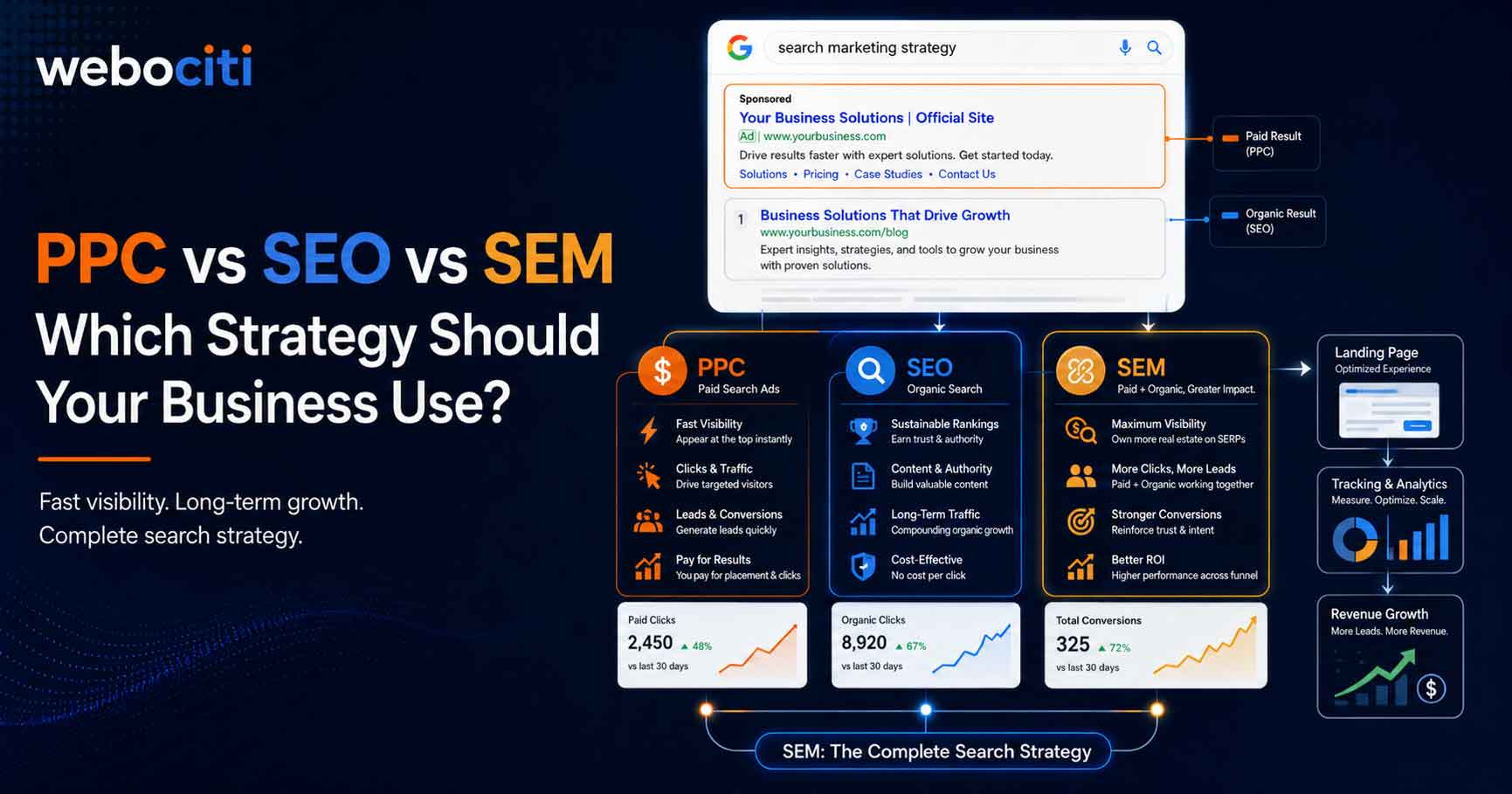
PPC, SEO, and SEM all help businesses increase visibility in search, but they work in different ways. The right strategy depends on your goals, timeline, budget, and how quickly you need leads.

Quick Summary:

PPC is paid advertising that can generate traffic and leads quickly.
SEO builds long-term organic visibility through content, technical optimization, and authority.
SEM is the broader search marketing strategy that can include both PPC and SEO.

For most growth-focused businesses, the strongest approach is not choosing one tactic in isolation. It is building a search strategy where paid ads, organic visibility, landing pages, lead capture, and conversion tracking work together.

Originally published in May 2023. Updated for 2026 with new guidance on PPC, SEO, SEM, search visibility, and revenue growth strategy.

Many businesses start with a simple question: should we invest in paid ads, SEO, or a broader search marketing strategy?

The answer depends on what you need most. If you need immediate visibility, PPC can help. If you want to build long-term organic traffic, SEO is usually the better foundation. If you want a coordinated search strategy that uses both paid and organic channels, SEM may be the right approach.

The mistake many companies make is treating PPC, SEO, and SEM as separate tactics instead of connected parts of a growth system. Search visibility only matters if it turns into qualified traffic, leads, conversations, and revenue.

For a deeper definition of PPC and SEM, read our related guide:
PPC vs SEM: What’s the Difference?

What Is PPC?

PPC stands for pay-per-click. It is a paid advertising model where businesses pay when someone clicks on an ad.

PPC ads often appear at the top of search engine results pages, on social media platforms, across display networks, and in video or streaming environments. Google Ads is one of the most common examples of PPC advertising.

PPC is often useful when a business wants faster visibility, wants to test offers, or needs to generate leads in a shorter period of time.

What Is SEO?

SEO stands for search engine optimization. SEO focuses on improving a website’s organic visibility in search results.

SEO includes content strategy, technical optimization, page structure, internal linking, local search visibility, authority building, and improving the user experience on your website.

SEO usually takes longer than PPC, but it can build more sustainable search visibility over time. When done correctly, SEO can help reduce long-term dependence on paid traffic.

If your business needs long-term organic visibility, stronger rankings, and content-driven lead generation, explore Webociti’s
SEO services for small business.

What Is SEM?

SEM stands for search engine marketing. SEM is the broader strategy of increasing visibility in search engines through paid and organic tactics.

SEM can include PPC, SEO, content marketing, landing page optimization, conversion tracking, and other strategies designed to turn search visibility into leads and revenue.

In simple terms, PPC and SEO are tactics. SEM is the larger search marketing strategy that can bring those tactics together.

PPC vs SEO vs SEM: Key Differences

Strategy Best For Timeline Main Limitation
PPC Fast visibility, paid leads, offer testing Short-term Traffic stops when the budget stops
SEO Organic traffic, authority, long-term visibility Longer-term Takes time to build momentum
SEM Coordinated paid and organic search strategy Short-term and long-term Requires strategy, tracking, and coordination

When PPC Makes Sense

PPC can be a good fit when your business needs immediate visibility or wants to generate leads quickly.

  • You are launching a new product or service
  • You need leads quickly
  • You want to test an offer or message
  • You are entering a competitive market
  • You want to retarget website visitors
  • You need visibility while SEO is still building

PPC works best when the ads are connected to strong landing pages, clear messaging, conversion tracking, and a defined follow-up process.

If your business needs faster visibility, paid traffic, or campaign support, explore Webociti’s
digital advertising services.

When SEO Makes Sense

SEO makes sense when your business wants to build long-term organic visibility and attract people who are actively searching for solutions.

  • You want to reduce dependence on paid traffic
  • You want more organic leads over time
  • You have useful expertise to publish
  • You want to rank for service, industry, or local search terms
  • You want to build authority and trust
  • You are willing to invest consistently over time

SEO is not instant, but it can become one of the most valuable long-term marketing assets for a business.

If your business needs long-term organic visibility, stronger rankings, and content-driven lead generation, explore Webociti’s
SEO services for small business.

When SEM Makes Sense

SEM makes sense when your business needs a more complete search strategy that combines the speed of paid search with the long-term value of organic search.

A strong SEM strategy may include:

  • Paid search campaigns
  • SEO strategy
  • Landing page optimization
  • Keyword and intent research
  • Content creation
  • Conversion tracking
  • Lead follow-up and reporting

SEM works best when PPC and SEO are not managed in isolation. Paid search can create speed, while SEO builds authority and long-term visibility.

Why Most Businesses Need a Combination

For many businesses, the best answer is not PPC or SEO. It is both, used at the right time and connected to the right strategy.

PPC can help generate leads while SEO is building. SEO can reduce long-term dependence on paid traffic. SEM can bring both together so the business is not relying on one channel alone.

The real goal is not just traffic. The goal is qualified traffic that turns into leads, opportunities, and revenue.

How to Choose Based on Timeline, Budget, and Goals

Use your timeline, budget, and business goals to decide where to focus first.

  • Need leads fast? Start with PPC and strong landing pages.
  • Need long-term visibility? Invest in SEO and content.
  • Need both speed and sustainability? Build an SEM strategy that combines PPC and SEO.
  • Not sure where to start? Look at your website, conversion paths, tracking, and current lead sources first.

The right choice depends on where your growth system is weakest. Some businesses need traffic. Others need better conversion. Others need stronger messaging before spending more on ads or SEO.

How PPC, SEO, and SEM Fit Into a Revenue Growth System

PPC, SEO, and SEM can all generate visibility, but visibility alone does not create growth.

Search marketing needs to connect to the full customer journey, including positioning, messaging, landing pages, lead capture, sales follow-up, and conversion tracking.

A PPC campaign may generate clicks, but if the offer is unclear, those clicks may not become qualified leads. SEO may generate organic traffic, but if the website lacks strong calls to action, that traffic may not turn into revenue.

That is why PPC, SEO, and SEM should be planned as part of a larger
revenue growth system.

Related guide:
For a deeper explanation of the relationship between paid search and search engine marketing, read

PPC vs SEM: What’s the Difference?
.

PPC vs SEO vs SEM Frequently Asked Questions

Which is better, PPC, SEO, or SEM?

PPC is best for immediate paid visibility. SEO is best for long-term organic growth. SEM is best when a business wants a complete search strategy that combines paid and organic visibility.

Should small businesses use PPC or SEO first?

It depends on the business goal. If a company needs leads quickly, PPC may be the better starting point. If the goal is sustainable organic traffic, SEO may be the better long-term investment.

Can PPC and SEO work together?

Yes. PPC and SEO often work best together. PPC can test keywords, offers, and landing pages quickly, while SEO can build long-term visibility around the topics and searches that matter most.

Is SEM the same as PPC?

No. PPC is a paid advertising model. SEM is a broader search marketing strategy that can include PPC, SEO, content, landing pages, and conversion tracking.

How long does SEO take compared to PPC?

PPC can begin generating traffic shortly after launch. SEO usually takes longer, often several months, because search engines need time to crawl, index, and evaluate content, authority, and technical improvements.

Need Help Choosing the Right Search Marketing Strategy?

PPC, SEO, and SEM can all help your business grow, but only when they are connected to the right message, offer, landing pages, tracking, and follow-up process.

Webociti helps businesses align paid search, SEO, lead generation, and conversion strategy into a smarter revenue growth system.

Need help deciding between paid search and organic growth? Explore our digital advertising services
or learn more about our SEO services for small business.

Not sure whether your business needs SEO, paid advertising, lead generation, or a broader growth strategy? Take the Webociti Growth Program Assessment to find the right next step.

Originally published May 28, 2015. Updated June 4, 2026.

Most businesses are creating more content than ever. Blog posts. Emails. Social media updates. Landing pages. Videos. Sales materials. Lead magnets. Website copy.

The problem is not always a lack of content.

The problem is that much of the content is created once, published once, and then forgotten.

That is where adaptive content becomes valuable.

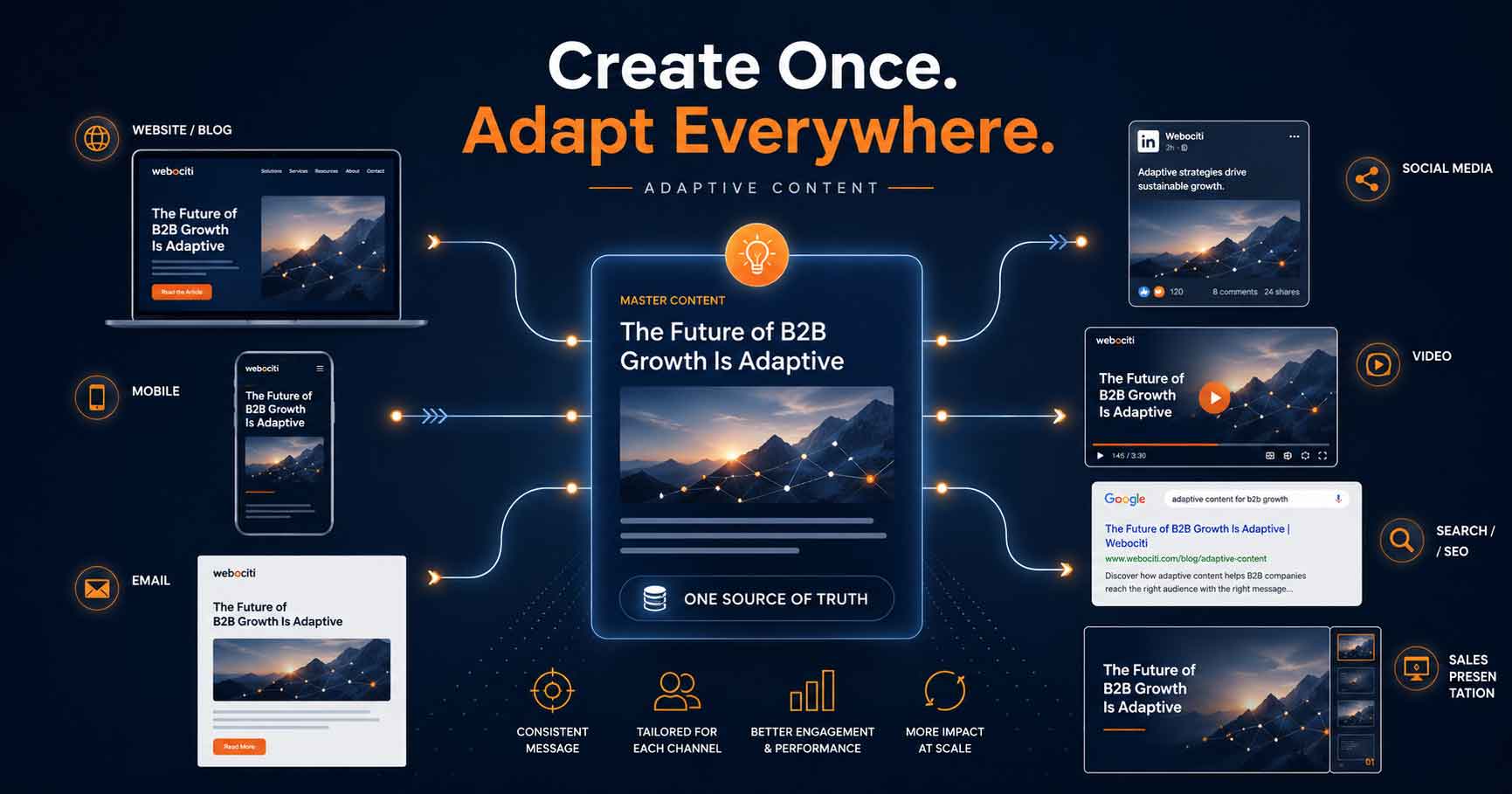
Adaptive content is content designed to work across multiple channels, formats, devices, and customer situations. Instead of creating one blog post for one purpose, adaptive content gives you a smarter way to reuse, reformat, personalize, and distribute your message wherever your customers are paying attention.

In a digital world where buyers move between Google, social media, email, websites, mobile devices, AI search tools, and sales conversations, content needs to do more than exist. It needs to adapt.

What Is Adaptive Content?

Adaptive content is content created with flexibility in mind.

It is structured so it can be reused across different platforms, personalized for different audiences, and delivered in different formats without starting from scratch every time.

A strong piece of adaptive content may begin as a blog post, but it can also become:

  • A short email newsletter
  • A LinkedIn post
  • A sales follow-up resource
  • A downloadable guide
  • A video script
  • A social media carousel
  • A landing page section
  • A frequently asked question
  • A talking point for your sales team

That is the power of adaptive content. It helps your message travel further without forcing your team to recreate everything from the beginning.

Adaptive Content Is More Than Evergreen Content

Adaptive content and evergreen content are related, but they are not the same thing.

Evergreen content is designed to stay useful over time. It does not rely heavily on short-term news, trends, or seasonal events. A strong evergreen article can continue attracting traffic months or years after it is published.

Adaptive content goes a step further.

Adaptive content is not only built to last. It is built to move.

It can be adjusted for different audiences, different buying stages, different channels, and different formats. A blog post on your website may serve an early-stage buyer who is researching a problem. A shorter version of that same content may help a prospect understand your approach in an email. A simplified version may become a social media post. A more detailed version may become part of a sales presentation or lead magnet.

Evergreen content lasts. Adaptive content travels.

Why Adaptive Content Matters for Modern Marketing

Buyers rarely move in a straight line.

They may discover your business through Google, visit your website on a phone, follow your company on LinkedIn, read a blog post, watch a video, sign up for an email, and then speak with your team weeks later.

That means your message needs to remain clear and consistent across every touchpoint.

Adaptive content helps your business:

  • Maintain a consistent message across channels
  • Reach buyers at different stages of the decision process
  • Improve the return on every piece of content you create
  • Support SEO, email, social media, advertising, and sales enablement
  • Reduce wasted effort from one-off content creation
  • Create a better experience for mobile users

Mobile matters because Google uses the mobile version of a site’s content for indexing and ranking. That makes mobile-ready content structure an important part of modern search visibility.

The Five Essentials of Adaptive Content

Adaptive content works best when it is planned before it is written.

Here are five essential characteristics.

1. It Is Built Around the Customer

Adaptive content starts with the audience.

Before creating content, ask:

  • Who is this for?
  • What problem are they trying to solve?
  • What do they already understand?
  • What questions do they need answered?
  • What action should they take next?

Content becomes more useful when it is connected to the customer’s actual situation.

For example, a founder of an early-stage company may need basic messaging and website structure. A CEO of a growing company may need stronger lead generation or fractional marketing leadership. A business owner preparing for acquisition may need a clearer value story.

The topic may be similar, but the content should adapt to the reader’s stage and need.

2. It Is Structured for Reuse

A long, unorganized page is harder to reuse.

Adaptive content should be structured in clear sections so pieces can stand on their own. That means using strong headings, short paragraphs, focused sections, lists, FAQs, and clear takeaways.

When content is well structured, you can easily turn one article into multiple assets.

For example, one blog post can become:

  • Five social posts
  • One email newsletter
  • Three short videos
  • A sales handout
  • A landing page section
  • A downloadable checklist

That is not just efficient. It creates consistency.

Your audience hears the same core message in different ways across different channels.

3. It Uses Meaningful Metadata

Metadata helps search engines and platforms understand your content.

This includes your SEO title, meta description, headings, image alt text, categories, tags, internal links, and structured data where appropriate.

That does not mean metadata alone will make content successful. It will not.

But when strong content is paired with clear structure and helpful metadata, it becomes easier for search engines and users to understand what the page is about.

For adaptive content, metadata should answer three questions:

  • What is this content about?
  • Who is it for?
  • What problem does it help solve?

4. It Is Mobile-Friendly

Adaptive content must work well on mobile devices.

That means more than fitting on a smaller screen. It means the content must be easy to scan, easy to read, and easy to act on.

Mobile-friendly adaptive content usually includes:

  • Shorter paragraphs
  • Clear subheadings
  • Simple formatting
  • Fast-loading images
  • Readable font sizes
  • Clear calls to action
  • Buttons that are easy to tap

If a visitor lands on your page from a phone and has to pinch, zoom, scroll endlessly, or hunt for the next step, the content is not really adaptive.

It may be published online, but it is not built for how people actually consume information.

5. It Supports the Next Step

The best adaptive content is not just informative. It is useful.

Every piece of content should help the visitor move forward.

That next step might be:

  • Reading a related article
  • Downloading a guide
  • Taking an assessment
  • Exploring a service page
  • Scheduling a strategy call
  • Sharing the content with someone else on their team

This is where many businesses miss the opportunity. They publish helpful content, but they do not connect it to a larger growth system.

Adaptive content should support the buyer journey, not just fill a blog.

Adaptive Content and AI Search

Adaptive content is becoming even more important as search behavior changes.

People still use Google, but they also ask questions inside AI tools, scan summaries, compare options across platforms, and expect faster answers.

That does not mean businesses should write for algorithms instead of people.

It means content needs to be clearer, more useful, and better structured.

Helpful adaptive content should include:

  • Clear definitions
  • Direct answers to common questions
  • Practical examples
  • Original insights based on real experience
  • Logical headings
  • Internal links to deeper resources

Content that is vague, thin, outdated, or overly promotional is easier to ignore.

Content that explains a problem clearly and gives the reader a practical next step is more likely to remain useful across traditional search, AI-assisted search, social sharing, and sales conversations.

Examples of Adaptive Content in Action

Here is what adaptive content can look like in practice.

Example 1: A Blog Post Becomes a Campaign

A company writes a detailed blog post explaining how to improve lead quality.

That post can become:

  • A LinkedIn post about why more leads are not always better
  • An email to prospects struggling with inconsistent pipeline
  • A short video explaining qualified pipeline
  • A landing page section for lead generation services
  • A sales follow-up resource after discovery calls

The original content becomes the foundation for a larger campaign.

Example 2: A Service Page Becomes Sales Enablement

A fractional CMO service page can also become adaptive content.

Sections from the page can be reused as:

  • A one-page PDF for prospects
  • A proposal introduction
  • A discovery call talking point
  • A nurture email
  • A comparison article about hiring a CMO vs. using a fractional CMO

That helps marketing and sales tell the same story.

Example 3: A Customer Question Becomes Search Content

If prospects keep asking the same question, that question may deserve its own article, FAQ, video, or email.

For example:

  • Do we need SEO or lead generation first?
  • When should we hire a fractional CMO?
  • How do we know if our messaging is holding back growth?
  • What should we fix before spending more on ads?

These questions are not just support issues. They are content opportunities.

How to Start Building an Adaptive Content System

You do not need to start from scratch.

A practical adaptive content process can look like this:

  1. Start with one core topic. Choose a topic connected to a real customer problem.
  2. Write the main article or page. Make it useful, structured, and easy to scan.
  3. Break it into smaller pieces. Pull out key ideas, examples, questions, and takeaways.
  4. Adapt each piece by channel. Turn sections into social posts, emails, videos, or sales assets.
  5. Connect everything with internal links. Guide readers to related services, programs, assessments, and next steps.
  6. Review and refresh over time. Update outdated examples, improve structure, and add new insights as your market changes.

The goal is not to create more random content.

The goal is to create content that can support visibility, trust, lead generation, sales conversations, and growth.

Adaptive Content Turns Marketing Into a System

Adaptive content works because it connects strategy and execution.

It helps your business move away from disconnected marketing activity and toward a more structured growth system.

Instead of asking, “What should we post this week?” you begin asking better questions:

  • What does our audience need to understand?
  • Where are buyers getting stuck?
  • Which messages should show up across multiple channels?
  • How can one strong idea support search, social, email, and sales?
  • What next step should this content support?

That shift matters.

Adaptive content is not just a content marketing tactic. It is a smarter way to make your message work harder across the entire buyer journey.

Need Help Turning Content Into a Growth System?

Adaptive content works best when it is connected to a larger growth strategy.

Webociti helps businesses clarify their message, improve their digital presence, and build content systems that support search visibility, lead generation, and revenue growth.

If your content feels scattered or disconnected from growth, start here:

Content should do more than fill your website. It should help your business attract the right audience, answer better questions, and move qualified prospects closer to action.

Revenue System Strategy

How to Build a Revenue Growth System

Growth does not become predictable because a company does more marketing, adds more sales activity, or reviews more dashboards. It becomes predictable when the pieces behind revenue are connected.

A revenue growth system connects positioning, demand generation, pipeline quality, conversion, and revenue feedback into one operating framework so leadership can diagnose where growth is working, where it is breaking, and what needs to improve next.

In Summary

A revenue growth system is the structure that connects how a business attracts the right buyers, qualifies opportunities, advances pipeline, converts revenue, and learns from market feedback.

Instead of treating marketing, sales, and revenue as separate functions, a revenue growth system aligns them around the same buyer, the same message, the same pipeline definitions, and the same growth outcomes.

The goal is not more activity. The goal is better-fit opportunities, stronger conversion, cleaner pipeline, and more predictable revenue.

Part of the Webociti Revenue System Series

This guide is part of a larger series on how businesses can move from disconnected marketing and sales activity to a connected revenue growth system.

Predictable revenue is not built from disconnected tactics. It is built from a connected system.

What Is a Revenue Growth System?

A revenue growth system is the connected structure behind how a company attracts the right buyers, qualifies opportunities, advances pipeline, converts revenue, and learns from market feedback.

It is not one campaign. It is not one sales process. It is not one CRM dashboard.

It is the operating system behind predictable growth.

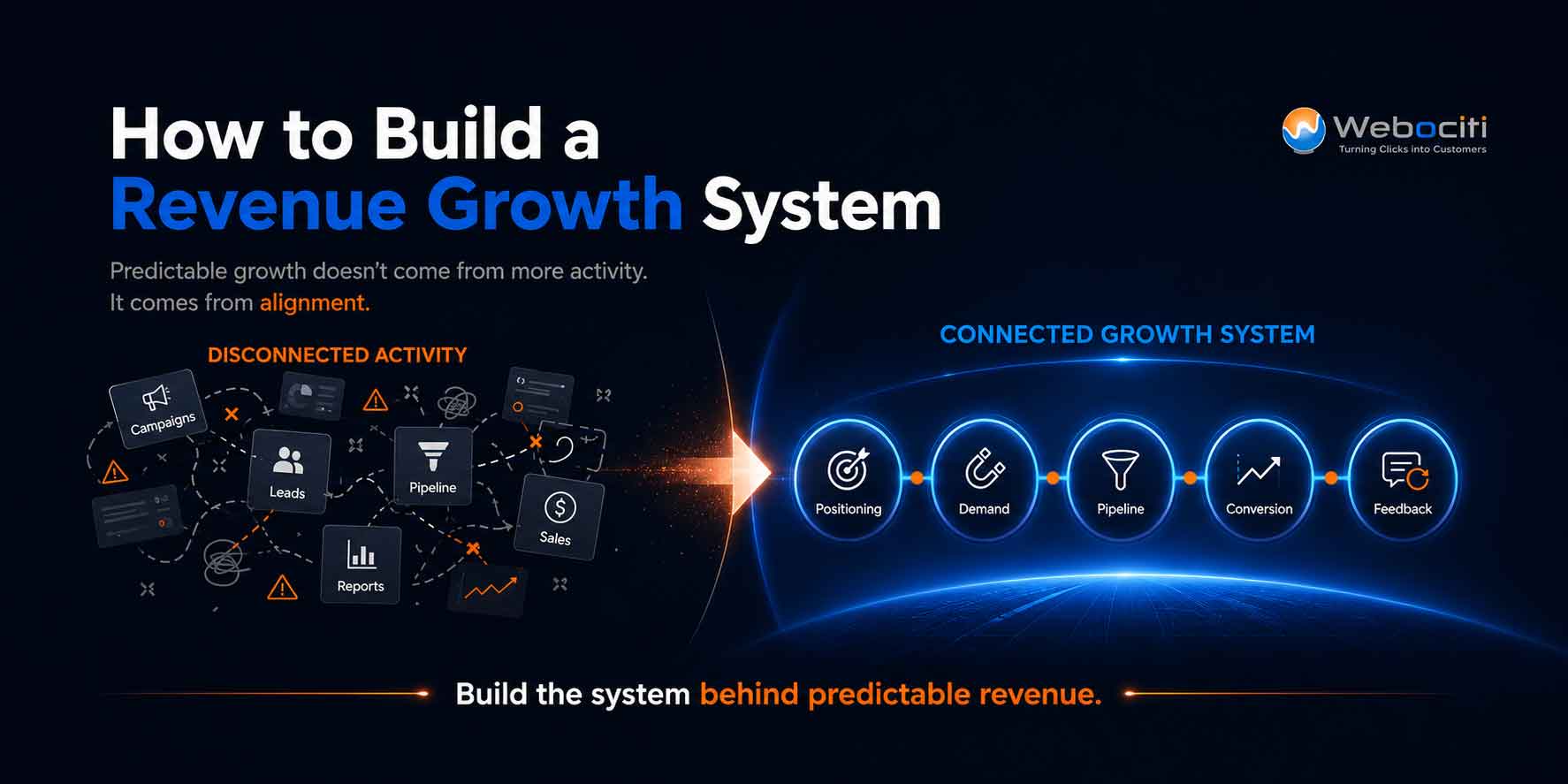
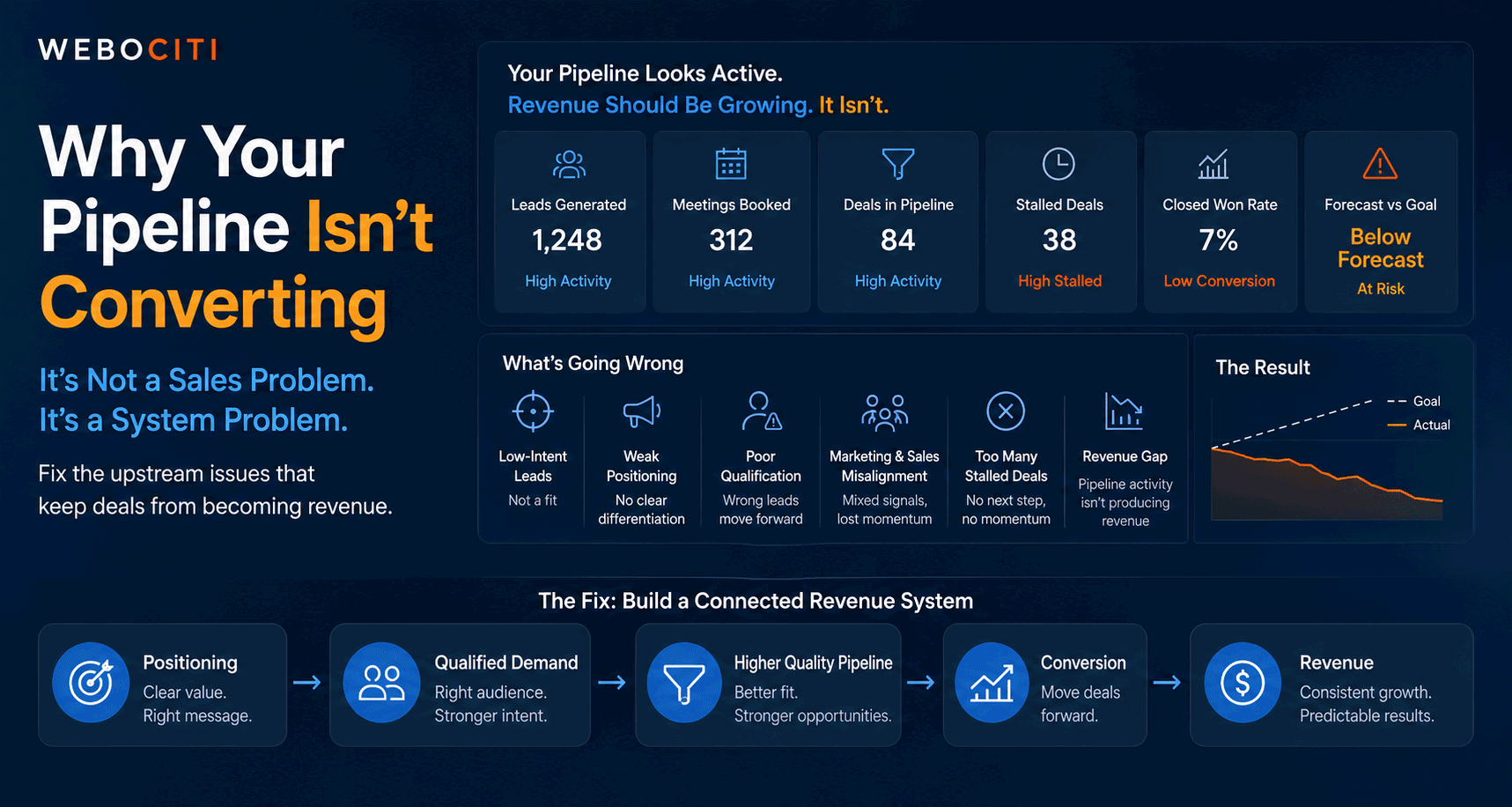
A strong revenue growth system connects five core parts:

Positioning → Demand → Pipeline → Conversion → Revenue Feedback

Each stage feeds the next. When one stage is weak, everything downstream becomes harder. When the stages are connected, the business can diagnose growth more clearly and improve the system over time.

This is the difference between companies that create activity and companies that create momentum.

Activity is easy to generate. Momentum requires alignment.

For a deeper look at the full framework, read: What a Real Revenue System Actually Looks Like.

Why Most Growth Systems Break

Most companies do not intentionally design their revenue system.

They add pieces over time.

  • A website gets built.
  • Marketing campaigns get launched.
  • Sales tools get added.
  • CRM stages get created.
  • Reporting dashboards get reviewed.
  • New people join the team.

Each piece may make sense on its own. But if those pieces are not connected, the company ends up with growth activity instead of a growth system.

That is where the breakdown starts.

  • Marketing attracts the wrong audience.
  • Sales questions lead quality.
  • Pipeline looks active but does not convert.
  • Leadership pushes for more leads instead of better-fit opportunities.
  • Revenue remains inconsistent.
Most growth problems are not caused by one broken tactic. They are caused by disconnected parts of the revenue system.

When marketing, sales, pipeline, and conversion are not aligned, activity can increase while revenue stays unpredictable.

If your marketing is creating activity but not qualified opportunities, this is likely part of the problem: Why Your Marketing Isn’t Generating Qualified Leads.

Step 1: Start With Positioning

Every revenue growth system starts with positioning.

Positioning defines who you serve, what problem you solve, why that problem matters, and why buyers should choose you instead of another option.

If positioning is weak, everything downstream becomes harder.

  • Marketing becomes too broad.
  • Content attracts the wrong audience.
  • Sales conversations require too much explanation.
  • Pipeline quality suffers.
  • Conversion becomes inconsistent.

Strong positioning creates clarity before the buyer ever talks to sales.

It helps answer the questions buyers are already asking:

  • Is this for me?
  • Do they understand my problem?
  • Can they solve the issue I care about?
  • Why should I act now?
  • Why should I choose this company?

Without those answers, marketing becomes noise and sales becomes education.

Weak positioning attracts weak-fit opportunities. Strong positioning creates the foundation for qualified demand.

That is why positioning is not just a branding exercise. It is the first operating decision in a revenue growth system.

Step 2: Define the Right Buyer

A revenue growth system cannot work if the company is unclear about who it is trying to attract.

Many companies define their market too broadly. They focus on everyone who could buy instead of the buyers most likely to convert, stay, grow, and create long-term value.

That creates noise in the system.

The right buyer should be defined by more than basic demographics, company size, or industry category.

Look at:

  • Fit — Does this buyer match your ideal customer profile?
  • Need — Do they have a real problem you can solve?
  • Urgency — Is there a reason to act?
  • Authority — Can they influence or make a decision?
  • Value — Is the opportunity worth pursuing?
  • Conversion potential — Can this buyer realistically move through your process?

This step matters because the wrong buyer can make every part of the revenue system look weaker than it actually is.

A poor-fit lead may engage with your marketing, book a call, and enter the pipeline, but that does not mean they are a real revenue opportunity.

If they lack urgency, budget, authority, need, or strategic fit, they slow the system down. Sales spends more time educating, qualifying, and chasing instead of advancing real opportunities.

The goal is not to attract everyone who could possibly buy.

The goal is to attract the buyers most likely to understand the value, move through the process, and convert into profitable revenue.

The clearer the buyer definition, the cleaner the pipeline becomes.

When the right buyer is clearly defined, campaigns improve, messaging sharpens, pipeline quality increases, and the sales team spends more time with better-fit opportunities.

Step 3: Build Demand Around Buyer Problems

Demand generation should not start with what you want to sell.

It should start with what the buyer needs to solve.

Many companies build marketing around services, features, internal priorities, or whatever campaign they want to push next.

But buyers respond to problems, outcomes, risks, and opportunities.

A strong revenue growth system turns positioning into demand by connecting the company’s message to real buyer pain.

That means your content, ads, email campaigns, social posts, landing pages, and offers should all answer one question:

Why should the right buyer care now?

If your marketing creates traffic, clicks, and form fills but not qualified opportunities, you are not building demand. You are building activity.

The goal is not attention alone.

The goal is qualified demand from buyers who understand the problem, see the value, and have a reason to take the next step.

Demand generation should create interest from the right buyers, not just more movement at the top of the funnel.

When demand is built around real buyer problems, marketing becomes more relevant, lead quality improves, and the pipeline has a better chance of turning into revenue.

Step 4: Design the Pipeline Around Quality

A pipeline should not be a dumping ground for every inquiry.

It should be a structured system for identifying, qualifying, advancing, and converting real opportunities.

This is where many companies lose control of growth.

They treat every lead like an opportunity. They allow low-fit prospects to move too far into the process. They measure pipeline volume instead of pipeline quality.

The result is predictable:

  • Sales gets buried in weak conversations.
  • Deals stall.
  • Forecasts become unreliable.
  • Leadership sees pipeline activity but not revenue momentum.

A strong revenue growth system defines what belongs in the pipeline and what does not.

That requires clear qualification criteria:

  • Who is a real fit?
  • What problem are they trying to solve?
  • What stage of awareness are they in?
  • What action should happen next?
  • What disqualifies an opportunity?
  • What signals real buying intent?

A quality-focused pipeline gives your team a cleaner view of what is real.

Instead of measuring success by the number of opportunities in the CRM, the company can evaluate whether those opportunities match the buyer profile, have a clear business need, and show enough momentum to justify continued sales effort.

This changes how the team manages growth.

Sales can focus on better conversations. Marketing can see which sources create real opportunities. Leadership gets a more accurate view of future revenue.

A full pipeline does not always mean a healthy pipeline. Pipeline quality matters more than pipeline volume.

If your pipeline looks full but deals are not moving, read:
Why Your Pipeline Isn’t Converting.

Step 5: Align Marketing and Sales Around Revenue

Marketing and sales cannot operate from different definitions of success.

If marketing is optimizing for lead volume while sales is responsible for revenue, the system will eventually break.

Marketing may celebrate activity while sales questions lead quality. Sales may blame marketing while marketing argues the leads were delivered. Leadership may see motion but not know where the real breakdown is happening.

The fix is alignment around shared revenue outcomes.

Both teams should agree on:

  • Who the ideal buyer is
  • What makes a lead qualified
  • What pipeline stages mean
  • What messages are resonating
  • Where opportunities are stalling
  • Which channels create real revenue

This alignment changes the conversation from blame to diagnosis.

Instead of asking whether marketing produced enough leads or whether sales followed up fast enough, the team can look at the full system and identify where revenue is actually breaking.

That might be a targeting issue. It might be a messaging issue. It might be a qualification issue. It might be a conversion issue.

But until marketing and sales share the same definitions, the business cannot diagnose the problem clearly.

Alignment gives leadership one shared view of growth instead of separate marketing, sales, and revenue opinions.

When marketing and sales are aligned, demand improves, pipeline gets cleaner, and conversion becomes more predictable.

When they are disconnected, revenue becomes a guessing game.

Step 6: Improve Conversion as a System Outcome

Conversion is often treated as a sales issue.

But conversion is usually the result of everything that happened before the sales conversation.

Clear positioning improves conversion. Better-fit demand improves conversion. Stronger qualification improves conversion. Sharper messaging improves conversion. Better handoffs improve conversion.

That is why companies should not look at conversion in isolation.

If close rates are weak, the answer may not be to pressure sales harder. The better question is:

What is happening upstream that makes conversion harder than it should be?

A revenue growth system makes conversion a shared outcome across positioning, marketing, sales, and leadership.

Conversion improves when the full system improves — not when sales is forced to work harder around weak-fit opportunities.

When the right buyers enter the pipeline with clearer expectations, stronger intent, and better alignment around the problem, sales conversations become easier to advance and easier to close.

Step 7: Use Revenue Feedback to Improve the System

A real revenue growth system learns from the market.

Revenue feedback should not stay trapped in reports, sales calls, CRM notes, or leadership meetings. It should be used to improve the entire system.

Look at:

  • Which buyers convert fastest?
  • Which deals stall?
  • Which messages create real engagement?
  • Which campaigns produce qualified opportunities?
  • Which objections keep appearing?
  • Which customer segments produce the most value?
  • Which offers lead to real conversations?

This feedback loop is what makes a revenue growth system stronger over time.

Every closed deal, stalled opportunity, lost proposal, and customer conversation contains useful information. The best companies use that information to refine positioning, sharpen messaging, improve qualification, adjust sales conversations, and strengthen the growth strategy.

Without this loop, companies keep repeating the same campaigns, the same sales motions, and the same mistakes without learning from the market.

Revenue feedback should not sit in reports. It should change how the system works.

Revenue feedback turns growth from a linear funnel into a learning system.

This is also why companies eventually outgrow traditional funnel thinking:
Revenue System vs Sales Funnel.

The Revenue Growth System Framework

A revenue growth system is not a collection of disconnected tactics.

It is a connected operating framework that helps leadership understand how growth is created, where it is breaking, and what needs to be improved.

Viewed as a whole, the system works when each stage feeds the next and revenue feedback improves everything over time.

This is what a revenue growth system looks like:

Revenue growth system framework showing positioning, demand generation, pipeline design, conversion, and revenue feedback connected as one growth system

The Five Parts of a Revenue Growth System

1. Positioning

Clarify who you serve, what problem you solve, why your solution matters, and why buyers should choose you.

2. Demand Generation

Create interest from the right buyers by connecting your message to real business problems, not just promoting services or features.

3. Pipeline Design

Filter, qualify, and advance real opportunities instead of allowing every inquiry to become a sales priority.

4. Conversion

Turn buyer fit into revenue through clear messaging, strong handoffs, defined next steps, and a repeatable sales process.

5. Revenue Feedback

Use market data, sales conversations, stalled deals, wins, losses, and customer insights to improve the system over time.

Each part affects the next.

If positioning is unclear, demand becomes weak. If demand is weak, pipeline quality suffers. If pipeline quality suffers, conversion becomes inconsistent. If conversion is inconsistent, revenue becomes unpredictable.

The framework gives leadership a way to diagnose growth as a system instead of reacting to symptoms one tactic at a time.

How to Know Your Revenue Growth System Is Broken

Once you look at growth through this system, the warning signs become much easier to see.

You may need to redesign your revenue growth system if the business is producing activity, but that activity is not turning into predictable revenue.

  • Your marketing is generating leads, but sales says they are not qualified.
  • Your pipeline looks full, but deals are not moving.
  • Your close rate is inconsistent.
  • Your sales cycle is getting longer.
  • Your messaging feels unclear or too broad.
  • Your team is doing more activity without better results.
  • Your revenue forecast is difficult to trust.
  • Your growth depends too heavily on individual effort.
  • Your marketing and sales teams are not aligned.

These are not random issues. They are symptoms of a system that is creating motion without enough momentum.

The solution is not always another campaign, another salesperson, or another dashboard. The solution is to identify where the system is breaking and fix the connection between positioning, demand, pipeline, conversion, and feedback.

If the business is busy but revenue still feels unpredictable, the problem is usually not effort. It is system design.

A revenue growth system gives leadership a way to diagnose the real constraint instead of reacting to surface-level symptoms.

Why This Matters for Founders and Leadership Teams

For founders, CEOs, and leadership teams, the revenue growth system matters because it changes how growth is managed.

Instead of reacting to symptoms, leadership can diagnose where the system is breaking and make better decisions about strategy, marketing, sales, pipeline, and investment.

  • If lead quality is weak, look at positioning and demand.
  • If pipeline is inflated, look at qualification and buyer fit.
  • If deals stall, look at urgency, messaging, and the sales process.
  • If revenue is inconsistent, look at the system, not just the team.

This creates better decisions.

It also makes the business more scalable.

A company with a clear revenue growth system is easier to manage, easier to measure, easier to improve, and more valuable over time.

That matters whether the goal is scaling, improving profitability, attracting investment, preparing for acquisition, or reducing the company’s dependence on individual effort.

A revenue growth system gives leadership a clearer way to manage growth instead of constantly reacting to disconnected marketing and sales activity.

For companies that need senior-level guidance, this is where a structured growth strategy or fractional marketing leadership model can help align the system and keep execution accountable.

Learn more about Webociti’s
Growth Strategy Program
and
Marketing Leadership Program.

The Bottom Line

Growth does not become predictable by doing more of everything.

More campaigns, more leads, more outreach, more pressure, and more reporting will not fix a disconnected revenue system.

Predictable growth comes from alignment.

That means the right positioning, the right buyers, the right demand, the right pipeline, the right conversion process, and the right feedback loop all working together.

When those pieces are disconnected, growth becomes reactive. When they are connected, the business has a system it can measure, improve, and scale.

A revenue growth system is not more activity. It is a better operating system for growth.

That is how companies move from scattered marketing and inconsistent pipeline to clearer strategy, cleaner opportunities, and more predictable revenue.

Continue the Revenue System Series

Explore the related articles in this series to better understand how positioning, qualified demand, pipeline quality, conversion, and revenue leadership work together.

Turn the Framework Into a Growth Plan

If your business needs help connecting strategy, lead generation, marketing leadership, and pipeline performance, Webociti’s growth programs are designed to help you build the system behind sustainable growth.

Build a Better Growth System

You Don’t Need More Growth Activity. You Need a Revenue Growth System.

If your marketing, sales, and pipeline are not working together, it may be time to diagnose the system behind your growth and identify the next move with more clarity.

TL;DR: If you’re comparing internet marketing companies in Atlanta, don’t start with tactics.
Start with strategy, measurement, and proof they can drive qualified leads (not just traffic). This guide shows what to look for in SEO, PPC, content, and conversion plus the red flags to avoid.

In Summary

Most Atlanta businesses don’t need “more marketing.” They need a system that turns visibility into revenue: the right traffic, the right message, and a conversion path that works. This page explains how to evaluate an internet marketing company in Atlanta, what services matter, how to assess strategy and reporting, and how to avoid agencies that sell activity instead of outcomes.

How to Choose an Internet Marketing Company in Atlanta (2026 Guide)

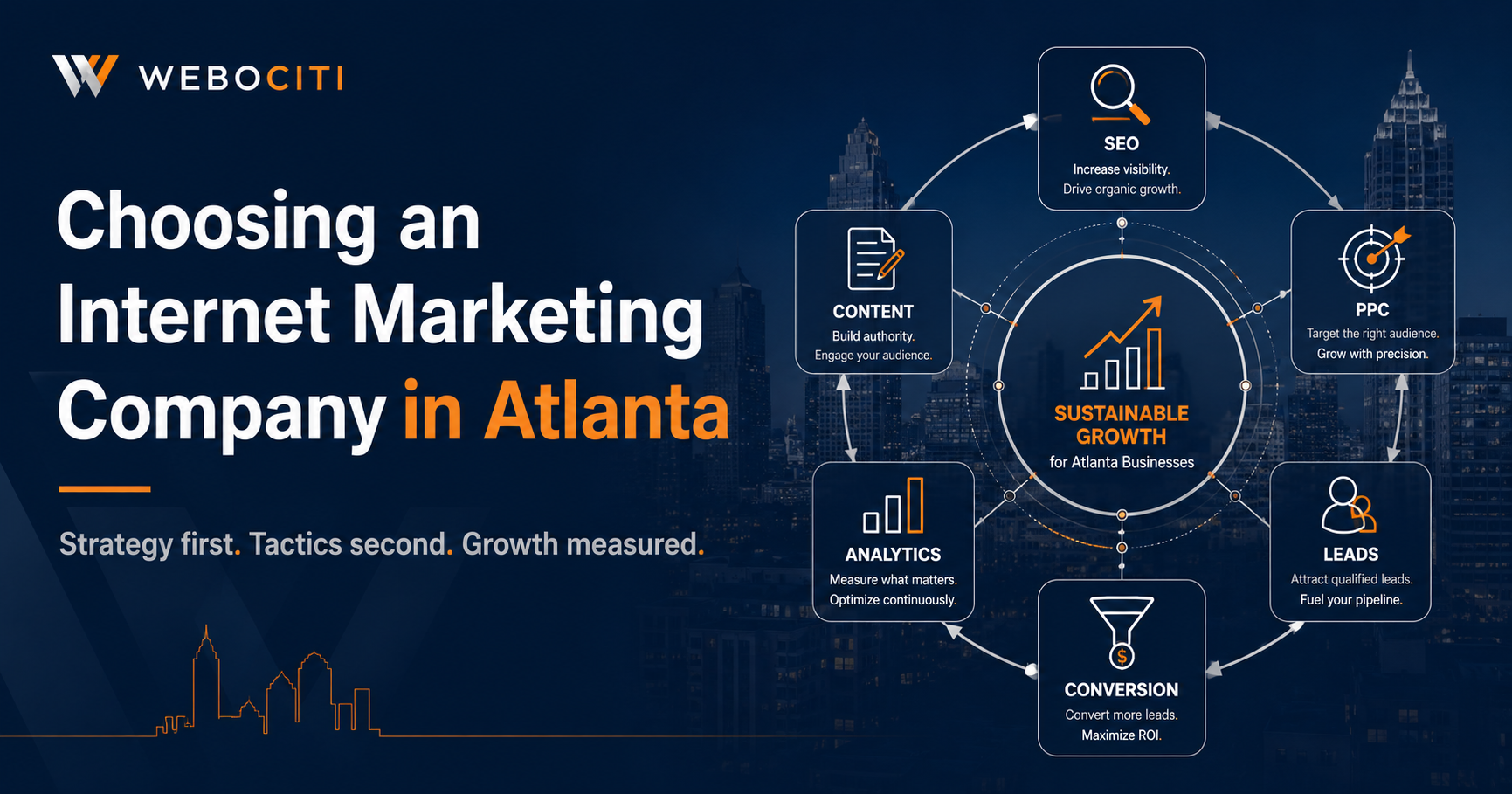
If you’re evaluating internet marketing companies in Atlanta, the most important factor is alignment, not just services. The right marketing partner should integrate SEO, PPC, content, analytics, and conversion strategy into one measurable growth system. In a competitive market like Atlanta, disconnected tactics waste budget quickly. If you want to understand what modern search strategy actually requires, this explains what makes SEO work today.

This guide explains how to compare agencies, evaluate pricing models, identify red flags, and determine whether an SEO-focused firm or a full-service marketing company is the better fit for your business.

What Is an Internet Marketing Company?

An internet marketing company in Atlanta typically provides services such as search engine optimization (SEO), paid advertising (PPC), content marketing, website optimization, and analytics tracking. Some firms specialize in a single channel, while others build integrated growth systems across multiple digital platforms.


Types of Internet Marketing Companies in Atlanta

The phrase internet marketing company is broad. Two agencies can use the same label and deliver completely different outcomes. Before you compare proposals, clarify what kind of partner you’re actually hiring:

  • SEO-focused agency: organic visibility, content strategy, technical SEO, local search performance
  • PPC / media buying firm: paid search, paid social, YouTube, programmatic, landing page testing
  • Content-led growth team: blogs, thought leadership, authority-building, conversion content
  • Web/creative shop: design and build work sometimes with light SEO, often without growth strategy
  • Full-funnel growth partner: messaging, strategy, channel mix, measurement, CRO, compounding systems

Executive takeaway: You’re not hiring “marketing.” You’re hiring a growth system or a set of disconnected tasks.


How Atlanta Businesses Should Evaluate a Marketing Company

If you want outcomes, evaluate agencies on the things that actually drive outcomes. Here’s the practical checklist.

1) Strategy Before Tactics

A strong Atlanta marketing partner should be able to explain why specific channels will work for your business not just list services. They should ask about your ideal customers, sales cycle, margin, and competitive density. That alignment only works when you understand how search engines drive business growth and how intent translates into revenue.

  • Do they understand your ICP and buyer journey?
  • Can they prioritize channels based on intent and economics?
  • Do they talk about positioning and conversion not just traffic?

2) Measurement, Attribution, and Accountability

Many agencies report on activity (posts, clicks, impressions). You want a partner who reports on outcomes (leads, booked calls, pipeline, revenue contribution where possible).

  • What KPIs define success for your business?
  • How do they track lead quality — not just lead volume?
  • How often do you review results and adjust strategy?
  • Do you own the accounts, data, and tracking infrastructure?

3) Ability to Compete in a Dense Market

Atlanta is crowded. If your category has strong incumbents, local competitors, and aggressive ad spend, the agency must know how to build a realistic plan that wins over time.

  • Can they show examples from competitive markets?
  • Do they understand local search dynamics (maps, reviews, proximity signals)?
  • Can they improve conversion rate so traffic turns into revenue?

SEO vs PPC vs Content vs Social: What Should You Invest In?

Most businesses don’t fail because they “picked the wrong channel.” They fail because they treat channels as separate tactics instead of building a connected system.

SEO (Long-Term Demand Capture)

SEO works best when you want compounding visibility for searches with real intent — especially in service categories where buyers research options before they call. If you’re questioning whether SEO still matters, this explains why search engine optimization still matters for serious growth businesses.

If you’re specifically evaluating SEO help in Atlanta, this is the most direct resource:
Atlanta SEO Services.

If you want the “why this matters” view — and how SEO compounds — this guide explains it clearly:
Why SEO Is Still the Most Reliable Long-Term Growth Channel.

For businesses with multiple service lines or product categories, structure matters. This guide explains how category page SEO improves search visibility. If you’re selling products or service packages, this explains how product page SEO directly impacts revenue.

PPC (Speed + Control)

Paid campaigns can generate demand quickly but only if conversion tracking is correct, landing pages match intent, and the offer is strong.

Content (Authority + Trust)

Content is not “blogging.” In competitive markets, it’s how you become the obvious choice.

Social (Support, Not the Foundation)

Social is valuable for trust and visibility, but it’s rarely the primary growth engine.

Rule: Your channel mix should match your buyer’s intent and your tracking should prove what’s working.


Red Flags When Hiring a Marketing Agency in Atlanta

  • Guaranteed rankings or “#1 on Google” promises
  • No questions about your buyer
  • Reporting focused on impressions and clicks
  • No plan for conversion
  • Everything is “content” with no technical SEO or internal linking
  • You don’t own your accounts

When Should an Atlanta Business Hire an Internet Marketing Company?

Hiring a marketing partner becomes high-leverage when:

  • You’ve plateaued and need a clearer strategy to break through
  • You’re spending on ads but don’t have consistent lead quality
  • Your website gets traffic but doesn’t convert into calls or purchases
  • You want predictable growth without relying only on referrals
  • You need senior-level marketing leadership without a full-time CMO hire

If you need more than a single marketing service, review Webociti’s
Digital Marketing Programs to see how strategy, execution, lead generation, and marketing leadership can work together as a connected growth system.

If you’re still unsure where to start, this framework connects the full system (SEO + ads + messaging + conversion):
Internet Marketing for Business Growth.


Questions to Ask Before You Sign an Agency Agreement

  • What does success look like in 90 days, 6 months, and 12 months?
  • Which KPIs do you report on — and how do you define lead quality?
  • What is your strategy for improving conversion rate?
  • How do you decide what to prioritize each month?
  • What access do we have to accounts, tracking, and data?
  • How do you handle competitive markets and rising ad costs?

What to Do Next

If you’re evaluating internet marketing companies in Atlanta, the winning move is to hire a partner that builds a measurable growth system not one that sells disconnected deliverables.

If your priority is search visibility and qualified inbound demand, start here:
Atlanta SEO Services.

And if you want a broader strategy-first view of how all channels connect into one growth engine, use this guide as your reference point:
Internet Marketing for Business Growth.

Not sure what kind of marketing support your business needs? Take the Webociti Growth Program Assessment to see whether your business is a better fit for Smart Start, Growth Strategy, Lead Generation, Marketing Leadership, or Acquisition Ready support.


Internet Marketing Companies in Atlanta: Quick FAQs

Below are the most common questions businesses ask when comparing internet marketing companies in Atlanta.

How much do marketing companies in Atlanta typically cost?
Pricing varies by scope and accountability. Strategy-led retainers are usually higher than “task-based” packages because they include planning, measurement, and optimization not just deliverables.
Should I hire an SEO agency or a full-service marketing company?
If SEO is your primary growth lever, hire an SEO-focused partner with technical depth and conversion alignment. If you need a connected multi-channel system, a strategy-led partner is usually a better fit.
How long does it take to see results?
PPC can generate results in weeks. SEO usually compounds over 3–6 months and becomes a durable growth asset over 6–12 months.

TL;DR: Category page SEO is the practice of optimizing eCommerce collection pages to rank for high-intent commercial keywords that drive revenue—not just traffic.

In Summary

Category pages often generate more organic revenue than individual product pages because they align with how buyers search and compare options. Effective category page SEO requires intent-driven keyword targeting, controlled indexation, strong internal linking, optimized category content, and conversion-ready UX. When structured correctly, category pages become durable ranking assets that scale with inventory.

Category Page SEO: How to Optimize Category Pages for Revenue

In eCommerce, product pages close the sale but category pages usually attract the buyer. When someone searches “men’s waterproof hiking boots” or “best espresso machines under $500,” they’re not looking for a single SKU. They’re looking for a curated set of options they can compare.

That’s why category pages (Shopify collections, WooCommerce product categories, and similar templates) often carry the biggest revenue SEO potential. Done right, they become stable ranking assets that generate consistent demand.


Why Category Page SEO Drives More Revenue Than Product Pages

Category pages tend to rank for broader, commercial-intent terms that capture buyers earlier in the journey. They also consolidate authority across products, reduce “orphan page” risk, and help search engines understand your site structure.

If your eCommerce SEO strategy is focused on revenue (not vanity traffic), category pages are often the highest-leverage place to improve.

Executive takeaway: Category pages aren’t navigation. They’re strategic landing pages for high-intent buyers.


Step 1: Align Category Pages With Purchase Intent

The most common category SEO mistake is building categories around internal naming instead of buyer language.

  • Bad: “Winter Collection 2026”
  • Better: “Men’s Insulated Winter Jackets”
  • Best: “Men’s Waterproof Winter Jackets for Extreme Cold”

Category pages should map to how customers search:

  • Product type + modifier (waterproof, insulated, non-toxic, etc.)
  • Brand + product type
  • Use case + product type
  • Problem-based searches (skin type, space constraints, pain points)

If your category pages don’t match purchase intent, you end up ranking for broad informational terms — or not ranking at all.


Step 2: Add Strategic Category Content (Without Killing UX)

A lot of stores either leave category pages thin and empty… or overload them with keyword-stuffed paragraphs. The best approach is:

  • 150–300 words of helpful, scannable copy (not fluff)
  • Clear “who this is for” guidance
  • Quick buyer considerations (materials, fit, sizing, use cases)
  • Subcategory links that help both customers and crawlers

Keep the copy tight. Your goal is to support relevance and trust — not to bury the products.

Rule: Category content should help a buyer decide — and help Google understand the page in under 30 seconds.


Step 3: Build Internal Linking That Makes Categories Rank

Category pages are the backbone of your internal linking architecture. They should be easy to reach and clearly supported by links from:

  • Homepage and primary navigation
  • Subcategory hubs
  • Relevant blog content (guides, comparisons, best-of lists)
  • High-authority pages across your site

Internal linking is how you “vote” for which categories matter. If a category page is buried 4–6 clicks deep, it will struggle to rank.

Related reading:
SEO for eCommerce Websites: What Actually Drives Revenue
(cornerstone).


Step 4: Control Indexation, Filters, and Duplicate URLs

Category pages are where eCommerce SEO can get messy fast because platforms generate duplicates via:

  • Filter URLs
  • Sort parameters
  • Pagination
  • Variants and collection paths
  • Tag archives

If you allow every variation to index, you create “index bloat” — too many low-value pages competing for the same keywords and diluting authority.

  • Canonicalize duplicates to the primary category page
  • Prevent thin filter variations from indexing
  • Keep one clean URL as the “ranking page” per intent

Reference: Google’s Core Web Vitals documentation emphasizes how performance impacts user experience and search visibility.
Google Core Web Vitals documentation.


Step 5: Optimize Category UX for Conversion (Because Rankings Don’t Pay Bills)

Category pages rank best when users engage. If visitors bounce, rankings eventually slip. The conversion-ready category page includes:

  • Fast load speed (especially on mobile)
  • Helpful filters that improve shopping (without creating index bloat)
  • Clear pricing and shipping/returns visibility
  • Trust signals (reviews, badges, guarantees where applicable)
  • Clean layout that supports scanning and comparison

Search visibility and conversion performance are connected. A page that ranks but doesn’t help customers decide won’t hold position long-term.

Related reading:
Product Page SEO: How to Optimize Product Pages for Revenue.


Common Category Page SEO Mistakes

  • Targeting internal naming instead of buyer intent keywords
  • Thin categories with no relevance signals
  • Over-indexing filters/tags/sort URLs
  • Poor internal link depth (categories too far from authority)
  • Bloated content that harms UX and engagement

How Category Page SEO Compounds Over Time

Strong categories compound because:

  • They support future product launches with built-in authority
  • They stabilize rankings across changing inventory
  • They create repeatable “money page” templates you can scale
  • They improve crawl efficiency and site understanding

This is why category architecture is one of the most durable long-term growth levers in eCommerce SEO.

Companion guide:
Why SEO Is Still the Most Reliable Long-Term Growth Channel.


Where Category SEO Fits in the Bigger System

Category SEO isn’t standalone. It works when your system is aligned:

  • Technical foundation (crawl/indexation/performance)
  • Category architecture (intent-driven collections)
  • Product pages (unique content + decision support)
  • Internal linking (authority flow + discoverability)
  • Conversion alignment (UX and trust)

If you want a broader view of how this connects with other growth channels, this guide helps:
Internet Marketing for Business Growth.

Category page SEO works best when integrated into a complete eCommerce SEO system. Technical health, product optimization, and internal linking must support category intent for rankings to compound over time.


What To Do Next

If you want category pages to rank consistently and drive revenue, start by choosing one priority category and optimizing it end-to-end: intent keyword targeting → structure → internal linking → index control → conversion UX.

If your business competes in a high-density market and needs strategy-led search visibility, you’ll see the same system applied in our location work as well — including Atlanta SEO services.

TL;DR: Product page SEO drives revenue when search intent, technical structure, trust signals, and conversion clarity work together. Rankings alone don’t sell optimized decision-making does.

In summary

Most product pages rank poorly or rank but don’t convert because they focus on keywords instead of buyer intent. High-performing product pages combine technical SEO, structured data, persuasive content, internal linking, and frictionless UX to turn search visibility into measurable revenue.

Why Product Page SEO Is Where Revenue Actually Happens

In eCommerce, category pages attract traffic but product pages close the sale.

If your product pages don’t rank for high-intent searches or fail to support decision-making once visitors arrive, your SEO investment stalls at visibility instead of revenue.


Step 1: Align the Product Page With Purchase Intent

Product page SEO starts with understanding the exact query that brings the buyer to the page. Is the search branded? Comparison-based? Feature-specific? Use-case driven?

  • Target long-tail purchase queries (brand + product + attribute)
  • Match page title and H1 to buyer language
  • Avoid keyword stuffing prioritize clarity
  • Ensure metadata reflects transactional intent

Product pages should answer the buyer’s final question not introduce the product for the first time.


Step 2: Build Unique, Conversion-Supporting Content

Manufacturer copy rarely ranks — and it rarely persuades. High-performing product pages include original content that supports decision confidence.

  • Clear value proposition above the fold
  • Use-case explanations
  • Specifications formatted for scanability
  • Benefit-driven subheadings
  • FAQ blocks that reduce purchase friction

If your product description looks identical to 20 competitors, search engines and buyers have no reason to choose you.


Step 3: Implement Clean Product Structured Data

Product schema enhances visibility and improves click-through rate by enabling rich results.

  • Product
  • Offer
  • AggregateRating (when applicable)
  • Review
  • Availability

Structured data doesn’t improve rankings directly but it improves how your listings appear, which increases performance.


Step 4: Strengthen Internal Linking to Support Rankings

Many eCommerce stores accidentally create orphaned product pages. Without internal links, Google treats those pages as low priority.

  • Link products from relevant categories
  • Add “Related Products” and cross-sells
  • Link from blog guides to priority SKUs
  • Reduce crawl depth for high-margin products

Internal linking isn’t just for SEO it also increases average order value.

If you’re restructuring an ecommerce website or launching a redesign, follow our website migration SEO checklist
to avoid losing rankings during site changes.


Step 5: Remove Conversion Friction

Even perfectly optimized pages fail when buyers hesitate.

  • Clear pricing
  • Visible shipping & returns
  • Trust badges
  • Customer reviews
  • Fast mobile performance

As we discussed in our guide on
Why SEO Is Still the Most Reliable Long-Term Growth Channel, sustainable SEO growth depends on alignment between visibility and conversion.


Common Product Page SEO Mistakes

  • Thin content
  • Duplicate manufacturer descriptions
  • Over-optimized anchor text
  • Slow mobile performance
  • Too many filter-indexed variations
  • Ignoring search intent mismatch

How Product Page SEO Compounds

When structured properly:

  • Each optimized product builds domain authority
  • Internal links strengthen priority categories
  • Rich snippets improve click-through rates
  • Better UX increases repeat buyers

Product page optimization is not a one-time task it’s an ongoing performance system.


Where Product Page SEO Fits Into the Bigger System

Product page SEO works best when connected to:

  • Category page strategy
  • Technical SEO structure
  • Content marketing
  • Conversion optimization

If you haven’t read it yet, start with our foundational guide: SEO for eCommerce Websites: What Actually Drives Revenue.


What To Do Next

If your product pages are ranking but not converting or not ranking at all the issue is rarely “more keywords.”

It’s alignment between search intent, technical execution, and buyer decision-making.

When those elements work together, product page SEO becomes a predictable revenue driver not a guessing game.

If you’re scaling ecommerce growth, working with an experienced SEO services team helps align strategy, technical execution, and conversion performance.

Want to improve product page performance?

Request a technical SEO review and we’ll identify where your product pages are losing visibility, conversions, and revenue.

Request a Free SEO Review

TL;DR:SEO for eCommerce websites drives revenue when technical foundations, category structure, product intent, and conversion paths work together as a system not isolated “SEO tasks.”

In summary

Most eCommerce SEO fails because it chases traffic instead of purchase intent. The stores that win build search visibility around how customers actually browse, compare, and buy using category architecture, product page optimization, internal linking, and technical performance to turn rankings into revenue.

Why SEO for eCommerce Websites Is Different Than “Normal” SEO

eCommerce sites don’t have a handful of service pages — they have dozens (or thousands) of products, multiple collections, filters, variants, and constantly changing inventory. That complexity is exactly why SEO can become a revenue engine… or a mess that burns time without meaningful outcomes.

The goal isn’t to “rank more pages.” The goal is to build visibility for the searches that indicate buying intent, then make it easy for searchers to choose you and complete a purchase.

Why Traffic Alone Doesn’t Drive Revenue

Many stores see an SEO bump and still don’t see sales lift. That’s usually because they’re ranking for broad, informational queries that don’t match purchase intent or because the site experience doesn’t convert once visitors arrive.

Sustainable eCommerce SEO focuses on the full chain: discovery → evaluation → decision. If any link breaks, rankings become a vanity metric.

The 5 Revenue Drivers of eCommerce SEO

1) Technical Foundation That Helps Search Engines Trust the Site

You can’t “content your way” out of technical problems. eCommerce SEO requires clean crawling and indexing, fast performance, stable templates, and controlled duplication from filters and variants.

  • Indexation control (what should and shouldn’t be indexed)
  • Canonical strategy for variants and duplicate URLs
  • Core Web Vitals + mobile performance
  • Clean category/product hierarchy and internal link depth

As Google explains, performance directly impacts both user experience and search rankings.

2) Category Page Strategy (Where Most Revenue SEO Lives)

In eCommerce, category and collection pages often carry the biggest revenue weight — because they match
how people shop (browse by intent, then narrow down).

  • Build category pages around buyer language, not internal naming
  • Target “money” queries: brand + product type + use case
  • Add helpful category content (brief, scannable, non-fluffy)
  • Use internal links to push authority into the right collections

3) Product Page Optimization That Supports Decision-Making

Product pages are where intent becomes revenue. SEO is only helpful if the page answers the questions buyers need to feel confident.

  • Unique product copy (not manufacturer boilerplate)
  • Clear value, specs, use cases, and trust signals
  • Strong internal linking: related products, accessories, “frequently bought together”
  • Clean structured data (Product, Offer, AggregateRating when applicable)

4) Internal Linking That Guides Both Crawlers and Customers

eCommerce sites naturally create “orphan” pages — products that exist but aren’t supported by internal links. Internal linking is how you control what ranks and what fades.

  • Use category → subcategory → product pathways consistently
  • Link to top collections from authority content (guides, “best of,” comparisons)
  • Reduce crawl depth for priority revenue pages
  • Avoid creating index bloat from thin tag/filter pages

5) Conversion Alignment (Because Rankings Don’t Pay Bills)

Search visibility is only valuable when it leads to action. That means aligning SEO landing pages with clear conversion paths — and removing friction in the purchase journey.

  • Fast pages, clear pricing, shipping/returns visibility
  • Stronger PDP trust: reviews, guarantees, comparison points
  • Better category UX: filters that help buyers, not hurt indexing
  • Landing-page intent match: the page must match the query’s promise

Platform Notes: Shopify vs WooCommerce vs Custom Stores

The fundamentals are the same, but execution varies. Shopify can create duplication through collections and URL patterns. WooCommerce can get heavy with plugins and performance issues. Custom builds often struggle with template consistency and crawl logic.

The key is not the platform — it’s the system: technical control + intent-driven architecture + conversion alignment.

Platform migrations require careful SEO planning. Our website migration checklist walks through the exact process to protect rankings.


Serious about scaling eCommerce revenue?
If you need an SEO system designed around revenue architecture — not traffic vanity metrics explore our SEO strategy framework →

How eCommerce SEO Compounds Over Time

Unlike paid traffic, SEO compounds. A strong category architecture strengthens future category launches. Great product pages rank and convert for years. Internal links push authority where you want it. And every improvement builds on the last.

This is why we’ve framed SEO as a long-term asset in our guide: Why SEO Is Still the Most Reliable Long-Term Growth Channel.

When to Invest in eCommerce SEO

eCommerce SEO becomes high-leverage when:

  • You sell products with repeat or evergreen demand
  • You’re competing in a category where ads are expensive
  • You want more first-time buyers without perpetual ad spend
  • You need stronger visibility for “ready to buy” searches

What to Do Next

If your SEO efforts are generating traffic but not revenue, it’s time to audit the system not the keywords., start by treating it as a system. That system connects search intent, technical structure, category architecture, product optimization, and conversion performance.

If your business competes in a high-density market and needs a strategy-led approach to search visibility, you’ll see the same framework applied in our location-based work as well including
Atlanta SEO services.

And if you’re mapping a broader marketing system that integrates SEO with the rest of your digital growth engine, this companion guide helps: Internet Marketing for Business Growth.


When SEO is engineered into the structure of the business not layered on top it becomes an asset that compounds for years.

If you’re evaluating how search should support revenue at scale, the first step is not more keywords. It’s clarity around structure, intent alignment, and conversion architecture.

This systems approach to search visibility is the same foundation we apply in competitive markets — including Atlanta SEO services.

TL;DR: Internet marketing works best when SEO, content, and digital channels are aligned around buyer intent and business goals not executed as isolated tactics.

In summary

Internet marketing today is no longer about individual channels or quick wins. Sustainable growth comes from aligning SEO, content, paid media, and strategy around how buyers actually discover, evaluate, and choose businesses.

What Internet Marketing Really Means Today

Internet marketing is the practice of using digital channels to attract, engage, and convert customers online. While the term once referred primarily to websites and email, modern internet marketing encompasses search engines, content, paid media, social platforms, and conversion optimization.

The key difference today is integration. No single channel operates in isolation, and results improve when each supports the others. For businesses comparing providers, this is especially important when evaluating an internet marketing company in Atlanta that builds strategy before tactics.

The Core Channels of Internet Marketing

Most effective internet marketing strategies are built on a combination of:

  • Search Engine Optimization (SEO) to capture demand when buyers are actively searching
  • Content marketing to educate, build authority, and support long sales cycles
  • Paid media to accelerate visibility and test demand
  • Website optimization to convert attention into action
  • Analytics and measurement to guide decisions and investment

Why SEO Anchors Internet Marketing

SEO often serves as the foundation of internet marketing because it captures high-intent demand and compounds over time. Unlike paid advertising, SEO continues generating visibility and traffic long after content is published.

For a deeper look at why SEO continues to outperform short-term channels, see why SEO compounds over time as a long-term growth strategy
.

If you’re evaluating whether SEO is still relevant in today’s environment, this explains why search engine optimization still matters for long-term growth businesses.

Execution also matters. This breakdown explains what makes SEO work today in competitive markets.

The Problem With Channel-First Marketing

Many businesses struggle with internet marketing because they approach it tactically. One vendor handles SEO, another runs ads, and content is produced without a clear strategy tying it all together.

The result is fragmented execution—activity without momentum and metrics without clarity.

How Strategy Changes Internet Marketing Outcomes

When internet marketing is driven by strategy, channels stop competing for credit and start reinforcing each other. SEO insights inform content, content improves conversion rates, and paid media validates demand.

This approach reduces wasted spend, shortens learning curves, and produces more predictable growth.

This same system-level thinking is explored in more detail in our breakdown of how search engines drive business growth.

What Internet Marketing Success Looks Like

Effective internet marketing produces outcomes that extend beyond traffic:

  • Consistent inbound demand from qualified prospects
  • Lower customer acquisition costs over time
  • Stronger brand authority in competitive markets
  • Clear insight into what drives growth

For businesses selling structured services or products, aligning search structure matters. Optimizing category-level SEO and strengthening product page SEO for revenue are examples of how channels reinforce one another.

Applying Internet Marketing Locally

While internet marketing principles apply broadly, execution often changes at the local level. For example, businesses competing in major metros require search and content strategies tailored to competitive density and buyer behavior.

This is the same strategic framework we apply when delivering Atlanta SEO services designed to support long-term, sustainable growth.

Internet Marketing as a Growth System

Internet marketing works best when viewed as a system—not a checklist. Businesses that invest in alignment, measurement, and strategy gain a durable competitive advantage that compounds over time.

When channels work together, internet marketing becomes more than promotion—it becomes a growth engine.

Businesses looking to operationalize this approach can explore how we apply integrated strategy across our digital marketing services.


Related Strategic Insights

TL;DR: SEO remains the most reliable long-term growth channel because it compounds over time, aligns with buyer intent, and continues generating demand long after the work is done.

In summary

While marketing tactics come and go, search engine optimization continues to deliver durable, compounding growth. This article explains why SEO remains the most reliable long-term growth channel—and how businesses can use it to build sustainable demand instead of chasing short-term wins.

The Problem With Short-Term Growth Tactics

Many businesses rely heavily on short-term marketing tactics like paid advertising, promotions, or campaign-based traffic. While these approaches can generate quick wins, they stop producing results the moment spending or effort pauses.

This creates a cycle of dependency where growth becomes unpredictable and increasingly expensive over time. For businesses evaluating strategic marketing direction, this broader framework explains how internet marketing drives sustainable business growth.

Why SEO Behaves Differently Than Other Channels

SEO works because it aligns with how buyers naturally search, research, and make decisions. Instead of interrupting audiences, it positions your business where demand already exists.

Each improvement—technical performance, content relevance, authority—builds on the last. Over time, SEO compounds instead of resetting. If you’re unsure what modern optimization requires, this breakdown explains what makes SEO work today.

How SEO Compounds Over Time

Unlike paid channels where results reset daily, SEO gains accumulate. Pages that rank today can continue driving traffic, leads, and revenue for months or years.

  • Content continues attracting qualified buyers
  • Authority strengthens across your entire site
  • Cost per acquisition decreases over time
  • Visibility supports every stage of the buyer journey

For businesses selling products or structured services, this is where strategic structure matters. Optimizing category-level search visibility and improving product page SEO for revenue accelerates compounding growth.

SEO Aligns With How Buyers Actually Decide

Modern buyers rely on search engines to understand problems, compare solutions, and evaluate providers. SEO supports this process by ensuring your business appears at the moments that matter most.

When search visibility is aligned with buyer intent, SEO becomes a trust-building mechanism—not just a traffic source. This is especially critical in competitive local markets like Atlanta, where choosing the right internet marketing company in Atlanta determines whether strategy or tactics lead the plan.

Why SEO Outlasts Algorithm Changes

While algorithms evolve, the fundamentals of SEO remain stable. Search engines consistently reward sites that deliver relevance, authority, and a strong user experience.

Businesses that treat SEO as a system—rather than a checklist—are far more resilient to updates and shifts in technology.

Where Businesses Go Wrong With SEO

SEO fails when it’s treated as a series of disconnected tactics. Common mistakes include:

  • Chasing keywords without understanding intent
  • Publishing content without conversion paths
  • Ignoring technical issues that block visibility
  • Measuring rankings instead of revenue impact

Many businesses lose visibility during redesigns because they overlook technical SEO planning. Use our website migration SEO checklist to protect rankings during major website changes.

If your SEO efforts aren’t producing results, it may be because the system isn’t aligned. This guide explains how search engines drive measurable business growth when executed strategically.

Why SEO Is Especially Powerful for Competitive Markets

In competitive and local markets, SEO creates a defensible advantage by capturing demand before buyers ever engage with ads or sales teams.

This is the same framework we apply when delivering Atlanta SEO services designed to support sustained growth in competitive environments.

What This Means for Long-Term Business Growth

SEO isn’t about quick wins—it’s about building an asset that supports your business year after year. When executed correctly, it becomes a reliable engine for visibility, trust, and revenue.

For businesses focused on long-term growth rather than short-term spikes, SEO remains the most dependable channel available.

Final Takeaway

Marketing trends will continue to change, but search behavior will not. Businesses that invest in SEO as a long-term growth system position themselves to win—not just today, but for years to come.

For businesses focused on long-term growth, working with an experienced SEO services team helps ensure strategy, execution, and measurement stay aligned.


Related Strategic Insights

TL;DR: Local SEO helps businesses get found by nearby customers at the exact moment they’re searching. When done correctly, it drives high-intent traffic, trust, and consistent local growth.

In summary

Local search plays a critical role in how customers discover, compare, and choose nearby businesses. This article explains how local SEO works, why it matters more than ever, and how search visibility turns local intent into real customer demand.

What Is Local SEO?

Local SEO is the practice of optimizing your online presence so your business appears when people search for products or services in a specific geographic area. These searches often include location modifiers like “near me,” city names, or neighborhood terms.

Unlike traditional SEO, which targets broad or national visibility, local SEO focuses on connecting businesses with customers who are ready to take action nearby. If you’re evaluating how local visibility fits into broader strategy, this guide explains why search engine optimization still matters as a growth channel.

Why Local Search Has Become the Default Buying Path

Today’s buyers rely on search engines to solve immediate problems. Whether they’re looking for a service provider, comparing options, or checking availability, local search is often the first step.

Search engines prioritize local relevance because proximity, intent, and trust signals help deliver better results to users. Businesses that appear in these results gain a significant advantage before a customer ever visits a website. This is part of the larger framework outlined in how search engines drive business growth.

How Local SEO Translates Visibility Into Customers

Local SEO works by aligning your business with how search engines evaluate relevance and trust. When done well, it helps your business appear consistently across key local touchpoints.

  • Search results for location-based queries
  • Google Business Profile listings
  • Maps and mobile search results
  • Local directories and citations

This visibility builds familiarity and credibility, making customers more likely to choose your business when they’re ready to act.

To understand how local visibility fits into a broader search strategy, revisit our article on What Makes SEO Work Today, which explains SEO as a long-term system.

What Actually Matters for Local SEO Today

Modern local SEO is not about stuffing city names into pages. It requires a coordinated approach that supports both search engines and real buyers.

  • Accurate and consistent business information
  • Clear alignment with local search intent
  • Authority signals like reviews and trusted mentions
  • Location-relevant content that answers real questions
  • Technical foundations that support crawlability and speed

When these elements work together, local SEO becomes a predictable growth channel rather than a guessing game. This compounding effect is why many businesses treat SEO as a long-term growth channel rather than a short-term tactic.

Where Many Local SEO Efforts Fall Short

Many businesses struggle with local SEO because they focus on isolated tactics instead of outcomes. Rankings are tracked, profiles are created, and content is published—but results remain inconsistent.

The missing piece is strategy. Without a clear plan that connects visibility to customer behavior, local SEO activity often fails to translate into measurable growth. This is especially common when comparing internet marketing companies in Atlanta that emphasize tasks instead of systems.

How Local SEO Supports Long-Term Business Growth

Unlike short-term advertising, local SEO compounds over time. Each improvement strengthens your visibility, trust, and relevance within your market.

Businesses that invest in local search visibility benefit from lower acquisition costs, stronger brand recognition, and demand that continues even when marketing budgets fluctuate. This alignment is part of a broader internet marketing growth strategy.

What This Means for Businesses Competing Locally

For businesses operating in competitive regions, local SEO must be treated as a system—not a checklist. Success comes from aligning technical execution, content, authority, and conversion paths with how local buyers actually search.

This same framework is applied when delivering Atlanta SEO services designed to help businesses capture local demand and convert search visibility into real revenue.

Final Takeaway

Local SEO influences nearly every local buying decision. When built correctly, it becomes a reliable engine for attracting qualified customers and supporting sustainable business growth.


Related Strategic Insights