
04 Jun How to Use Adaptive Content to Reach All Your Potential Customers
Originally published May 28, 2015. Updated June 4, 2026.
Most businesses are creating more content than ever. Blog posts. Emails. Social media updates. Landing pages. Videos. Sales materials. Lead magnets. Website copy.
The problem is not always a lack of content.
The problem is that much of the content is created once, published once, and then forgotten.
That is where adaptive content becomes valuable.
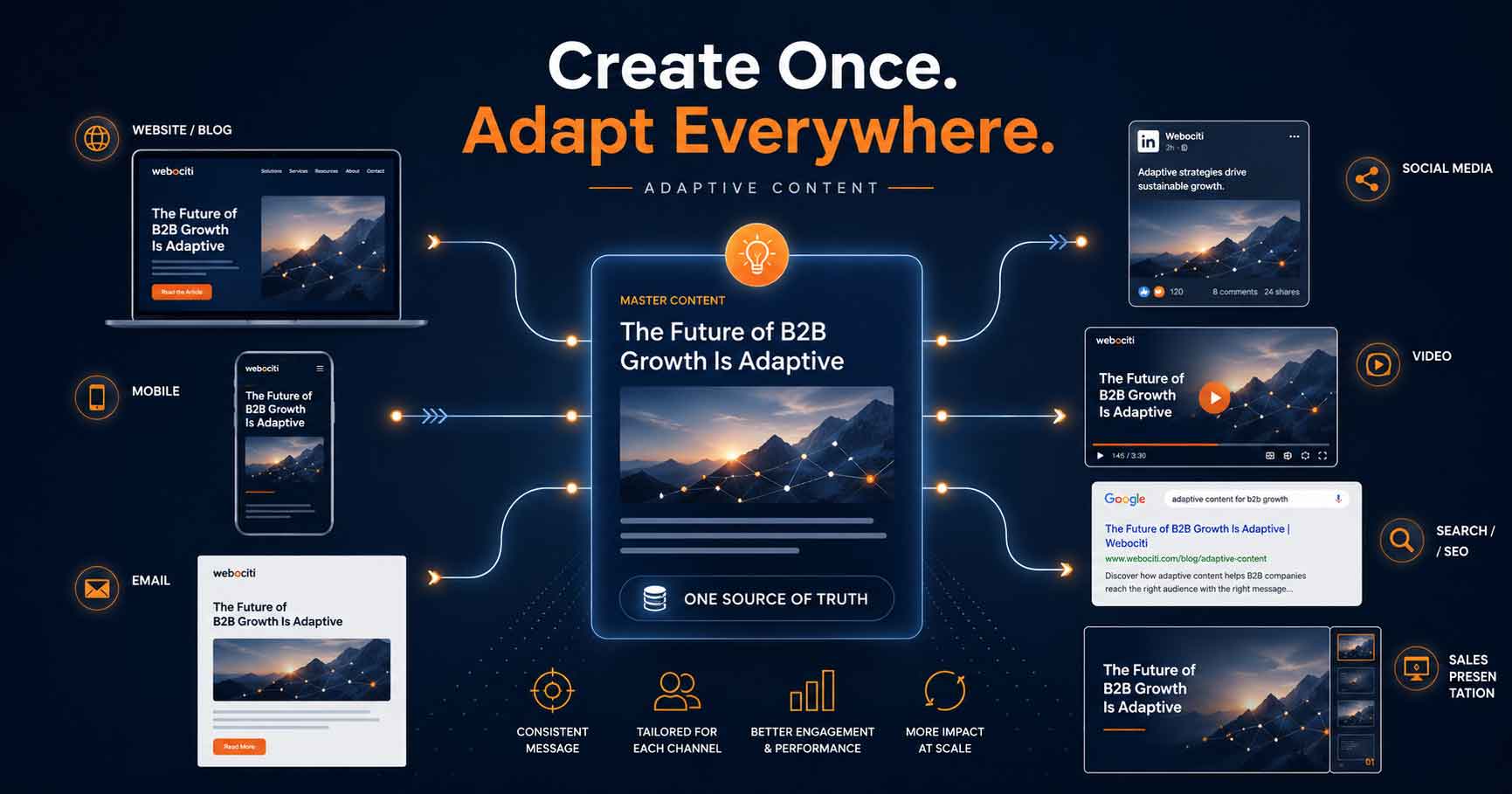
Adaptive content is content designed to work across multiple channels, formats, devices, and customer situations. Instead of creating one blog post for one purpose, adaptive content gives you a smarter way to reuse, reformat, personalize, and distribute your message wherever your customers are paying attention.
In a digital world where buyers move between Google, social media, email, websites, mobile devices, AI search tools, and sales conversations, content needs to do more than exist. It needs to adapt.
What Is Adaptive Content?
Adaptive content is content created with flexibility in mind.
It is structured so it can be reused across different platforms, personalized for different audiences, and delivered in different formats without starting from scratch every time.
A strong piece of adaptive content may begin as a blog post, but it can also become:
- A short email newsletter
- A LinkedIn post
- A sales follow-up resource
- A downloadable guide
- A video script
- A social media carousel
- A landing page section
- A frequently asked question
- A talking point for your sales team
That is the power of adaptive content. It helps your message travel further without forcing your team to recreate everything from the beginning.
Adaptive Content Is More Than Evergreen Content
Adaptive content and evergreen content are related, but they are not the same thing.
Evergreen content is designed to stay useful over time. It does not rely heavily on short-term news, trends, or seasonal events. A strong evergreen article can continue attracting traffic months or years after it is published.
Adaptive content goes a step further.
Adaptive content is not only built to last. It is built to move.
It can be adjusted for different audiences, different buying stages, different channels, and different formats. A blog post on your website may serve an early-stage buyer who is researching a problem. A shorter version of that same content may help a prospect understand your approach in an email. A simplified version may become a social media post. A more detailed version may become part of a sales presentation or lead magnet.
Evergreen content lasts. Adaptive content travels.
Why Adaptive Content Matters for Modern Marketing
Buyers rarely move in a straight line.
They may discover your business through Google, visit your website on a phone, follow your company on LinkedIn, read a blog post, watch a video, sign up for an email, and then speak with your team weeks later.
That means your message needs to remain clear and consistent across every touchpoint.
Adaptive content helps your business:
- Maintain a consistent message across channels
- Reach buyers at different stages of the decision process
- Improve the return on every piece of content you create
- Support SEO, email, social media, advertising, and sales enablement
- Reduce wasted effort from one-off content creation
- Create a better experience for mobile users
Mobile matters because Google uses the mobile version of a site’s content for indexing and ranking. That makes mobile-ready content structure an important part of modern search visibility.
The Five Essentials of Adaptive Content
Adaptive content works best when it is planned before it is written.
Here are five essential characteristics.
1. It Is Built Around the Customer
Adaptive content starts with the audience.
Before creating content, ask:
- Who is this for?
- What problem are they trying to solve?
- What do they already understand?
- What questions do they need answered?
- What action should they take next?
Content becomes more useful when it is connected to the customer’s actual situation.
For example, a founder of an early-stage company may need basic messaging and website structure. A CEO of a growing company may need stronger lead generation or fractional marketing leadership. A business owner preparing for acquisition may need a clearer value story.
The topic may be similar, but the content should adapt to the reader’s stage and need.
2. It Is Structured for Reuse
A long, unorganized page is harder to reuse.
Adaptive content should be structured in clear sections so pieces can stand on their own. That means using strong headings, short paragraphs, focused sections, lists, FAQs, and clear takeaways.
When content is well structured, you can easily turn one article into multiple assets.
For example, one blog post can become:
- Five social posts
- One email newsletter
- Three short videos
- A sales handout
- A landing page section
- A downloadable checklist
That is not just efficient. It creates consistency.
Your audience hears the same core message in different ways across different channels.
3. It Uses Meaningful Metadata
Metadata helps search engines and platforms understand your content.
This includes your SEO title, meta description, headings, image alt text, categories, tags, internal links, and structured data where appropriate.
That does not mean metadata alone will make content successful. It will not.
But when strong content is paired with clear structure and helpful metadata, it becomes easier for search engines and users to understand what the page is about.
For adaptive content, metadata should answer three questions:
- What is this content about?
- Who is it for?
- What problem does it help solve?
4. It Is Mobile-Friendly
Adaptive content must work well on mobile devices.
That means more than fitting on a smaller screen. It means the content must be easy to scan, easy to read, and easy to act on.
Mobile-friendly adaptive content usually includes:
- Shorter paragraphs
- Clear subheadings
- Simple formatting
- Fast-loading images
- Readable font sizes
- Clear calls to action
- Buttons that are easy to tap
If a visitor lands on your page from a phone and has to pinch, zoom, scroll endlessly, or hunt for the next step, the content is not really adaptive.
It may be published online, but it is not built for how people actually consume information.
5. It Supports the Next Step
The best adaptive content is not just informative. It is useful.
Every piece of content should help the visitor move forward.
That next step might be:
- Reading a related article
- Downloading a guide
- Taking an assessment
- Exploring a service page
- Scheduling a strategy call
- Sharing the content with someone else on their team
This is where many businesses miss the opportunity. They publish helpful content, but they do not connect it to a larger growth system.
Adaptive content should support the buyer journey, not just fill a blog.
Adaptive Content and AI Search
Adaptive content is becoming even more important as search behavior changes.
People still use Google, but they also ask questions inside AI tools, scan summaries, compare options across platforms, and expect faster answers.
That does not mean businesses should write for algorithms instead of people.
It means content needs to be clearer, more useful, and better structured.
Helpful adaptive content should include:
- Clear definitions
- Direct answers to common questions
- Practical examples
- Original insights based on real experience
- Logical headings
- Internal links to deeper resources
Content that is vague, thin, outdated, or overly promotional is easier to ignore.
Content that explains a problem clearly and gives the reader a practical next step is more likely to remain useful across traditional search, AI-assisted search, social sharing, and sales conversations.
Examples of Adaptive Content in Action
Here is what adaptive content can look like in practice.
Example 1: A Blog Post Becomes a Campaign
A company writes a detailed blog post explaining how to improve lead quality.
That post can become:
- A LinkedIn post about why more leads are not always better
- An email to prospects struggling with inconsistent pipeline
- A short video explaining qualified pipeline
- A landing page section for lead generation services
- A sales follow-up resource after discovery calls
The original content becomes the foundation for a larger campaign.
Example 2: A Service Page Becomes Sales Enablement
A fractional CMO service page can also become adaptive content.
Sections from the page can be reused as:
- A one-page PDF for prospects
- A proposal introduction
- A discovery call talking point
- A nurture email
- A comparison article about hiring a CMO vs. using a fractional CMO
That helps marketing and sales tell the same story.
Example 3: A Customer Question Becomes Search Content
If prospects keep asking the same question, that question may deserve its own article, FAQ, video, or email.
For example:
- Do we need SEO or lead generation first?
- When should we hire a fractional CMO?
- How do we know if our messaging is holding back growth?
- What should we fix before spending more on ads?
These questions are not just support issues. They are content opportunities.
How to Start Building an Adaptive Content System
You do not need to start from scratch.
A practical adaptive content process can look like this:
- Start with one core topic. Choose a topic connected to a real customer problem.
- Write the main article or page. Make it useful, structured, and easy to scan.
- Break it into smaller pieces. Pull out key ideas, examples, questions, and takeaways.
- Adapt each piece by channel. Turn sections into social posts, emails, videos, or sales assets.
- Connect everything with internal links. Guide readers to related services, programs, assessments, and next steps.
- Review and refresh over time. Update outdated examples, improve structure, and add new insights as your market changes.
The goal is not to create more random content.
The goal is to create content that can support visibility, trust, lead generation, sales conversations, and growth.
Adaptive Content Turns Marketing Into a System
Adaptive content works because it connects strategy and execution.
It helps your business move away from disconnected marketing activity and toward a more structured growth system.
Instead of asking, “What should we post this week?” you begin asking better questions:
- What does our audience need to understand?
- Where are buyers getting stuck?
- Which messages should show up across multiple channels?
- How can one strong idea support search, social, email, and sales?
- What next step should this content support?
That shift matters.
Adaptive content is not just a content marketing tactic. It is a smarter way to make your message work harder across the entire buyer journey.
Need Help Turning Content Into a Growth System?
Adaptive content works best when it is connected to a larger growth strategy.
Webociti helps businesses clarify their message, improve their digital presence, and build content systems that support search visibility, lead generation, and revenue growth.
If your content feels scattered or disconnected from growth, start here:
- Explore Webociti’s Content Marketing Services
- Review the Growth Strategy Program
- Review the Lead Generation Program
- Take the Growth Program Assessment
Content should do more than fill your website. It should help your business attract the right audience, answer better questions, and move qualified prospects closer to action.

Joe Mediate
Fractional CMO & Growth Strategist
Joe helps companies build more predictable growth by connecting positioning, demand generation, pipeline, conversion, and execution into one accountable revenue system.
If your pipeline is not converting, it may not be a sales problem. It may be a system problem.
A serial entrepreneur and experienced growth operator, Joe has launched and scaled multiple companies, helped businesses secure growth capital, and led a technology company from concept through acquisition. His experience spans marketing strategy, revenue systems, and operational growth.
Joe was nominated for Ernst & Young’s Entrepreneur of the Year award and served as an instructor and program mentor at The Wharton School.
Diagnose Your Revenue System →
Learn more on the About page or connect with Joe on LinkedIn.