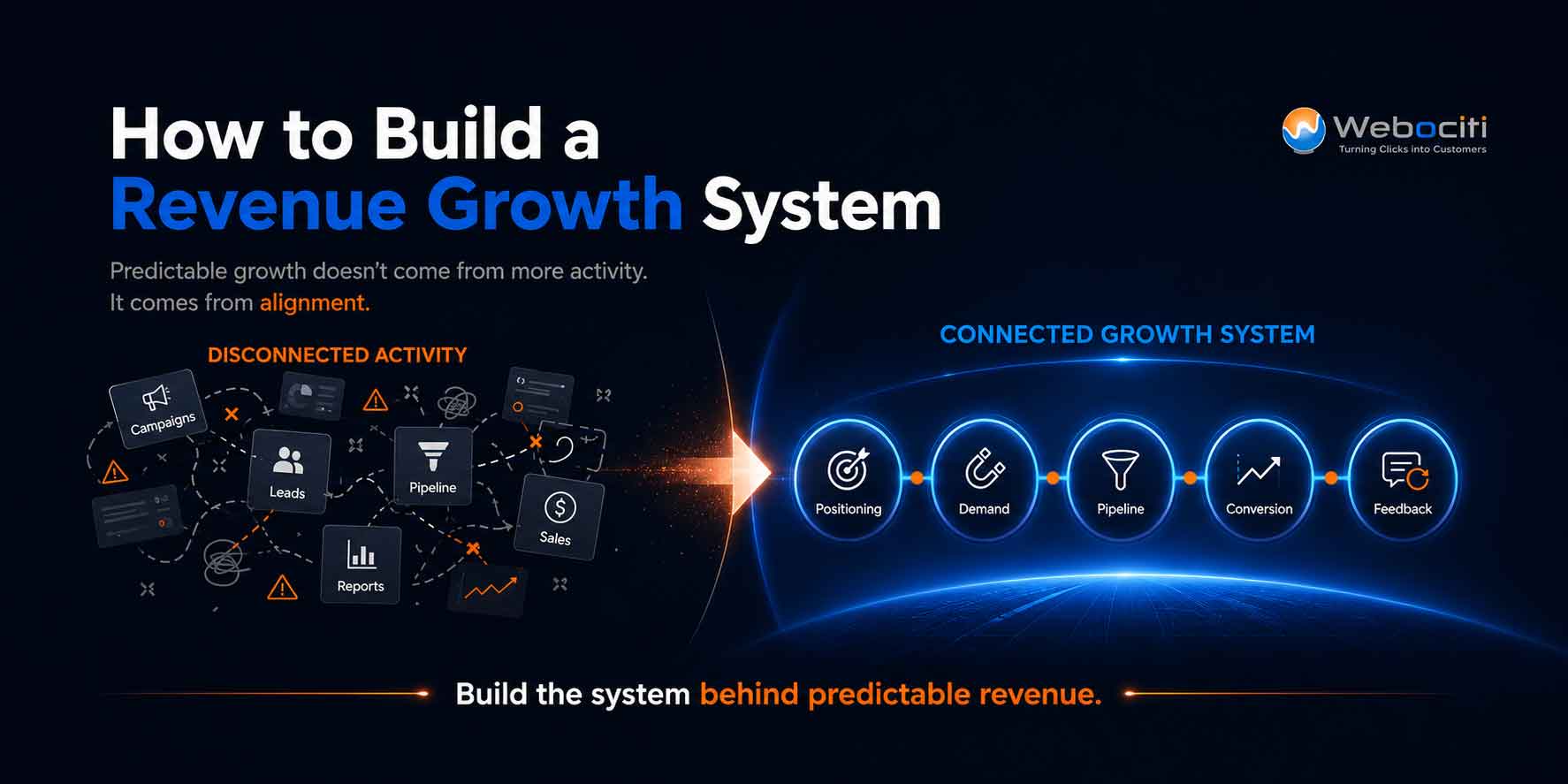
Growth does not become predictable because you do more marketing.

It becomes predictable when the pieces behind revenue are connected.

Most companies are not short on activity. They have campaigns running, salespeople following up, CRM data being tracked, and reports being reviewed.

But activity alone does not create scalable growth.

If positioning is unclear, demand quality suffers. If demand quality suffers, the pipeline fills with noise. If the pipeline is weak, conversion becomes inconsistent. If conversion is inconsistent, revenue becomes unpredictable.

That is why companies need more than marketing tactics, sales pressure, or another dashboard.

They need a revenue growth system.

In Summary

A revenue growth system connects positioning, demand generation, pipeline design, conversion, and revenue feedback into one operating framework.

Instead of treating marketing, sales, and revenue as separate functions, a revenue growth system aligns them around the same buyer, the same message, the same pipeline, and the same growth outcomes.

The goal is not more activity. The goal is better-fit opportunities, stronger conversion, and more predictable revenue.

Predictable revenue is not built from disconnected tactics. It is built from a connected system.

What Is a Revenue Growth System?

A revenue growth system is the structure that connects how a company attracts, qualifies, advances, converts, and learns from buyers.

It is not one campaign. It is not one sales process. It is not one CRM dashboard.

It is the operating system behind growth.

A strong revenue growth system connects five core parts:

Positioning → Demand → Pipeline → Conversion → Revenue Feedback

Each stage feeds the next. When one stage is weak, everything downstream becomes harder.

This is the difference between companies that create activity and companies that create momentum.

Activity is easy to generate.

Momentum requires alignment.

For a deeper explanation of the framework, read:
What a Real Revenue System Actually Looks Like.

Why Most Growth Systems Break

Most companies do not intentionally design their revenue system.

They add pieces over time.

  • A website gets built.
  • Marketing campaigns get launched.
  • Sales tools get added.
  • CRM stages get created.
  • Reporting dashboards get reviewed.
  • New people join the team.

Each piece may make sense on its own.

But if those pieces are not connected, the company ends up with growth activity instead of a growth system.

That is where problems start.

  • Marketing attracts the wrong audience.
  • Sales questions lead quality.
  • Pipeline looks active but does not convert.
  • Leadership pushes for more leads.
  • Revenue remains inconsistent.
Most growth problems are not caused by one broken tactic. They are caused by disconnected parts of the revenue system.

If your marketing is creating activity but not qualified opportunities, this is likely part of the problem:
Why Your Marketing Isn’t Generating Qualified Leads.

Step 1: Start With Positioning

Every revenue growth system starts with positioning.

Positioning defines who you serve, what problem you solve, why your solution matters, and why buyers should choose you over another option.

If positioning is weak, everything downstream becomes harder.

  • Marketing becomes too broad.
  • Content attracts the wrong audience.
  • Sales conversations require too much explanation.
  • Pipeline quality suffers.
  • Conversion becomes inconsistent.

Strong positioning creates clarity before the buyer ever talks to sales.

It answers the questions buyers are already asking:

  • Is this for me?
  • Do they understand my problem?
  • Can they solve the issue I care about?
  • Why should I act now?
  • Why should I choose this company?

Without those answers, marketing becomes noise and sales becomes education.

Weak positioning attracts weak-fit opportunities. Strong positioning creates the foundation for qualified demand.

Step 2: Define the Right Buyer

A revenue growth system cannot work if the company is unclear about who it is trying to attract.

Many companies define their market too broadly.

They focus on everyone who could buy instead of the buyers most likely to convert, stay, grow, and create value.

That is a mistake.

The right buyer should be defined by more than basic demographics or company size.

Look at:

  • Fit — Does this buyer match your ideal customer profile?
  • Need — Do they have a real problem you can solve?
  • Urgency — Is there a reason to act?
  • Authority — Can they influence or make a decision?
  • Value — Is the opportunity worth pursuing?
  • Conversion potential — Can this buyer realistically move through your process?

This step matters because the wrong buyer can make every part of the system look weaker than it actually is.

A poor-fit lead may engage with your marketing, book a call, and enter the pipeline, but that does not mean they are a real revenue opportunity.

If they lack urgency, budget, authority, need, or strategic fit, they will slow the system down. Sales will spend more time educating, qualifying, and chasing instead of advancing real opportunities.

The goal is not to attract everyone who could possibly buy.

The goal is to attract the buyers most likely to understand the value, move through the process, and convert into profitable revenue.

The more clearly you define the right buyer, the easier it becomes to build the rest of the system.

Your campaigns improve. Your messaging sharpens. Your pipeline gets cleaner. Your sales team spends more time with better-fit opportunities.

Step 3: Build Demand Around Buyer Problems

Demand generation should not start with what you want to sell.

It should start with what the buyer needs to solve.

Many companies build marketing around services, features, or internal priorities.

But buyers respond to problems, outcomes, risks, and opportunities.

A strong revenue growth system turns positioning into demand by connecting the company’s message to real buyer pain.

That means your content, ads, email campaigns, social posts, landing pages, and offers should all answer one question:

Why should the right buyer care now?

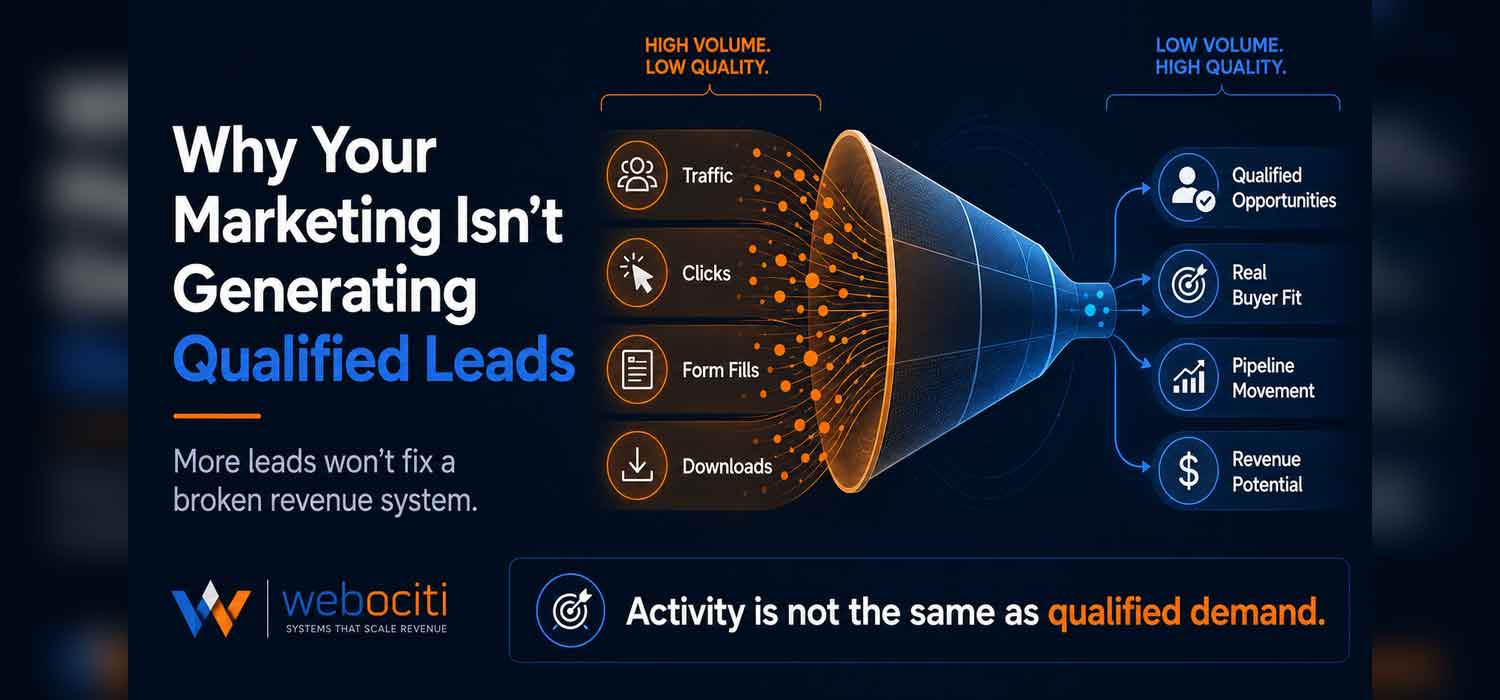
If your marketing creates traffic, clicks, and form fills but not qualified opportunities, you are not building demand. You are building activity.

The goal is not attention alone.

The goal is qualified demand.

Demand generation should create interest from the right buyers, not just more movement at the top of the funnel.

Step 4: Design the Pipeline Around Quality

A pipeline should not be a dumping ground for every inquiry.

It should be a structured system for identifying, qualifying, advancing, and converting real opportunities.

This is where many companies lose control of growth.

They treat every lead like an opportunity. They allow low-fit prospects to move too far into the process. They measure pipeline volume instead of pipeline quality.

The result is predictable:

  • Sales gets buried in weak conversations.
  • Deals stall.
  • Forecasts become unreliable.
  • Leadership sees pipeline but not revenue.

A strong revenue growth system defines what belongs in the pipeline and what does not.

That requires clear qualification criteria:

  • Who is a real fit?
  • What problem are they trying to solve?
  • What stage of awareness are they in?
  • What action should happen next?
  • What disqualifies an opportunity?
  • What signals real buying intent?

A quality-focused pipeline gives your team a cleaner view of what is real.

Instead of measuring success by the number of opportunities in the CRM, the company can evaluate whether those opportunities match the buyer profile, have a clear business need, and show enough momentum to justify continued sales effort.

This changes how the team manages growth.

Sales can focus on better conversations. Marketing can see which sources create real opportunities. Leadership gets a more accurate view of future revenue.

Pipeline quality matters because a full pipeline does not always mean a healthy pipeline.

If your pipeline looks full but deals are not moving, read:
Why Your Pipeline Isn’t Converting.

Step 5: Align Marketing and Sales Around Revenue

Marketing and sales cannot operate from different definitions of success.

If marketing is optimizing for leads and sales is responsible for revenue, the system will eventually break.

Marketing may celebrate volume while sales complains about quality.

Sales may blame marketing while marketing argues the leads were delivered.

Leadership may see activity but not know where the real breakdown is happening.

The fix is alignment around shared revenue outcomes.

Both teams should agree on:

  • Who the ideal buyer is
  • What makes a lead qualified
  • What pipeline stages mean
  • What messages are resonating
  • Where opportunities are stalling
  • Which channels create real revenue

This alignment changes the conversation from blame to diagnosis.

Instead of asking whether marketing produced enough leads or whether sales followed up fast enough, the team can look at the full system and identify where revenue is actually breaking.

That might be a targeting issue. It might be a messaging issue. It might be a qualification issue. It might be a conversion issue.

But until marketing and sales share the same definitions, the business cannot diagnose the problem clearly.

Alignment gives the company one shared view of growth instead of separate marketing, sales, and leadership opinions.

When marketing and sales are aligned, demand improves, pipeline gets cleaner, and conversion becomes more predictable.

When they are disconnected, revenue becomes a guessing game.

Step 6: Improve Conversion as a System Outcome

Conversion is often treated as a sales issue.

But conversion is usually the result of everything that happened before the sales conversation.

Clear positioning improves conversion.

Better-fit demand improves conversion.

Stronger qualification improves conversion.

Sharper messaging improves conversion.

Better handoffs improve conversion.

That is why companies should not look at conversion in isolation.

If close rates are weak, the answer may not be to pressure sales harder.

The better question is:

What is happening upstream that makes conversion harder than it should be?

A revenue growth system makes conversion a shared outcome across positioning, marketing, sales, and leadership.

Step 7: Use Revenue Feedback to Improve the System

A real revenue growth system learns from the market.

Revenue feedback should not stay trapped in reports or sales calls.

It should be used to improve the entire system.

Look at:

  • Which buyers convert fastest?
  • Which deals stall?
  • Which messages create real engagement?
  • Which campaigns produce qualified opportunities?
  • Which objections keep appearing?
  • Which customer segments produce the most value?
  • Which offers lead to real conversations?

This feedback loop is what makes a revenue growth system stronger over time.

Every closed deal, stalled opportunity, lost proposal, and customer conversation contains useful information.

The best companies use that information to refine their positioning, sharpen their messaging, improve qualification, and adjust their growth strategy.

Without this loop, companies keep repeating the same campaigns, the same sales motions, and the same mistakes without learning from the market.

Revenue feedback should not sit in reports. It should change how the system works.

That feedback should refine positioning, demand generation, pipeline qualification, sales messaging, and conversion strategy so the system gets stronger over time.

Revenue feedback turns growth from a linear funnel into a learning system.

This is also why companies eventually outgrow traditional funnel thinking:
Revenue System vs Sales Funnel.

The Revenue Growth System Framework

A revenue growth system is not a collection of disconnected tactics.

It is a connected operating framework that helps leadership understand how growth is created, where it is breaking, and what needs to be improved.

Viewed as a whole, the system works when each stage feeds the next and revenue feedback improves everything over time.

This is what a revenue growth system looks like:
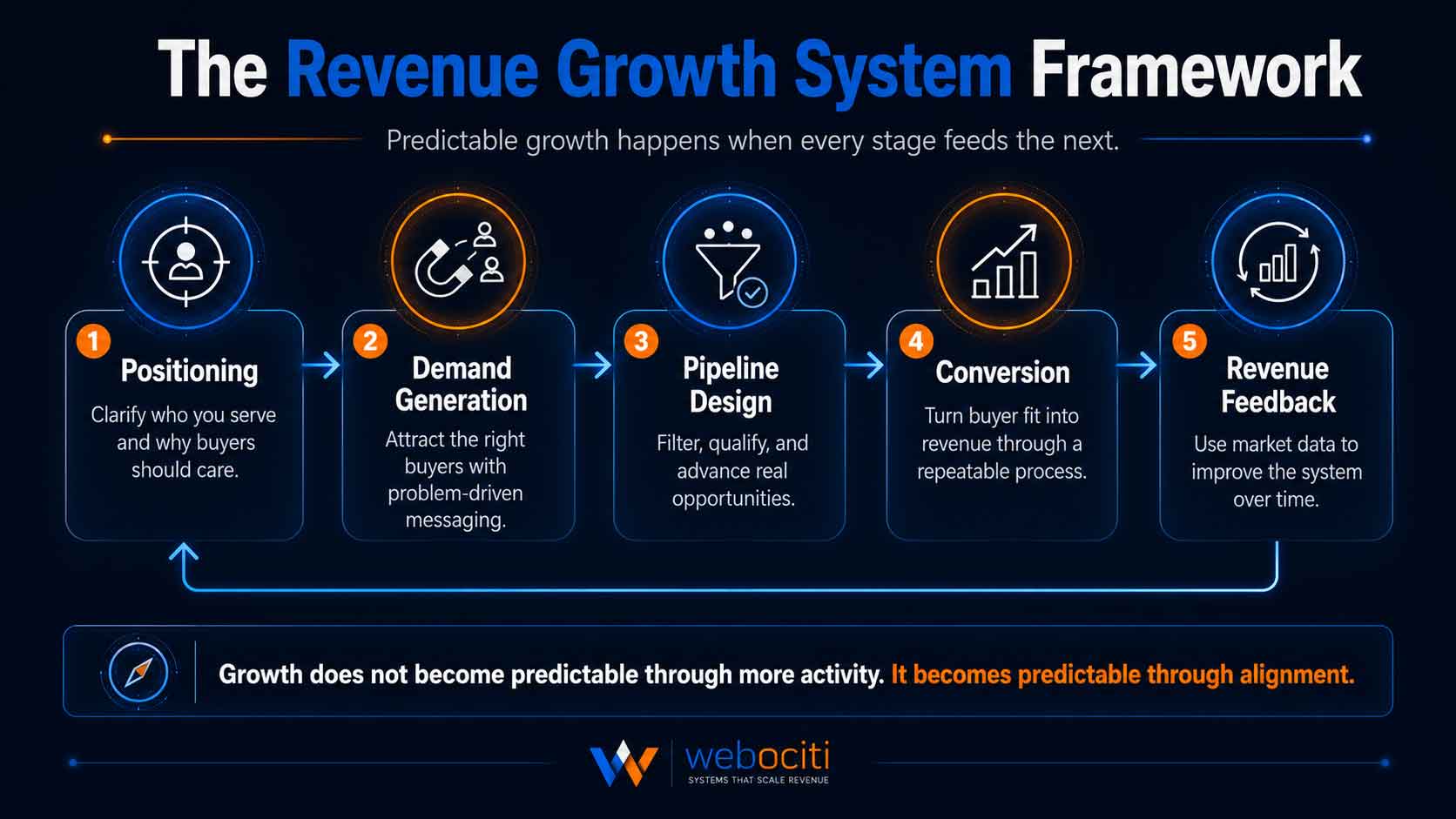
Revenue growth system framework showing positioning, demand generation, pipeline design, conversion, and revenue feedback connected as one growth system

1. Positioning

Clarify who you serve, what problem you solve, why your solution matters, and why buyers should choose you.

2. Demand Generation

Create interest from the right buyers by connecting your message to real business problems, not just promoting services or features.

3. Pipeline Design

Filter, qualify, and advance real opportunities instead of allowing every inquiry to become a sales priority.

4. Conversion

Turn buyer fit into revenue through clear messaging, strong handoffs, defined next steps, and a repeatable sales process.

5. Revenue Feedback

Use market data, sales conversations, stalled deals, wins, losses, and customer insights to improve the system over time.

Each part affects the next.

If positioning is unclear, demand becomes weak. If demand is weak, pipeline quality suffers. If pipeline quality suffers, conversion becomes inconsistent. If conversion is inconsistent, revenue becomes unpredictable.

That is why this framework matters.

It gives leadership a way to diagnose growth as a system instead of reacting to symptoms one tactic at a time.

How to Know Your Revenue Growth System Is Broken

Once you look at growth through this system, the warning signs become much easier to see.

You may need to redesign your revenue growth system if the business is producing activity, but the activity is not turning into predictable revenue.

  • Your marketing is generating leads, but sales says they are not qualified.
  • Your pipeline looks full, but deals are not moving.
  • Your close rate is inconsistent.
  • Your sales cycle is getting longer.
  • Your messaging feels unclear or too broad.
  • Your team is doing more activity without better results.
  • Your revenue forecast is difficult to trust.
  • Your growth depends too heavily on individual effort.
  • Your marketing and sales teams are not aligned.

These are not random issues. They are symptoms of a system that is creating motion without enough momentum.

The solution is not always another campaign, another salesperson, or another dashboard. The solution is to identify where the system is breaking and fix the connection between positioning, demand, pipeline, conversion, and feedback.

Why This Matters for Founders and Leadership Teams

For founders, CEOs, and leadership teams, the revenue growth system matters because it changes how growth is managed.

Instead of reacting to symptoms, leadership can diagnose where the system is breaking.

  • If lead quality is weak, look at positioning and demand.
  • If pipeline is inflated, look at qualification.
  • If deals stall, look at buyer fit, urgency, and sales process.
  • If revenue is inconsistent, look at the system, not just the team.

This creates better decisions.

It also makes the business more scalable.

A company with a clear revenue growth system is easier to manage, easier to measure, easier to improve, and more valuable over time.

That matters whether the goal is scaling, improving profitability, attracting investment, or preparing for a future acquisition.

The Bottom Line

Growth does not become predictable by doing more of everything.

More campaigns, more leads, more outreach, more pressure, and more reporting will not fix a disconnected revenue system.

Predictable growth comes from alignment.

That means the right positioning, the right buyers, the right demand, the right pipeline, the right conversion process, and the right feedback loop all working together.

When those pieces are disconnected, growth becomes reactive. When they are connected, the business has a system it can measure, improve, and scale.

That is how you build a revenue growth system.

Not more activity.

A better system.

You Don’t Need More Growth Activity. You Need a Revenue Growth System.

If your marketing, sales, and pipeline are not working together, it may be time to diagnose the system behind your growth.

Diagnose Your Revenue System →

More leads will not fix a bad revenue system.

If your marketing is generating activity but not qualified leads, the problem is usually not the campaign alone.

It is usually deeper than that.

You may be attracting the wrong audience. Your message may be too broad. Your offer may not be clear. Your sales team may be receiving leads that were never a fit in the first place.

That creates a common growth problem:

Marketing looks busy. Sales stays frustrated. Revenue does not move.

When that happens, the answer is not always more traffic, more ads, more content, or more outreach.

Sometimes the real issue is that your marketing is not connected to a clear revenue system.

In Summary

If your marketing is not generating qualified leads, the problem is often caused by unclear positioning, weak targeting, broad messaging, disconnected campaigns, or poor alignment between marketing and sales.

Qualified leads are not created by volume alone. They come from a system that connects positioning, demand generation, pipeline design, and conversion. When those parts are aligned, marketing attracts better-fit buyers and sales spends more time with real opportunities.

Lead quality is not just a marketing problem. It is a system problem.

Why More Leads Are Not Always the Answer

When growth slows, many companies make the same assumption:

We need more leads.

That sounds logical. If revenue is not growing, fill the top of the funnel. Run more ads. Publish more content. Send more emails. Increase outreach.

But more leads only help if they are the right leads.

If your marketing is attracting people who are not a fit, not ready, not qualified, or not aligned with your offer, more volume simply creates more noise.

Your team gets busier, but the business does not get healthier.

  • Marketing reports more activity.
  • Sales receives more names.
  • The CRM looks fuller.
  • Leadership sees movement.
  • Revenue still feels inconsistent.

That is the trap.

The goal is not more leads. The goal is more qualified opportunities that can actually convert.

This is where many companies confuse demand generation with activity generation.

What Is a Qualified Lead?

A qualified lead is not just someone who filled out a form, clicked an ad, downloaded a guide, or booked a call.

A qualified lead is someone who matches the type of buyer your business can actually help, has a real problem you can solve, and has enough fit, need, urgency, and authority to move through your sales process.

That does not mean every qualified lead is ready to buy immediately.

But it does mean they belong in the system.

A qualified lead usually has some combination of:

  • Fit — they match your ideal customer profile.
  • Need — they have a real problem your solution addresses.
  • Awareness — they understand the issue enough to engage.
  • Authority — they can influence or make a decision.
  • Timing — there is a reason to act now or soon.
  • Value — the opportunity is worth pursuing.

Without those elements, a lead may create activity, but it will not reliably create revenue.

Why Your Marketing Attracts the Wrong Leads

Poor lead quality usually starts before the campaign ever launches.

The issue is often upstream.

It starts with how the company defines its market, explains its value, targets its audience, and connects marketing activity to sales outcomes.

Here are the most common reasons marketing fails to generate qualified leads.

1. Your Positioning Is Too Broad

If your positioning is too broad, your marketing will attract a broad audience.

That may increase traffic or lead volume, but it usually weakens quality.

When a company tries to speak to everyone, it often fails to connect deeply with the buyers who matter most.

Broad messaging creates vague interest. Clear positioning creates qualified demand.

If buyers cannot quickly understand who you help, what problem you solve, and why it matters, the wrong people will enter your funnel.

2. Your Message Focuses on Services Instead of Buyer Problems

Many companies describe what they do, but not why the buyer should care.

They list services, features, tools, or capabilities.

But buyers respond to problems, outcomes, risks, and opportunities.

If your marketing says what you offer but does not clearly connect to the buyer’s pain, you may attract curiosity without intent.

That creates weak leads.

The best marketing does not just explain your services. It helps the right buyer recognize their problem and see why your company is positioned to solve it.

3. Your Campaigns Are Optimized for Volume

Not all marketing metrics are equal.

Traffic, impressions, clicks, downloads, and form submissions can be useful indicators, but they are not the same as revenue progress.

If your campaigns are optimized only for volume, you may get more leads that sales does not want.

That is how companies end up with impressive marketing reports and disappointing revenue results.

A campaign that generates fewer but better-fit opportunities is often more valuable than a campaign that generates high volume with low conversion potential.

4. Marketing and Sales Do Not Agree on Lead Quality

A major reason companies struggle with qualified leads is that marketing and sales are not working from the same definition.

Marketing may define a lead as someone who takes an action.

Sales may define a lead as someone worth pursuing.

Those are not the same thing.

If both teams are not aligned on what makes a lead qualified, conflict is inevitable.

  • Marketing thinks sales is not following up.
  • Sales thinks marketing is sending bad leads.
  • Leadership sees activity but not conversion.

The fix is not just better reporting.

The fix is alignment around buyer fit, qualification criteria, pipeline stages, and revenue outcomes.

5. Your Offer Is Not Clear Enough

Sometimes the right buyers are seeing your marketing, but they are not taking action because the offer is unclear.

They do not understand what happens next.

They do not know what problem you solve first.

They do not see enough urgency to engage.

A strong offer creates a clear next step for the right buyer.

A weak offer creates hesitation.

If your calls to action are vague, generic, or disconnected from buyer pain, qualified prospects may leave without converting.

6. Your Pipeline Is Accepting Too Much Noise

Lead quality is not only a marketing issue.

It is also a pipeline design issue.

If every inquiry gets treated like a real opportunity, the pipeline becomes inflated.

Sales spends too much time sorting, chasing, and qualifying instead of advancing real opportunities.

That creates the illusion of pipeline strength.

But the pipeline is full of noise.

If this sounds familiar, read:
Why Your Pipeline Isn’t Converting.

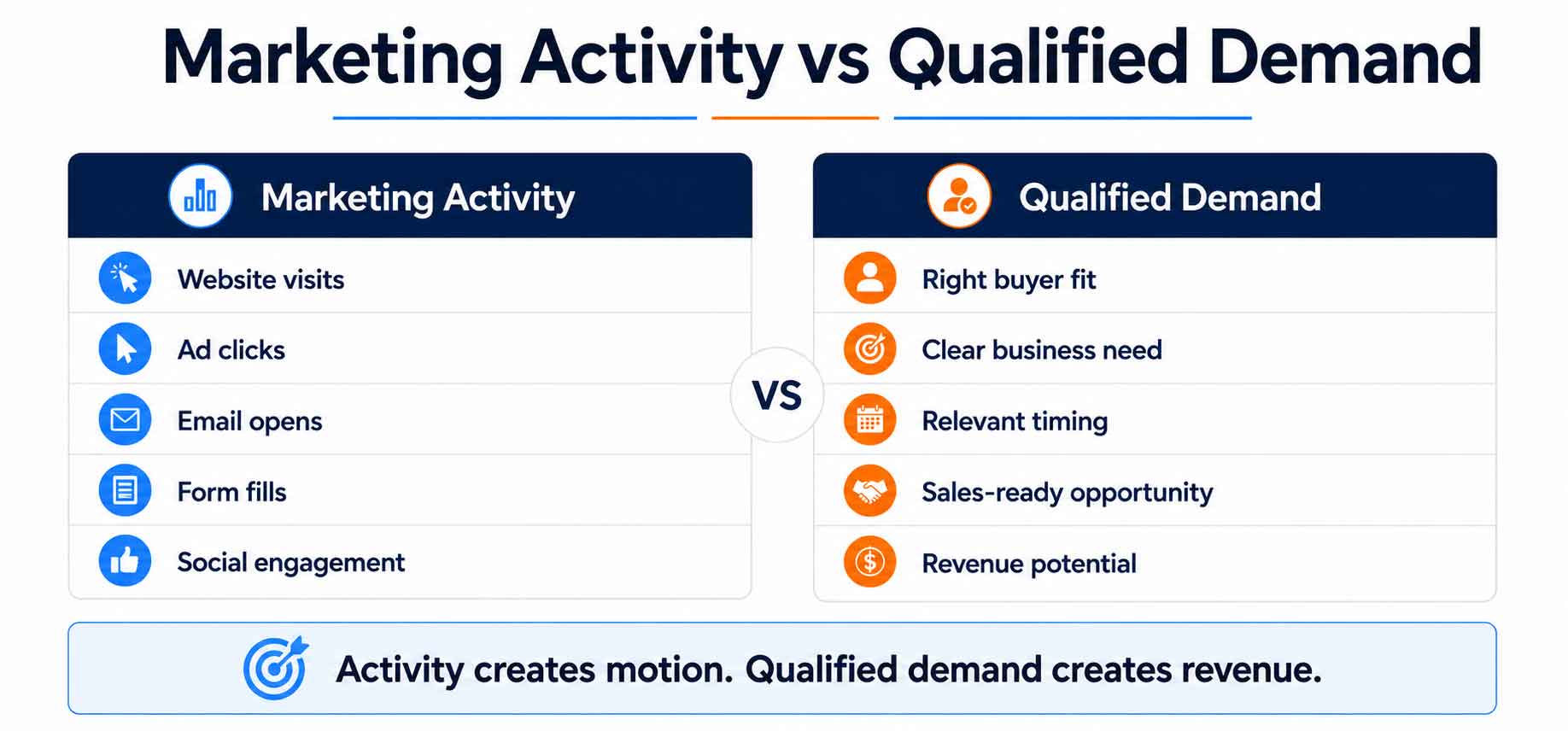
Marketing Activity vs Qualified Demand

Marketing Activity vs Qualified Demand comparison showing website visits, ad clicks, email opens, form fills, and social engagement versus right buyer fit, clear business need, relevant timing, sales-ready opportunity, and revenue potential

One of the biggest mistakes companies make is treating activity as demand.

Activity is easy to create.

Qualified demand is harder.

Activity can look like:

  • Website visits
  • Ad clicks
  • Email opens
  • Social engagement
  • Form fills
  • Downloaded content

Qualified demand looks different.

  • The buyer fits your ideal customer profile.
  • The problem is real and relevant.
  • The message connects to a business need.
  • The lead has a reason to engage.
  • The opportunity can realistically move through the pipeline.

Both matter, but they are not equal.

Marketing should not be judged by how much activity it creates. It should be judged by whether it creates qualified demand that supports revenue growth.

Why This Is Really a Revenue System Problem

When marketing is not generating qualified leads, most companies try to fix the campaign.

Sometimes that is necessary.

But often the campaign is only exposing a deeper problem.

The company does not have a connected revenue system.

A real revenue system connects:

Positioning → Demand → Pipeline → Conversion → Revenue

Each stage feeds the next. When one stage is weak, everything downstream becomes harder.

If positioning is weak, demand quality suffers.

If demand quality suffers, pipeline fills with low-fit opportunities.

If pipeline quality is weak, conversion becomes inconsistent.

If conversion is inconsistent, revenue becomes unpredictable.

That is why lead quality cannot be solved in isolation.

It has to be solved as part of the system.

For the full framework, read:
What a Real Revenue System Actually Looks Like.

How to Fix Marketing That Is Not Generating Qualified Leads

Fixing lead quality starts with changing the question.

Instead of asking, “How do we get more leads?” ask, “Why are we attracting the wrong leads?”

That shift changes the entire strategy.

1. Clarify Your Ideal Customer

Start by defining who you are actually trying to attract.

Not everyone who can buy from you is an ideal buyer.

Your ideal customer should be defined by more than industry or company size. Look at need, urgency, value, buying process, fit, and likelihood to convert.

The clearer the buyer profile, the easier it becomes to build marketing that attracts the right prospects and filters out the wrong ones.

2. Tighten Your Positioning

Your positioning should make it clear who you help, what problem you solve, and why your approach matters.

If the message is vague, the audience will be vague.

Strong positioning creates sharper demand because it helps the right buyers recognize themselves in your message.

3. Build Campaigns Around Buyer Problems

Campaigns should not start with what you want to sell.

They should start with what the buyer is trying to solve.

The more your marketing connects to real buyer problems, the more likely you are to attract prospects with meaningful intent.

4. Align Marketing and Sales Around Qualification

Marketing and sales need a shared definition of a qualified lead.

That definition should include fit, need, timing, authority, and revenue potential.

Without that agreement, marketing will keep optimizing for one outcome while sales needs another.

5. Improve the Offer and Call to Action

A qualified buyer needs a clear reason to take the next step.

Generic calls to action like “Contact Us” or “Learn More” may not be enough.

A stronger offer connects directly to the buyer’s problem.

For example:

  • Diagnose where your pipeline is breaking.
  • Clarify your growth strategy.
  • Find out why your marketing is not converting.
  • Build a system for qualified demand.

The more specific the next step, the easier it is for the right buyer to act.

6. Measure What Happens After the Lead

Lead generation does not end when someone fills out a form.

You need to measure what happens next.

  • How many leads become qualified opportunities?
  • How many qualified opportunities advance?
  • How many convert into customers?
  • Which channels produce real revenue?
  • Which messages attract the best-fit buyers?

This is where marketing becomes a revenue function instead of an activity function.

Signs Your Marketing Is Attracting the Wrong Leads

You may have a lead quality problem if:

  • Sales regularly says the leads are not a fit.
  • Your pipeline is full but close rates are low.
  • You are getting inquiries from people who cannot afford your solution.
  • You attract buyers who misunderstand what you do.
  • Your sales team spends too much time educating unqualified prospects.
  • Deals stall early or disappear after the first conversation.
  • Marketing reports look strong, but revenue does not improve.

These are not just marketing symptoms.

They are signs that the revenue system needs to be realigned.

The Bottom Line

If your marketing is not generating qualified leads, the answer is not always more marketing.

It may be better positioning.

It may be sharper targeting.

It may be stronger messaging.

It may be better alignment between marketing and sales.

It may be a clearer pipeline qualification process.

But most of the time, it is not one isolated issue.

It is a system issue.

Qualified leads come from a connected revenue system that attracts the right buyers, filters real opportunities, and supports conversion.

More leads are not the goal.

Better-fit opportunities are the goal.

Your Marketing May Be Creating Activity, Not Qualified Demand.

If your leads are not converting, it may be time to diagnose the system behind your marketing, pipeline, and revenue growth.


Diagnose Your Lead Quality Problem →

Most companies still think about growth like a funnel.

Leads enter at the top. Prospects move through the middle. Customers come out at the bottom.

It’s clean. It’s simple. It’s easy to explain.

It’s also incomplete.

A sales funnel can show where buyers are in the process, but it does not explain why growth is inconsistent, why pipeline stalls, why leads don’t convert, or why revenue feels unpredictable.

That’s why companies need more than a funnel.

They need a revenue system.

In Summary

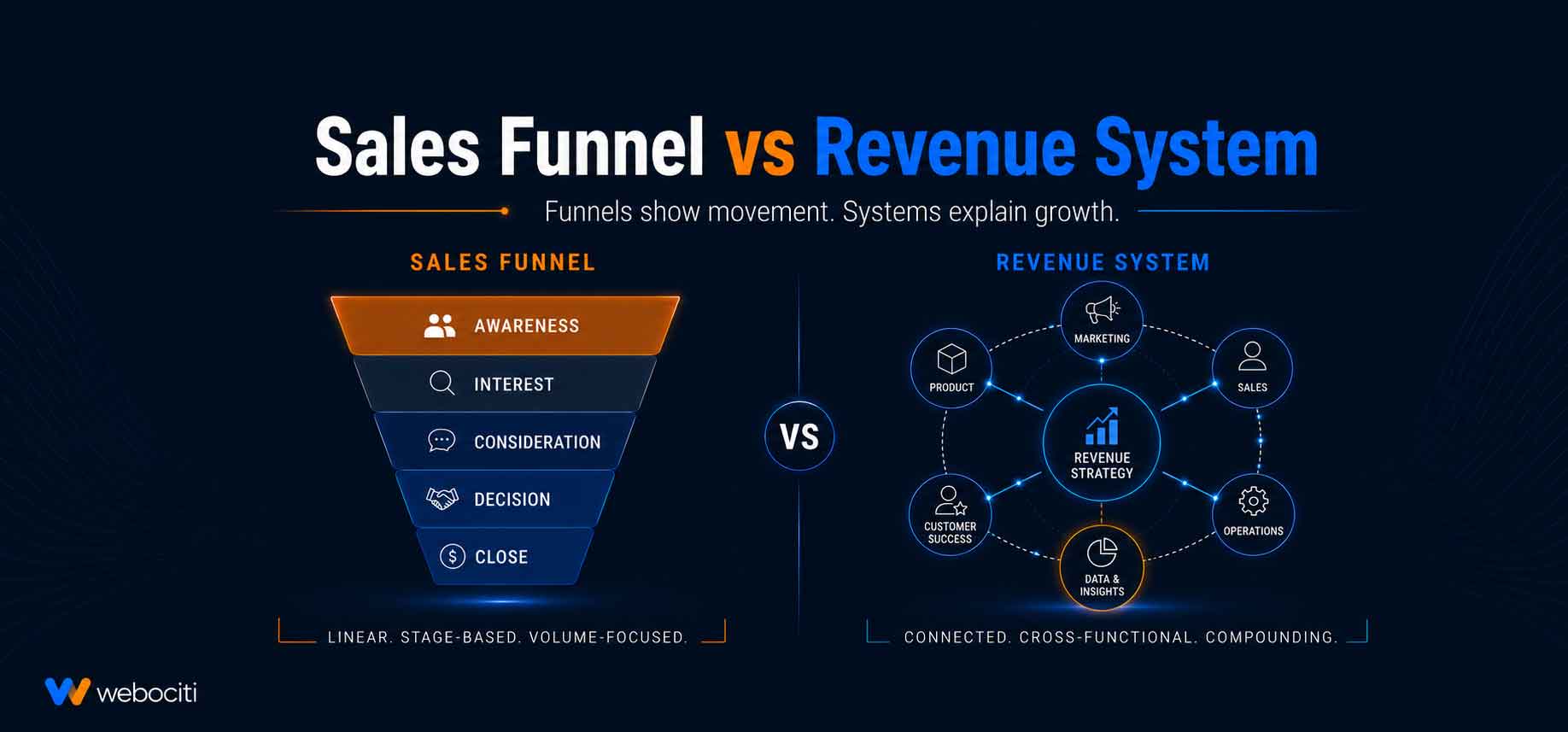
A sales funnel shows the stages buyers move through. A revenue system shows how positioning, demand generation, pipeline design, conversion, and revenue performance work together.

Funnels are useful for tracking movement, but they do not explain why growth breaks. A real revenue system connects the full growth engine so companies can improve pipeline quality, conversion, and revenue predictability.

A funnel tracks movement. A revenue system explains performance.

What a Sales Funnel Actually Does

A sales funnel is a visual model that shows how prospects move from awareness to consideration to decision.

At its best, a funnel helps teams understand where buyers are in the customer journey and what actions should happen at each stage.

That is useful.

Funnels can help companies organize marketing campaigns, sales follow-up, lead nurturing, and conversion activity.

But the funnel is only a map of movement.

It does not tell you whether the right buyers are entering the system. It does not tell you whether your positioning is clear. It does not explain why pipeline quality is weak, why deals stall, or why revenue is inconsistent.

That is where funnel thinking starts to break down.

Where the Funnel Model Breaks Down

The funnel model assumes that if you put more leads into the top, more revenue will come out the bottom.

That sounds logical.

But in real companies, growth rarely breaks that cleanly.

Revenue problems usually happen because the pieces around the funnel are disconnected.

  • Positioning is unclear, so the wrong buyers enter the funnel.
  • Demand generation is misaligned, so marketing creates activity instead of qualified opportunities.
  • Pipeline is poorly designed, so low-fit prospects move too far into the sales process.
  • Conversion depends on individual effort, instead of a clear, repeatable system.

When that happens, the funnel may still look active.

Leads are coming in. Meetings are happening. The CRM has opportunities. The dashboard looks busy.

But revenue does not follow.

That is not a funnel problem. It is a system problem.

If your sales pipeline looks full but deals are not moving, this is often the deeper issue:
Why Your Pipeline Isn’t Converting.

What a Revenue System Does Differently

A revenue system looks beyond the funnel.

It connects the full growth engine: positioning, demand, pipeline, conversion, and revenue.

Instead of asking, “How do we get more leads?” a revenue system asks better questions:

  • Are we attracting the right buyers?
  • Is our positioning clear enough to create demand?
  • Are marketing and sales aligned around the same buyer and outcome?
  • Is our pipeline filtering real opportunities or just collecting activity?
  • Do we have a repeatable conversion process?
  • Can revenue performance be improved systematically?

That shift matters.

Because predictable growth does not come from simply pushing more volume through a funnel.

It comes from designing the system that makes revenue more consistent.

For a deeper breakdown of that model, read:
What a Real Revenue System Actually Looks Like.

Revenue System vs Sales Funnel: The Real Difference

A sales funnel and a revenue system are not the same thing.

A funnel is a model for tracking buyer progression.

A revenue system is a framework for managing growth performance.

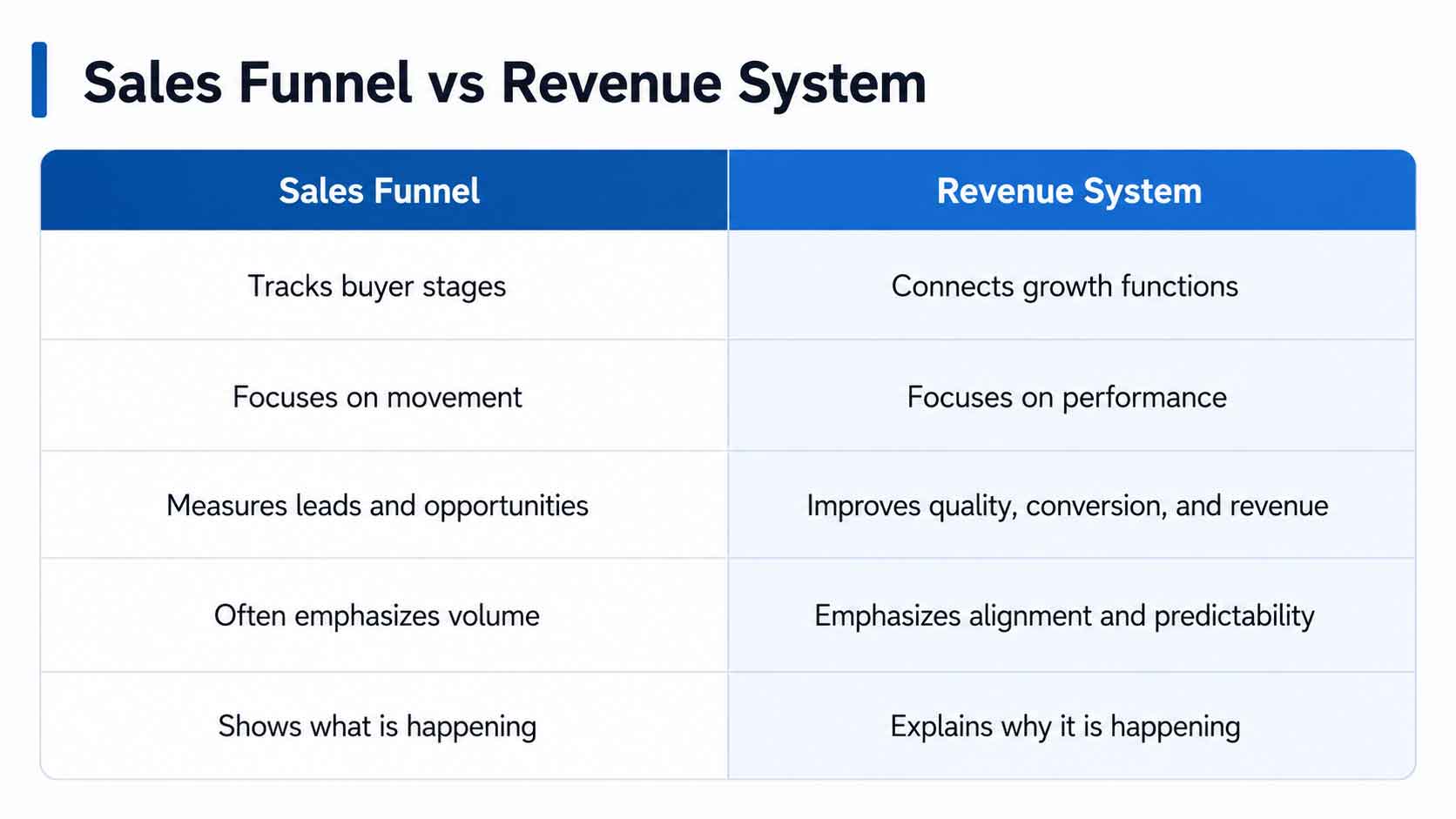
Sales Funnel vs Revenue System

Sales Funnel vs Revenue System comparison showing a linear sales funnel beside a connected revenue system framework

The funnel helps you see where prospects are.

The revenue system helps you understand why prospects are or are not converting.

That is the difference.

Why Companies Outgrow Funnel Thinking

Funnel thinking works when growth is simple.

But as companies scale, the funnel alone becomes too limited.

More channels get added. More people get involved. More campaigns launch. More data enters the system. More handoffs happen between marketing, sales, operations, and leadership.

At that point, growth can no longer be managed as a simple top-to-bottom flow.

It becomes a connected operating system.

That is where many companies start to struggle.

  • Marketing generates leads, but sales questions the quality.
  • Sales works opportunities, but deals stall late in the process.
  • Leadership pushes for more pipeline, but conversion does not improve.
  • Teams debate tactics, but no one fixes the underlying system.

The company keeps feeding the funnel.

But the system underneath it is broken.

Most companies do not outgrow marketing. They outgrow disconnected growth activity.

How to Shift From Funnel Management to Revenue System Design

The goal is not to abandon the funnel.

The goal is to stop treating the funnel as the entire growth strategy.

A better approach is to use the funnel as one part of a larger revenue system.

1. Start With Positioning

Before you fix campaigns, pipeline, or sales execution, clarify who you serve and why your solution matters.

Weak positioning attracts the wrong audience. And once the wrong buyers enter the system, everything downstream becomes harder.

2. Align Demand Generation With Buyer Fit

Demand generation should not be judged by volume alone.

It should be judged by whether it creates interest from the right buyers.

Traffic, impressions, clicks, and leads matter only if they move the company closer to qualified revenue.

3. Redesign the Pipeline Around Quality

A healthy pipeline is not just full.

It is filtered.

Pipeline should help your team separate real opportunities from noise. If low-fit prospects move too far into the process, sales gets buried in conversations that were never likely to convert.

4. Improve Conversion as a System

Conversion is not just a sales skill.

It is the result of everything that came before it.

Clear positioning improves conversion. Better demand improves conversion. Stronger qualification improves conversion. Better handoffs improve conversion.

When conversion is treated as a system outcome, companies stop blaming sales for problems that started upstream.

5. Use Revenue Feedback to Improve the System

Revenue performance should feed back into the system.

Which buyers converted? Which deals stalled? Which messages worked? Which channels produced real opportunities? Which objections slowed down momentum?

That feedback should refine positioning, demand generation, pipeline structure, and conversion strategy.

That is how growth compounds.

The Revenue System Framework

A real revenue system connects five core parts:

Positioning → Demand → Pipeline → Conversion → Revenue

Each stage feeds the next. When one stage breaks, everything downstream becomes inconsistent.

This is why funnel metrics alone can be misleading.

You may have leads, but not the right buyers.

You may have pipeline, but not real opportunities.

You may have meetings, but not momentum.

You may have activity, but not revenue.

The funnel shows movement.

The system explains whether that movement is creating value.

How to Know You Need a Revenue System

You may need to move beyond funnel thinking if:

  • Your pipeline looks active, but revenue is inconsistent.
  • You are generating leads, but sales says they are not qualified.
  • Your team keeps asking for more volume, but close rates are not improving.
  • Your sales cycle is getting longer.
  • Your messaging feels unclear or too broad.
  • You are investing in marketing, but cannot clearly connect it to revenue outcomes.
  • Your growth depends too heavily on individual effort instead of a repeatable process.

These are not isolated problems.

They are signs that the system is not aligned.

Why This Matters for Founders and Leadership Teams

For founders, CEOs, and leadership teams, this distinction matters because the wrong diagnosis leads to the wrong fix.

If you think the funnel is the problem, you will usually try to add more activity.

  • More campaigns
  • More leads
  • More outreach
  • More sales pressure
  • More reporting

But if the real problem is the system, more activity only creates more noise.

You do not fix a broken revenue system by pushing harder.

You fix it by redesigning how growth works.

The Bottom Line

A sales funnel is still useful.

But it is not enough.

Funnels help companies track buyer movement. Revenue systems help companies understand and improve growth performance.

If your company is generating activity but revenue still feels inconsistent, the funnel may not be the issue.

The system behind the funnel may be broken.

And until that system is fixed, more leads, more campaigns, and more pressure will not create predictable growth.

Growth needs more than a funnel.

It needs a system.

Your Funnel May Not Be the Problem. Your Revenue System Might Be.

If growth feels inconsistent, the answer is not always more leads. It may be time to diagnose the system behind your revenue.


Diagnose Your Revenue System →

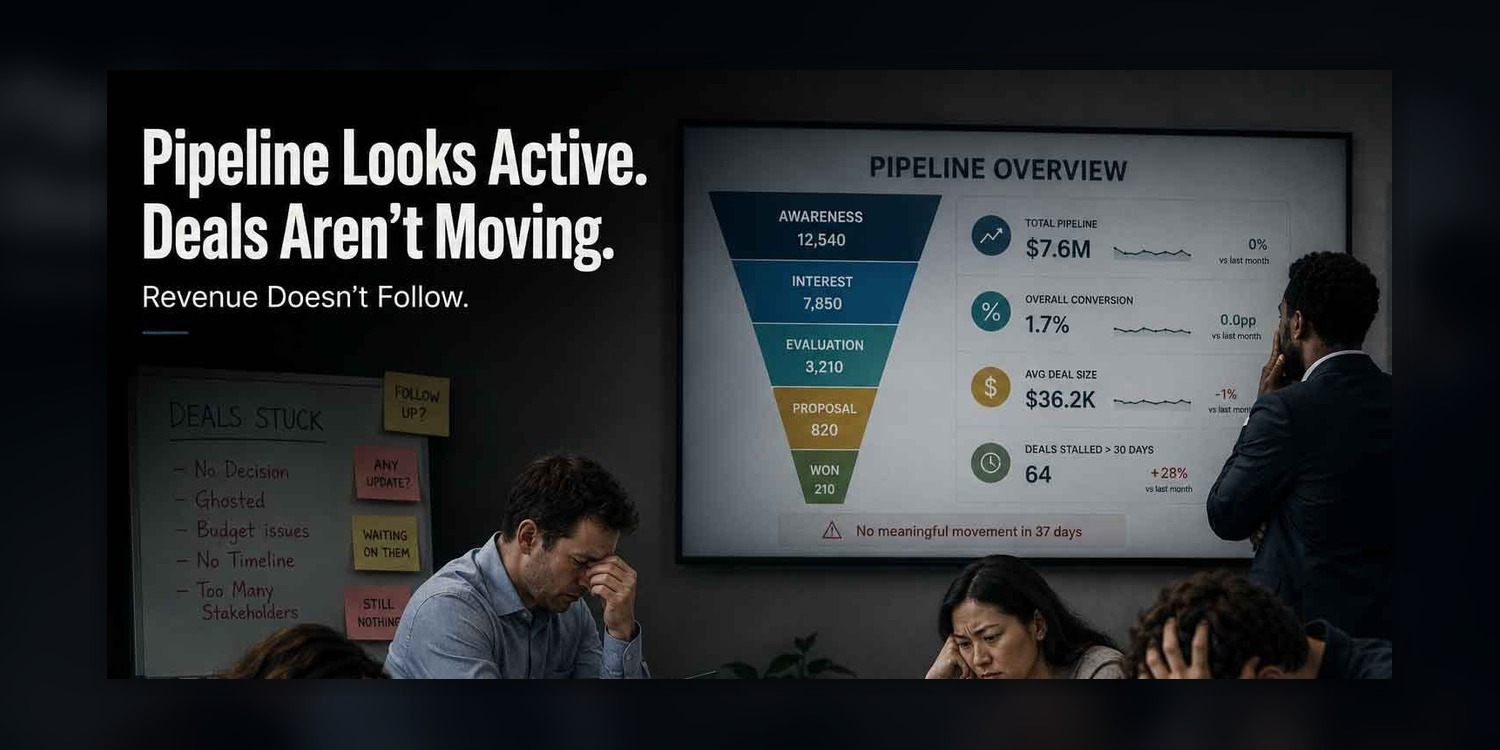
Your pipeline looks active. Revenue should be growing. It isn’t.

Your pipeline looks active. Deals are moving. Activity is high.

But revenue isn’t following.

That’s not a sales problem. It’s a pipeline quality problem that starts long before sales ever gets involved.

Most companies don’t have a pipeline problem.
They have a qualification problem disguised as pipeline.

Most companies think they have a pipeline problem. In reality, they have a broken revenue system.
Understanding how revenue systems actually work is the first step to fixing pipeline performance.

In Summary

Poor conversion is rarely a sales execution issue. It’s a pipeline quality issue driven by weak positioning, low-intent leads, and disconnected systems upstream.

At that point, most leadership teams look at the numbers and assume the same thing: sales isn’t performing.

So they hire a stronger VP of Sales, push harder on quotas, or bring in new tools.

But nothing really changes.

Pipeline still feels inconsistent. Deals stall. Forecasts miss.

Because the problem was never sales.


What a “Healthy Pipeline” Actually Looks Like

A pipeline only works when positioning, demand, and conversion are aligned.
This is the difference between a revenue system and a traditional sales funnel.

A healthy pipeline is defined by what happens before sales ever engages. Prospects should enter the process with a clear understanding of the problem they’re trying to solve and a belief that your company is relevant to that solution.

This is the difference between a pipeline that needs to be managed and one that needs to be fixed.

Your pipeline should consistently include:

  • Prospects who recognize the problem you solve
  • Buyers who see your positioning as differentiated
  • Leads with urgency, not curiosity
  • Opportunities that move forward without excessive education

When those conditions are met, sales conversations get shorter, more focused, and more predictable. When they’re not, pipeline becomes a holding area for stalled conversations.


If you’re seeing inconsistent pipeline performance, it’s usually a signal that your revenue system is broken.
Most companies don’t need better sales leadership. They need a connected revenue system.

Why Most Pipelines Break Before Sales Ever Starts

By the time a lead reaches sales, most of the outcome has already been shaped.

If the inputs are wrong, the output will always be inconsistent.

Here’s where things break:

1. Weak Positioning
If your messaging is generic, you attract the wrong audience. Sales ends up explaining instead of closing.

2. Low-Intent Leads
More leads does not mean better pipeline. If demand isn’t qualified, sales spends time on deals that were never viable.

3. Misaligned Marketing and Sales
Marketing optimizes for traffic. Sales needs qualified opportunities. Without alignment, pipeline quality suffers.

4. No Defined Revenue System
Most companies operate in silos. There’s no system connecting positioning, demand, pipeline, and conversion.


The Real Problem: You’re Measuring Activity, Not Outcomes

If your pipeline looks active but revenue isn’t following, something upstream is broken.


Diagnose your revenue system →

Most dashboards track:

  • Leads generated
  • Meetings booked
  • Deals in pipeline

But those metrics don’t tell you if your system actually works.

They tell you if people are busy.

Revenue doesn’t come from activity. It comes from alignment.


Why Sales Can’t Fix This

Sales converts opportunities. It doesn’t create them.

By the time a lead reaches sales, the outcome is mostly decided. The buyer either has urgency or doesn’t. They either understand the problem or they don’t. They either see you as a fit or just another option.

Sales teams inherit those conditions.

So when pipeline quality is low, even strong sales teams struggle. They spend time educating, requalifying, and chasing deals that were never viable.

More pressure doesn’t fix that. It increases activity, not effectiveness.

The real solution is owning the full revenue system, not just the sales function.


The Shift That Changes Everything

Companies that fix pipeline conversion don’t start with sales.

They fix how pipeline is created.

  • Clear, differentiated positioning
  • Demand aligned to the right audience
  • Pipeline stages tied to real buying behavior
  • Clean handoff between marketing and sales

This isn’t a sales fix.

It’s a revenue system fix.


What to Do If Your Pipeline Isn’t Converting

If your inputs are broken, no amount of sales optimization will fix conversion.
Most pipeline problems start with how leads are generated and qualified.

If you don’t understand how your pipeline is built, you don’t have a sales problem. You have a system problem.

This is where structured marketing and revenue strategy becomes critical.

If you want to fix this, audit the inputs:

  • Who you’re attracting
  • What they believe before sales
  • How clearly your positioning communicates value
  • Where deals consistently break

Patterns show up quickly. Most conversion problems are upstream consistency problems.

Fix the system, and pipeline becomes predictable.


The Bottom Line

If your pipeline isn’t converting, it’s not a performance problem.

It’s a structural problem.

Most companies don’t need better sales execution.

They need a better revenue system.


If your pipeline feels inconsistent, this is the next step:
Most Companies Don’t Need a VP of Sales. They Need a CRO →

If your pipeline feels unpredictable, it’s not a closing problem.
It’s a system problem upstream.


Your Pipeline Isn’t Broken. It Was Built Wrong.

If your pipeline isn’t converting, more effort won’t fix it. The system has to change.


Diagnose Where Your Pipeline Is Breaking →

Revenue doesn’t break in one place. It breaks across a system.

Most companies do not struggle because one campaign failed or one sales rep underperformed. They struggle because positioning, demand generation, pipeline quality, and conversion are not working together.

That is not a marketing problem. It is a revenue system problem.

In Summary

A real revenue system connects positioning, demand generation, pipeline design, and conversion into one cohesive growth engine.

When those elements are disconnected, growth becomes inconsistent. When they are aligned, revenue becomes more predictable.

At Webociti, we help founders, CEOs, and leadership teams identify where growth is breaking down across positioning, demand generation, pipeline quality, and conversion, then build the structure needed to create more predictable revenue.

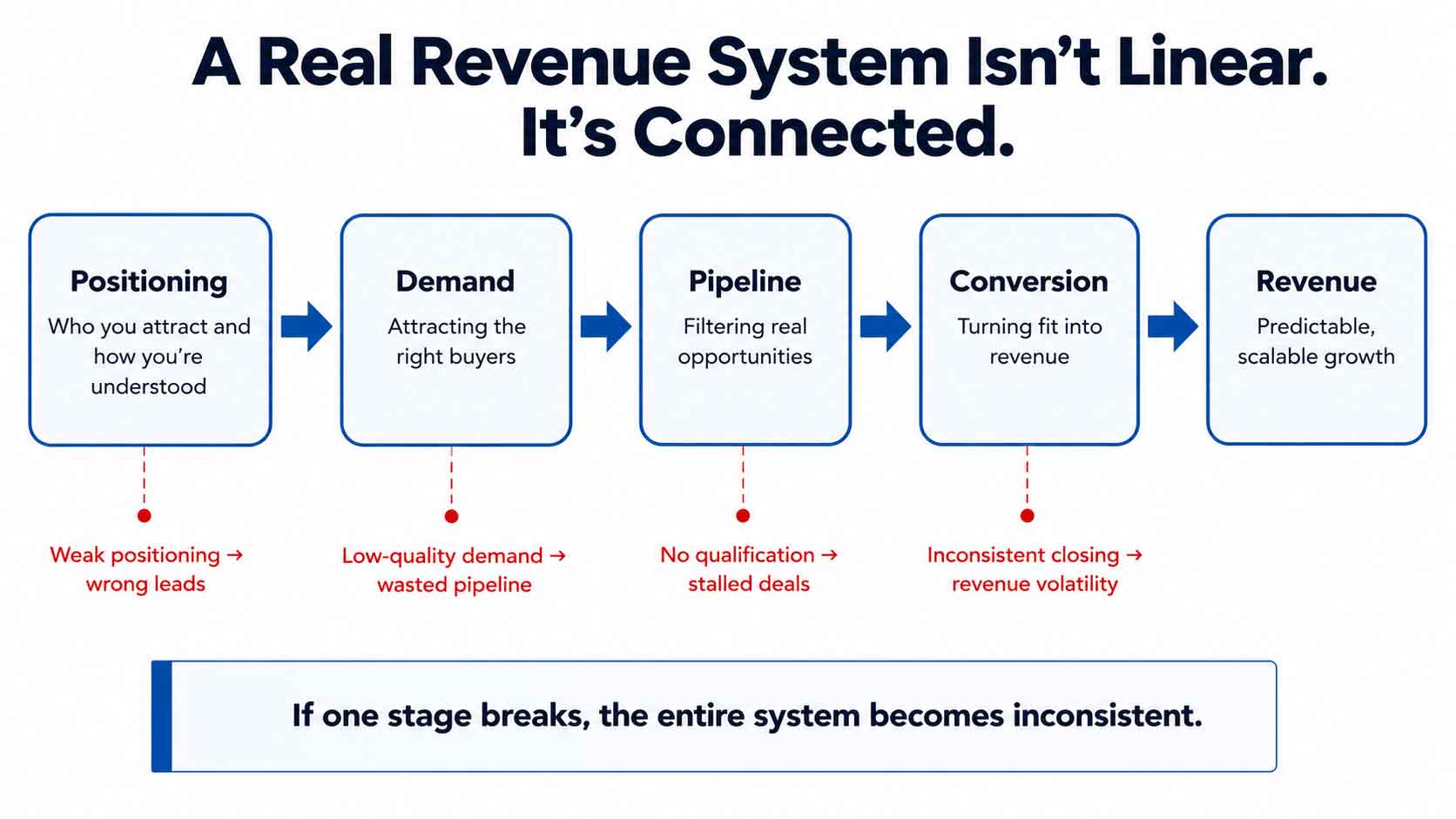
This is how a real revenue system actually works:

Revenue System Framework: Positioning, Demand, Pipeline, Conversion, Revenue

Most companies are not missing activity. They are missing alignment.

If one stage breaks, everything downstream becomes inconsistent.

What a Revenue System Is Not

A revenue system is not a CRM.

It is not a sales team. It is not a marketing campaign.

It is not a dashboard full of metrics that do not connect.

Most companies confuse tools and activity for a system. They invest in platforms, hire more people, and increase output, but nothing fundamentally changes.

Because the system was never designed.

If your pipeline looks active but revenue is not converting, start here:
Why Your Pipeline Isn’t Converting

The Four Operating Layers of a Revenue System

A real revenue system is built across four connected operating layers. Revenue is the outcome when those layers work together.

  • Positioning defines who you attract and how your value is understood.
  • Demand Generation creates interest from the right buyers.
  • Pipeline Design filters and structures real opportunities.
  • Conversion turns fit into predictable revenue.

Each layer feeds the next. Break one, and the entire system becomes unstable.

The Revenue System, Simplified

Positioning → Demand → Pipeline → Conversion → Revenue

Each stage feeds the next. Break one, and the entire system becomes inconsistent.

1. Positioning: The Starting Point of Revenue

Positioning determines who you attract and how buyers interpret your value.

If you attract the wrong buyers, everything downstream breaks. Pipeline quality drops, sales cycles get longer, and conversion becomes unpredictable.

Most companies try to fix this with better sales execution. That is backwards.

Strong positioning aligns your message with real buyer problems and creates clarity before the sales conversation ever begins.

2. Demand Generation: Attracting the Right Buyers

Demand generation is not about volume. It is about relevance.

Most companies generate traffic, but not qualified demand. The result is activity without outcomes.

When demand aligns with positioning, you do not just get more leads. You get the right leads, buyers who are already a fit.

If your marketing is producing activity but not qualified opportunities, read:
Why Your Marketing Isn’t Generating Qualified Leads

3. Pipeline Design: Filtering for Real Opportunities

Your pipeline should not be a holding area for conversations.

It should be a structured system that qualifies, filters, and advances opportunities based on fit.

If everything enters your pipeline, nothing moves through it efficiently.

If your pipeline is full but deals are not closing, it is not a sales problem:
It is a pipeline design problem.

4. Conversion: Turning Fit Into Revenue

Conversion is where alignment is tested.

If positioning, demand, and pipeline are working, conversion becomes more predictable.

If they are not, conversion becomes inconsistent, and sales gets blamed.

But sales operates at the end of the system, not the beginning.

What Most Companies Actually Have

  • Disconnected marketing campaigns
    Activity increases, but it is not tied to a clear revenue outcome.
  • Unqualified leads entering the pipeline
    Sales spends time filtering instead of closing.
  • Sales teams chasing low-fit opportunities
    Effort is wasted on deals that were never going to convert.
  • Metrics that measure activity instead of outcomes
    Dashboards look strong, but revenue does not follow.

Everything looks active. Nothing compounds.

This is exactly why pipelines feel full but fail to convert:
Why Your Pipeline Isn’t Converting

How Revenue Systems Break

  • Positioning attracts the wrong audience
  • Demand generation produces low-quality leads
  • Pipeline lacks qualification structure
  • Conversion depends on individual performance

This creates inconsistency. And inconsistency kills growth.

What Changes When the System Works

  • Leads are more qualified
  • Sales cycles shorten
  • Close rates improve
  • Revenue becomes more consistent

This is not about working harder. It is about fixing the system.

For a deeper look at how to build this kind of structure, read:
How to Build a Revenue Growth System

How To Know Your Revenue System Is Broken

  • High pipeline volume with low close rates
  • Inconsistent revenue performance
  • Marketing and sales misalignment
  • Constant pressure to generate more leads
  • Unclear messaging that fails to differentiate
  • Revenue forecasts with limited visibility
Most companies do not have a pipeline problem. They have a system problem disguised as activity.

If you are still thinking about marketing, sales, and pipeline as separate functions, you are not managing growth. You are reacting to it.

The Bottom Line

Revenue does not come from effort alone. It comes from alignment.

If your system is broken, more activity will not fix it.

Most companies do not need more campaigns, more dashboards, or more disconnected sales activity.

They need a better revenue system.

Most Companies Don’t Need a VP of Sales. They Need a Revenue System.

Still thinking in funnels instead of systems?
Revenue System vs Sales Funnel

If your company needs senior-level guidance to diagnose and fix these gaps, learn more about
Webociti’s revenue systems approach.

Your Revenue System Is Already Breaking. The Question Is Where.

If you want consistent growth, you need a system that actually works.


Schedule a Revenue Strategy Call →

Most companies respond to stalled growth by adding sales leadership. But what looks like a sales problem is usually a system failure upstream, and that distinction is where most decisions go wrong.

In Summary

Most companies don’t need another sales leader. They need a revenue system.
Growth becomes predictable when positioning, demand, pipeline, and conversion are connected and owned as one system.

Jump to:
Where Growth Breaks |
Why Sales Fails |
Revenue System |
What a CRO Does

Most companies respond to stalled growth the same way. They hire a VP of Sales. It feels logical on the surface. Revenue is flat, pipeline is inconsistent, and deals are not closing, so the assumption becomes simple: sales is the problem.

But in most cases, that assumption is wrong. What looks like a sales issue is usually a system failure that starts much earlier in the buyer journey and compounds by the time opportunities reach the pipeline.

Growth Doesn’t Break in Sales

Growth does not break at the point of conversion. It breaks earlier, often much earlier, in ways that are harder to see but far more damaging over time.

By the time a deal reaches sales, most of the outcome has already been shaped. The quality of the lead, the clarity of the positioning, the urgency of the problem, and the alignment of expectations are all determined before a rep ever gets involved.

When those inputs are off, sales does not fail. It inherits a situation that was already misaligned. That is why teams can work harder, follow better process, and still struggle to produce consistent results.

No amount of sales leadership fixes bad inputs.

Why Hiring More Sales Leadership Often Fails

When growth slows, leadership looks at sales first because it is the most visible part of the revenue engine. But what looks like a conversion problem is usually something deeper.

Marketing generates low-quality leads.
Sales is not struggling to close. They are working opportunities that should have never entered the pipeline.

Messaging lacks clarity.
If the value proposition is not sharp, every deal becomes a negotiation instead of a decision.

Pipeline definitions are inconsistent.
Forecasting becomes unreliable, and leadership starts reacting instead of planning.

Revenue feels unpredictable.
Not because people are not working hard, but because there is no system connecting activity to outcomes.

This is not a sales problem. This is a system problem.

If you’re seeing these issues, it’s usually a signal that your growth strategy needs to be restructured. Our Growth Strategy Program is designed to identify where revenue breaks and rebuild how your pipeline actually works.

Why This Keeps Happening

Most companies are structured around functions, not revenue. Marketing generates leads, sales closes deals, and customer success handles retention. Each operates independently.

As a result, teams can perform individually while the overall system fails. That disconnect is where growth breaks.

What Companies Actually Need Is Revenue Ownership

A VP of Sales can optimize a team. But they do not control positioning, demand quality, or how pipeline is created.

What is missing is ownership of the entire revenue system.

If your organization lacks that oversight, our Marketing Leadership Program provides fractional CMO and revenue strategy support to align your entire growth engine.

Most Companies Operate Like the Left. Growth Comes From Building the Right.

Broken Growth vs Revenue System

Siloed Execution

Marketing
Sales
Leads
Pipeline

Revenue System

Positioning
Demand
Pipeline
Conversion
Retention

What a Revenue System Actually Looks Like

A revenue system connects positioning, demand, pipeline, and conversion into a measurable, repeatable model.

If your pipeline feels inconsistent, the issue is usually upstream.

Diagnose My Revenue System

What a Real CRO Actually Does

A CRO owns how revenue is created across the business. They identify breakdowns, redefine pipeline structure, and connect the full system.

It is not a coordination role. It is a system design role.

The Bottom Line

Most companies stall because their revenue system is fragmented.

You do not fix growth by adding pressure to sales.

You fix it by building a system that works.

If you’re preparing for scale or exit, explore our Acquisition Ready Program.


Frequently Asked Questions

What is the difference between a CRO and a VP of Sales?

A CRO owns the full revenue system. A VP of Sales manages the sales team.

When should a company hire a CRO?

When growth becomes inconsistent or pipeline quality declines.

Why doesn’t hiring a VP of Sales fix growth?

Because most issues originate before sales begins.

Your Revenue System Is Already Costing You Growth

If growth feels inconsistent, the issue is not effort. It is how your system is built.

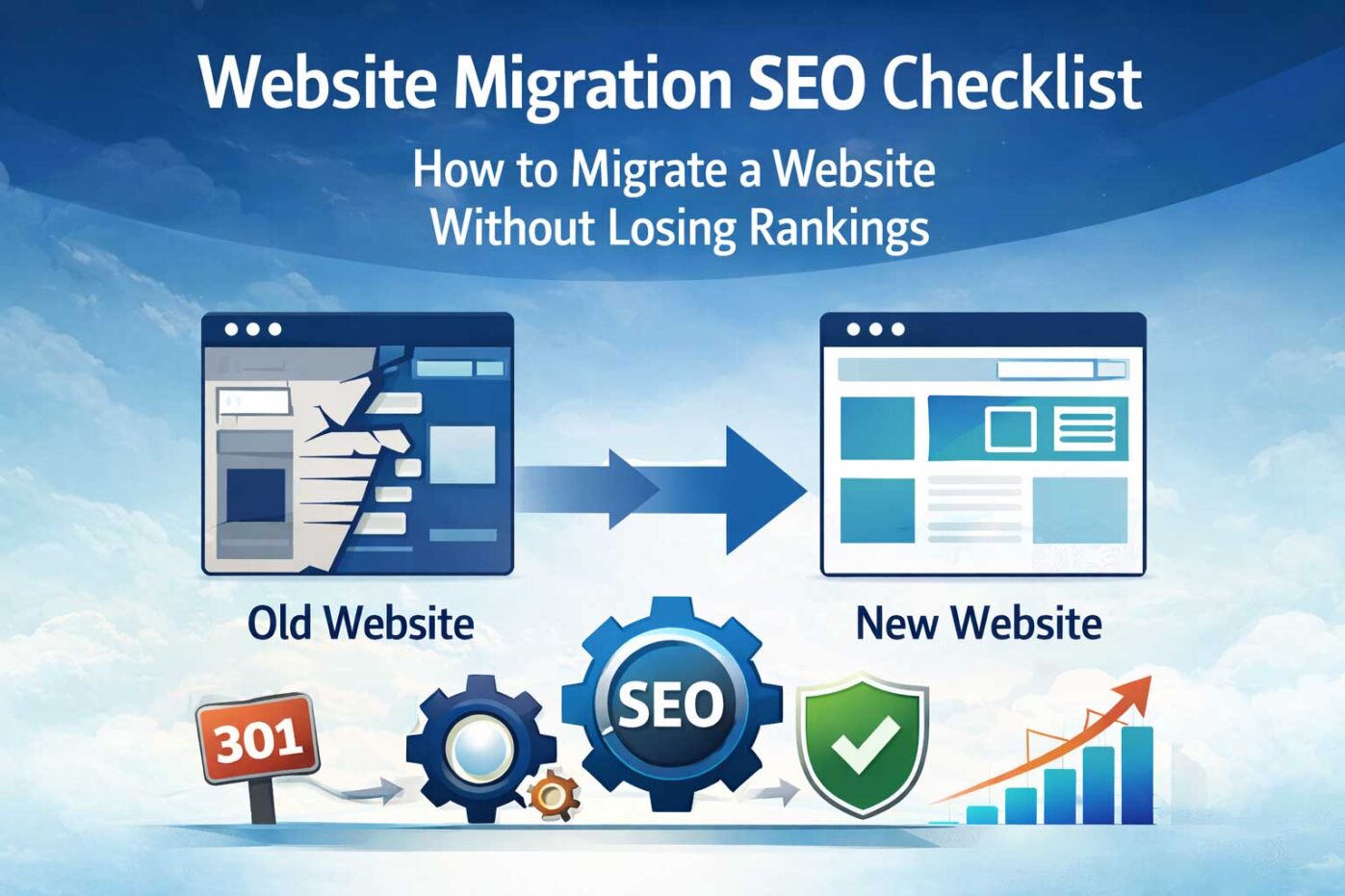
A website migration SEO checklist helps businesses protect search rankings and traffic during a redesign, domain change, or platform migration. Without proper planning, migrations can cause ranking drops, broken links, and lost organic visibility.

Quick Summary:

A successful website migration requires planning, testing, and SEO protection. Key steps include:

  • Crawling your existing website
  • Mapping old URLs to new pages
  • Implementing 301 redirects
  • Preserving SEO elements
  • Updating XML sitemaps
  • Testing before launch
  • Monitoring rankings after launch

Following these steps ensures a smooth migration without losing search visibility.

What Is a Website Migration SEO Checklist?

A website migration SEO checklist is a step-by-step process used to protect rankings and traffic during a redesign, domain change, or platform migration. It includes crawling URLs, mapping redirects, preserving SEO elements, updating sitemaps, and monitoring performance after launch.

Website Migration SEO Checklist (Quick Steps)

  1. Crawl your existing website
  2. Map old URLs to new URLs
  3. Implement 301 redirects
  4. Preserve important SEO elements
  5. Update XML sitemaps
  6. Test redirects before launch
  7. Monitor search performance after launch

If you’re planning a redesign, review our guide on how to replace your existing website without losing SEO traffic.

What Is a Website Migration?

A website migration refers to major changes that impact search visibility, including redesigns, domain changes, platform switches, URL restructuring, and hosting upgrades. Because search engines rely heavily on URLs, internal links, and structured data, even small changes can affect rankings if not handled properly.

Website Migration SEO Checklist

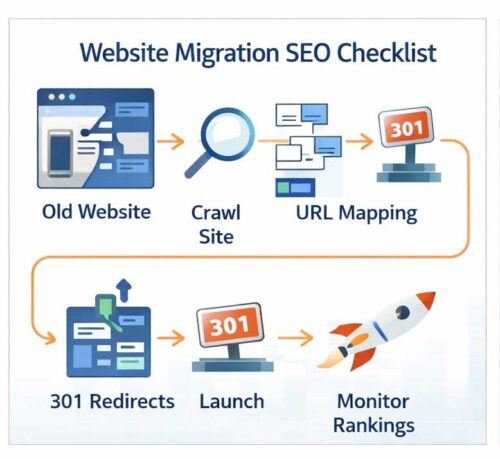
Website migration SEO checklist showing crawl URL mapping redirects launch and monitoring steps

1. Crawl Your Existing Website

Before launching a new website, crawl your existing site using tools like Screaming Frog or Sitebulb. Export all URLs so you know exactly which pages must be redirected.

2. Map Old URLs to New URLs

Create a spreadsheet mapping each old URL to its corresponding new page. This ensures users and search engines are properly redirected after launch.

3. Implement 301 Redirects

301 redirects permanently forward users and search engines from old pages to new ones. This step preserves the SEO authority your pages have built over time.

If you’re unfamiliar with redirects, read our guide on website migration without losing traffic.

4. Preserve Important SEO Elements

  • Page titles
  • Meta descriptions
  • Internal links
  • Header tags
  • Structured data

Maintaining these elements helps search engines understand that your new site represents the same content as the previous version.

5. Update XML Sitemaps

Generate a new XML sitemap and submit it to Google Search Console and Bing Webmaster Tools to help search engines discover and index your pages quickly.

6. Test Redirects Before Launch

Before launching, test redirects to ensure they point correctly and do not produce errors.

7. Monitor Search Console After Launch

After launching, monitor Google Search Console for crawl errors, indexing issues, and ranking fluctuations.

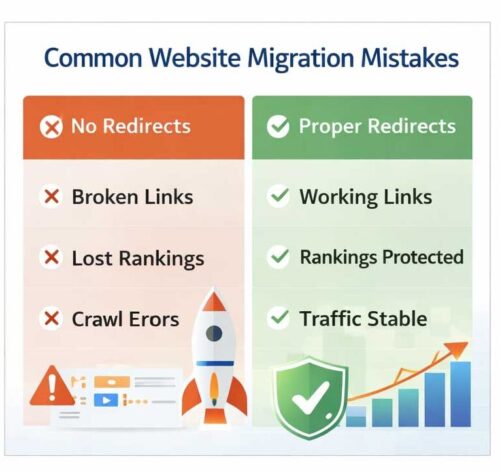
Common Website Migration Mistakes

Common website migration mistakes including broken links lost rankings and crawl errors

  • Failing to implement proper 301 redirects
  • Launching without URL mapping
  • Changing URL structures unnecessarily
  • Forgetting updated sitemaps
  • Not monitoring search performance

Should Businesses Use SEO and PPC After a Website Launch?

Many businesses use paid advertising immediately after launch to maintain traffic while rankings stabilize. Understanding how paid and organic search work together helps businesses recover faster.

If you’re unfamiliar with how these channels work together, read our guide on PPC vs SEM and how they drive website traffic.

Website Migration FAQ

How long does SEO recovery take after a website migration?

SEO performance can fluctuate for several weeks after a migration. Most websites stabilize within 30–90 days if handled correctly.

Will I lose rankings after a website redesign?

Temporary ranking changes are common. Proper redirects, content preservation, and updated sitemaps reduce traffic loss.

Should I change URLs during a redesign?

Whenever possible, keep existing URLs. If changes are necessary, implement proper 301 redirects for every page.

What is included in a website migration checklist?

A migration checklist includes crawling URLs, mapping redirects, preserving SEO elements, updating sitemaps, testing redirects, and monitoring rankings after launch.

What is the biggest SEO risk during a website migration?

The biggest risk is failing to redirect old URLs correctly. Without proper redirects, search engines may treat new pages as different content and rankings can drop.

For a full walkthrough, see our guide on how to replace your existing website without losing traffic.

Need Help With a Website Migration?

Website migrations require careful planning to protect SEO rankings and organic traffic. If you’re planning a redesign or launch, Webociti can help ensure a smooth transition.

Contact us to learn more about our website design services and SEO migration strategies.

Quick Summary:

Replacing an existing website can improve design, speed, user experience, and lead generation, but it must be handled carefully to avoid losing SEO rankings and organic traffic.

Key steps include:

  • Mapping existing URLs before launching the new site
  • Implementing 301 redirects from old URLs to new pages
  • Preserving important page titles, meta descriptions, and structured data
  • Updating internal links and XML sitemaps
  • Testing forms, tracking, and conversion points before launch
  • Monitoring rankings, crawl errors, and traffic after migration

A properly planned website migration strategy helps preserve SEO rankings while improving site performance, user experience, and conversion.

Replacing an existing website is not just a design project. It is an SEO, traffic, and revenue protection project.

A new website can improve your brand, user experience, speed, lead generation, and conversion. But if the migration is handled poorly, your business can lose rankings, organic traffic, and qualified leads almost overnight.

A well-planned website migration strategy protects your SEO rankings, preserves existing traffic, and helps ensure your new website launches without damaging the search visibility your current site has already earned.

Website migrations often impact search rankings, which is why businesses should understand how search visibility works. If you’re unfamiliar with paid and organic search strategies, read our guide on PPC vs SEM and how they affect website traffic.

There’s nothing quite as exciting as launching a new website. Your website is far more than a simple marketing tool. It represents the culmination of months of planning, development, and strategy. A strong digital presence helps prospects and customers find the information they need while helping your business grow revenue.

When replacing an existing website, however, you must protect the SEO value your current site has built over time. Without a proper migration strategy, companies risk losing search rankings, organic traffic, and valuable leads.

It would be fantastic if you could simply “flip the switch” and bring your site live while maintaining all of your search visibility. Unfortunately, this rarely happens without planning. Following the steps below helps ensure your new website launch protects the momentum your current site has already built.


Case study: A major automotive upfitter went from thousands of monthly visits on their website to only two visits per month after launching a new website with another digital marketing firm. When they came to Webociti, we helped restore their SEO using the strategies outlined below. Unfortunately, the damage was already done and it took nearly 180 days for the company to regain its traffic levels.

SEO Website Migration Checklist

Before replacing your existing website, make sure these items are handled before launch:

  • Export and review all current website URLs
  • Map every important old URL to the correct new URL
  • Set up 301 redirects before launch
  • Preserve important page titles, meta descriptions, and structured data
  • Update internal links so they point to the correct new pages
  • Create and submit a new XML sitemap
  • Test forms, tracking, analytics, and conversion points
  • Monitor Google Search Console after launch for crawl errors

Tips for Moving Your Website

Have a security certificate in place? Check. Proofed all the text? Check. But what about the small details companies often discover after launch, details that can frustrate visitors or harm SEO performance?

These website migration tips help ensure your new website launch goes smoothly, protects existing rankings, and provides the best possible experience for visitors.

Use a 301 Redirect Strategy

When you are creating a new website from the ground up, it’s critical to maintain your current site until the new site is fully tested and ready to launch. One of the most important steps in a website migration is implementing 301 redirects.

A 301 redirect uses HTTP Status Code 301 to forward users and search engines from specific pages on your old site to the same pages on your new site. This allows search engines to transfer ranking signals from the old URLs to the new ones.

When users enter your old URL, they are automatically redirected to the corresponding page on your new website. This ensures visitors can still find your content while protecting the traffic your site has earned over time.

Have URL Mapping Performed on Your Site

Carefully review your existing website using a tool like Screaming Frog SEO Spider. This tool helps identify every page on your current website so you can map each page to a matching page on your new website.

URL mapping is one of the most important steps in protecting your SEO during a redesign. Every important page should have a clear destination on the new site, especially pages that already rank, generate traffic, earn backlinks, or support lead generation.

If you have pages that no longer exist on the new site, avoid sending everything to the homepage by default. Whenever possible, redirect old URLs to the most relevant new page, service page, category page, or related resource. This creates a better experience for users and gives search engines a clearer signal about where the old content has moved.

Update Sitemaps

Sitemaps are more important today than ever before. Both HTML and XML sitemaps help search engines understand your website structure and find important pages more quickly.

SEO PPC SEM Marketing

Google provides a great overview of sitemaps in their Search Console documentation. You can also learn more about implementing sitemaps through Yoast on our guide explaining what SEO is.

Your team should create two types of sitemaps:

  • HTML sitemap – helps visitors navigate your website
  • XML sitemap – used by search engines to crawl and index your pages

XML sitemaps can be submitted through Google Search Console and Bing Webmaster Tools to ensure search engines quickly discover your new pages.

Site Transition

When launching a new website or performing a redesign, coordinate with your marketing, sales, and customer service teams before launch. Choose a time with lower traffic levels to minimize disruption for visitors.

Once your new site goes live, review the full list of 301 redirects to ensure every important page has been redirected correctly. Start with the highest-traffic pages and work down through the rest of the site.

During the first few hours after launch, have team members test important pages to confirm everything works properly. Over the following weeks, monitor Google Search Console to identify crawl errors, indexing issues, or pages that may require additional redirects.

Do Not Attempt This Without Professional Help

Failing to follow proper migration procedures can severely damage your search rankings. Without advanced SEO techniques, a website migration may result in a significant loss of organic traffic for months.

If you do not have an experienced SEO strategist guiding the project, it is common to see traffic drops during a redesign. Even with a professional SEO team, a temporary 5 to 7 percent dip in traffic can occur after launch before rankings stabilize.

These are specialized marketing services that help ensure your new website launch strengthens your digital presence rather than harming it.

Common Website Migration Mistakes That Hurt SEO

Many companies combine website redesign projects with search marketing campaigns such as Google Ads management to quickly rebuild and grow website traffic after a launch.

Website migrations can significantly impact rankings if not handled properly. Some of the most common mistakes include:

  • Failing to implement proper 301 redirects
  • Launching a new site without mapping old URLs
  • Changing site structure without redirect planning
  • Deleting useful pages that already rank or earn backlinks
  • Forgetting to submit updated XML sitemaps
  • Not checking forms, tracking, analytics, and conversion points
  • Not monitoring Google Search Console after launch

Avoiding these mistakes helps ensure your new website maintains its search engine visibility while benefiting from improved design and performance.

A website migration can also affect more than search rankings. If your website is a core part of your lead generation and sales process, lost traffic can quickly become lost pipeline. That is why a redesign should be planned as part of a larger revenue system, not treated as a standalone design project.

SEO Considerations When Replacing a Website

Replacing a website without a proper SEO migration plan can lead to significant traffic loss. Search engines rely on page URLs, redirects, internal links, and sitemaps to understand your website structure.

During a redesign, businesses should preserve important SEO elements such as page titles, meta descriptions, internal links, heading structure, image alt text, schema markup, and high-value content whenever possible.

Working with an experienced SEO agency helps ensure your new website launch improves rankings instead of damaging them.

Website Migration and Conversion Tracking

SEO is not the only thing that can break during a website migration. Forms, phone tracking, analytics, conversion pixels, CRM integrations, and call-to-action buttons should also be tested before and after launch.

A redesigned website may look better, but if lead forms stop working or conversion tracking disappears, your team can lose visibility into what is actually driving growth. Before launch, confirm that Google Analytics, Google Search Console, Google Ads conversion tracking, Meta pixels, call tracking, and CRM forms are working properly.

This is especially important for companies that rely on organic search, paid media, or website leads as part of their growth system.

Related Website Migration Resources

Planning a website redesign or migration requires a strong SEO strategy. These guides can help you better understand how search visibility, paid advertising, and SEO work together to protect and grow your traffic:

Website Migration Frequently Asked Questions

Will I lose SEO if I replace my website?

You may lose rankings if the migration is not handled correctly. Implementing 301 redirects, maintaining important URLs, preserving high-value content, and submitting updated sitemaps helps preserve SEO performance.

What is a 301 redirect?

A 301 redirect permanently forwards visitors and search engines from an old page to a new page while transferring SEO value to the new URL.

How long does it take Google to reindex a new website?

Google can begin indexing a new site within a few days, but rankings often take several weeks to stabilize after a major website migration. Larger sites or sites with major URL changes may take longer.

Should I change URLs when launching a new website?

It is best to keep existing URLs whenever possible. If URLs must change, proper 301 redirects should be implemented to maintain SEO rankings and prevent users from landing on broken pages.

What should I check after a website migration?

After launch, review Google Search Console for crawl errors, check that redirects are working, submit your new XML sitemap, test forms and tracking, monitor rankings, and review organic traffic performance.

Replacing Your Website? Protect Your SEO Before You Launch

A new website should strengthen your visibility, not erase the rankings and traffic you have already earned. If you are planning a redesign, Webociti can help you map your URLs, protect your SEO, improve your site structure, and launch with a smarter migration strategy.

Before launching a redesigned website, follow a complete website migration SEO checklist to ensure your rankings and traffic are protected.

Schedule a Revenue Strategy Call with Webociti to review your website migration plan before launch.

Quick Summary:

PPC is a paid advertising model where businesses pay each time someone clicks on an ad.
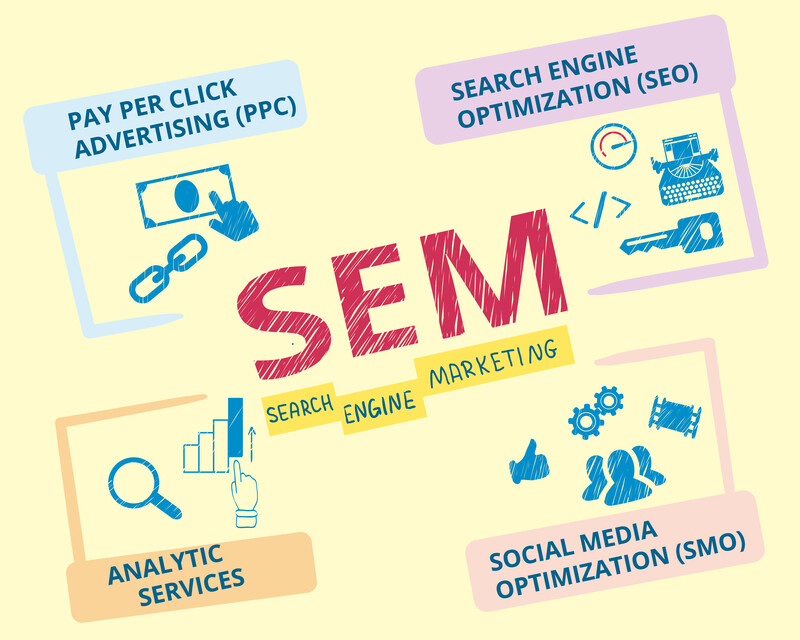
SEM is a broader search marketing strategy that includes PPC, SEO, and other tactics designed to increase visibility in search engines.

PPC can generate traffic quickly. SEO builds long-term organic visibility. SEM brings both together into a more complete search marketing strategy.

Many businesses hear the terms PPC and SEM used interchangeably, but they are not the same thing.

PPC, or pay-per-click advertising, is a paid advertising model where businesses pay each time someone clicks their ad. SEM, or search engine marketing, is a broader strategy that includes both paid search advertising and organic strategies like SEO services for small businesses.

Understanding the difference between PPC and SEM helps businesses choose the right search marketing strategy to generate leads, increase website traffic, and grow revenue.

The real question is not whether PPC or SEM is better. The real question is whether your search strategy is connected to the rest of your revenue system. Paid search, SEO, landing pages, messaging, lead capture, and conversion all need to work together if you want search traffic to turn into revenue.

Businesses looking for a complete online growth strategy often combine SEO and paid advertising through structured digital marketing programs that align lead generation, search visibility, and long-term business growth.

Watch: SEM vs PPC Explained

What Is the Difference Between PPC and SEM?

PPC stands for pay-per-click. It is a paid advertising model where businesses pay for every click on their ad.

SEM stands for search engine marketing. SEM is the broader strategy of increasing visibility in search engines through paid ads, SEO, content, technical optimization, and other search-focused tactics.

In simple terms, PPC is part of SEM. PPC can drive immediate traffic, while SEM includes both paid and organic strategies designed to create short-term visibility and long-term search growth.

PPC vs SEM: Key Differences

Feature PPC SEM
Meaning Pay-per-click advertising Search engine marketing
Type Paid advertising model Overall search marketing strategy
Traffic Speed Immediate traffic after launch Short-term and long-term visibility
Cost Pay for each click Combination of paid and organic investments
Sustainability Traffic stops when ads stop Can build long-term traffic and authority
Best For Immediate leads, promotions, testing, and visibility Long-term visibility, brand authority, and search growth

In short, PPC delivers immediate paid traffic while SEM includes both PPC and long-term strategies like SEO that build sustainable search visibility.

SEM vs SEO vs PPC: What’s the Difference?

Many business owners also ask how SEM, SEO, and PPC differ. While these terms are related, they play different roles in a search marketing strategy.

  • SEO focuses on improving a website’s organic rankings in search engines through content, technical optimization, site structure, and authority building.
  • PPC is paid advertising where businesses pay each time someone clicks on an ad.
  • SEM is the larger search marketing strategy that can include both SEO and PPC to increase visibility in search results.

For most businesses, SEO and PPC should not be treated as competing strategies. They work best when they support each other.

PPC vs SEO vs SEM: What Businesses Should Know

Many businesses compare PPC vs SEO when deciding how to invest their marketing budget. Both strategies help generate website traffic, but they work in very different ways.

  • PPC generates traffic quickly through paid ads.
  • SEO builds organic search rankings over time.
  • PPC stops generating traffic when the ads stop running.
  • SEO can continue driving traffic long after the work is completed.
  • SEM brings search tactics together into a larger visibility strategy.

For most companies, the best approach is combining both strategies. PPC can generate leads quickly while SEO services for small businesses build long-term visibility and sustainable traffic.

Many businesses pair SEO with Google Ads management services to generate both short-term leads and long-term growth.

How Paid Digital Advertising Increases Revenue

If you have been placing pay-per-click ads and hoping for a major increase in sales, you may be disappointed if the campaign is not connected to the right strategy. Successful PPC advertising campaigns require planning, testing, landing page alignment, and ongoing optimization.

Effective digital advertising campaigns usually involve:

  • Researching high-performing keywords
  • Analyzing competitor advertising strategies
  • Setting clear budgets and performance goals
  • Creating strong ad copy and landing pages
  • Testing different ads, offers, and audiences
  • Tracking conversions and lead quality
  • Continually refining campaigns for better results

Without these steps, businesses may generate impressions and clicks but fail to convert that traffic into leads, opportunities, and customers.

What Is SEM? Search Engine Marketing Explained

Search engine marketing focuses on increasing a website’s visibility in search engine results pages. SEM strategies may include paid advertising, SEO, technical optimization, content marketing, landing page optimization, and conversion tracking.

When a website is optimized correctly with relevant content, strong technical structure, useful landing pages, and clear calls to action, search engines and users have a better experience. That can lead to stronger visibility, better traffic quality, and more qualified leads.

SEM should not be viewed as a single tactic. It is a coordinated search strategy designed to help the right people find your business when they are actively searching for solutions.

What Is PPC? Pay-Per-Click Advertising Explained

Pay-per-click advertising refers to paid ads that often appear at the top of search engine results pages. Businesses bid on keywords and only pay when someone clicks their advertisement.

The cost of each click depends on competition, industry, search volume, location, and keyword intent. Highly competitive keywords may cost several dollars per click, while niche keywords may cost less.

Advertisers typically set a daily budget for their campaigns. Once that budget is reached, the ads stop running until the next day.

Professional Google Ads management services can help businesses improve ad targeting, landing page alignment, conversion tracking, and return on ad spend.

When Should a Business Use PPC?

PPC can be a good fit when your business needs immediate visibility or wants to test offers quickly.

  • Launching a new product or service
  • Promoting limited-time offers
  • Competing in highly competitive industries
  • Generating immediate leads
  • Testing marketing messages
  • Supporting a new website or landing page
  • Retargeting visitors who did not convert the first time

PPC works best when the campaign is connected to strong landing pages, clear messaging, conversion tracking, and a defined follow-up process.

When Should Businesses Focus on SEM?

Businesses should focus on SEM when they want a more complete search marketing strategy that combines short-term visibility with long-term organic growth.

  • Increasing organic website traffic
  • Building brand authority
  • Reducing long-term dependence on paid ads
  • Generating consistent inbound leads
  • Improving search visibility across multiple stages of the buyer journey
  • Combining SEO and PPC into one coordinated growth strategy

For many companies, SEM is strongest when paid search and SEO are planned together instead of managed as separate tactics.

How PPC and SEM Fit Into a Revenue System

PPC and SEM can help drive traffic, but traffic alone does not create growth. Search marketing needs to connect to the full customer journey, including positioning, messaging, landing pages, lead capture, sales follow-up, and conversion.

A PPC campaign may generate clicks, but if the landing page is weak or the offer is unclear, those clicks may not become qualified leads. SEO may generate organic traffic, but if the content does not align with buyer intent or the site lacks strong calls to action, rankings may not translate into revenue.

That is why search marketing should be planned as part of a larger revenue system. When SEO, PPC, messaging, lead generation, and conversion strategy work together, search traffic has a better chance of becoming real pipeline.

Launching a New Website? Protect Your Search Visibility

If you are planning to launch a new website, it is important to protect your search rankings during the transition. A poorly planned redesign can damage SEO performance, disrupt paid campaigns, and reduce lead flow.

Learn how to avoid traffic loss during a website migration, or use our website migration SEO checklist before launching a redesigned site.

Related Questions About PPC and SEM

Business owners researching search marketing often ask several related questions about PPC, SEO, and SEM. Understanding how these strategies work together can help you build a stronger digital marketing plan.

  • What is the difference between PPC and SEO?
  • Is Google Ads the same as PPC?
  • How much should a small business spend on PPC?
  • Can PPC help SEO rankings?
  • Should businesses use SEO and PPC together?

Most successful businesses use a combination of SEO, PPC advertising, and broader SEM strategies to create both immediate lead generation and long-term search visibility.

PPC vs SEM Frequently Asked Questions

Is PPC the same as SEM?

No. PPC is a paid advertising model, while SEM is a broader search marketing strategy that can include PPC, SEO, content, technical optimization, and other search visibility tactics.

What is the difference between PPC and SEO?

PPC is paid advertising where businesses pay for each click. SEO focuses on earning organic visibility in search engines through content, technical optimization, and site authority. PPC can generate traffic quickly, while SEO usually builds over time.

Does PPC help SEO rankings?

PPC does not directly improve organic SEO rankings. However, PPC can help businesses test keywords, offers, ad copy, messaging, and landing pages. Those insights can improve the effectiveness of an SEO strategy.

Should businesses invest in both SEO and PPC?

Many businesses benefit from using both. PPC can create immediate visibility and lead flow, while SEO builds long-term organic traffic and authority. Together, they can support a stronger SEM strategy.

Which is better, PPC or SEM?

PPC is best for immediate paid visibility. SEM is better when a business wants a broader search strategy that includes both paid and organic growth. In many cases, PPC works best as one part of a larger SEM strategy.

How long does SEO take compared to PPC?

PPC campaigns can begin generating traffic soon after launch. SEO usually takes longer, often several months, because search engines need time to crawl, index, and evaluate content, authority, and technical improvements.

Need Search Marketing That Connects to Revenue?

PPC, SEO, and SEM can all help your business grow, but only when they are connected to the right message, landing pages, lead capture process, and conversion strategy.

Webociti helps businesses align paid search, SEO, lead generation, and conversion into a smarter revenue growth system.

Real Estate Marketing • Positioning & Strategy

Real Estate Marketing Has Changed: Strategy Beats Listings (Redfin Confirms It)

Listings aren’t the advantage anymore. Strategy is. Here’s how top agents differentiate and win more listings through insight—not inventory.

AI TL;DR:

  • Listings are no longer the competitive advantage in real estate.
  • Consumers already have access — they need strategic guidance.
  • Agents who position themselves as decision-making advisors win more listings.
  • Marketing must shift from promotion to positioning.

As featured in Redfin

Redfin featured Webociti’s perspective on how top agents differentiate through strategy—not listings.

Read the Redfin article →

“Most buyers and sellers don’t need an agent to find listings anymore. What they really need is someone who helps them make smart decisions in a crowded market.”

— Joe Mediate, Webociti (quoted in Redfin)

For years, real estate marketing revolved around one thing: listings. More exposure. More portals. More visibility.

Today, buyers and sellers don’t need an agent to find homes. Inventory is accessible. The advantage has shifted.

The new differentiator isn’t access. It’s guidance. Agents who win today position themselves as strategic advisors—before the first conversation ever happens.

If you want your website and messaging to reflect this shift, here’s how we approach real estate marketing for agents and brokers and combine it with local SEO for small business to build visibility where it matters most.

Listings Are No Longer the Advantage

Ten years ago, access to listings was leverage. Today, it’s commoditized. Consumers don’t hire agents because they can’t find homes. They hire agents because they:

  • Don’t understand pricing strategy
  • Need neighborhood context and local nuance
  • Want negotiation confidence
  • Fear making expensive mistakes

Information is everywhere. Interpretation is rare. That’s why your marketing should reinforce the one thing portals can’t replicate: clear, strategic guidance.

Why Most Real Estate Marketing Is Broken

Most real estate marketing still looks like “post listings and boost them.” Agents end up stuck in:

  • Over-reliance on third-party portals
  • No local differentiation
  • Inconsistent lead flow
  • Websites with generic messaging
  • Random tactics with no compounding system

Marketing without strategy creates activity not predictable growth.

That’s why we build strategy-first real estate marketing systems designed to create consistent visibility and a predictable pipeline often starting with our Growth Strategy Program.

Executive Summary

Real estate marketing has shifted. Access to listings is commoditized. What differentiates successful agents today is strategic guidance: pricing insight, negotiation clarity, local authority, and risk reduction.

Agents who market themselves as strategic advisors (not inventory promoters) attract higher-quality listings and reduce dependence on third-party platforms. Positioning—not promotion—is now the competitive advantage.

Real Estate Marketing FAQs

Quick answers to the most common questions agents ask as the market shifts from “promoting listings” to “positioning expertise.”

What is “strategy-first” real estate marketing?

Strategy-first marketing starts with positioning why someone should choose you—then builds the system around it: local visibility, authority content, conversion-focused pages, and campaigns that support predictable listing growth.

Do listings still matter for real estate marketing?

Listings matter, but they aren’t what differentiates you anymore. Buyers and sellers can find inventory anywhere. What they’re looking for is clarity—pricing insight, neighborhood nuance, negotiation confidence, and risk reduction.

How can agents win more listings without relying on portals?

Build owned visibility: local SEO, Google Business visibility, neighborhood-specific content, and seller-focused landing pages. Then reinforce it with retargeting and follow-up that turns interest into conversations.

How long does real estate marketing take to show results?

You can see early activity in weeks with paid campaigns and better positioning. Sustainable growth typically builds over 60–120 days as SEO, authority, and conversion systems compound.

What should an agent’s website say if listings aren’t the hook?

Lead with guidance: how you help clients make smarter decisions. Be specific about your market, your process, the mistakes you help people avoid, and the outcomes you deliver—confidence, clarity, and fewer costly surprises.

Want predictable listing growth—without portal dependence?

Webociti builds strategy-first marketing systems for agents, brokers, and teams who want to win more listings by owning local authority.


Explore Real Estate Marketing Services →