Real Estate Marketing • Positioning & Strategy

Real Estate Marketing Has Changed: Strategy Beats Listings (Redfin Confirms It)

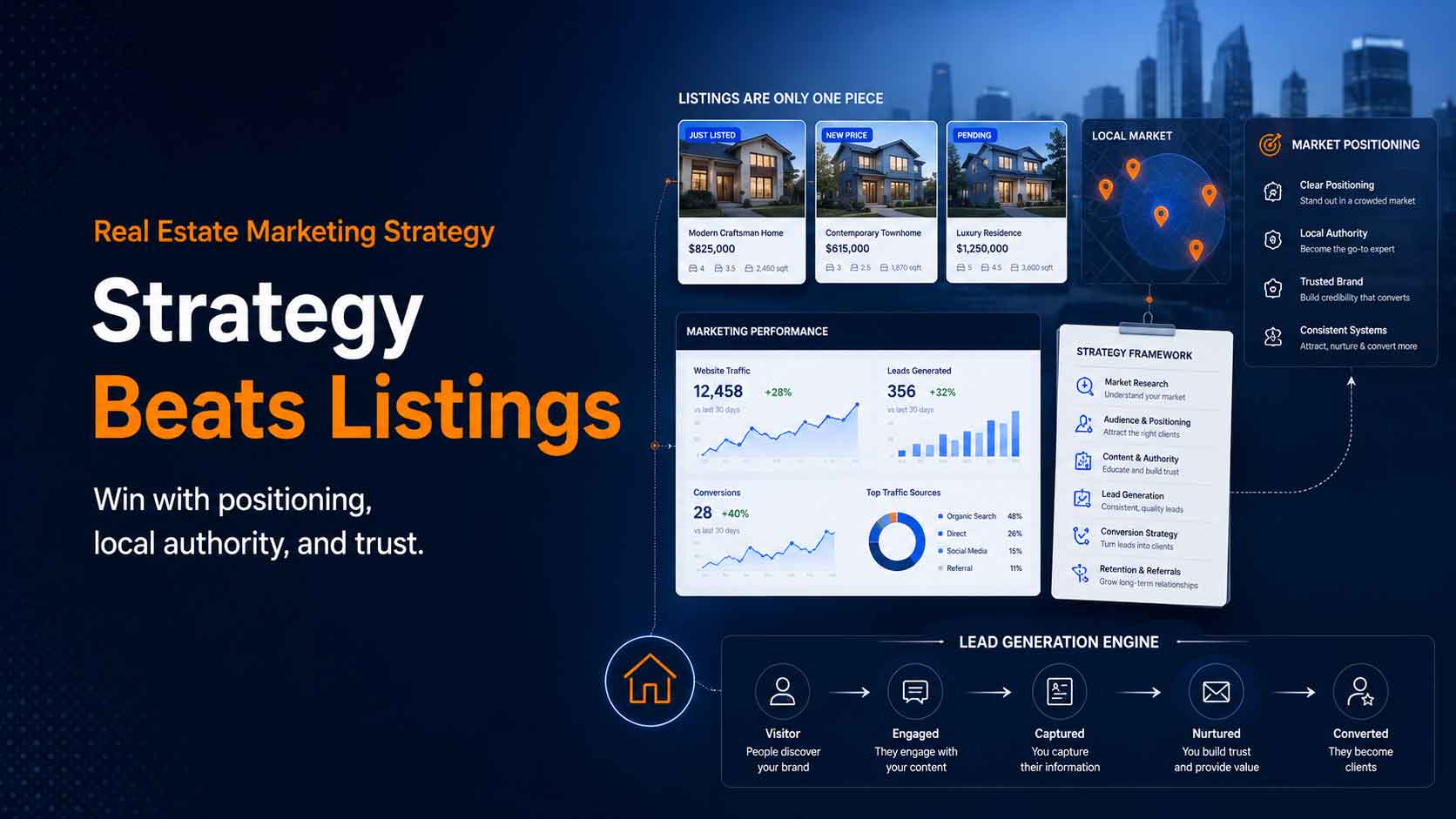
Listings aren’t the advantage anymore. Strategy is. Here’s how top agents differentiate and win more listings through insight—not inventory.

AI TL;DR:

  • Listings are no longer the competitive advantage in real estate.
  • Consumers already have access — they need strategic guidance.
  • Agents who position themselves as decision-making advisors win more listings.
  • Marketing must shift from promotion to positioning.

As featured in Redfin

Redfin featured Webociti’s perspective on how top agents differentiate through strategy—not listings.

Read the Redfin article →

“Most buyers and sellers don’t need an agent to find listings anymore. What they really need is someone who helps them make smart decisions in a crowded market.”

— Joe Mediate, Webociti (quoted in Redfin)

For years, real estate marketing revolved around one thing: listings. More exposure. More portals. More visibility.

Today, buyers and sellers don’t need an agent to find homes. Inventory is accessible. The advantage has shifted.

The new differentiator isn’t access. It’s guidance. Agents who win today position themselves as strategic advisors—before the first conversation ever happens.

If you want your website and messaging to reflect this shift, here’s how we approach real estate marketing for agents and brokers and combine it with local SEO for small business to build visibility where it matters most.

Listings Are No Longer the Advantage

Ten years ago, access to listings was leverage. Today, it’s commoditized. Consumers don’t hire agents because they can’t find homes. They hire agents because they:

  • Don’t understand pricing strategy
  • Need neighborhood context and local nuance
  • Want negotiation confidence
  • Fear making expensive mistakes

Information is everywhere. Interpretation is rare. That’s why your marketing should reinforce the one thing portals can’t replicate: clear, strategic guidance.

Why Most Real Estate Marketing Is Broken

Most real estate marketing still looks like “post listings and boost them.” Agents end up stuck in:

  • Over-reliance on third-party portals
  • No local differentiation
  • Inconsistent lead flow
  • Websites with generic messaging
  • Random tactics with no compounding system

Marketing without strategy creates activity not predictable growth.

That’s why we build strategy-first real estate marketing systems designed to create consistent visibility and a predictable pipeline often starting with our Growth Strategy Program.

Executive Summary

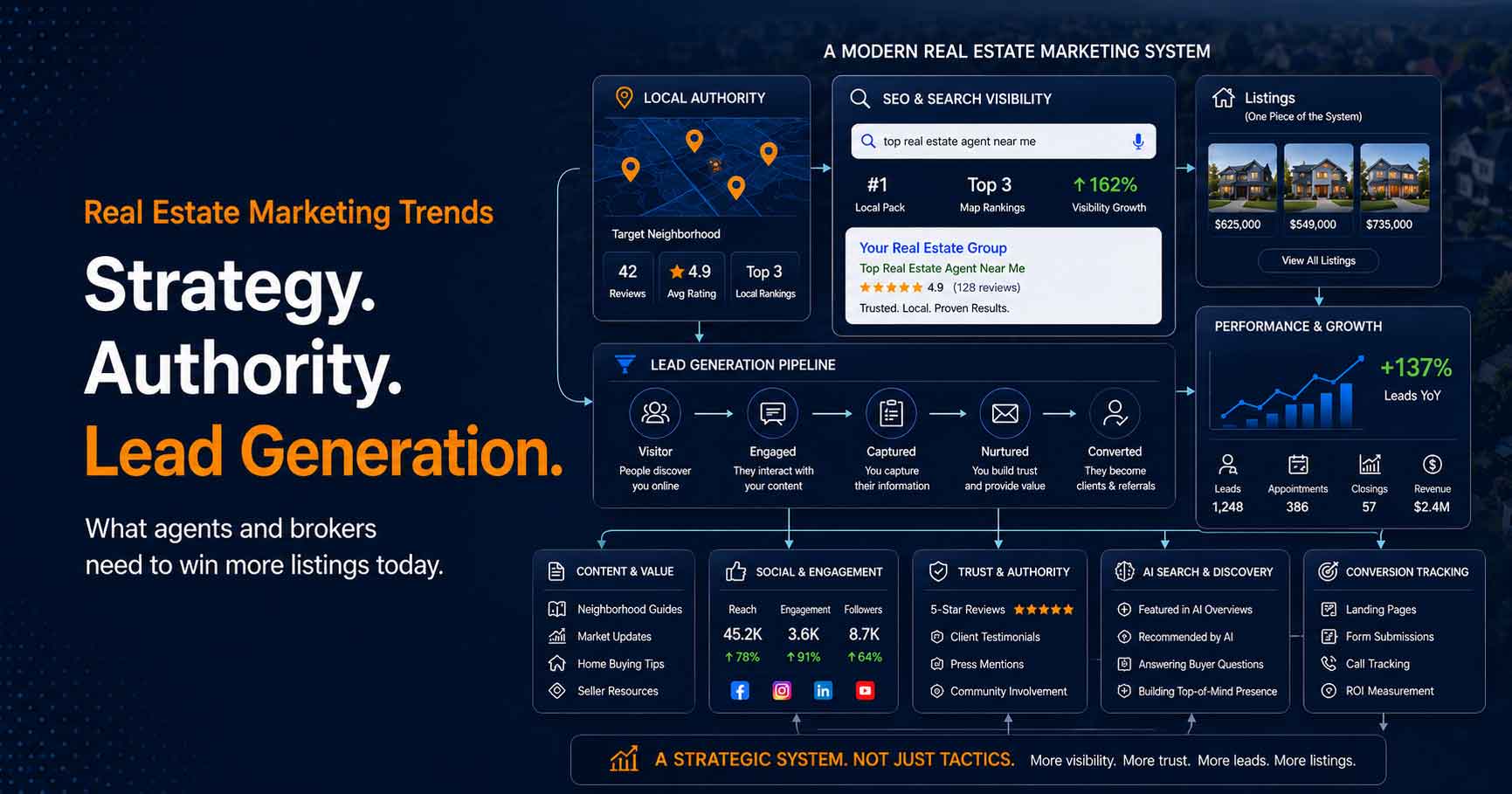
Real estate marketing has shifted. Access to listings is commoditized. What differentiates successful agents today is strategic guidance: pricing insight, negotiation clarity, local authority, and risk reduction.

Agents who market themselves as strategic advisors (not inventory promoters) attract higher-quality listings and reduce dependence on third-party platforms. Positioning—not promotion—is now the competitive advantage.

Real Estate Marketing FAQs

Quick answers to the most common questions agents ask as the market shifts from “promoting listings” to “positioning expertise.”

What is “strategy-first” real estate marketing?

Strategy-first marketing starts with positioning why someone should choose you—then builds the system around it: local visibility, authority content, conversion-focused pages, and campaigns that support predictable listing growth.

Do listings still matter for real estate marketing?

Listings matter, but they aren’t what differentiates you anymore. Buyers and sellers can find inventory anywhere. What they’re looking for is clarity—pricing insight, neighborhood nuance, negotiation confidence, and risk reduction.

How can agents win more listings without relying on portals?

Build owned visibility: local SEO, Google Business visibility, neighborhood-specific content, and seller-focused landing pages. Then reinforce it with retargeting and follow-up that turns interest into conversations.

How long does real estate marketing take to show results?

You can see early activity in weeks with paid campaigns and better positioning. Sustainable growth typically builds over 60–120 days as SEO, authority, and conversion systems compound.

What should an agent’s website say if listings aren’t the hook?

Lead with guidance: how you help clients make smarter decisions. Be specific about your market, your process, the mistakes you help people avoid, and the outcomes you deliver—confidence, clarity, and fewer costly surprises.

Want predictable listing growth—without portal dependence?

Webociti builds strategy-first marketing systems for agents, brokers, and teams who want to win more listings by owning local authority.


Explore Real Estate Marketing Services →

Affordable Online Marketing Program for Startups & Small Businesses

By Joe Mediate – September 19, 2025 – Digital Marketing Programs

Looking for an affordable online marketing program that helps you grow without wasting money or time? You’re not alone. Most small business owners feel overwhelmed by the complexity and cost of digital marketing—but it doesn’t have to be that way.

At Webociti, we designed the Smart Start Program to help startups and small business owners build a solid foundation without breaking the bank. It includes everything you need to attract leads, build your brand, and create lasting growth—at a price that works for your budget.

Start With the Right Marketing Strategy

Marketing success starts with clarity. We help you identify your goals, audience, and message so you don’t waste time on tactics that don’t work. You’ll walk away with:

  • A clearly defined ideal customer profile
  • A core message that differentiates you
  • A focused go-to-market plan

Build Your Online Presence

A strong online presence is non-negotiable. Our team helps you launch or refine your digital footprint with:

  • A clean, fast-loading website (or a refresh of your existing one)
  • Basic SEO setup so customers can find you on Google
  • Setup of local listings and branded social profiles

Capture Leads Automatically

Too many businesses miss opportunities because they don’t have a system to collect leads. We’ll help you:

  • Add forms to capture email addresses and inquiries
  • Set up simple automations for follow-ups
  • Use tools like Mailchimp or Klaviyo to stay top of mind

Get Monthly Expert Guidance

You’ll never feel lost. The Smart Start Program includes monthly strategy calls with our experts. We’ll review your progress, answer questions, and update your plan based on what’s working.

Built to Be Budget-Friendly

We know early-stage businesses are watching every dollar. That’s why our program starts at just $499/month—giving you everything you need without locking you into long-term contracts.

Who Benefits from This Program?

Whether you’re a solopreneur or small local business, Smart Start is designed for you. It’s especially ideal for:

  • Founders launching a product or service
  • Service-based businesses looking for local leads
  • Entrepreneurs who want expert support without agency-level fees

Plug In and Launch

Starting your marketing journey doesn’t have to be complicated. With Webociti’s Smart Start Program, you’ll finally have a step-by-step system, expert coaching, and the confidence to grow.

Click here to explore all our digital marketing programs and find the one that fits you best.

Book a Free Strategy Call

Posted in Digital Marketing Programs


Customer Journey Marketing Strategy: How to Make Your Brand Story Resonate

A well-crafted customer journey marketing strategy ensures that your brand storytelling connects with your audience and leads to conversions.

Most brands make one crucial mistake:

  • They talk too much about themselves—their history, their features, their success.
  • But customers only care about how you can help them solve their problem.

The best brands don’t position themselves as the hero of the story. They position themselves as the trusted guide helping the customer succeed.

In this post, we’ll show you how to shift your messaging to focus on your customers, tell a compelling brand story, and start converting more leads using a customer journey marketing strategy.

Internal Resource: Check out our Customer Journey Marketing Strategy Guide
to dive deeper into this concept.


Why Customers Ignore Self-Centered Marketing

  • People are bombarded with thousands of marketing messages daily—and they filter out anything that doesn’t feel relevant to them.
  • Customers are constantly looking for solutions, not company backstories.
  • A brand that talks about itself too much comes off as self-promotional, unrelatable, and forgettable.

Example:

  • Brand A: “We’ve been in business for 25 years, serving thousands of satisfied clients.”
  • Brand B: “Struggling with [Problem]? We help businesses like yours solve it with [Solution].”

Which one grabs your attention?


How a Customer Journey Marketing Strategy Improves Storytelling

Instead of focusing on what you do, focus on who you help and how you help them.

The StoryBrand Framework is a great way to structure your brand message:

customer journey map

  • The Customer = The Hero (They have a challenge they need to overcome)
  • Your Brand = The Guide (You provide the solution and expertise)
  • A Clear Plan (You show them exactly how you’ll help them succeed)
  • A Call to Action (Encourage them to take the next step)
  • The Transformation (How their life/business improves after working with you)

Example of a Story Shift:

  • Old Message: “We create cutting-edge software for business automation.”
  • New Message: “Struggling with wasted time and inefficient processes? We help businesses streamline operations with easy-to-use automation tools.”

See the difference? The second one speaks directly to the customer’s pain point.


How to Rewrite Your Brand Story to Focus on the Customer

Step 1: Identify Your Customer’s Biggest Pain Points

  • What keeps them up at night?
  • What problem are they actively trying to solve?
  • How does your solution fit into their journey?

Step 2: Speak Their Language, Not Yours

  • Avoid industry jargon. Use simple, relatable language.
  • Talk about outcomes and benefits, not just features.

Step 3: Show Empathy & Authority

  • Let them know you understand their struggle and have the experience to guide them.
  • Use case studies, testimonials, or success stories to prove it.

Internal Resource: Explore our Case Study on Customer-Centric Branding to see this strategy in action.


It’s Time to Optimize Your Customer Journey Marketing Strategy

Watch the Video: How to Make Your Customer the Hero

  • If your marketing isn’t getting the engagement or conversions you expect, it’s time to rethink your messaging.
  • Make your customer the hero and position your brand as the trusted guide.
  • Speak to their problems, desires, and goals—not just about what you offer.

Learn More About Storytelling in Marketing

Need help crafting a compelling brand story?

Contact Webociti today for a free consultation!

Read more marketing insights on our blog: https://www.webociti.com/blog/

5 Reasons a Marketing Agency Beats a Freelancer Every Time

In today’s fast-paced and competitive business world, effective marketing is no longer a luxury – it’s a necessity. Whether you’re a startup looking to establish your presence or a growing business aiming to scale, having the right marketing partner is crucial. Many businesses face a tough choice: Should you hire a freelancer or work with a marketing agency? While freelancers may offer flexibility and affordability, agencies provide the expertise, scalability, and strategic approach necessary for sustained success.

This blog explores five compelling reasons why partnering with a marketing agency is the smarter choice for businesses looking to achieve real, measurable results.

1. A Full Team of Experts

When comparing a Marketing Agency vs Freelancer, agencies bring a full team of experts to the table. Freelancers are often skilled in one or two areas of marketing, such as content creation or social media management. Agencies, on the other hand, provide a full team of specialists, from graphic designers and copywriters to SEO analysts and strategists. This diverse expertise ensures your campaigns are comprehensive and aligned with your business goals.

Example: A freelancer might create beautiful social media posts, but a marketing agency Comparison of a marketing agency vs freelancer highlighting the benefits of agencies for businesses.will also track performance, optimize ad spend, and ensure your posts align with your brand’s overarching strategy.

2. Scalability and Resources

Freelancers can handle only so much work at once. As your business grows, you may outpace their capacity. Agencies are built to scale with your needs, offering the resources and manpower to manage larger campaigns and expand into new channels without skipping a beat.

Benefit: Need a sudden increase in ad spend for a product launch? An agency can quickly mobilize a team to meet your needs, while a freelancer might struggle to keep up.

3. Strategic Planning and Long-Term Vision

Strategic planning is a key advantage of choosing a Marketing Agency vs Freelancer. Marketing agencies don’t just execute campaigns; they create long-term strategies tailored to your business. Agencies invest time in understanding your target audience, analyzing competitors, and crafting data-driven plans to achieve sustained growth. Freelancers, by contrast, often focus on individual tasks rather than big-picture strategy.

Key Insight: With an agency, you’re not just getting a service provider – you’re gaining a strategic partner dedicated to your success.

4. Access to Advanced Tools and Technology

Marketing agencies invest in premium tools and software for analytics, automation, and campaign management. These tools allow for more precise targeting, better performance tracking, and superior optimization. Most freelancers rely on free or limited tools, which can restrict the effectiveness of your campaigns.

Advantage: Agencies leverage tools like SEMrush, HubSpot, or Google Analytics to gain deeper insights and maximize your ROI.

5. Reliability and Consistency

Freelancers, while talented, are individuals and may face challenges like bandwidth issues, personal emergencies, or competing priorities. Agencies, with their teams and structured processes, ensure consistent delivery of results regardless of circumstances. Additionally, agencies often provide dedicated account managers to keep communication seamless and progress on track.

Example: If your freelancer suddenly becomes unavailable, your marketing could come to a halt. An agency ensures continuity and peace of mind.

Final Thoughts

For businesses seeking growth, the decision between a Marketing Agency vs Freelancer is clear. While freelancers can be a great choice for small, isolated projects, marketing agencies are the go-to solution for businesses aiming to grow, scale, and thrive in today’s competitive landscape. With their team expertise, strategic planning, and reliable resources, agencies provide unmatched value that can transform your marketing efforts.

Investing in a marketing agency is more than just outsourcing tasks – it’s partnering with a team that’s dedicated to your success. By leveraging their experience, tools, and strategic insight, you can unlock new levels of growth and performance that freelancers simply can’t deliver.

Ready to take your marketing to the next level? Learn more about how agencies excel compared to freelancers by checking out this detailed guide on outsourcing marketing. Contact Us to see how our team can help your business grow.

Schedule Your Free Consultation

Why Most Businesses Fail at Digital Marketing (And How You Can Avoid Their Mistakes)

You’ve poured time, energy, and money into your digital marketing efforts, but the results just aren’t there. Maybe you’re not getting the website traffic you expected, or your social media ads are falling flat. The harsh reality is, most businesses are set up to fail at digital marketing.

But here’s the good news: It’s not your fault—there’s just a right way and a wrong way to approach it. In this post, we’ll dive into the 10 most common digital marketing mistakes businesses make and show you how to avoid these pitfalls so you can create marketing campaigns that drive real results without wasting your budget.

Mistake 1: Not Having a Clear Strategy

The Problem:
Many businesses jump into digital marketing without a well-defined plan. They invest in Facebook ads, pay-per-click campaigns, or social media content without understanding how each tactic fits into the bigger picture.

Why This Leads to Failure:
Without a strategy, marketing becomes disjointed, with no cohesive messaging or focus. Businesses end up throwing money at the wall, hoping something sticks. Unfortunately, this approach rarely delivers ROI.

The Solution:
Start with a clear, data-driven marketing strategy. Define your goals, know your target audience, and decide which marketing channels will reach them most effectively. At Webociti, we always begin by crafting a strategy that aligns with your business goals—because a focused plan is the first step toward success.
Common reasons why businesses fail at digital marketing

Mistake 2: Targeting the Wrong Audience

The Problem:
One of the biggest digital marketing mistakes is failing to identify the right audience. It’s tempting to believe that everyone could be your customer, but in reality, this leads to wasted ad spend and poor results.

Why This Leads to Failure:
Targeting too broadly dilutes your messaging and prevents you from connecting with the people most likely to convert. A general approach doesn’t resonate with anyone in particular.

The Solution:
To avoid this, businesses must create detailed buyer personas. These personas help tailor your messaging, content, and advertising specifically to the people most interested in your product or service. The right message to the right people at the right time is key—and we can help you uncover exactly who those people are.

Mistake 3: Focusing on the Wrong Metrics

The Problem:
Measuring the wrong KPIs (Key Performance Indicators) is a common mistake. Many businesses focus on vanity metrics like followers, likes, or website traffic, assuming these numbers equal success.

Why This Leads to Failure:
While these metrics can be encouraging, they don’t necessarily equate to leads, sales, or ROI. You might have 10,000 followers on Instagram, but if they’re not converting into paying customers, something is wrong.

The Solution:
Focus on metrics that matter: conversion rates, customer acquisition cost (CAC), return on ad spend (ROAS), and lifetime customer value (LCV). These numbers reveal the real impact of your marketing efforts. At Webociti, we monitor these metrics closely to ensure your marketing investment is delivering results that move the needle for your business.

Mistake 4: Ignoring Mobile Users

The Problem:
Despite the fact that over 50% of all internet traffic now comes from mobile devices, many businesses still fail to optimize their websites and digital content for mobile users.

Why This Leads to Failure:
A website that doesn’t load properly on mobile is a massive turnoff for visitors. Mobile users will abandon slow, clunky sites within seconds, leading to a high bounce rate and missed opportunities.

The Solution:
Ensure that your website is fully mobile-optimized. This includes fast load times, responsive design, and easy navigation. Not only will this improve user experience, but it will also improve your rankings on search engines like Google. Webociti can audit your current site and optimize it for mobile so you’re never missing out on valuable traffic.

Mistake 5: Neglecting Content Marketing

The Problem:
Some businesses think that content marketing is optional or secondary to paid advertising. They fail to create valuable, informative content that engages potential customers.

Why This Leads to Failure:
In today’s digital landscape, consumers are savvier than ever. They want to research and engage with brands before they make a purchase. Without high-quality content, you miss the chance to build trust and establish your brand as an authority.

The Solution:
Content marketing isn’t just about having a blog—it’s about delivering value. This could be in the form of blog posts, videos, infographics, podcasts, and more. Webociti helps businesses create a content strategy that provides useful information and engages your audience at every stage of their buyer’s journey.

Mistake 6: Inconsistent Branding Across Platforms

How businesses can avoid mistakes in digital marketing strategies
The Problem:
Consistency in branding is often overlooked, especially when a business is running campaigns across multiple digital platforms (Facebook, Google, Instagram, etc.).

Why This Leads to Failure:
Inconsistent branding confuses potential customers and undermines your brand’s credibility. If your messaging, design, or tone varies across channels, people won’t recognize or trust your brand.

The Solution:
Develop brand guidelines and ensure every campaign, post, and ad reflects the same tone, visuals, and messaging. A consistent brand creates trust and familiarity, which leads to loyalty. At Webociti, we help businesses create unified branding strategies that resonate with their target audience across all platforms.

Mistake 7: Not Utilizing Retargeting

The Problem:
Many businesses invest heavily in driving traffic to their site but fail to capitalize on that traffic through retargeting. They simply let potential customers slip away.

Why This Leads to Failure:
The average website conversion rate is about 2%. That means 98% of people leave your site without taking any action, but they could still be interested. Without retargeting, those potential customers are lost.

The Solution:
Use retargeting ads to reach people who have already visited your site. These ads are a gentle reminder to those who showed interest in your products or services but didn’t convert. Retargeting often leads to much higher conversion rates and lower customer acquisition costs. Webociti can help set up and optimize retargeting campaigns that bring those lost visitors back to your site to convert.

Mistake 8: Underestimating the Importance of SEO

The Problem:
Search Engine Optimization (SEO) can seem overwhelming, so many businesses ignore it or treat it as an afterthought in their digital marketing strategy.

Why This Leads to Failure:
SEO is the foundation of organic traffic. Without a strong SEO strategy, your website won’t rank on Google, and potential customers won’t be able to find you. Ignoring SEO means relying solely on paid ads, which is costly and unsustainable.

The Solution:
Invest in a long-term SEO strategy that includes on-page optimization, backlink building, and keyword research. By ranking higher on search engines, your business will see a steady stream of organic traffic that doesn’t require ongoing ad spend. Webociti specializes in SEO optimization that drives results—putting your website at the top of search engine results pages (SERPs).

Mistake 9: Lack of Consistency in Digital Marketing Efforts

The Problem:
Businesses often fail by starting and stopping their digital marketing efforts. This could be due to budget constraints, a lack of time, or shifting priorities.

Why This Leads to Failure:
Digital marketing requires consistency. Sporadic efforts result in poor brand recall, missed opportunities, and inefficient ad spending. You need to stay active to stay relevant.

The Solution:
Create a sustainable marketing plan that you can stick with long-term. Instead of doing everything at once, focus on the most important channels and be consistent. This steady approach will yield better results over time. At Webociti, we help businesses develop realistic, ongoing digital marketing strategies that drive consistent traffic and growth.

Mistake 10: Failing to Adapt to Changing Trends

The Problem:
Digital marketing is an ever-evolving field. Many businesses make the mistake of sticking to what worked in the past, ignoring emerging trends and technologies.

Why This Leads to Failure:
What worked last year might not work today. Failing to adapt means your strategies become outdated, and you fall behind your competitors who are more agile and innovative.

The Solution:
Stay informed about the latest digital marketing trends, tools, and platforms. Whether it’s a new social media algorithm, Google’s latest SEO update, or AI-driven marketing tools, adaptability is key to staying ahead. Webociti stays on the cutting edge of digital marketing trends, ensuring that our clients are always ahead of the curve.

Conclusion: Avoiding Failure and Finding Success in Digital Marketing

In digital marketing, the path to success is paved with careful planning, adaptability, and a focus on what really works. By understanding and avoiding these common mistakes, you can stop wasting time and money on strategies that don’t deliver and start building a digital marketing plan that drives real results.

At Webociti, we’ve helped countless businesses avoid these pitfalls and build successful digital marketing campaigns that deliver ROI. Want to make sure your business is on the right track? Contact us today for a free consultation and discover how we can transform your digital marketing strategy.

How to Use Email Marketing to Retain Customers

Email marketing remains a powerful tool for businesses to keep their customers engaged and loyal. At Webociti, we’ve seen firsthand how effective email campaigns can significantly boost customer retention rates.

In this post, we’ll explore proven strategies for using email marketing to retain customers and build lasting relationships. We’ll cover everything from personalization techniques to measuring campaign success, giving you actionable insights to enhance your email marketing efforts.

Why Email Marketing Is Your Customer Retention Powerhouse

Email marketing stands as the unsung hero of customer retention. Businesses transform their customer relationships through strategic email campaigns. But what makes email so effective for keeping customers around?

Direct Line to Your Customers

Email provides a direct channel to your customers’ inboxes. Unlike social media, where your message competes with countless others, email allows for focused, one-on-one communication. This direct line helps build stronger, more personal relationships with your customers over time.

Email marketing statistics demonstrate just how powerful email can be for acquiring and retaining customers. This power applies equally to retaining your existing customer base.

Cost-Effective Customer Retention

Research by Invesp shows that acquiring a new customer can cost five times more than retaining an existing one. Email marketing slashes these costs dramatically. With minimal investment, you create targeted campaigns that keep your customers engaged and coming back for more.

Fact - How does email marketing boost customer retention?

For example, a simple “We miss you” email campaign can recover up to 5% of lost customers (as reported by Marketing Sherpa). That’s a significant return on a relatively small investment.

Personalization at Scale

Email marketing allows for unprecedented levels of personalization. You tailor your messages based on customer behavior, preferences, and purchase history. This level of customization is essential for retention.

Personalized experiences significantly impact consumer behavior. By leveraging customer data, you create highly relevant content that resonates with each segment of your audience.

Implementing Effective Strategies

You don’t need complex systems to start improving your email marketing. Try these steps:

  1. Segment your list based on purchase history or engagement levels.
  2. Create targeted content for each segment.
  3. Implement dynamic content that changes based on individual user data (as you grow more sophisticated).

The goal is to make each customer feel valued and understood. When done right, email marketing doesn’t just retain customers – it turns them into loyal advocates for your brand.

Now that we’ve established the power of email marketing for customer retention, let’s explore specific strategies to maximize its effectiveness in the next section.

Proven Email Strategies That Keep Customers Coming Back

Email marketing stands as a powerful tool for customer retention, but its effectiveness depends on the execution of your strategy. Let’s explore key tactics that consistently deliver results for businesses.

Segment for Success

One size doesn’t fit all in email marketing. Segmentation proves crucial for delivering relevant content that resonates with different customer groups. Start by dividing your list based on purchase history, engagement levels, or demographic data. For instance, create separate campaigns for frequent buyers, occasional customers, and those at risk of churning.

Does Personalization Drive Consumer Purchases?

A study found that segmented campaigns had a 14.31% higher open rate compared to non-segmented campaigns. This underscores the importance of tailoring your message to specific audience segments.

Craft Content That Captivates

Your email content should provide real value to your customers. This could include exclusive offers, insider tips, or early access to new products. For example, if you’re a SaaS company, you might send a weekly email with productivity hacks using your software.

Try to avoid generic, salesy language. Instead, focus on solving your customers’ problems. A survey revealed that 58% of consumers say receiving discounts is the top reason they subscribe to a brand’s email list. However, don’t limit yourself to discounts – educational content can be equally compelling.

Automate for Consistency

Automated email campaigns ensure your customers receive timely, relevant communications without constant manual effort. Set up triggered emails based on specific actions or milestones. Welcome emails, post-purchase follow-ups, and re-engagement campaigns for inactive customers are all prime candidates for automation.

Reports show that automated emails generate 6 times more revenue per email than non-automated emails. This highlights the power of delivering the right message at the right time.

Personalize to Connect

Personalization extends beyond using a customer’s name. Use data from past purchases, browsing history, and preferences to tailor your content. For instance, if a customer frequently buys running shoes, send them updates on the latest running gear or local marathon events.

Research indicates that 80% of consumers are more likely to make a purchase when brands offer personalized experiences. This extends to email marketing – the more relevant your emails, the more likely customers are to engage and stay loyal.

Time It Right

The timing of your emails can significantly impact their effectiveness. While there’s no universal “best time” to send emails, you can use your own data to determine when your audience is most responsive.

Start by testing different send times and days of the week. Track open rates and engagement levels to identify patterns. An analysis of 14 studies found that Tuesday, Thursday, and Wednesday were the best days to send emails (in that order). However, your specific audience may have different preferences.

These strategies provide a solid foundation for effective email marketing. However, the journey doesn’t end here. The next chapter will explore how to measure the success of your email retention campaigns, ensuring you can continually refine and improve your approach.

How to Measure Email Marketing Success

Track Open Rates: The Gateway to Engagement

Open rates indicate your email’s initial effectiveness. Real Estate holds the title for both lowest open rate by industry (17.1%), and the biggest jump in open rate year-over-year, up 4.5%. If your open rates fall below this benchmark, reassess your subject lines and sender names.

Fact - How Can You Supercharge Your Email Marketing?

To increase open rates, test personalized subject lines. Personalized subject lines can boost open rates by 26% (Experian). Also, consider email timing. The highest open rates occur between 8 AM and 9 AM, and 3 PM to 4 PM (Omnisend).

Analyze Click-Through Rates: Measuring Engagement

Click-through rates (CTR) show how well your email content resonates with recipients. The average CTR across industries is 2.62% (Campaign Monitor). If your CTRs fall short, improve your email content and call-to-action (CTA) buttons.

Try action-oriented language in your CTAs. For example, replace “Click here” with “Get your exclusive offer now.” Personalized CTAs can significantly improve conversion rates.

Monitor Conversion Rates: The Bottom Line

Email retention campaigns aim to drive desired actions (purchases, webinar sign-ups, resource downloads). Conversion rates measure how effectively your emails achieve these goals.

Conversion rates vary by industry and campaign objectives, but the average email marketing conversion rate hovers around 1.5% (Barilliance). To improve conversion rates, align your email content closely with the linked landing page. This consistency can increase conversions by up to 55% (Marketing Sherpa).

Use A/B Testing for Optimization

A/B testing refines your email marketing strategy. Test different elements of your emails (subject lines, content, CTAs, send times) to identify what resonates best with your audience.

An A/B test found that using emojis in subject lines increased open rates by 56% for some brands (Litmus). However, results can vary, so conduct your own tests.

When A/B testing, focus on one variable at a time and ensure a large enough sample size (at least 1,000 subscribers per variation) for statistically significant results.

Integrate Email Data with Customer Insights

Combine your email marketing data with other customer data sources for a holistic view of retention efforts. This integration allows you to track customer lifetime value, purchase frequency, and other key metrics that indicate long-term retention success.

For example, combining email engagement data with purchase history helps identify which email types drive repeat purchases most effectively. This insight allows for more tailored retention strategies.

Final Thoughts

Email marketing to retain customers proves its effectiveness time and again. We explored strategies like segmentation, personalization, and automation that boost customer loyalty and drive repeat business. Measuring success through open rates, click-through rates, and conversion rates provides valuable insights into audience preferences.

Fact - How Can You Boost Your Email Marketing Performance?

Consistency and value form the foundation of successful email retention campaigns. Every email should offer something meaningful to customers, whether it’s exclusive offers, helpful tips, or relevant content. This approach builds trust and keeps your brand at the forefront of customers’ minds.

Webociti offers tailored solutions to elevate your email marketing efforts and overall digital strategy. Our expertise can help you unlock the full potential of your campaigns and broader digital marketing initiatives. Visit Webociti’s website to learn how we can drive growth and engagement for your business.


Customer-Centric Marketing: How Top Brands Solve Real Problems

Setting the Scene: A Shift in Strategy

Consumers are tuning out product pitches—but they’re leaning in when brands talk about their struggles, dreams, and daily frustrations. That’s why today’s smartest marketers are turning to customer-centric marketing strategies that focus on solving real problems—not just selling features.

Traditional marketing often highlights a product’s features or superiority—but that alone doesn’t cut it anymore. Today’s customers expect brands to understand their needs and provide real solutions. The shift from product-focused to problem-solving marketing isn’t just a trend; it’s a fundamental change in how companies connect with their customers.


Marketing experts discussing strategies on a digital display

Marketing experts discussing strategies on a digital display


Problem-Solving at the Core of Customer-Centric Marketing Strategies

The heart of customer-centric marketing strategies lies in identifying real problems your audience faces—and positioning your product as the solution. This approach builds deeper trust, boosts engagement, and strengthens long-term loyalty.

For instance, instead of promoting a cleaning product based on ingredients, emphasize how it creates a safer home by eliminating 99.9% of germs, offering peace of mind to busy families. The product becomes the solution to a real-life concern—not just a commodity.


Creating Curiosity and Engagement

Curiosity drives engagement. When your marketing sparks curiosity, it turns passive readers into active seekers of information. Storytelling is a powerful tool here. Use scenarios that reflect your audience’s daily lives and position your product as the hero.

For example, when marketing a financial app, tell a story about a couple navigating unexpected expenses and how the app helps them plan for a dream vacation. The emotional payoff makes the product relevant and memorable. This is just one of many ways customer-centric marketing strategies can create powerful engagement moments.


Learning from the Best: Case Studies

Some of the most successful brands today didn’t get there by pushing features—they did it by solving problems their customers care about.

Take Slack, for instance. Instead of advertising itself as just a chat app, Slack focused on solving workplace chaos. Their messaging positioned the tool as a way to simplify communication, reduce email clutter, and streamline teamwork. That real-world benefit helped Slack explode in popularity.

Another great example is Dove. Rather than selling soap, Dove launched its “Real Beauty” campaign to address self-esteem and confidence issues among women—turning the product into a symbol of empowerment. Sales soared, and the brand built deep emotional connections with its audience.

These real-life case studies show how customer-centric marketing strategies can generate emotional impact, loyalty, and measurable business growth. Learn more about this approach from this HubSpot guide to customer-centric marketing.


5 Ways to Apply Customer-Centric Marketing Strategies Today

  • Talk to your customers: Conduct surveys, interviews, or use social listening to uncover the problems they care most about.
  • Mirror their language: Use copy that reflects the way your audience talks about their challenges and desires.
  • Position your product as the guide: Don’t make it the hero. Instead, show how it helps your audience overcome obstacles.
  • Share transformation stories: Showcase real customers and how your product changed their situation for the better.
  • Focus on benefits over features: Shift your messaging from “what it does” to “how it improves life or work.” This is one of the most effective customer-centric marketing strategies you can implement today.


Common Pitfalls to Avoid

Even with the best intentions, brands can fall into traps. Here are a few mistakes to watch out for when applying customer-centric marketing strategies:

  • Talking too much about yourself: If your marketing starts with “we” or “our product,” flip it to focus on the customer instead.
  • Overloading on features: Don’t list features without explaining their value. Tie every feature to a customer problem it solves.
  • Neglecting emotion: Facts tell, but stories sell. Make sure your messaging connects emotionally, not just logically.


Trends in Customer-Centric Marketing Strategies

As digital transformation accelerates, customers expect more personalized, value-driven interactions. Forward-thinking companies are investing in AI-driven personalization, predictive analytics, and omnichannel experiences to stay ahead. According to Gartner, businesses that integrate personalization into their customer-centric marketing strategies see significantly higher engagement and conversion rates.

Another key trend is the rise of interactive content—from quizzes and polls to calculators and assessments. These tools don’t just entertain; they offer valuable insights into customer needs while showcasing how your product or service fits into their journey. Embedding these into your customer-centric marketing strategies can elevate engagement and increase lead quality.


Start Using Customer-Centric Marketing Strategies Today

Want a marketing strategy that speaks directly to your customers’ pain points—and earns their trust? At Webociti, we help businesses like yours turn problems into growth opportunities through proven customer-centric marketing strategies.

📞 Schedule Your Free Consultation or call us at 678-892-7157.

Implementing customer-centric marketing strategies doesn’t happen overnight—but small changes add up. Start by rethinking your email campaigns, website copy, or ad messaging. Focus each piece of content on how your brand improves your customer’s life, not just what you sell. Over time, this shift will reshape how people connect with your business.


Conclusion

In today’s crowded digital space, products alone don’t stand out. Brands that win are those that offer solutions, tell authentic stories, and put the customer first. By embracing customer-centric marketing strategies, you move from pitching products to building meaningful relationships—and that’s where real growth begins.


Your Brand, Their Story: Why Making Customers the Hero Wins Every Time

Have you ever stopped to think about who really should be the hero of your brand story? Is it your brand itself, or is it the customers whose lives you aim to transform? In today’s marketplace, understanding the answer can revolutionize your marketing strategy.

In the realm of marketing, storytelling is not just a tool; it’s a powerful conduit for connecting with your audience on a deeply personal level. However, a common misstep for many businesses is casting themselves as the hero of the story, rather than the customer. By flipping this script and positioning your customer as the main character, you can transform the effectiveness of your marketing strategy.

Understanding the Hero’s Journey in Marketing

The Hero’s Journey, conceptualized by Joseph Campbell, outlines a universal narrative arc that resonates across cultures and time. This journey isn’t just for epic tales and blockbuster movies; it’s incredibly applicable to marketing. In this framework, the customer is the hero, facing challenges and seeking solutions—your products or services are the tools or allies they encounter on their quest.

Examples of Customer as Hero

Companies like Apple and Nike have masterfully made their customers the heroes. Apple’s marketing often shows how its products enable customers to be more creative, productive, or connected, rather than merely showcasing the technical features of those products. Similarly, Nike positions its products within the narrative of personal achievement and overcoming obstacles, making the customer the athlete-hero in their own sports story.

Benefits of Customer-Centric Storytelling

The benefits of positioning your customers as the main characters in your brand’s story are profound and numerous. Here are a few key advantages:

  • Increased Engagement: When customers see themselves as the main characters in your brand’s story, they connect more deeply with your message, fostering stronger loyalty and more meaningful interactions.
  • Enhanced Loyalty: Recognizing and addressing your customers’ needs and triumphs helps cultivate a lasting relationship, as customers tend to stick with brands that they feel understand and value them.
  • Greater Conversions: A relatable and resonant narrative is far more compelling than a straightforward sales pitch. When customers can see their own aspirations and challenges reflected in your offerings, they are more likely to invest in your products or services.

How to Craft Your Marketing to Make the Customer the Hero

Listen and Understand:

Truly effective marketing begins with listening. Start by engaging directly with your customers through surveys, social media interactions, and direct feedback. Use these insights to understand their unique challenges, desires, and aspirations. This deep understanding forms the foundation of a marketing strategy that genuinely resonates with your audience.

Craft Relatable Messages:

Once you have a clear grasp of your customers’ needs, develop marketing messages that directly address these. Frame your product or service as the supporting character in their story, providing solutions and aiding their journey. This approach helps to create a narrative where the customer sees themselves as the hero, empowered by what you offer.

Leverage Customer Stories:

There’s no better way to demonstrate your product’s impact than showcasing real-life examples. Encourage your customers to share their success stories and highlight how they have overcome challenges using your products or services. These testimonials not only serve as powerful endorsements but also solidify the role of your offerings as essential tools in the customer’s journey.

Highlight the Journey:

Emphasize the transformation customers can expect by using your product or service. Describe the before and after, detailing how your offerings facilitate this change. This not only helps potential customers visualize the benefits but also cements your brand’s role in their success story.

Avoiding Common Pitfalls

While shifting the narrative focus to the customer is a powerful approach, there are common mistakes that can undermine its effectiveness. Being aware of these pitfalls can help ensure your strategy remains authentic and impactful:

Over-Branding the Story

Many brands make the mistake of inserting too much of their own voice and branding into what should be the customer’s story. The result can feel more like a sales pitch than a genuine narrative that centers around the customer’s experiences. For instance, a tech company might focus too much on the specifications and features of a product rather than how it solves real-life problems for users.

Solution: Always frame your content to reflect the customer’s perspective. Instead of focusing on product features, highlight how these features transform the customer’s daily life or business operations.

Ignoring Customer Feedback

Ignoring or not seeking customer feedback is another significant pitfall. This feedback is crucial not only for product development but also for crafting messages that resonate with your audience.

Solution: Regularly engage with your customers through surveys, social media, and direct communication to gather insights about their needs and how they perceive your brand. Use this data to adjust your narratives and strategies.

Lack of Authenticity

Customers are quick to spot inauthentic narratives, which can severely damage trust and brand loyalty. An example of this could be a brand claiming environmental responsibility without substantive actions to back it up, which can lead to accusations of greenwashing.

Solution: Ensure that every story or message shared is backed by genuine actions and experiences. Transparency about your processes and admitting shortcomings can actually strengthen trust.

Exaggerating Benefits

Over-promising and under-delivering can disillusion customers and lead to higher churn rates. A common example is software companies promising seamless integration and user-friendliness without addressing potential challenges users may encounter.

Solution: Maintain realistic expectations in your marketing. It’s better to be honest about potential challenges and discuss how your company supports customers in overcoming them.

Failing to Evolve With Customer Needs

A static story or value proposition can become irrelevant as customer needs and market dynamics evolve. For example, during the COVID-19 pandemic, many brands had to quickly adjust their narratives to stay relevant to the new challenges their customers faced.

Solution: Continuously revisit and revise your customer personas and journey maps. Stay flexible in your marketing to adapt quickly to changing circumstances and customer feedback.

Conclusion: Empower Your Customer, Transform Your Brand

In every story worth telling, there is a hero that rises to meet their challenges. In the story of your brand, shouldn’t that hero be your customer? This shift in perspective from brand-centric to customer-centric storytelling not only enhances the effectiveness of your marketing efforts but also fosters a more heartfelt and enduring connection with your audience.

Reflect on your current marketing strategy: Is it truly customer-centric? Are you allowing your customers to be the heroes, or are they merely extras in the story of your brand? Making this shift might require rethinking how you communicate, how you engage with your audience, and how you view your products or services within the lives of those you serve.

Embracing your customers as the heroes of your narrative is not just about changing your marketing messages; it’s about transforming your entire approach to business. It involves genuine commitment, continual feedback, and an ongoing dialogue with the very people who use your services or products.

Are you ready to rewrite the script and let your customers lead the story? If so, you’re on the path to not just telling better stories but creating a brand that lives and breathes customer success.

Ready to transform your marketing narrative? If you’re looking to make your customers the center of your marketing story and need guidance on how to do it effectively, Webociti is here to help. Our team of experts specializes in crafting marketing strategies that resonate deeply with target audiences, turning your brand story into their success story. Contact us today to learn more about how we can assist you in elevating your brand narrative. Schedule a Strategy Call

Unlocking Success: The Webociti Marketing Makeover Program Revealed

Are you ready to revolutionize your digital marketing but unsure where to start? Ninety percent of businesses fail to effectively leverage digital tools for growth. Don’t be part of that statistic—discover how the Webociti Marketing Makeover Program can transform your strategy and results.

Transform Your Business with the Webociti Marketing Makeover Program

In today’s fast-paced digital landscape, merely blending in is not an option. The Webociti Marketing Makeover Program combines strategic insights, tailored solutions, and proven techniques to propel your business to unprecedented heights. Discover how companies across various industries have dramatically increased their market reach and sales through our program.

What is the Webociti Marketing Makeover Program?

The Webociti Marketing Makeover Program offers a holistic solution, meticulously tailored to meet the specific needs and objectives of your business. From startups carving out a robust online niche to established enterprises amplifying sales and conversions, our approach ensures your marketing goals are not just met but exceeded.


What Makes Webociti Different?

Expertise Born from Experience:

Webociti stands apart due to our unique background in founding, scaling, and selling companies. This entrepreneurial experience is not just theoretical; it’s practical and woven into every strategy we deliver, ensuring you receive guidance that’s actionable and impactful.

Content That Connects:

  • Engaging Narratives: We don’t just tell your story; we tell it compellingly. Our content captures your brand’s essence—its values, mission, and vision—through:
    • Blog posts that resonate and engage.
    • Social media updates that foster community and conversation.
    • Email newsletters that keep your audience informed and interested.
    • Website content that enhances user experience and boosts SEO.

Guided Learning Journey:

In a world teeming with information, our content does more than just inform—it inspires. We guide your prospects through their decision-making process with insightful and actionable content, positioning your brand as the trusted authority. This not only builds lasting relationships but also converts casual browsers into loyal customers.

Ready to Transform Your Marketing?

If you’re ready to elevate your marketing efforts, the Webociti Marketing Makeover Program is ready to launch you to new heights. Embrace excellence—let us help you achieve exceptional outcomes.

Contact us today for a free consultation and discover how our expertise can propel your business forward. Call us at 678-892-7157 or click here to get started.

Conclusion

In today’s competitive digital arena, a robust online presence is essential. With the Webociti Marketing Makeover Program, unlock your business’s full potential and elevate your marketing beyond the ordinary. Invest in your success with Webociti and take the first step towards remarkable business growth.

Take the first step towards success! Contact us now to schedule your consultation.

Choosing the Right Social Media Platforms

While platforms like Facebook, Twitter, and LinkedIn are free to join, the true costs of social media marketing are often less apparent. Creating and maintaining engaging content can be both time-consuming and costly.

There was a time, about 3 to 5 years ago, often referred to as the “Golden Days” of social media marketing, when businesses could promote themselves more freely. Nowadays, with platforms pushing for paid advertising, marketers might find themselves nostalgic for those days.

Social Media Is Free, But Social Media Marketing Is Not

It’s a common misconception that social media marketing is free. Although signing up and creating a company or brand page on platforms like Facebook or LinkedIn doesn’t cost anything, the real expense has always been hidden in the ‘cost’ of time spent managing these platforms.

The Realities of Social Media Marketing

As the owner of Webociti, an internet marketing firm, I understand that effective social media marketing requires:

  • Eye-Catching Headlines: To grab attention and make people want to read more.
  • Relevant Content: To ensure the audience receives value from your posts.
  • Optimization: To reach the widest possible audience.
  • Engagement: Through comments and interactions.
  • Shareable Links: To encourage propagation of your content.

The labor involved in maintaining fresh and relevant social media content can be substantial. Unlike blogs that might adhere to a more relaxed posting schedule, social media demands frequent, sometimes even daily updates, especially if promoting time-sensitive specials or events.

Social Media Marketing is not Free

Tools to Streamline Social Media Marketing

To manage the demands of frequent posts, several tools can help:

  • WordPress: The leading CMS that powers over 74 million websites, offering extensive features for content management.
  • Google Keyword Planner: Helps by generating up to 800 search terms related to a primary keyword, which can optimize your content for better search engine visibility.
  • Long Tail Pro: Offers similar functionality to Google Keyword Planner but includes more detailed filtering options to target keywords more effectively. While it’s a paid service, it offers a free 10-day trial.

The Necessity of Mobile Optimization

With up to 75% of consumers accessing social media on mobile devices, optimizing for mobile is crucial. Consumers expect fast-loading pages, easy navigation, and seamless checkout processes. Failing to provide these can drive potential customers away.

If you haven’t optimized your social media content for mobile, or if you’re unsure how it appears on devices like smartphones, it may be time to consider professional help. Webociti specializes in optimizing social media marketing strategies for mobile engagement.

Need Help?

To see how your strategy holds up in the mobile-first world, or to improve your social media marketing efforts, contact Webociti at 678-892-7157. Let us help you make the most of your digital marketing by ensuring your social media presence is as dynamic and effective as possible.