Digital Marketing • Social Media • Search Marketing

Social media marketing and search engine marketing both help businesses reach potential customers, but they work in different ways. Social media builds awareness, trust, and engagement. Search marketing captures people who are already looking for answers, products, or services.

AI TL;DR:

Social media marketing is best for building awareness, trust, community, and ongoing engagement.
Search engine marketing is best for capturing demand from people actively searching for solutions.

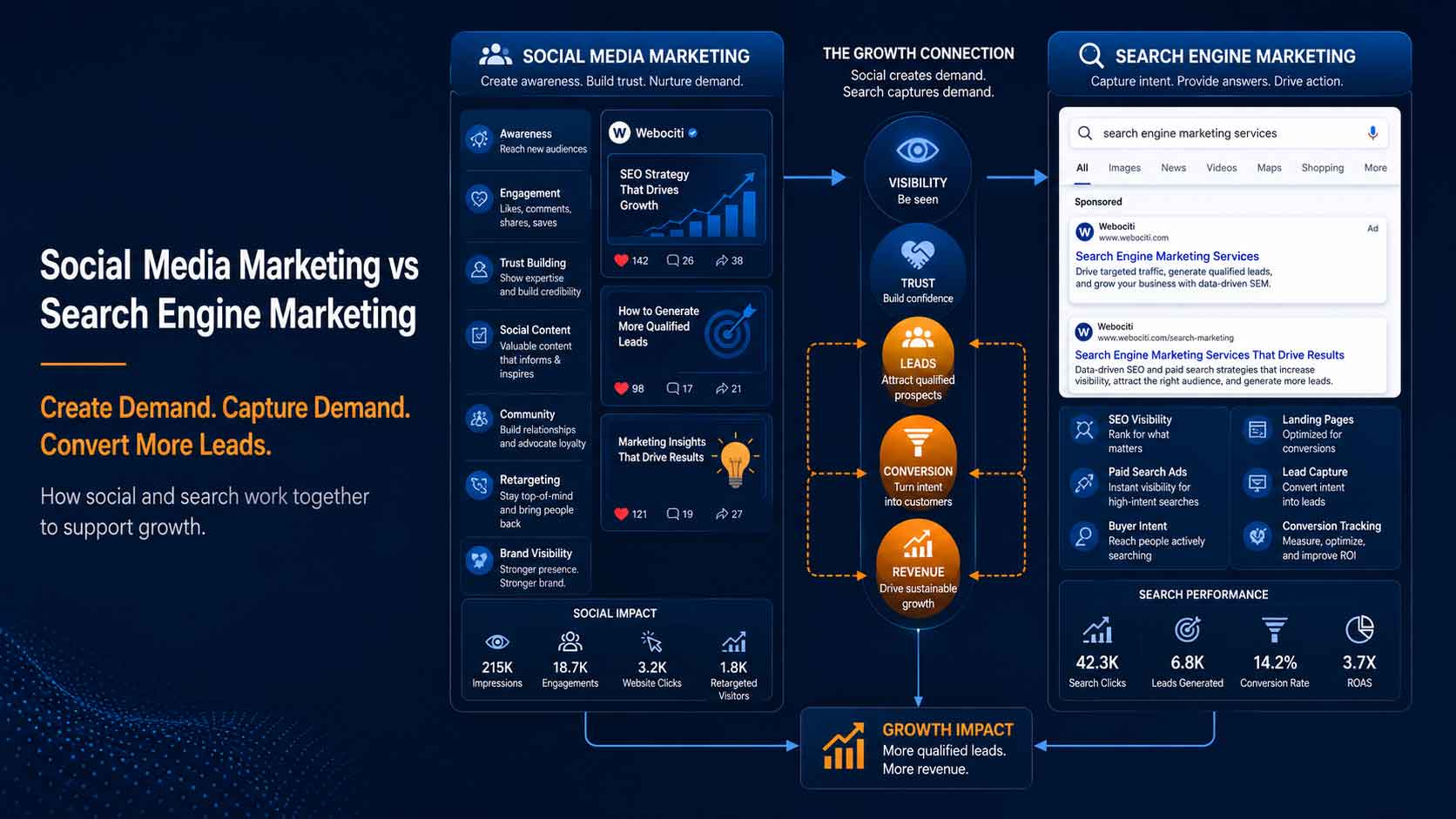
Most businesses should not treat social media and search as competing strategies. Social media helps create and nurture demand. Search marketing captures demand. A stronger growth system connects both to lead generation, conversion, and revenue.

Originally published in May 2024. Updated for 2026 with new guidance on social media marketing, search engine marketing, demand creation, demand capture, and revenue growth strategy.

Businesses often ask whether they should invest more in social media marketing or search engine marketing.

It is the wrong question if you treat the answer as either-or.

Social media and search marketing solve different problems. Social media helps people discover, remember, and trust your brand. Search marketing helps your business show up when people are actively looking for information, comparisons, products, services, or providers.

The better question is: where does your business need the most help right now?

  • Do you need more visibility and awareness?
  • Do you need more high-intent website traffic?
  • Do you need stronger trust before people contact you?
  • Do you need better lead generation?
  • Do you need a complete system that connects awareness, search, conversion, and revenue?

This guide compares social media marketing vs search engine marketing so you can decide how each channel should fit into your growth strategy.

What Is Social Media Marketing?

Social media marketing uses platforms such as Facebook, Instagram, LinkedIn, YouTube, TikTok, and other social channels to reach, engage, and influence an audience.

Social media can include organic posts, short-form video, community engagement, paid social advertising, retargeting, thought leadership, brand storytelling, customer education, and reputation building.

Social media works best when your business needs to build visibility and trust before someone is ready to buy. It keeps your brand in front of prospects, referral sources, customers, and people who may not be actively searching yet.

If your business needs stronger visibility and engagement across social channels, explore Webociti’s
social media marketing services.

What Is Search Engine Marketing?

Search engine marketing focuses on increasing visibility in search engines when people are actively looking for information, products, services, or solutions.

SEM can include paid search advertising, SEO, content strategy, landing page optimization, technical SEO, conversion tracking, and other tactics designed to help a business appear when buyer intent is high.

Search marketing is powerful because it reaches people at the moment they are searching. Instead of interrupting someone, search marketing meets demand that already exists.

For businesses comparing paid search, SEO, and SEM, read our related guide:
PPC vs SEO vs SEM: Which Strategy Should Your Business Use?.

Social Media Marketing vs Search Engine Marketing: Key Differences

Factor Social Media Marketing Search Engine Marketing
Primary Role Builds awareness, trust, and engagement Captures people actively searching
Audience Intent Often passive or early-stage Often active and intent-driven
Best For Demand creation, brand visibility, community, retargeting Demand capture, lead generation, SEO, paid search
Timeline Builds influence over time Can create faster traffic through paid search and long-term visibility through SEO
Measurement Reach, engagement, clicks, followers, assisted conversions Rankings, traffic, paid clicks, conversions, calls, leads

When Social Media Marketing Makes Sense

Social media marketing makes sense when your business needs to stay visible, build trust, educate prospects, and create ongoing engagement.

Social media is especially useful when:

  • Your audience needs to see your brand multiple times before taking action
  • You want to build trust and authority
  • You need to educate prospects before they are ready to buy
  • You rely on referrals, reputation, or relationship-building
  • You want to retarget people who visited your website
  • You have visual, educational, or story-driven content
  • You want to stay top of mind with customers and prospects

The mistake many businesses make is treating social media as random posting. Social media should support positioning, trust-building, lead nurturing, and conversion.

When Search Engine Marketing Makes Sense

Search engine marketing makes sense when your business wants to reach people who are already looking for answers, providers, services, or solutions.

Search marketing is especially useful when:

  • People already search for what you sell
  • You need high-intent website traffic
  • You want to generate leads from Google
  • You want to improve organic visibility through SEO
  • You want to use paid search for faster visibility
  • You need landing pages that convert search traffic
  • You want to track calls, forms, and booked appointments

If your business needs long-term organic visibility, stronger rankings, and content-driven lead generation, explore Webociti’s
SEO services for small business.

If your business needs faster visibility through paid campaigns, explore our
digital advertising services.

Demand Creation vs Demand Capture

The real difference between social media marketing and search engine marketing comes down to demand creation and demand capture.

Social media often helps create demand. It puts ideas, stories, insights, offers, and proof in front of people before they are actively searching. It can make people aware of a problem, remember your brand, and trust your point of view.

Search marketing captures demand. It reaches people when they are already searching for information, comparisons, services, products, or providers.

Simple rule: Social media helps people discover and trust you. Search marketing helps people find you when they are ready to act.

Strong marketing does both. It creates awareness before someone is searching and captures demand when that person begins looking for solutions.

Why Most Businesses Need Both

Choosing between social media marketing and search engine marketing is often too narrow.

Most businesses need both, but not always in the same proportion.

Social media can help build familiarity, trust, and engagement. Search marketing can help capture high-intent traffic. Together, they can support the full buyer journey.

For example:

  • A prospect sees your insight on LinkedIn
  • They later search for a solution on Google
  • Your SEO page or paid ad appears in search
  • They visit your website
  • Retargeting keeps your brand visible
  • A strong landing page converts them into a lead

That is not social media or search working alone. That is a connected growth system.

How Social Media and Search Fit Into a Revenue Growth System

Social media marketing and search engine marketing should not operate as disconnected channels.

They should connect to positioning, messaging, content, lead generation, conversion tracking, and sales follow-up.

A social post may create awareness, but if the website is unclear, the opportunity is lost. A search campaign may drive traffic, but if the landing page does not convert, the traffic is wasted. SEO may generate organic visits, but if there is no follow-up process, those visits may never become pipeline.

That is why Webociti views marketing through a broader
revenue growth system.

The goal is not more activity. The goal is a connected system that turns visibility into trust, leads, conversations, and revenue.

How to Choose Based on Goals, Timeline, and Budget

Use your goals, timeline, and budget to decide where to focus first.

  • Need awareness and trust? Strengthen social media marketing.
  • Need high-intent traffic? Invest in search engine marketing.
  • Need faster leads? Consider paid search or paid social campaigns.
  • Need long-term visibility? Invest in SEO and content.
  • Need better conversion? Improve landing pages, messaging, and calls to action.
  • Need predictable growth? Connect social, search, content, tracking, and follow-up into one system.

The right answer depends on your current bottleneck. Some businesses need more visibility. Others need better lead quality. Others need stronger conversion before spending more on traffic.

Social Media Marketing vs Search Engine Marketing: Which Is Better?

Neither is universally better.

Social media marketing is better when your business needs awareness, engagement, trust, reputation, and ongoing visibility.

Search engine marketing is better when your business needs to reach people with active intent who are already looking for solutions.

The strongest strategy often combines both. Social media helps shape demand and build trust. Search marketing captures demand and turns intent into traffic. Your website, landing pages, content, and follow-up process turn that attention into measurable growth.

Related guide:
If you are comparing paid search, organic search, and broader search strategy, read

PPC vs SEO vs SEM: Which Strategy Should Your Business Use?
.

Digital Marketing Strategy

Need a Marketing Strategy That Connects Social, Search, and Revenue?

Webociti helps businesses connect social media, search marketing, SEO, paid advertising, lead generation, and conversion into a smarter growth system.


Take the Growth Program Assessment

Social Media Marketing vs Search Engine Marketing FAQs

Quick answers to common questions about social media marketing, search engine marketing, SEO, paid search, and choosing the right strategy.

What is the difference between social media marketing and search engine marketing?

Social media marketing focuses on awareness, engagement, trust, and community. Search engine marketing focuses on reaching people who are actively searching for information, products, services, or providers.

Is social media marketing better than search engine marketing?

Social media marketing is better for awareness, trust-building, and engagement. Search engine marketing is better for capturing active buyer intent. Most businesses benefit from using both strategically.

Should small businesses use social media or search marketing first?

It depends on the goal. If the business needs awareness and trust, social media may be a strong starting point. If people are already searching for the service, search marketing may create more immediate lead opportunities.

Can social media help SEO?

Social media does not directly replace SEO, but it can support visibility, content distribution, brand awareness, engagement, and traffic. These signals can help more people discover, share, and interact with your content.

Should social media and search marketing be managed together?

Yes. Social media and search marketing work best when they share the same positioning, messaging, offers, landing pages, tracking, and lead follow-up strategy.

Search Marketing • PPC • SEO • SEM

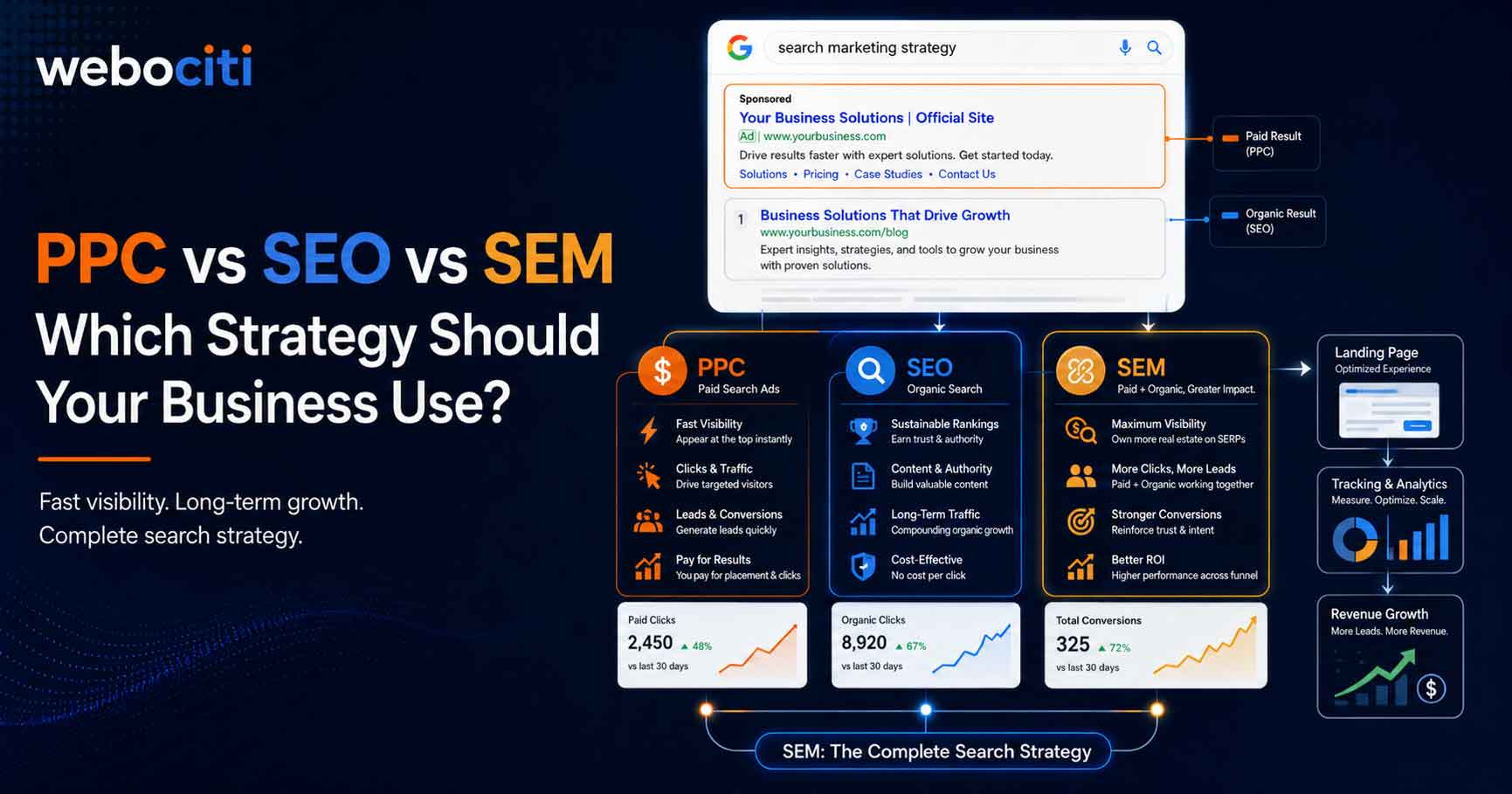
PPC, SEO, and SEM all help businesses increase visibility in search, but they work in different ways. The right strategy depends on your goals, timeline, budget, and how quickly you need leads.

Quick Summary:

PPC is paid advertising that can generate traffic and leads quickly.
SEO builds long-term organic visibility through content, technical optimization, and authority.
SEM is the broader search marketing strategy that can include both PPC and SEO.

For most growth-focused businesses, the strongest approach is not choosing one tactic in isolation. It is building a search strategy where paid ads, organic visibility, landing pages, lead capture, and conversion tracking work together.

Originally published in May 2023. Updated for 2026 with new guidance on PPC, SEO, SEM, search visibility, and revenue growth strategy.

Many businesses start with a simple question: should we invest in paid ads, SEO, or a broader search marketing strategy?

The answer depends on what you need most. If you need immediate visibility, PPC can help. If you want to build long-term organic traffic, SEO is usually the better foundation. If you want a coordinated search strategy that uses both paid and organic channels, SEM may be the right approach.

The mistake many companies make is treating PPC, SEO, and SEM as separate tactics instead of connected parts of a growth system. Search visibility only matters if it turns into qualified traffic, leads, conversations, and revenue.

For a deeper definition of PPC and SEM, read our related guide:
PPC vs SEM: What’s the Difference?

What Is PPC?

PPC stands for pay-per-click. It is a paid advertising model where businesses pay when someone clicks on an ad.

PPC ads often appear at the top of search engine results pages, on social media platforms, across display networks, and in video or streaming environments. Google Ads is one of the most common examples of PPC advertising.

PPC is often useful when a business wants faster visibility, wants to test offers, or needs to generate leads in a shorter period of time.

What Is SEO?

SEO stands for search engine optimization. SEO focuses on improving a website’s organic visibility in search results.

SEO includes content strategy, technical optimization, page structure, internal linking, local search visibility, authority building, and improving the user experience on your website.

SEO usually takes longer than PPC, but it can build more sustainable search visibility over time. When done correctly, SEO can help reduce long-term dependence on paid traffic.

If your business needs long-term organic visibility, stronger rankings, and content-driven lead generation, explore Webociti’s
SEO services for small business.

What Is SEM?

SEM stands for search engine marketing. SEM is the broader strategy of increasing visibility in search engines through paid and organic tactics.

SEM can include PPC, SEO, content marketing, landing page optimization, conversion tracking, and other strategies designed to turn search visibility into leads and revenue.

In simple terms, PPC and SEO are tactics. SEM is the larger search marketing strategy that can bring those tactics together.

PPC vs SEO vs SEM: Key Differences

Strategy Best For Timeline Main Limitation
PPC Fast visibility, paid leads, offer testing Short-term Traffic stops when the budget stops
SEO Organic traffic, authority, long-term visibility Longer-term Takes time to build momentum
SEM Coordinated paid and organic search strategy Short-term and long-term Requires strategy, tracking, and coordination

When PPC Makes Sense

PPC can be a good fit when your business needs immediate visibility or wants to generate leads quickly.

  • You are launching a new product or service
  • You need leads quickly
  • You want to test an offer or message
  • You are entering a competitive market
  • You want to retarget website visitors
  • You need visibility while SEO is still building

PPC works best when the ads are connected to strong landing pages, clear messaging, conversion tracking, and a defined follow-up process.

If your business needs faster visibility, paid traffic, or campaign support, explore Webociti’s
digital advertising services.

When SEO Makes Sense

SEO makes sense when your business wants to build long-term organic visibility and attract people who are actively searching for solutions.

  • You want to reduce dependence on paid traffic
  • You want more organic leads over time
  • You have useful expertise to publish
  • You want to rank for service, industry, or local search terms
  • You want to build authority and trust
  • You are willing to invest consistently over time

SEO is not instant, but it can become one of the most valuable long-term marketing assets for a business.

If your business needs long-term organic visibility, stronger rankings, and content-driven lead generation, explore Webociti’s
SEO services for small business.

When SEM Makes Sense

SEM makes sense when your business needs a more complete search strategy that combines the speed of paid search with the long-term value of organic search.

A strong SEM strategy may include:

  • Paid search campaigns
  • SEO strategy
  • Landing page optimization
  • Keyword and intent research
  • Content creation
  • Conversion tracking
  • Lead follow-up and reporting

SEM works best when PPC and SEO are not managed in isolation. Paid search can create speed, while SEO builds authority and long-term visibility.

Why Most Businesses Need a Combination

For many businesses, the best answer is not PPC or SEO. It is both, used at the right time and connected to the right strategy.

PPC can help generate leads while SEO is building. SEO can reduce long-term dependence on paid traffic. SEM can bring both together so the business is not relying on one channel alone.

The real goal is not just traffic. The goal is qualified traffic that turns into leads, opportunities, and revenue.

How to Choose Based on Timeline, Budget, and Goals

Use your timeline, budget, and business goals to decide where to focus first.

  • Need leads fast? Start with PPC and strong landing pages.
  • Need long-term visibility? Invest in SEO and content.
  • Need both speed and sustainability? Build an SEM strategy that combines PPC and SEO.
  • Not sure where to start? Look at your website, conversion paths, tracking, and current lead sources first.

The right choice depends on where your growth system is weakest. Some businesses need traffic. Others need better conversion. Others need stronger messaging before spending more on ads or SEO.

How PPC, SEO, and SEM Fit Into a Revenue Growth System

PPC, SEO, and SEM can all generate visibility, but visibility alone does not create growth.

Search marketing needs to connect to the full customer journey, including positioning, messaging, landing pages, lead capture, sales follow-up, and conversion tracking.

A PPC campaign may generate clicks, but if the offer is unclear, those clicks may not become qualified leads. SEO may generate organic traffic, but if the website lacks strong calls to action, that traffic may not turn into revenue.

That is why PPC, SEO, and SEM should be planned as part of a larger
revenue growth system.

Related guide:
For a deeper explanation of the relationship between paid search and search engine marketing, read

PPC vs SEM: What’s the Difference?
.

PPC vs SEO vs SEM Frequently Asked Questions

Which is better, PPC, SEO, or SEM?

PPC is best for immediate paid visibility. SEO is best for long-term organic growth. SEM is best when a business wants a complete search strategy that combines paid and organic visibility.

Should small businesses use PPC or SEO first?

It depends on the business goal. If a company needs leads quickly, PPC may be the better starting point. If the goal is sustainable organic traffic, SEO may be the better long-term investment.

Can PPC and SEO work together?

Yes. PPC and SEO often work best together. PPC can test keywords, offers, and landing pages quickly, while SEO can build long-term visibility around the topics and searches that matter most.

Is SEM the same as PPC?

No. PPC is a paid advertising model. SEM is a broader search marketing strategy that can include PPC, SEO, content, landing pages, and conversion tracking.

How long does SEO take compared to PPC?

PPC can begin generating traffic shortly after launch. SEO usually takes longer, often several months, because search engines need time to crawl, index, and evaluate content, authority, and technical improvements.

Need Help Choosing the Right Search Marketing Strategy?

PPC, SEO, and SEM can all help your business grow, but only when they are connected to the right message, offer, landing pages, tracking, and follow-up process.

Webociti helps businesses align paid search, SEO, lead generation, and conversion strategy into a smarter revenue growth system.

Need help deciding between paid search and organic growth? Explore our digital advertising services
or learn more about our SEO services for small business.

Not sure whether your business needs SEO, paid advertising, lead generation, or a broader growth strategy? Take the Webociti Growth Program Assessment to find the right next step.

In the fast-paced and ever-evolving world of digital marketing, success hinges on your ability to adapt to changing trends, technologies, and consumer behaviors. Staying ahead of the curve is not just a competitive advantage; it’s essential for survival in the digital landscape. In this blog post, we’ll explore some of the top strategies to unlock digital marketing success in today’s dynamic environment.

Content Marketing Mastery

Content is King, a phrase coined by Bill Gates back in 1996, remains as relevant as ever. In fact, it’s the cornerstone of digital marketing success. Content marketing is about creating and distributing valuable, relevant content to attract and engage a clearly defined audience. Here’s how to master it:

High-Quality Content Creation

Your content should provide real value to your audience. It should answer their questions, solve their problems, or entertain them. High-quality content not only establishes your brand as an industry authority but also encourages trust and loyalty.

Consistency is Key

Consistency in publishing content is essential. Whether it’s blog posts, videos, podcasts, or social media updates, a consistent schedule keeps your audience engaged and coming back for more.

SEO Optimization

Optimize your content for search engines. Use relevant keywords, metadata, and alt tags to improve your visibility on search engine results pages (SERPs). A strong SEO strategy ensures your content reaches a broader audience.

Storytelling

Craft compelling stories that resonate with your audience. Stories create an emotional connection and make your brand more relatable. Share success stories, customer testimonials, or behind-the-scenes glimpses of your business.

Social Media Strategies

Social media platforms are powerful tools for building brand awareness, engaging with your audience, and driving traffic to your website. To harness their potential, you need a well-thought-out social media strategy.

Choose the Right Platforms

Not all social media platforms are created equal. Focus your efforts on platforms that align with your target audience. For instance, Instagram and Pinterest are great for visual content, while LinkedIn is ideal for B2B connections.

Consistent Branding

Maintain a consistent brand image across all social media profiles. Use the same profile picture, cover photo, and brand colors to make your brand easily recognizable.

Content Diversity

Diversify your content. Share a mix of text, images, videos, and infographics. Experiment with different content types to keep your audience engaged.

Engage with Your Audience

Social media is a two-way street. Engage with your audience by responding to comments, messages, and mentions promptly. Encourage discussions and interactions.

Effective Email Campaigns

Email marketing remains a potent tool for nurturing leads, retaining customers, and driving sales. To run effective email campaigns, keep these strategies in mind:

Segmentation

Segment your email list based on demographics, behavior, and interests. Sending targeted, relevant content improves open rates and click-through rates.

Personalization

Personalize your emails. Use the recipient’s name, recommend products based on their previous purchases, and tailor content to their preferences.

Mobile Optimization

Most emails are now opened on mobile devices. Ensure your emails are mobile-friendly, with responsive design and clear calls to action.

A/B Testing

Experiment with different subject lines, email copy, images, and CTAs. A/B testing helps you identify what resonates best with your audience.

Search Engine Optimization (SEO) Secrets

SEO is the foundation of organic traffic. To unlock digital marketing success, you need to rank well on search engine results pages (SERPs). Here are some SEO strategies to consider:

Keyword Research

Thorough keyword research is the first step. Identify relevant keywords and phrases that your target audience is searching for. Use tools like Google Keyword Planner for insights.

On-Page SEO

Optimize your web pages for SEO. This includes optimizing title tags, meta descriptions, headers, and alt tags for images. Ensure your content is well-structured and easy to read.

High-Quality Backlinks

Backlinks from authoritative websites boost your SEO rankings. Focus on building high-quality, relevant backlinks through guest posting, outreach, and content marketing.

Mobile Optimization

Google now considers mobile-friendliness as a ranking factor. Ensure your website is responsive and provides a seamless experience on mobile devices.

Paid Advertising Insights

While organic traffic is crucial, paid advertising can provide an immediate boost to your digital marketing efforts. Here’s how to make the most of it:

Targeted Advertising

Use detailed targeting options on platforms like Google Ads and Facebook Ads to reach your ideal audience. Define demographics, interests, and behaviors for precise ad targeting.

Ad Creatives

Invest time in creating compelling ad creatives. Your ad copy, images, and CTAs should align with your audience’s needs and preferences.

Landing Page Optimization

Ensure your landing pages are optimized for conversions. A well-designed landing page with a clear value proposition and a strong CTA can significantly improve your ad campaign’s success.

Data-Driven Decision Making

In the digital marketing world, data is your compass. Analyze data from various sources, including website analytics, email marketing reports, and social media insights. Use this data to make informed decisions and refine your strategies.

Automation and AI

Leverage marketing automation tools and artificial intelligence to streamline your marketing efforts. Automation can handle repetitive tasks like email scheduling and social media posting, freeing up your team for more strategic work.

User Experience (UX) Enhancement

A seamless user experience is vital for retaining visitors and converting them into customers. Focus on website speed, navigation, and responsive design to create a user-friendly environment.

Voice and Visual Search Optimization

With the rise of voice assistants and visual search, optimizing your content for these technologies is becoming increasingly important. Voice search-friendly content and visually searchable images can give you an edge.

Video Marketing

Video content continues to dominate the digital landscape. Incorporate video into your marketing strategy, whether it’s through YouTube, social media, or your website. Live streaming and interactive videos can further engage your audience.

Conclusion

Digital marketing success requires a multi-faceted approach that combines content marketing, social media strategies, effective email campaigns, SEO, paid advertising, data-driven decision-making, automation, user experience enhancement, and adaptation to emerging technologies. By implementing these strategies, you can unlock the full potential of your digital marketing efforts and stay ahead in the ever-evolving digital landscape.

Ready to unlock your digital marketing success? Start implementing these strategies today and watch your online presence flourish. Stay ahead of the curve, adapt to changes, and keep your audience engaged. The digital world is yours to conquer! Contact Webociti Today! 678-892-7157

Tips and Tricks for Small Businesses

In today’s digital age, advertising your small business online is a necessity, but it doesn’t have to break the bank. With the right digital advertising strategies, small businesses can maximize their reach and ROI even on a tight budget. In this blog post, we’ll explore some cost-effective tips and tricks for digital advertising that can help small businesses thrive in the digital landscape.

Set Clear Objectives

Before diving into any advertising campaign, it’s crucial to define your goals. Are you looking to increase website traffic, generate leads, boost sales, or enhance brand awareness? Having clear objectives will guide your budget allocation and help you prioritize your efforts.

Know Your Audience

Understanding your target audience is essential for efficient spending. Conduct research to identify your ideal customer demographics, interests, and online behavior. This knowledge will enable you to focus your advertising efforts on platforms and channels where your audience is most active.

Start with Social Media Advertising

Social media platforms like Facebook, Instagram, Twitter, and LinkedIn offer cost-effective advertising options. They allow you to define your audience precisely, set budget limits, and track performance in real-time. Experiment with different ad formats (e.g., boosted posts, carousel ads) to see what works best for your business.

Explore Pay-Per-Click (PPC) Advertising

PPC advertising, such as Google Ads, can be an efficient way to reach potential customers. With PPC, you only pay when someone clicks on your ad, making it a budget-friendly option. Use keyword research to target high-value, low-competition keywords for better results.

Content Marketing and SEO

Invest in creating high-quality, informative content that resonates with your audience. Optimize your website for search engines (SEO) to improve organic traffic. A strong online presence and valuable content can help reduce your reliance on paid advertising.

Leverage Email Marketing

Email marketing remains a cost-effective method to engage and nurture leads. Build and segment your email list, create compelling content, and use email automation tools to streamline your efforts.

Embrace Remarketing

Remarketing allows you to re-engage users who have previously visited your website. It’s a cost-efficient way to remind potential customers about your products or services and encourage them to return and convert.

Monitor and Optimize Continuously

Regularly analyze the performance of your digital advertising campaigns. Identify what’s working and what isn’t, then adjust your strategies accordingly. A/B testing can help refine ad copy, visuals, and targeting.

Collaborate with Influencers

Consider partnerships with micro-influencers in your niche. They often have dedicated, engaged followings that can be receptive to your products or services. Influencer marketing can be more affordable than traditional advertising.

DIY vs. Professional Assistance

While many aspects of digital advertising can be managed in-house, consider seeking professional help for complex tasks like PPC campaign management or SEO. Outsourcing certain tasks can be a cost-effective way to ensure expertise and efficiency.

In conclusion

Digital advertising on a budget is entirely possible for small businesses. It requires careful planning, audience targeting, and continuous optimization. By following these tips and tricks, you can make the most of your limited budget and achieve significant results in the digital realm. Remember, every dollar spent wisely can contribute to your business’s growth and success.

Ready to Maximize Your Digital Advertising on a Budget?

Don’t let a tight budget hold your small business back from digital advertising success. Start implementing these cost-effective strategies today, and watch your online presence grow.

If you’re looking for expert guidance or need assistance in navigating the digital advertising landscape, contact us at Webociti 678-892-7157. Our team specializes in helping small businesses like yours thrive in the digital realm. Let’s chat about how we can tailor a digital advertising strategy that fits your budget and drives real results. Remember, every dollar invested wisely can lead to significant returns.

Don’t miss out on the countless opportunities digital advertising offers. Take action now and unlock your business’s full online potential.

Why Choosing the Right Digital Advertising Network Matters

Struggling to see results from your digital ads? You’re not alone—many businesses waste thousands of dollars on ineffective advertising platforms. But with the right digital advertising network, you can reach your ideal customers and maximize ROI. Let’s dive into how you can choose the best platform for your business and avoid costly mistakes.


For a more in-depth look at digital advertising strategies, check out HubSpot’s Guide to Digital Advertising.

Which Digital Advertising Platform is Right for Your Business?

Not all ad platforms work the same way. Some are better for search-driven buyers, while others excel at brand awareness. Here’s a quick breakdown:

  • Google Ads – Best for search intent and immediate leads.
  • Facebook & Instagram Ads – Ideal for brand awareness and visually-driven ads.
  • LinkedIn Ads – Perfect for B2B companies looking to generate leads.
  • TikTok & Snapchat Ads – Great for reaching younger demographics.

Aligning your objectives with the right platform will significantly impact your success.


When assessing your target audience, it’s also crucial to consider behavioral trends and preferences. For instance, younger demographics tend to engage more with short-form video content on platforms like TikTok, whereas professionals may be more receptive to in-depth content on LinkedIn. Understanding these behavioral insights can help you fine-tune your ad messaging and format.

Assessing Cost-Effectiveness of Digital Advertising Networks

Budget considerations play a significant role in digital advertising. Different networks have varying costs per click (CPC) or cost per thousand impressions (CPM), and it’s essential to evaluate the potential return on investment (ROI) for each option. Finding the right balance between cost and effectiveness is critical in optimizing your advertising budget.


In addition to platform-provided analytics, leveraging third-party tools like Google Analytics, SEMrush, or HubSpot can provide deeper insights into campaign effectiveness. A/B testing different ad creatives and formats is also a valuable method to refine performance and optimize ad spend.

The Value of Expertise in Digital Advertising

Navigating the complex world of digital advertising can be overwhelming, especially for businesses new to the landscape. Partnering with a marketing professional or agency can provide invaluable expertise and guidance. They can help you identify the most suitable advertising network, craft compelling ad campaigns, and monitor performance for optimal results.


Another major mistake businesses make is failing to optimize their landing pages. Even with a well-placed ad, if the landing page is not engaging, lacks a clear CTA, or loads too slowly, conversion rates will suffer. Ensuring your ads direct users to high-performing, optimized landing pages can significantly boost campaign success.

  • Not setting clear advertising goals
  • Choosing the wrong platform for their audience
  • Ignoring cost-effectiveness and ROI metrics
  • Not leveraging data analytics for campaign optimization

Conclusion

Choosing the right digital advertising network can make or break your marketing success. By understanding your objectives, evaluating audience reach, considering cost-effectiveness, leveraging data, and seeking expert guidance, you can avoid wasted time and money while achieving meaningful results.

Get Started with the Best Digital Advertising Network

Want to stop wasting money on digital ads that don’t convert? Our experts at Webociti will match you with the best advertising network to maximize every dollar spent. Let’s build a campaign that drives real results—fast. Contact us now or call 678-892-7157 to get started!

Further Reading:

Essentials for Online Advertising

AID

AIDA is Essential to Internet Marketing

Internet copywriters often use a formula known as AIDA. This acronym stands for,

  1. Attention
  2. Interest
  3. Desire
  4. Action

My post today takes a look at AIDA as an Internet Marketing Tool.

Attention

Ads are useless unless they grab an Internet user’s attention. An ad that is never looked at by its target audience is no better than no ad at all. Also, ads that are delivered to the wrong location or beside problematic content, or attracting invalid traffic is of no help either.

With all the digital ads on the Internet, how can you differentiate your company and attract visitors to your website – after all, if you run a pet supply online store why is it different from other pet supply merchants? Grab the attention of Internet users with tactical weapons such as,

  • Illustrations
  • Photos
  • Sound
  • Interesting words
  • Video

As an experienced Internet marketer, I keep all of these in my toolbox. Note, you don’t have to think of a brand to attract attention – just make a point about your product or company that is interesting and unique. Present your products and services as no one else has. Effective techniques for getting attention include

  • The ability to grab attention in 3 seconds or less
  • Be as specific as humanly possible
  • Headlines can be several lines or just a short blurb

Headlines that work include,

  • How-to–How to Be Healthy in Less Than a Week
  • News style – Woman Loses Thirty Pound in Thirty Days
  • Direct Offer – Take 25% Off Now
  • Guarantee – If You Aren’t Happy You Get Your Money Back!
  • Benefit – Get Your Six Pack Abs the Easy Way
  • Testimonial – I Love (your product) So Much!
  • Explanatory – The Never Before Revealed Secrets of Weight Loss

So words like these accompanied by photos or other imagery are proven ways to get the attention you deserve.

Interest

Generating interest in your product or service is limited only by your imagination. In my area of the country, there are ads running on TV for the Duluth Trading Company. One ad pits their brand of underwear against a grizzly bear – of course, the underwear wins. The ad is interesting (at least to me) as I remembered it and cited it here. Use social media along with paid advertising to make your Internet ad campaign more compelling.

Desire

Another challenge is making a product or service desirable. Prompt responses to posts on your website or social media page is important to establish your customer service chops and help make folks want to use your products or services.

Action

Be sure that your calls to action (CTA) are clear and written specifically for the site you are posting on. The CTA on Facebook may be to offer a free download of an article about your products while on your website the CTA might be for a purchase.

Running an online marketing campaign requires unique knowledge and skills. As a long-time Internet marketing firm owner, I have both. If you need help in running your online ad campaign call or contact me at Webociti. Our number is 678-892-7157.

Till Next Time,

Joe