Search Marketing • PPC • SEO • SEM

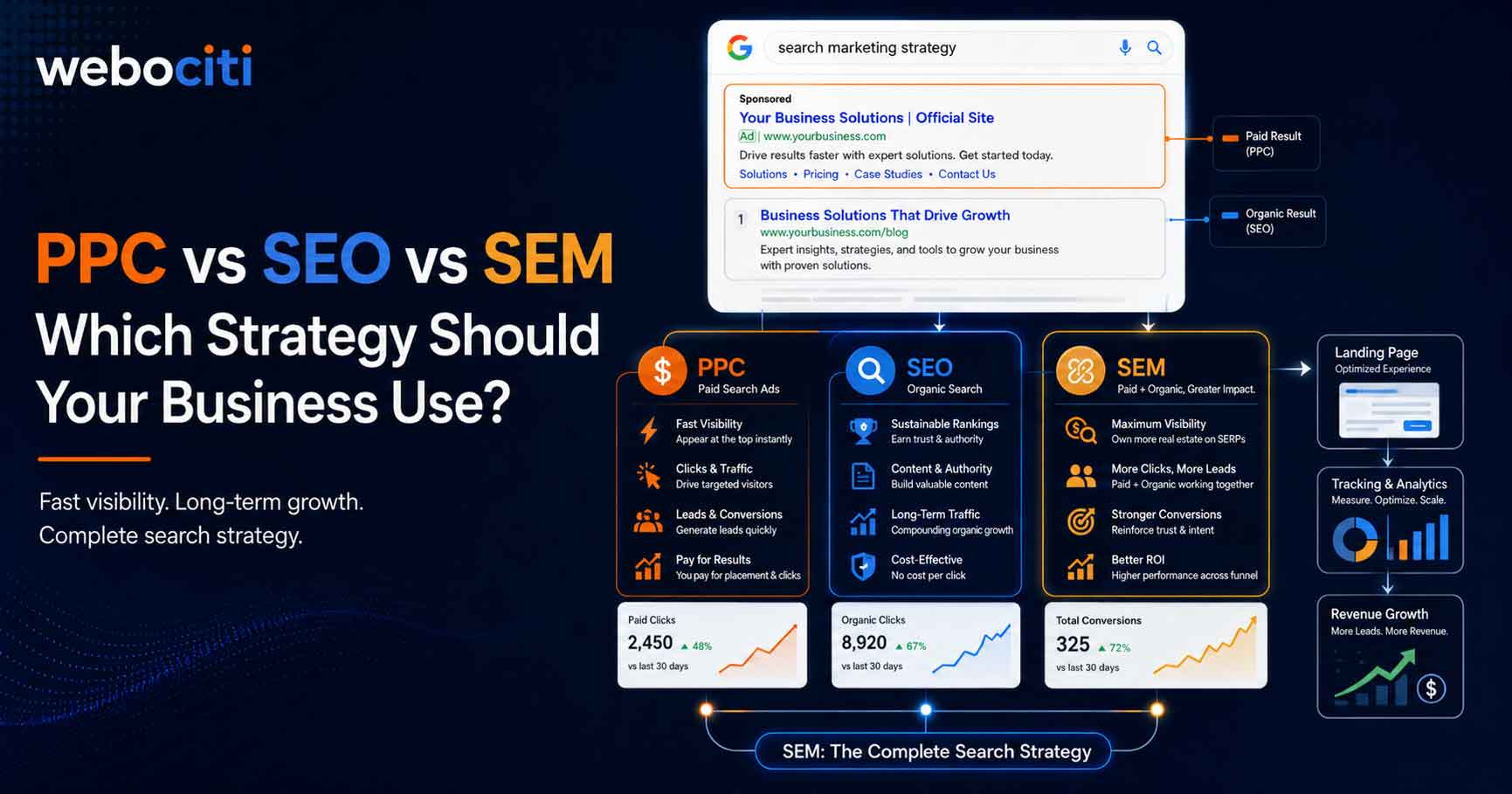
PPC, SEO, and SEM all help businesses increase visibility in search, but they work in different ways. The right strategy depends on your goals, timeline, budget, and how quickly you need leads.

Quick Summary:

PPC is paid advertising that can generate traffic and leads quickly.
SEO builds long-term organic visibility through content, technical optimization, and authority.
SEM is the broader search marketing strategy that can include both PPC and SEO.

For most growth-focused businesses, the strongest approach is not choosing one tactic in isolation. It is building a search strategy where paid ads, organic visibility, landing pages, lead capture, and conversion tracking work together.

Originally published in May 2023. Updated for 2026 with new guidance on PPC, SEO, SEM, search visibility, and revenue growth strategy.

Many businesses start with a simple question: should we invest in paid ads, SEO, or a broader search marketing strategy?

The answer depends on what you need most. If you need immediate visibility, PPC can help. If you want to build long-term organic traffic, SEO is usually the better foundation. If you want a coordinated search strategy that uses both paid and organic channels, SEM may be the right approach.

The mistake many companies make is treating PPC, SEO, and SEM as separate tactics instead of connected parts of a growth system. Search visibility only matters if it turns into qualified traffic, leads, conversations, and revenue.

For a deeper definition of PPC and SEM, read our related guide:
PPC vs SEM: What’s the Difference?

What Is PPC?

PPC stands for pay-per-click. It is a paid advertising model where businesses pay when someone clicks on an ad.

PPC ads often appear at the top of search engine results pages, on social media platforms, across display networks, and in video or streaming environments. Google Ads is one of the most common examples of PPC advertising.

PPC is often useful when a business wants faster visibility, wants to test offers, or needs to generate leads in a shorter period of time.

What Is SEO?

SEO stands for search engine optimization. SEO focuses on improving a website’s organic visibility in search results.

SEO includes content strategy, technical optimization, page structure, internal linking, local search visibility, authority building, and improving the user experience on your website.

SEO usually takes longer than PPC, but it can build more sustainable search visibility over time. When done correctly, SEO can help reduce long-term dependence on paid traffic.

If your business needs long-term organic visibility, stronger rankings, and content-driven lead generation, explore Webociti’s
SEO services for small business.

What Is SEM?

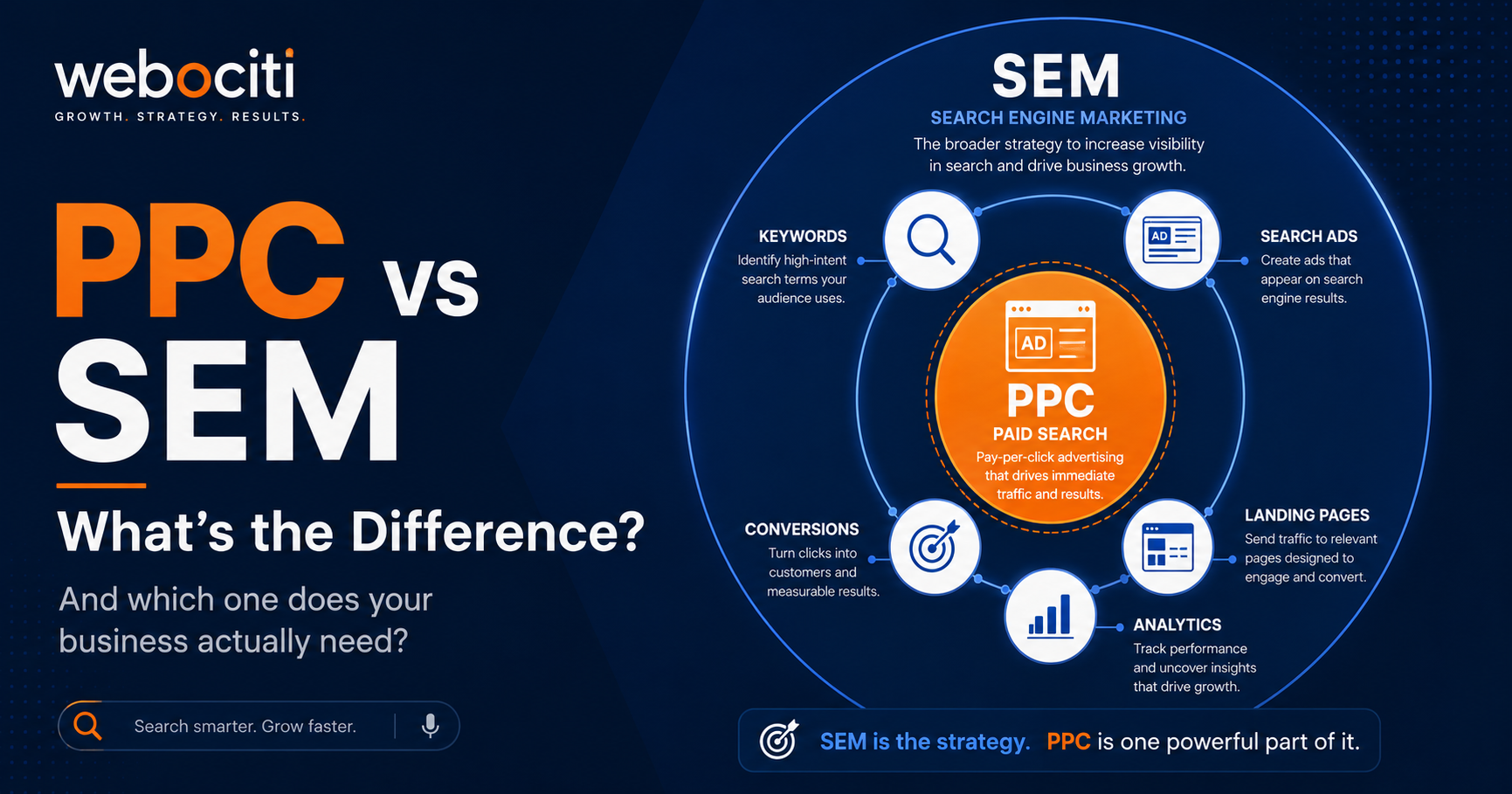
SEM stands for search engine marketing. SEM is the broader strategy of increasing visibility in search engines through paid and organic tactics.

SEM can include PPC, SEO, content marketing, landing page optimization, conversion tracking, and other strategies designed to turn search visibility into leads and revenue.

In simple terms, PPC and SEO are tactics. SEM is the larger search marketing strategy that can bring those tactics together.

PPC vs SEO vs SEM: Key Differences

Strategy Best For Timeline Main Limitation
PPC Fast visibility, paid leads, offer testing Short-term Traffic stops when the budget stops
SEO Organic traffic, authority, long-term visibility Longer-term Takes time to build momentum
SEM Coordinated paid and organic search strategy Short-term and long-term Requires strategy, tracking, and coordination

When PPC Makes Sense

PPC can be a good fit when your business needs immediate visibility or wants to generate leads quickly.

  • You are launching a new product or service
  • You need leads quickly
  • You want to test an offer or message
  • You are entering a competitive market
  • You want to retarget website visitors
  • You need visibility while SEO is still building

PPC works best when the ads are connected to strong landing pages, clear messaging, conversion tracking, and a defined follow-up process.

If your business needs faster visibility, paid traffic, or campaign support, explore Webociti’s
digital advertising services.

When SEO Makes Sense

SEO makes sense when your business wants to build long-term organic visibility and attract people who are actively searching for solutions.

  • You want to reduce dependence on paid traffic
  • You want more organic leads over time
  • You have useful expertise to publish
  • You want to rank for service, industry, or local search terms
  • You want to build authority and trust
  • You are willing to invest consistently over time

SEO is not instant, but it can become one of the most valuable long-term marketing assets for a business.

If your business needs long-term organic visibility, stronger rankings, and content-driven lead generation, explore Webociti’s
SEO services for small business.

When SEM Makes Sense

SEM makes sense when your business needs a more complete search strategy that combines the speed of paid search with the long-term value of organic search.

A strong SEM strategy may include:

  • Paid search campaigns
  • SEO strategy
  • Landing page optimization
  • Keyword and intent research
  • Content creation
  • Conversion tracking
  • Lead follow-up and reporting

SEM works best when PPC and SEO are not managed in isolation. Paid search can create speed, while SEO builds authority and long-term visibility.

Why Most Businesses Need a Combination

For many businesses, the best answer is not PPC or SEO. It is both, used at the right time and connected to the right strategy.

PPC can help generate leads while SEO is building. SEO can reduce long-term dependence on paid traffic. SEM can bring both together so the business is not relying on one channel alone.

The real goal is not just traffic. The goal is qualified traffic that turns into leads, opportunities, and revenue.

How to Choose Based on Timeline, Budget, and Goals

Use your timeline, budget, and business goals to decide where to focus first.

  • Need leads fast? Start with PPC and strong landing pages.
  • Need long-term visibility? Invest in SEO and content.
  • Need both speed and sustainability? Build an SEM strategy that combines PPC and SEO.
  • Not sure where to start? Look at your website, conversion paths, tracking, and current lead sources first.

The right choice depends on where your growth system is weakest. Some businesses need traffic. Others need better conversion. Others need stronger messaging before spending more on ads or SEO.

How PPC, SEO, and SEM Fit Into a Revenue Growth System

PPC, SEO, and SEM can all generate visibility, but visibility alone does not create growth.

Search marketing needs to connect to the full customer journey, including positioning, messaging, landing pages, lead capture, sales follow-up, and conversion tracking.

A PPC campaign may generate clicks, but if the offer is unclear, those clicks may not become qualified leads. SEO may generate organic traffic, but if the website lacks strong calls to action, that traffic may not turn into revenue.

That is why PPC, SEO, and SEM should be planned as part of a larger
revenue growth system.

Related guide:
For a deeper explanation of the relationship between paid search and search engine marketing, read

PPC vs SEM: What’s the Difference?
.

PPC vs SEO vs SEM Frequently Asked Questions

Which is better, PPC, SEO, or SEM?

PPC is best for immediate paid visibility. SEO is best for long-term organic growth. SEM is best when a business wants a complete search strategy that combines paid and organic visibility.

Should small businesses use PPC or SEO first?

It depends on the business goal. If a company needs leads quickly, PPC may be the better starting point. If the goal is sustainable organic traffic, SEO may be the better long-term investment.

Can PPC and SEO work together?

Yes. PPC and SEO often work best together. PPC can test keywords, offers, and landing pages quickly, while SEO can build long-term visibility around the topics and searches that matter most.

Is SEM the same as PPC?

No. PPC is a paid advertising model. SEM is a broader search marketing strategy that can include PPC, SEO, content, landing pages, and conversion tracking.

How long does SEO take compared to PPC?

PPC can begin generating traffic shortly after launch. SEO usually takes longer, often several months, because search engines need time to crawl, index, and evaluate content, authority, and technical improvements.

Need Help Choosing the Right Search Marketing Strategy?

PPC, SEO, and SEM can all help your business grow, but only when they are connected to the right message, offer, landing pages, tracking, and follow-up process.

Webociti helps businesses align paid search, SEO, lead generation, and conversion strategy into a smarter revenue growth system.

Need help deciding between paid search and organic growth? Explore our digital advertising services
or learn more about our SEO services for small business.

Not sure whether your business needs SEO, paid advertising, lead generation, or a broader growth strategy? Take the Webociti Growth Program Assessment to find the right next step.

Quick Summary:

PPC is a paid advertising model where businesses pay when someone clicks on an ad.
SEM is the broader search marketing strategy that includes PPC, SEO, content, technical optimization, and conversion tracking.

PPC can generate traffic quickly. SEO builds long-term organic visibility. SEM brings both together into a more complete search marketing strategy designed to turn search visibility into leads and revenue.

Updated for 2026: This guide reflects how PPC, SEO, and SEM now work together as part of a connected revenue growth system.

Many businesses hear the terms PPC and SEM used interchangeably, but they are not the same thing.

PPC, or pay-per-click advertising, is a paid advertising model where businesses pay each time someone clicks their ad. SEM, or search engine marketing, is a broader strategy that includes both paid search advertising and organic strategies like SEO services for small businesses.

Understanding the difference between PPC and SEM helps businesses choose the right search marketing strategy to generate leads, increase website traffic, and grow revenue.

The real question is not whether PPC or SEM is better. The real question is whether your search strategy is connected to the rest of your revenue system. Paid search, SEO, landing pages, messaging, lead capture, and conversion all need to work together if you want search traffic to turn into revenue.

Businesses looking for a complete online growth strategy often combine SEO and paid advertising through structured digital marketing programs that align lead generation, search visibility, and long-term business growth.

Watch: SEM vs PPC Explained

What Is the Difference Between PPC and SEM?

PPC stands for pay-per-click. It is a paid advertising model where businesses pay for every click on their ad.

SEM stands for search engine marketing. SEM is the broader strategy of increasing visibility in search engines through paid ads, SEO, content, technical optimization, and other search-focused tactics.

In simple terms, PPC is part of SEM. PPC can drive immediate traffic, while SEM includes both paid and organic strategies designed to create short-term visibility and long-term search growth.

PPC vs SEM: Key Differences

Feature PPC SEM
Meaning Pay-per-click advertising Search engine marketing
Type Paid advertising model Overall search marketing strategy
Traffic Speed Immediate traffic after launch Short-term and long-term visibility
Cost Pay for each click Combination of paid and organic investments
Sustainability Traffic stops when ads stop Can build long-term traffic and authority
Best For Immediate leads, promotions, testing, and visibility Long-term visibility, brand authority, and search growth

Should Your Business Choose PPC, SEM, or SEO?

The right choice depends on your goals, timeline, budget, and how quickly you need results.

  • Choose PPC if you need immediate visibility, want to test offers, or need leads quickly.
  • Choose SEO if you want to build long-term organic visibility and reduce dependence on paid traffic over time.
  • Choose SEM if you want a complete search strategy that combines paid ads, SEO, content, landing pages, and conversion tracking.

For most growth-focused businesses, the best answer is not PPC or SEO. It is a coordinated SEM strategy where paid search creates speed, SEO builds compounding visibility, and conversion strategy turns traffic into qualified opportunities.

In short, PPC delivers immediate paid traffic while SEM includes both PPC and long-term strategies like SEO that build sustainable search visibility.

If your business needs long-term organic visibility, content-driven lead generation, and stronger rankings over time, explore Webociti’s
SEO services for small business.

SEM vs SEO vs PPC: What’s the Difference?

Many business owners also ask how SEM, SEO, and PPC differ. While these terms are related, they play different roles in a search marketing strategy.

  • SEO focuses on improving a website’s organic rankings in search engines through content, technical optimization, site structure, and authority building.
  • PPC is paid advertising where businesses pay each time someone clicks on an ad.
  • SEM is the larger search marketing strategy that can include both SEO and PPC to increase visibility in search results.

For most businesses, SEO and PPC should not be treated as competing strategies. They work best when they support each other.

PPC vs SEO vs SEM: What Businesses Should Know

Many businesses compare PPC vs SEO when deciding how to invest their marketing budget. Both strategies help generate website traffic, but they work in very different ways.

  • PPC generates traffic quickly through paid ads.
  • SEO builds organic search rankings over time.
  • PPC stops generating traffic when the ads stop running.
  • SEO can continue driving traffic long after the work is completed.
  • SEM brings search tactics together into a larger visibility strategy.

For most companies, the best approach is combining both strategies. PPC can generate leads quickly while SEO services for small businesses build long-term visibility and sustainable traffic.

Many businesses pair SEO with
digital advertising services
to generate both short-term leads and long-term organic growth.

How Paid Digital Advertising Increases Revenue

If you have been placing pay-per-click ads and hoping for a major increase in sales, you may be disappointed if the campaign is not connected to the right strategy. Successful PPC advertising campaigns require planning, testing, landing page alignment, and ongoing optimization.

Effective digital advertising campaigns usually involve:

  • Researching high-performing keywords
  • Analyzing competitor advertising strategies
  • Setting clear budgets and performance goals
  • Creating strong ad copy and landing pages
  • Testing different ads, offers, and audiences
  • Tracking conversions and lead quality
  • Continually refining campaigns for better results

Without these steps, businesses may generate impressions and clicks but fail to convert that traffic into leads, opportunities, and customers.

What Is SEM? Search Engine Marketing Explained

Search engine marketing focuses on increasing a website’s visibility in search engine results pages. SEM strategies may include paid advertising, SEO, technical optimization, content marketing, landing page optimization, and conversion tracking.

When a website is optimized correctly with relevant content, strong technical structure, useful landing pages, and clear calls to action, search engines and users have a better experience. That can lead to stronger visibility, better traffic quality, and more qualified leads.

SEM should not be viewed as a single tactic. It is a coordinated search strategy designed to help the right people find your business when they are actively searching for solutions.

What Is PPC? Pay-Per-Click Advertising Explained

Pay-per-click advertising refers to paid ads that often appear at the top of search engine results pages. Businesses bid on keywords and only pay when someone clicks their advertisement.

The cost of each click depends on competition, industry, search volume, location, and keyword intent. Highly competitive keywords may cost several dollars per click, while niche keywords may cost less.

Advertisers typically set a daily budget for their campaigns. Once that budget is reached, the ads stop running until the next day.

Professional Google Ads management services can help businesses improve ad targeting, landing page alignment, conversion tracking, and return on ad spend.

When Should a Business Use PPC?

PPC can be a good fit when your business needs immediate visibility or wants to test offers quickly.

  • Launching a new product or service
  • Promoting limited-time offers
  • Competing in highly competitive industries
  • Generating immediate leads
  • Testing marketing messages
  • Supporting a new website or landing page
  • Retargeting visitors who did not convert the first time

PPC works best when the campaign is connected to strong landing pages, clear messaging, conversion tracking, and a defined follow-up process.

When Should Businesses Focus on SEM?

Businesses should focus on SEM when they want a more complete search marketing strategy that combines short-term visibility with long-term organic growth.

  • Increasing organic website traffic
  • Building brand authority
  • Reducing long-term dependence on paid ads
  • Generating consistent inbound leads
  • Improving search visibility across multiple stages of the buyer journey
  • Combining SEO and PPC into one coordinated growth strategy

For many companies, SEM is strongest when paid search and SEO are planned together instead of managed as separate tactics.

How PPC and SEM Fit Into a Revenue System

PPC and SEM can help drive traffic, but traffic alone does not create growth. Search marketing needs to connect to the full customer journey, including positioning, messaging, landing pages, lead capture, sales follow-up, and conversion.

A PPC campaign may generate clicks, but if the landing page is weak or the offer is unclear, those clicks may not become qualified leads. SEO may generate organic traffic, but if the content does not align with buyer intent or the site lacks strong calls to action, rankings may not translate into revenue.

That is why search marketing should be planned as part of a larger revenue system. When SEO, PPC, messaging, lead generation, and conversion strategy work together, search traffic has a better chance of becoming real pipeline.

Launching a New Website? Protect Your Search Visibility

If you are planning to launch a new website, it is important to protect your search rankings during the transition. A poorly planned redesign can damage SEO performance, disrupt paid campaigns, and reduce lead flow.

Learn how to avoid traffic loss during a website migration, or use our website migration SEO checklist before launching a redesigned site.

Related Questions About PPC and SEM

Business owners researching search marketing often ask several related questions about PPC, SEO, and SEM. Understanding how these strategies work together can help you build a stronger digital marketing plan.

  • What is the difference between PPC and SEO?
  • Is Google Ads the same as PPC?
  • How much should a small business spend on PPC?
  • Can PPC help SEO rankings?
  • Should businesses use SEO and PPC together?

Most successful businesses use a combination of SEO, PPC advertising, and broader SEM strategies to create both immediate lead generation and long-term search visibility.

Related insight: PPC and SEM work best when they are connected to a complete growth system. Learn how search visibility, lead generation, and conversion fit together in our guide to building a revenue growth system
.

Related guide: Still deciding between paid search, organic SEO, and a combined search strategy? Read PPC vs SEO vs SEM: Which Strategy Should Your Business Use? .

PPC vs SEM Frequently Asked Questions

Is PPC the same as SEM?

No. PPC is a paid advertising model, while SEM is a broader search marketing strategy that can include PPC, SEO, content, technical optimization, and other search visibility tactics.

What is the difference between PPC and SEO?

PPC is paid advertising where businesses pay for each click. SEO focuses on earning organic visibility in search engines through content, technical optimization, and site authority. PPC can generate traffic quickly, while SEO usually builds over time.

Does PPC help SEO rankings?

PPC does not directly improve organic SEO rankings. However, PPC can help businesses test keywords, offers, ad copy, messaging, and landing pages. Those insights can improve the effectiveness of an SEO strategy.

Should businesses invest in both SEO and PPC?

Many businesses benefit from using both. PPC can create immediate visibility and lead flow, while SEO builds long-term organic traffic and authority. Together, they can support a stronger SEM strategy.

Which is better, PPC or SEM?

PPC is best for immediate paid visibility. SEM is better when a business wants a broader search strategy that includes both paid and organic growth. In many cases, PPC works best as one part of a larger SEM strategy.

How long does SEO take compared to PPC?

PPC campaigns can begin generating traffic soon after launch. SEO usually takes longer, often several months, because search engines need time to crawl, index, and evaluate content, authority, and technical improvements.

Need Search Marketing That Connects to Revenue?

PPC, SEO, and SEM can all help your business grow, but only when they are connected to the right message, landing pages, lead capture process, and conversion strategy.

Webociti helps businesses align paid search, SEO, lead generation, and conversion into a smarter revenue growth system.

Not sure whether your business needs SEO, paid advertising, lead generation, or a broader growth strategy? Take the Webociti Growth Program Assessment to find the right next step.

Need help deciding between paid search and organic growth? Explore our digital advertising services
or learn more about our SEO services for small business.

The Ultimate Guide to Social Media Advertising, Google Ads, and Programmatic: Which is Right for Your Business?

Social media ads vs Google
In 2024, businesses are expected to spend over $600 billion on digital advertising, but with so many platforms available, how do you know where to invest for the best returns? Among the most powerful are social media advertising, Google Ads, and the increasingly popular programmatic advertising. Each of these platforms offers unique ways to reach your audience, and understanding how they work is crucial to making an informed decision.

In this post, we’ll explore the strengths and weaknesses of each option, giving you the insight you need to choose the right advertising approach for your business.


Understanding Social Media Advertising

Social media advertising allows businesses to promote their products or services directly within the feeds of popular social platforms such as Facebook, Instagram, LinkedIn, and TikTok. This type of advertising leverages rich user data to target audiences based on their interests, behaviors, and demographics, making it an incredibly effective tool for building brand awareness and engaging potential customers.

But there’s an important distinction to make: successful social media advertising isn’t about how many likes you get, it’s about how many people engage with your posts and ads.

Engagement Over Vanity Metrics

While accumulating likes, followers, and shares might feel gratifying, these “vanity metrics” don’t necessarily translate into tangible business results. Instead, what really matters is engagement—how many people are interacting meaningfully with your content. Engagement metrics, such as comments, shares, click-through rates, and even direct messages, give you deeper insight into how your audience is connecting with your brand.

Why is engagement more important than likes?

  • Higher Engagement = More Reach: Social media algorithms prioritize content that generates high engagement, meaning the more your audience interacts with your posts (through comments, clicks, and shares), the more people will see your content organically.
  • Engagement Drives Conversions: People who take the time to engage with your posts—whether by commenting, clicking on links, or sharing—are more likely to convert into leads or customers. This makes engagement a more actionable metric for determining the success of your campaigns.
  • Better Audience Insights: Engagement shows how well your message resonates with your target audience. By focusing on engagement, you can gain a better understanding of what content drives action and tailor future campaigns for higher performance.

Key Features of Social Media Advertising

Social Media Advertising

  • Visually Driven Content: Social platforms are inherently visual, making them ideal for businesses that can create engaging images or videos.
  • Robust Audience Targeting: Social media platforms collect extensive user data, allowing for highly targeted ads based on location, interests, behaviors, and past interactions with your brand.
  • Multiple Ad Formats: You can choose from a variety of ad formats, including photo ads, video ads, carousel ads, and stories, depending on the platform and your goals.

Pros of Social Media Advertising

  • High Engagement Rates: Social media platforms encourage interaction, meaning well-crafted ads can generate high engagement, which boosts their visibility to a broader audience.
  • Great for Building Brand Awareness: Social media helps increase your brand’s visibility and fosters direct interaction with customers through comments, shares, and other engagements.
  • Affordable: Even businesses with smaller budgets can experiment with social ads and scale their spending as they see results.

Success Story: One Webociti client increased their social media engagement by 35% after shifting their focus from likes to meaningful engagement, resulting in a 20% increase in conversions. This proves that quality interaction far outweighs sheer numbers!

Cons of Social Media Advertising

  • Lower Purchase Intent: Users on social media are often not actively looking to buy, so while engagement may be high, conversions can be lower.
  • Algorithm Dependence: Changes in platform algorithms can affect the visibility and performance of your ads, requiring constant adaptation.

Need help mastering social media advertising? Our team at Webociti can craft a strategy that ensures your business gets real engagement, not just likes. Contact us today!


Understanding Google Ads

Google Ads operates on a pay-per-click (PPC) model, where businesses bid on specific keywords to have their ads appear at the top of search engine results pages. This platform is particularly effective for targeting users with a high purchase intent, as they are actively searching for products or services.

Key Features of Google Ads

Understanding Google Ads

  • Search Intent: Google Ads capitalizes on users who are already searching for solutions, making it easier to capture customers further down the sales funnel.
  • Keyword Targeting: By bidding on relevant keywords, you can ensure your ads reach users interested in your products or services.
  • Multiple Formats: Google Ads supports text ads, shopping ads, display ads, and video ads, providing versatility in reaching your audience.

Pros of Google Ads

  • High Purchase Intent: Since users are actively searching, they are more likely to convert when they see your ad.
  • Precise Keyword Targeting: You can target specific searches, ensuring your ads are relevant to what people are looking for.
  • Immediate Results: Google Ads campaigns can drive traffic and conversions quickly after launch.

Cons of Google Ads

  • Competitive and Costly: Popular keywords can be expensive, especially in competitive industries.
  • Requires Expertise: Running an optimized campaign requires PPC knowledge and can be time-consuming without proper management.

Ready to capture high-intent customers? Webociti’s Google Ads experts can help you create a PPC campaign that drives conversions. Contact us now for a free consultation!


Understanding Programmatic Advertising

Programmatic advertising is the automated buying and selling of ad inventory across a wide variety of platforms and devices. It uses machine learning and AI to purchase ad space in real time, targeting users with high precision across websites, apps, videos, and even smart TVs.

Retargeting with Programmatic Ads

One of the key strengths of programmatic advertising is retargeting—the ability to show ads to users who have already visited your website or engaged with your brand in some way.   Retargeting is an effective way to re-engage users who didn’t convert the first time they interacted with your content, helping to nurture them further down the sales funnel.
Retarageting Ads

How does retargeting work?
Through tracking pixels or cookies, programmatic platforms can display your ads to people who have previously interacted with your website, ensuring your brand stays top of mind as they browse the internet.

Key Features of Programmatic Advertising

  • Real-Time Bidding (RTB): Programmatic ads are placed using automated auctions that happen in milliseconds, ensuring that your ads are shown to the right users at the right time.
  • Cross-Platform Reach: Programmatic ads can appear on websites, apps, video platforms, and even smart TVs, giving you access to a wide range of audiences.
  • Automated Optimization: Machine learning continuously refines your campaign to improve performance over time.

Pros of Programmatic Advertising

  • Efficient and Scalable: Programmatic ads are automated, reducing the need for manual effort and allowing campaigns to scale quickly.
  • Precise Targeting & Retargeting: With access to first-party and third-party data, programmatic allows for highly granular audience targeting, including retargeting users who have previously engaged with your brand.
  • Performance Optimization: AI-powered systems adjust your bids and ad placements in real time to optimize performance and reduce wasted spend.

Cons of Programmatic Advertising

  • Complex Setup: While programmatic is automated, setting it up and managing it effectively requires specialized knowledge.
  • Potential for Ad Fraud: The automated nature of programmatic advertising can expose advertisers to risks such as bot traffic or click fraud, although many platforms offer fraud detection tools.

Want to explore programmatic advertising? Webociti’s experts can help you take advantage of this advanced advertising technique to scale your campaigns efficiently. Get in touch for more information!


Which Advertising Platform is Right for Your Business?

Each platform serves different purposes depending on your business goals, audience, and budget. Here’s a quick guide to help you choose:

1. Brand Awareness

Best option: Social Media Advertising
Social platforms are ideal for building brand awareness and engaging with a broad audience through visually compelling ads.

2. Driving Conversions

Advertising Platform is Right
Best option: Google Ads
If your goal is to capture high-intent users actively searching for products or services, Google Ads can drive immediate sales and conversions.

3. Cross-Platform Reach

Best option: Programmatic Advertising
For businesses looking to scale their advertising efforts across multiple platforms and devices, programmatic advertising offers the efficiency and reach needed to engage diverse audiences.

4. Budget Considerations

Best option: Social Media Advertising (Smaller Budgets) or Google Ads (Performance-Based)
Social media advertising allows for flexible budgets and incremental spending, while Google Ads offers predictable costs through a pay-per-click model.


The Hybrid Approach: Combining Social Media, Google Ads, and Programmatic

For many businesses, a hybrid approach—using all three platforms—yields the best results. Social media advertising can increase brand awareness and engagement, Google Ads can capture high-intent searchers ready to buy, and programmatic advertising ensures you reach your audience across multiple channels with automated precision.


Final Thoughts: Choosing the Right Digital Marketing Strategy

Choosing between social media advertising, Google Ads, and programmatic advertising depends on your business goals, target audience, and budget. Often, a mix of these platforms provides the most comprehensive approach to capturing leads at every stage of the buyer’s journey.

At Webociti, we specialize in creating tailored digital marketing strategies that include the perfect combination of social media, Google Ads, and programmatic advertising. Our team of experts can help you determine which platforms will deliver the best ROI for your business. Contact us today to get started with a free consultation!

Why Choosing the Right Digital Advertising Network Matters

Struggling to see results from your digital ads? You’re not alone—many businesses waste thousands of dollars on ineffective advertising platforms. But with the right digital advertising network, you can reach your ideal customers and maximize ROI. Let’s dive into how you can choose the best platform for your business and avoid costly mistakes.


For a more in-depth look at digital advertising strategies, check out HubSpot’s Guide to Digital Advertising.

Which Digital Advertising Platform is Right for Your Business?

Not all ad platforms work the same way. Some are better for search-driven buyers, while others excel at brand awareness. Here’s a quick breakdown:

  • Google Ads – Best for search intent and immediate leads.
  • Facebook & Instagram Ads – Ideal for brand awareness and visually-driven ads.
  • LinkedIn Ads – Perfect for B2B companies looking to generate leads.
  • TikTok & Snapchat Ads – Great for reaching younger demographics.

Aligning your objectives with the right platform will significantly impact your success.


When assessing your target audience, it’s also crucial to consider behavioral trends and preferences. For instance, younger demographics tend to engage more with short-form video content on platforms like TikTok, whereas professionals may be more receptive to in-depth content on LinkedIn. Understanding these behavioral insights can help you fine-tune your ad messaging and format.

Assessing Cost-Effectiveness of Digital Advertising Networks

Budget considerations play a significant role in digital advertising. Different networks have varying costs per click (CPC) or cost per thousand impressions (CPM), and it’s essential to evaluate the potential return on investment (ROI) for each option. Finding the right balance between cost and effectiveness is critical in optimizing your advertising budget.


In addition to platform-provided analytics, leveraging third-party tools like Google Analytics, SEMrush, or HubSpot can provide deeper insights into campaign effectiveness. A/B testing different ad creatives and formats is also a valuable method to refine performance and optimize ad spend.

The Value of Expertise in Digital Advertising

Navigating the complex world of digital advertising can be overwhelming, especially for businesses new to the landscape. Partnering with a marketing professional or agency can provide invaluable expertise and guidance. They can help you identify the most suitable advertising network, craft compelling ad campaigns, and monitor performance for optimal results.


Another major mistake businesses make is failing to optimize their landing pages. Even with a well-placed ad, if the landing page is not engaging, lacks a clear CTA, or loads too slowly, conversion rates will suffer. Ensuring your ads direct users to high-performing, optimized landing pages can significantly boost campaign success.

  • Not setting clear advertising goals
  • Choosing the wrong platform for their audience
  • Ignoring cost-effectiveness and ROI metrics
  • Not leveraging data analytics for campaign optimization

Conclusion

Choosing the right digital advertising network can make or break your marketing success. By understanding your objectives, evaluating audience reach, considering cost-effectiveness, leveraging data, and seeking expert guidance, you can avoid wasted time and money while achieving meaningful results.

Get Started with the Best Digital Advertising Network

Want to stop wasting money on digital ads that don’t convert? Our experts at Webociti will match you with the best advertising network to maximize every dollar spent. Let’s build a campaign that drives real results—fast. Contact us now or call 678-892-7157 to get started!

Further Reading:

Benefits of Using Paid Advertising Online

When it comes to marketing, there is no substitute for paid advertising online. Its benefits are substantial and deliver results that most other methods simply cannot match. Whether you are running paid ads on Google or other search engines, this approach offers one of the best returns on investment (ROI) for your marketing dollars.

A smart business strategy includes leveraging internet advertising. Here are the top benefits of doing so:

Paid Advertising Online

1. Instant Visibility on the First Page of Search Engines

The ultimate goal for any company is to appear on the first page of search engine results. Studies show that most users rarely venture past the first page when searching for a product or service. Appearing in the top three results dramatically increases your chances of generating clicks, traffic, and conversions.

While organic SEO can take months (or even years) to achieve these results, paid advertising online guarantees immediate placement in the top search results. With strategic keyword targeting, your website will attract high-quality traffic and generate a strong ROI. To better understand how Google Ads work, check out this Google Ads Overview.

2. A/B Testing to Optimize Ad Performance

One significant advantage of paid advertising is the ability to test and refine your ads. Through A/B testing, you can experiment with different headlines, descriptions, and keywords to identify what resonates best with your audience.

With tools like Google Ads, you can:

  • Monitor which ads are driving the most clicks and conversions.
  • Tweak underperforming ads to improve their effectiveness.
  • Fine-tune your keyword strategy for consistent, long-term success.

This testing is also invaluable for launching new products or services. By analyzing ad performance, you can determine what generates the most interest, helping your business focus on profitable opportunities.

3. Reach a Wider Audience with Precision Targeting

Search engines remain the most popular way for people to find information online. Compared to social media or banner ads, search engine ads reach a broader, more intent-driven audience. Google alone dominates with a market share of over 65% and extends its reach through an extensive network of partner websites.

Paid search advertising allows you to target:

  • Specific demographics, locations, and interests.
  • Users actively searching for your products or services.
  • Audiences across multiple platforms (Google Display Network, YouTube, and more).

Maximize Your ROI with Paid Advertising

When it comes to online advertising, search engine marketing is an investment that pays off. The ability to reach a vast audience, optimize ads, and achieve top visibility makes paid advertising one of the most effective digital marketing strategies available.

Ready to take your business to the next level? Contact Webociti today to set up and manage your paid advertising campaigns. We’ll design a custom program that works for your business needs.
Call us at 678-892-7157.