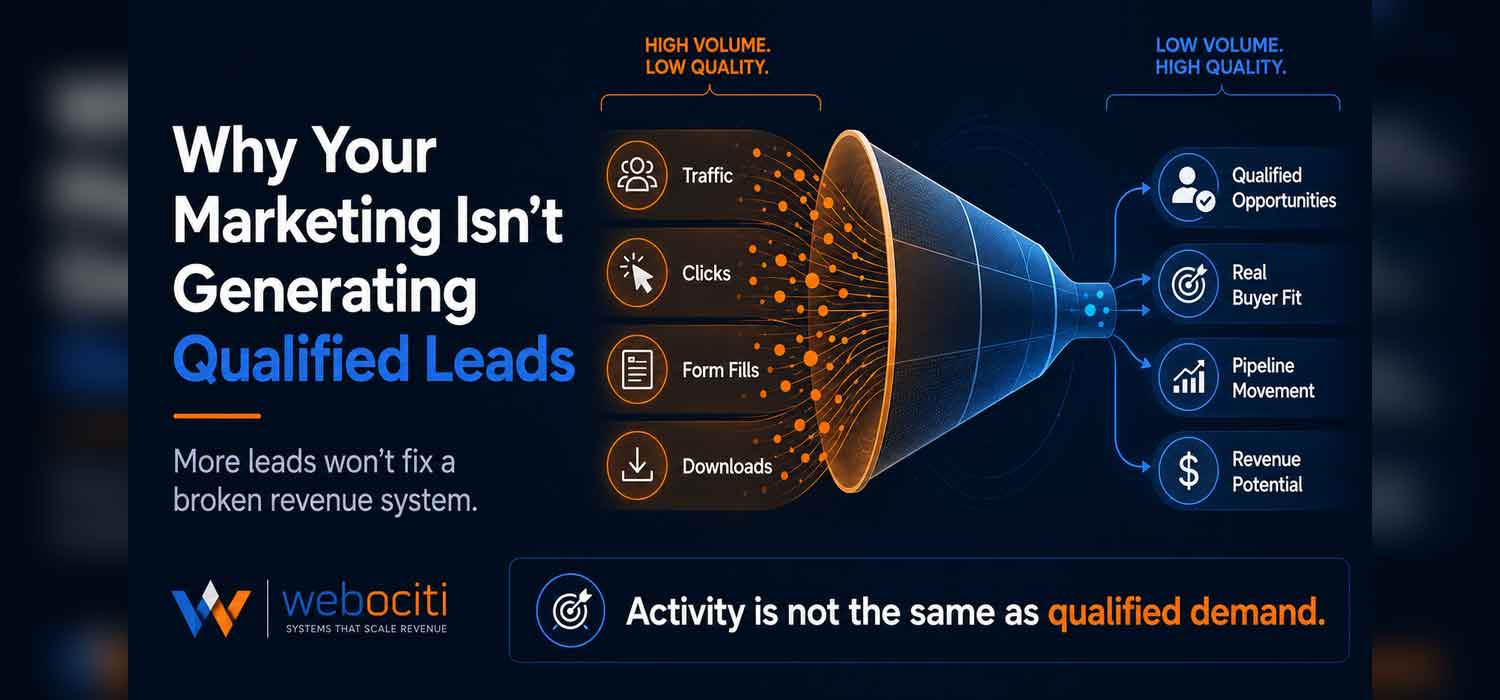
More leads will not fix a bad revenue system.

If your marketing is generating activity but not qualified leads, the problem is usually not the campaign alone.

It is usually deeper than that.

You may be attracting the wrong audience. Your message may be too broad. Your offer may not be clear. Your sales team may be receiving leads that were never a fit in the first place.

That creates a common growth problem:

Marketing looks busy. Sales stays frustrated. Revenue does not move.

When that happens, the answer is not always more traffic, more ads, more content, or more outreach.

Sometimes the real issue is that your marketing is not connected to a clear revenue system.

In Summary

If your marketing is not generating qualified leads, the problem is often caused by unclear positioning, weak targeting, broad messaging, disconnected campaigns, or poor alignment between marketing and sales.

Qualified leads are not created by volume alone. They come from a system that connects positioning, demand generation, pipeline design, and conversion. When those parts are aligned, marketing attracts better-fit buyers and sales spends more time with real opportunities.

Lead quality is not just a marketing problem. It is a system problem.

Why More Leads Are Not Always the Answer

When growth slows, many companies make the same assumption:

We need more leads.

That sounds logical. If revenue is not growing, fill the top of the funnel. Run more ads. Publish more content. Send more emails. Increase outreach.

But more leads only help if they are the right leads.

If your marketing is attracting people who are not a fit, not ready, not qualified, or not aligned with your offer, more volume simply creates more noise.

Your team gets busier, but the business does not get healthier.

  • Marketing reports more activity.
  • Sales receives more names.
  • The CRM looks fuller.
  • Leadership sees movement.
  • Revenue still feels inconsistent.

That is the trap.

The goal is not more leads. The goal is more qualified opportunities that can actually convert.

This is where many companies confuse demand generation with activity generation.

What Is a Qualified Lead?

A qualified lead is not just someone who filled out a form, clicked an ad, downloaded a guide, or booked a call.

A qualified lead is someone who matches the type of buyer your business can actually help, has a real problem you can solve, and has enough fit, need, urgency, and authority to move through your sales process.

That does not mean every qualified lead is ready to buy immediately.

But it does mean they belong in the system.

A qualified lead usually has some combination of:

  • Fit — they match your ideal customer profile.
  • Need — they have a real problem your solution addresses.
  • Awareness — they understand the issue enough to engage.
  • Authority — they can influence or make a decision.
  • Timing — there is a reason to act now or soon.
  • Value — the opportunity is worth pursuing.

Without those elements, a lead may create activity, but it will not reliably create revenue.

Why Your Marketing Attracts the Wrong Leads

Poor lead quality usually starts before the campaign ever launches.

The issue is often upstream.

It starts with how the company defines its market, explains its value, targets its audience, and connects marketing activity to sales outcomes.

Here are the most common reasons marketing fails to generate qualified leads.

1. Your Positioning Is Too Broad

If your positioning is too broad, your marketing will attract a broad audience.

That may increase traffic or lead volume, but it usually weakens quality.

When a company tries to speak to everyone, it often fails to connect deeply with the buyers who matter most.

Broad messaging creates vague interest. Clear positioning creates qualified demand.

If buyers cannot quickly understand who you help, what problem you solve, and why it matters, the wrong people will enter your funnel.

2. Your Message Focuses on Services Instead of Buyer Problems

Many companies describe what they do, but not why the buyer should care.

They list services, features, tools, or capabilities.

But buyers respond to problems, outcomes, risks, and opportunities.

If your marketing says what you offer but does not clearly connect to the buyer’s pain, you may attract curiosity without intent.

That creates weak leads.

The best marketing does not just explain your services. It helps the right buyer recognize their problem and see why your company is positioned to solve it.

3. Your Campaigns Are Optimized for Volume

Not all marketing metrics are equal.

Traffic, impressions, clicks, downloads, and form submissions can be useful indicators, but they are not the same as revenue progress.

If your campaigns are optimized only for volume, you may get more leads that sales does not want.

That is how companies end up with impressive marketing reports and disappointing revenue results.

A campaign that generates fewer but better-fit opportunities is often more valuable than a campaign that generates high volume with low conversion potential.

4. Marketing and Sales Do Not Agree on Lead Quality

A major reason companies struggle with qualified leads is that marketing and sales are not working from the same definition.

Marketing may define a lead as someone who takes an action.

Sales may define a lead as someone worth pursuing.

Those are not the same thing.

If both teams are not aligned on what makes a lead qualified, conflict is inevitable.

  • Marketing thinks sales is not following up.
  • Sales thinks marketing is sending bad leads.
  • Leadership sees activity but not conversion.

The fix is not just better reporting.

The fix is alignment around buyer fit, qualification criteria, pipeline stages, and revenue outcomes.

5. Your Offer Is Not Clear Enough

Sometimes the right buyers are seeing your marketing, but they are not taking action because the offer is unclear.

They do not understand what happens next.

They do not know what problem you solve first.

They do not see enough urgency to engage.

A strong offer creates a clear next step for the right buyer.

A weak offer creates hesitation.

If your calls to action are vague, generic, or disconnected from buyer pain, qualified prospects may leave without converting.

6. Your Pipeline Is Accepting Too Much Noise

Lead quality is not only a marketing issue.

It is also a pipeline design issue.

If every inquiry gets treated like a real opportunity, the pipeline becomes inflated.

Sales spends too much time sorting, chasing, and qualifying instead of advancing real opportunities.

That creates the illusion of pipeline strength.

But the pipeline is full of noise.

If this sounds familiar, read:
Why Your Pipeline Isn’t Converting.

Marketing Activity vs Qualified Demand
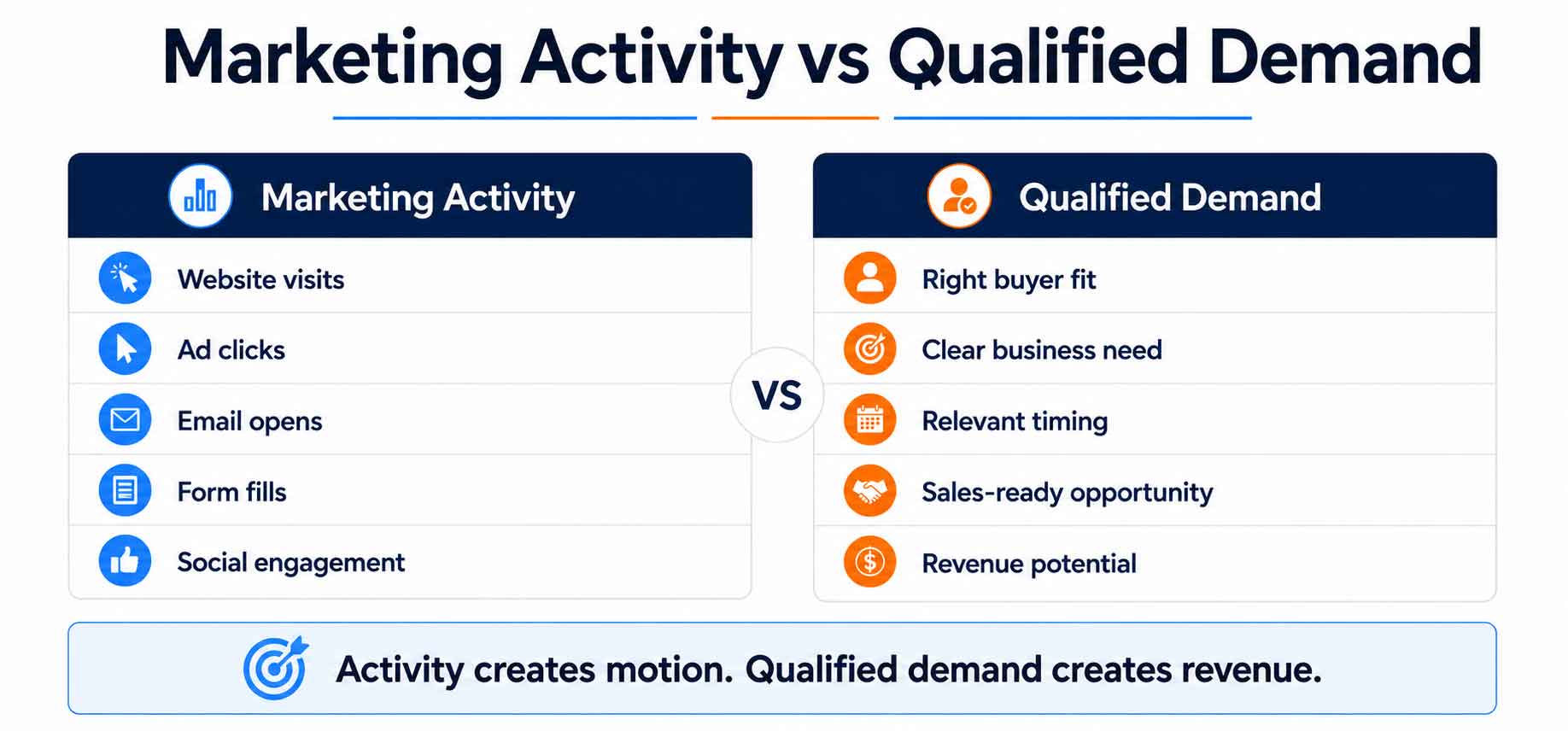
Marketing Activity vs Qualified Demand comparison showing website visits, ad clicks, email opens, form fills, and social engagement versus right buyer fit, clear business need, relevant timing, sales-ready opportunity, and revenue potential

One of the biggest mistakes companies make is treating activity as demand.

Activity is easy to create.

Qualified demand is harder.

Activity can look like:

  • Website visits
  • Ad clicks
  • Email opens
  • Social engagement
  • Form fills
  • Downloaded content

Qualified demand looks different.

  • The buyer fits your ideal customer profile.
  • The problem is real and relevant.
  • The message connects to a business need.
  • The lead has a reason to engage.
  • The opportunity can realistically move through the pipeline.

Both matter, but they are not equal.

Marketing should not be judged by how much activity it creates. It should be judged by whether it creates qualified demand that supports revenue growth.

Why This Is Really a Revenue System Problem

When marketing is not generating qualified leads, most companies try to fix the campaign.

Sometimes that is necessary.

But often the campaign is only exposing a deeper problem.

The company does not have a connected revenue system.

A real revenue system connects:

Positioning → Demand → Pipeline → Conversion → Revenue

Each stage feeds the next. When one stage is weak, everything downstream becomes harder.

If positioning is weak, demand quality suffers.

If demand quality suffers, pipeline fills with low-fit opportunities.

If pipeline quality is weak, conversion becomes inconsistent.

If conversion is inconsistent, revenue becomes unpredictable.

That is why lead quality cannot be solved in isolation.

It has to be solved as part of the system.

For the full framework, read:
What a Real Revenue System Actually Looks Like.

How to Fix Marketing That Is Not Generating Qualified Leads

Fixing lead quality starts with changing the question.

Instead of asking, “How do we get more leads?” ask, “Why are we attracting the wrong leads?”

That shift changes the entire strategy.

1. Clarify Your Ideal Customer

Start by defining who you are actually trying to attract.

Not everyone who can buy from you is an ideal buyer.

Your ideal customer should be defined by more than industry or company size. Look at need, urgency, value, buying process, fit, and likelihood to convert.

The clearer the buyer profile, the easier it becomes to build marketing that attracts the right prospects and filters out the wrong ones.

2. Tighten Your Positioning

Your positioning should make it clear who you help, what problem you solve, and why your approach matters.

If the message is vague, the audience will be vague.

Strong positioning creates sharper demand because it helps the right buyers recognize themselves in your message.

3. Build Campaigns Around Buyer Problems

Campaigns should not start with what you want to sell.

They should start with what the buyer is trying to solve.

The more your marketing connects to real buyer problems, the more likely you are to attract prospects with meaningful intent.

4. Align Marketing and Sales Around Qualification

Marketing and sales need a shared definition of a qualified lead.

That definition should include fit, need, timing, authority, and revenue potential.

Without that agreement, marketing will keep optimizing for one outcome while sales needs another.

5. Improve the Offer and Call to Action

A qualified buyer needs a clear reason to take the next step.

Generic calls to action like “Contact Us” or “Learn More” may not be enough.

A stronger offer connects directly to the buyer’s problem.

For example:

  • Diagnose where your pipeline is breaking.
  • Clarify your growth strategy.
  • Find out why your marketing is not converting.
  • Build a system for qualified demand.

The more specific the next step, the easier it is for the right buyer to act.

6. Measure What Happens After the Lead

Lead generation does not end when someone fills out a form.

You need to measure what happens next.

  • How many leads become qualified opportunities?
  • How many qualified opportunities advance?
  • How many convert into customers?
  • Which channels produce real revenue?
  • Which messages attract the best-fit buyers?

This is where marketing becomes a revenue function instead of an activity function.

Signs Your Marketing Is Attracting the Wrong Leads

You may have a lead quality problem if:

  • Sales regularly says the leads are not a fit.
  • Your pipeline is full but close rates are low.
  • You are getting inquiries from people who cannot afford your solution.
  • You attract buyers who misunderstand what you do.
  • Your sales team spends too much time educating unqualified prospects.
  • Deals stall early or disappear after the first conversation.
  • Marketing reports look strong, but revenue does not improve.

These are not just marketing symptoms.

They are signs that the revenue system needs to be realigned.

The Bottom Line

If your marketing is not generating qualified leads, the answer is not always more marketing.

It may be better positioning.

It may be sharper targeting.

It may be stronger messaging.

It may be better alignment between marketing and sales.

It may be a clearer pipeline qualification process.

But most of the time, it is not one isolated issue.

It is a system issue.

Qualified leads come from a connected revenue system that attracts the right buyers, filters real opportunities, and supports conversion.

More leads are not the goal.

Better-fit opportunities are the goal.

Your Marketing May Be Creating Activity, Not Qualified Demand.

If your leads are not converting, it may be time to diagnose the system behind your marketing, pipeline, and revenue growth.


Diagnose Your Lead Quality Problem →

Affordable Online Marketing Program for Startups & Small Businesses

By Joe Mediate – September 19, 2025 – Digital Marketing Programs

Looking for an affordable online marketing program that helps you grow without wasting money or time? You’re not alone. Most small business owners feel overwhelmed by the complexity and cost of digital marketing—but it doesn’t have to be that way.

At Webociti, we designed the Smart Start Program to help startups and small business owners build a solid foundation without breaking the bank. It includes everything you need to attract leads, build your brand, and create lasting growth—at a price that works for your budget.

Start With the Right Marketing Strategy

Marketing success starts with clarity. We help you identify your goals, audience, and message so you don’t waste time on tactics that don’t work. You’ll walk away with:

  • A clearly defined ideal customer profile
  • A core message that differentiates you
  • A focused go-to-market plan

Build Your Online Presence

A strong online presence is non-negotiable. Our team helps you launch or refine your digital footprint with:

  • A clean, fast-loading website (or a refresh of your existing one)
  • Basic SEO setup so customers can find you on Google
  • Setup of local listings and branded social profiles

Capture Leads Automatically

Too many businesses miss opportunities because they don’t have a system to collect leads. We’ll help you:

  • Add forms to capture email addresses and inquiries
  • Set up simple automations for follow-ups
  • Use tools like Mailchimp or Klaviyo to stay top of mind

Get Monthly Expert Guidance

You’ll never feel lost. The Smart Start Program includes monthly strategy calls with our experts. We’ll review your progress, answer questions, and update your plan based on what’s working.

Built to Be Budget-Friendly

We know early-stage businesses are watching every dollar. That’s why our program starts at just $499/month—giving you everything you need without locking you into long-term contracts.

Who Benefits from This Program?

Whether you’re a solopreneur or small local business, Smart Start is designed for you. It’s especially ideal for:

  • Founders launching a product or service
  • Service-based businesses looking for local leads
  • Entrepreneurs who want expert support without agency-level fees

Plug In and Launch

Starting your marketing journey doesn’t have to be complicated. With Webociti’s Smart Start Program, you’ll finally have a step-by-step system, expert coaching, and the confidence to grow.

Click here to explore all our digital marketing programs and find the one that fits you best.

Book a Free Strategy Call

Posted in Digital Marketing Programs


What Google Expects From Your Website in 2025 (And What Customers Want Too)

In this post: Discover exactly what Google and your visitors expect from your website in 2025—and how to meet those expectations to increase traffic, trust, and conversions.

What Google Expects From Your Website: A 2025 Wake-Up Call

If your website isn’t generating leads, building trust, or delivering a great user experience, it’s falling behind. As we head into 2025, both Google and your potential customers expect more than just a pretty homepage. They want speed, clarity, security, and usefulness—all from the first click. In this post, we’ll break down what Google expects from your website and how to exceed those expectations.

Why What Google Expects From Your Website Matters

Google remains the gatekeeper to online visibility. Its ranking algorithm grows more sophisticated each year, increasingly focused on user experience and content quality. In 2025, Google’s What Google expects from your website in 2025 – website performance, user experience, and trust signalsexpectations will include:

  • Core Web Vitals: Measuring page load speed, interactivity, and visual stability
  • Mobile-first indexing: Prioritizing mobile usability and responsive design
  • Helpful content: Rewarding content that genuinely solves problems and demonstrates expertise
  • AI-generated content detection: Ensuring your website adds human value beyond automation
  • EEAT: Experience, Expertise, Authoritativeness, and Trustworthiness—Google’s trust metrics for ranking

For a deeper look at these priorities, check out Google’s Page Experience guidelines.

What Customers Expect From Your Website in 2025

It’s not just Google’s bots evaluating your site—your visitors are, too. In 2025, your customers expect your website to deliver fast, helpful, and secure experiences. That means your site must:

  • Load fast: 2 seconds or less is the new standard
  • Be mobile-optimized: More than 70% of browsing is now on smartphones
  • Provide instant clarity: Who you are, what you offer, and how it helps them—within 5 seconds
  • Offer social proof: Testimonials, reviews, and case studies
  • Feel personal: Content and calls to action tailored to their intent
  • Be secure and trustworthy: SSL encryption, transparent policies, and fast support

Today’s online audiences have shorter attention spans and higher expectations. A poorly optimized site isn’t just an inconvenience—it’s a dealbreaker. Your website is often the first impression of your business, and visitors will judge your professionalism, credibility, and capability based on it within seconds. Meeting these expectations isn’t a luxury—it’s a necessity for competing online.

1. Core Web Vitals: What Google Expects From Your Website Speed

Google’s Core Web Vitals will continue to shape rankings. These metrics include:

  • Largest Contentful Paint (LCP): How fast the main content loads
  • First Input Delay (FID): How quickly users can interact
  • Cumulative Layout Shift (CLS): How stable the page layout is while loading

If your site takes more than 2.5 seconds to load or jumps around as it loads, you’re likely losing both rankings and visitors. Optimizing images, enabling caching, and reducing unnecessary code are crucial.

Simple updates like choosing faster hosting, compressing files, or using a content delivery network (CDN) can significantly improve your scores and enhance both SEO and UX. Test your site regularly with tools like Google PageSpeed Insights or GTmetrix to ensure optimal performance.

2. Mobile Optimization: Critical to What Google Expects From Your Website

With Google using mobile-first indexing, your mobile site is now your primary site. That means navigation, tap targets, image loading, and copy readability must all be optimized for smaller screens. In 2025, visitors will leave quickly if your mobile experience feels cramped, confusing, or slow.

Focus on mobile menus that are easy to access, avoid intrusive pop-ups, and make sure buttons are easy to click with a thumb. Clean, simple designs and mobile-first layouts ensure you won’t alienate over half your audience.

3. Content That Actually Helps (and Meets Google’s Expectations)

Google’s Helpful Content Update puts the user first. Gone are the days of keyword stuffing or shallow blog posts. Your content must answer real questions and show real expertise. Blogs, FAQs, landing pages, and even product pages should be written with clarity and helpful intent.

Use structured data, include FAQs, add video summaries, and link to authoritative sources like Google’s SEO Starter Guide and Moz’s Beginner’s Guide to SEO. Keep content skimmable, but detailed.

Also consider using long-form blog content that answers related questions in depth. This not only satisfies your audience but improves dwell time and signals quality to search engines.

4. EEAT: What Google Expects From Your Website’s Trust Signals

Google is pushing hard on “EEAT” (Experience, Expertise, Authoritativeness, and Trustworthiness). To compete, your site should:

  • Feature expert authors or real company leadership
  • Include detailed “About” and “Team” pages
  • Display client logos, case studies, and testimonials
  • Link out to credible sources
  • Maintain an active blog that demonstrates thought leadership

These trust signals assure both Google and your visitors that your brand is knowledgeable, legitimate, and worth doing business with. The more transparent and informative you are, the more likely people are to engage and convert.


🚀 Let’s Improve Your Website Today

5. Human Over AI: Why Originality Matters More Than Ever

As AI content becomes more common, Google is prioritizing human insight and experience. Repurposing generic content will lower your visibility. Use storytelling, personal examples, and real case studies to stand out. Voice and tone that reflects your brand’s personality are also key.

Think of content as a conversation. Speak directly to your audience’s problems, and don’t be afraid to inject personality. In 2025, people won’t just be searching for information—they’ll be seeking connection and credibility.

6. Design That Supports What Google and Customers Expect

Good design isn’t about bells and whistles. It’s about guiding visitors toward action. In 2025, effective website design will:

  • Use a clear visual hierarchy and whitespace
  • Feature short headlines and action-oriented CTAs
  • Balance images with copy (and use real photography when possible)
  • Keep forms short and user-friendly

Your website is your #1 sales rep. Make sure it looks and behaves like one. If users get lost, overwhelmed, or distracted—they won’t convert. Simplicity is more effective than complexity when your goal is action.

7. Conversion-Ready: What Google Expects From Your Website’s Engagement

Traffic means nothing without conversion. Your website should be optimized to capture leads, guide inquiries, and support sales follow-up. Essentials include:

  • Sticky call-to-action buttons
  • Live chat or contact widgets
  • Lead magnets (eBooks, free consultations)
  • Exit-intent popups or reminders

In 2025, people expect to interact on their terms. Give them multiple ways to raise their hand. And make your conversion actions feel seamless and rewarding, not like a sales trap.

Key Takeaways: How to Future-Proof Your Website

  • Meet Core Web Vitals benchmarks: fast, stable, and interactive
  • Design mobile-first with intuitive navigation
  • Create human-first content with real value
  • Showcase trust signals: reviews, credentials, partnerships
  • Optimize for conversions: clear CTAs and interactive elements

Is Your Website Ready for What Google Expects in 2025?

Chances are, your website could be doing more to meet what Google expects from your website and your customers’ expectations. At Webociti, we help businesses transform outdated websites into modern growth engines that rank better, convert more, and build trust with every click.


🚀 Let’s Improve Your Website Today

The Ultimate Guide to Social Media Advertising, Google Ads, and Programmatic: Which is Right for Your Business?

Social media ads vs Google
In 2024, businesses are expected to spend over $600 billion on digital advertising, but with so many platforms available, how do you know where to invest for the best returns? Among the most powerful are social media advertising, Google Ads, and the increasingly popular programmatic advertising. Each of these platforms offers unique ways to reach your audience, and understanding how they work is crucial to making an informed decision.

In this post, we’ll explore the strengths and weaknesses of each option, giving you the insight you need to choose the right advertising approach for your business.


Understanding Social Media Advertising

Social media advertising allows businesses to promote their products or services directly within the feeds of popular social platforms such as Facebook, Instagram, LinkedIn, and TikTok. This type of advertising leverages rich user data to target audiences based on their interests, behaviors, and demographics, making it an incredibly effective tool for building brand awareness and engaging potential customers.

But there’s an important distinction to make: successful social media advertising isn’t about how many likes you get, it’s about how many people engage with your posts and ads.

Engagement Over Vanity Metrics

While accumulating likes, followers, and shares might feel gratifying, these “vanity metrics” don’t necessarily translate into tangible business results. Instead, what really matters is engagement—how many people are interacting meaningfully with your content. Engagement metrics, such as comments, shares, click-through rates, and even direct messages, give you deeper insight into how your audience is connecting with your brand.

Why is engagement more important than likes?

  • Higher Engagement = More Reach: Social media algorithms prioritize content that generates high engagement, meaning the more your audience interacts with your posts (through comments, clicks, and shares), the more people will see your content organically.
  • Engagement Drives Conversions: People who take the time to engage with your posts—whether by commenting, clicking on links, or sharing—are more likely to convert into leads or customers. This makes engagement a more actionable metric for determining the success of your campaigns.
  • Better Audience Insights: Engagement shows how well your message resonates with your target audience. By focusing on engagement, you can gain a better understanding of what content drives action and tailor future campaigns for higher performance.

Key Features of Social Media Advertising

Social Media Advertising

  • Visually Driven Content: Social platforms are inherently visual, making them ideal for businesses that can create engaging images or videos.
  • Robust Audience Targeting: Social media platforms collect extensive user data, allowing for highly targeted ads based on location, interests, behaviors, and past interactions with your brand.
  • Multiple Ad Formats: You can choose from a variety of ad formats, including photo ads, video ads, carousel ads, and stories, depending on the platform and your goals.

Pros of Social Media Advertising

  • High Engagement Rates: Social media platforms encourage interaction, meaning well-crafted ads can generate high engagement, which boosts their visibility to a broader audience.
  • Great for Building Brand Awareness: Social media helps increase your brand’s visibility and fosters direct interaction with customers through comments, shares, and other engagements.
  • Affordable: Even businesses with smaller budgets can experiment with social ads and scale their spending as they see results.

Success Story: One Webociti client increased their social media engagement by 35% after shifting their focus from likes to meaningful engagement, resulting in a 20% increase in conversions. This proves that quality interaction far outweighs sheer numbers!

Cons of Social Media Advertising

  • Lower Purchase Intent: Users on social media are often not actively looking to buy, so while engagement may be high, conversions can be lower.
  • Algorithm Dependence: Changes in platform algorithms can affect the visibility and performance of your ads, requiring constant adaptation.

Need help mastering social media advertising? Our team at Webociti can craft a strategy that ensures your business gets real engagement, not just likes. Contact us today!


Understanding Google Ads

Google Ads operates on a pay-per-click (PPC) model, where businesses bid on specific keywords to have their ads appear at the top of search engine results pages. This platform is particularly effective for targeting users with a high purchase intent, as they are actively searching for products or services.

Key Features of Google Ads

Understanding Google Ads

  • Search Intent: Google Ads capitalizes on users who are already searching for solutions, making it easier to capture customers further down the sales funnel.
  • Keyword Targeting: By bidding on relevant keywords, you can ensure your ads reach users interested in your products or services.
  • Multiple Formats: Google Ads supports text ads, shopping ads, display ads, and video ads, providing versatility in reaching your audience.

Pros of Google Ads

  • High Purchase Intent: Since users are actively searching, they are more likely to convert when they see your ad.
  • Precise Keyword Targeting: You can target specific searches, ensuring your ads are relevant to what people are looking for.
  • Immediate Results: Google Ads campaigns can drive traffic and conversions quickly after launch.

Cons of Google Ads

  • Competitive and Costly: Popular keywords can be expensive, especially in competitive industries.
  • Requires Expertise: Running an optimized campaign requires PPC knowledge and can be time-consuming without proper management.

Ready to capture high-intent customers? Webociti’s Google Ads experts can help you create a PPC campaign that drives conversions. Contact us now for a free consultation!


Understanding Programmatic Advertising

Programmatic advertising is the automated buying and selling of ad inventory across a wide variety of platforms and devices. It uses machine learning and AI to purchase ad space in real time, targeting users with high precision across websites, apps, videos, and even smart TVs.

Retargeting with Programmatic Ads

One of the key strengths of programmatic advertising is retargeting—the ability to show ads to users who have already visited your website or engaged with your brand in some way.   Retargeting is an effective way to re-engage users who didn’t convert the first time they interacted with your content, helping to nurture them further down the sales funnel.
Retarageting Ads

How does retargeting work?
Through tracking pixels or cookies, programmatic platforms can display your ads to people who have previously interacted with your website, ensuring your brand stays top of mind as they browse the internet.

Key Features of Programmatic Advertising

  • Real-Time Bidding (RTB): Programmatic ads are placed using automated auctions that happen in milliseconds, ensuring that your ads are shown to the right users at the right time.
  • Cross-Platform Reach: Programmatic ads can appear on websites, apps, video platforms, and even smart TVs, giving you access to a wide range of audiences.
  • Automated Optimization: Machine learning continuously refines your campaign to improve performance over time.

Pros of Programmatic Advertising

  • Efficient and Scalable: Programmatic ads are automated, reducing the need for manual effort and allowing campaigns to scale quickly.
  • Precise Targeting & Retargeting: With access to first-party and third-party data, programmatic allows for highly granular audience targeting, including retargeting users who have previously engaged with your brand.
  • Performance Optimization: AI-powered systems adjust your bids and ad placements in real time to optimize performance and reduce wasted spend.

Cons of Programmatic Advertising

  • Complex Setup: While programmatic is automated, setting it up and managing it effectively requires specialized knowledge.
  • Potential for Ad Fraud: The automated nature of programmatic advertising can expose advertisers to risks such as bot traffic or click fraud, although many platforms offer fraud detection tools.

Want to explore programmatic advertising? Webociti’s experts can help you take advantage of this advanced advertising technique to scale your campaigns efficiently. Get in touch for more information!


Which Advertising Platform is Right for Your Business?

Each platform serves different purposes depending on your business goals, audience, and budget. Here’s a quick guide to help you choose:

1. Brand Awareness

Best option: Social Media Advertising
Social platforms are ideal for building brand awareness and engaging with a broad audience through visually compelling ads.

2. Driving Conversions

Advertising Platform is Right
Best option: Google Ads
If your goal is to capture high-intent users actively searching for products or services, Google Ads can drive immediate sales and conversions.

3. Cross-Platform Reach

Best option: Programmatic Advertising
For businesses looking to scale their advertising efforts across multiple platforms and devices, programmatic advertising offers the efficiency and reach needed to engage diverse audiences.

4. Budget Considerations

Best option: Social Media Advertising (Smaller Budgets) or Google Ads (Performance-Based)
Social media advertising allows for flexible budgets and incremental spending, while Google Ads offers predictable costs through a pay-per-click model.


The Hybrid Approach: Combining Social Media, Google Ads, and Programmatic

For many businesses, a hybrid approach—using all three platforms—yields the best results. Social media advertising can increase brand awareness and engagement, Google Ads can capture high-intent searchers ready to buy, and programmatic advertising ensures you reach your audience across multiple channels with automated precision.


Final Thoughts: Choosing the Right Digital Marketing Strategy

Choosing between social media advertising, Google Ads, and programmatic advertising depends on your business goals, target audience, and budget. Often, a mix of these platforms provides the most comprehensive approach to capturing leads at every stage of the buyer’s journey.

At Webociti, we specialize in creating tailored digital marketing strategies that include the perfect combination of social media, Google Ads, and programmatic advertising. Our team of experts can help you determine which platforms will deliver the best ROI for your business. Contact us today to get started with a free consultation!

The Top 7 Warning Signs Your Website Needs a Makeover

In the fast-paced world of digital marketing, your website serves as the storefront of your business. It’s often the first interaction potential customers have with your brand, and as we all know, first impressions matter. Just like physical stores need renovations to stay modern and appealing, websites also require updates to keep up with changing trends, user expectations, and business growth. A website that’s outdated, slow, or poorly designed can cost you in terms of both user engagement and conversions.

In this blog post, we’ll explore the top 7 warning signs that your website might need a makeover and how a fresh design can significantly impact your user experience and bottom line.

1. Your Website Isn’t Mobile-Friendly

More than half of all web traffic now comes from mobile devices. If your website isn’t mobile-friendly, you’re likely losing a significant portion of potential customers. A website that doesn’t scale properly on mobile screens can frustrate users, leading to higher bounce rates and lower conversions.
SEO

Signs your website isn’t mobile-friendly:

  • Visitors have to pinch or zoom to view content.
  • Buttons or links are hard to click because they are too small.
  • The layout looks skewed or off-balance on mobile devices.
  • Page load times are significantly longer on mobile.

Having a responsive, mobile-optimized website is no longer optional; it’s a necessity. Not only does it improve the user experience, but Google also prioritizes mobile-friendly sites in its search rankings.

If your website isn’t mobile-friendly, you could be missing out on valuable leads. Contact us today to explore how Webociti can help redesign your site for the modern mobile experience and drive more conversions.

2. Your Website Is Slow to Load

Did you know that 40% of visitors will abandon a website if it takes more than 3 seconds to load? In the age of instant gratification, users expect websites to load almost instantaneously. If your website is slow, it’s a sure sign you need a makeover.

Signs your website is too slow:

  • High bounce rates (users leaving your site after visiting only one page).
  • Poor performance scores on website speed tests like Google PageSpeed Insights or GTmetrix.
  • Complaints from users about slow page load times.
  • Noticeable delays in loading images, videos, or interactive elements.

A website that loads quickly improves user experience, boosts engagement, and has a positive impact on your SEO ranking. During a website makeover, optimizing images, compressing files, and updating outdated code can significantly improve load times.

3. Your Website Looks Outdated

Design trends in web development evolve rapidly, and what looked modern five years ago may now appear outdated. An old, cluttered design can make your business look unprofessional and out of touch. A dated website can hurt your brand image and decrease your credibility with visitors.

Signs your website design is outdated:

  • Your site uses outdated design elements like skeuomorphism, Flash animations, or old fonts.
  • It lacks modern web features like parallax scrolling, minimalist design, or clean, intuitive navigation.
  • Your website hasn’t been updated in the last 3-5 years.
  • The design looks cluttered, making it difficult for visitors to navigate.

A website makeover will give your business a fresh, modern look that aligns with current design trends and meets user expectations. Incorporating features like sleek typography, bold visuals, and intuitive navigation can dramatically improve your site’s overall appeal.

4. Your Website Isn’t Generating Leads or Conversions

Your website is a powerful tool for lead generation and sales, but if it’s not delivering, something may be off with the design or user flow. Visitors might find it difficult to navigate, locate the right information, or take action, such as filling out a form or making a purchase.

Signs your website isn’t optimized for conversions:

  • Visitors leave your site without taking any action.
  • Your call-to-action (CTA) buttons are hard to find, unclear, or ineffective.
  • Forms are too complicated or lengthy, leading to high abandonment rates.
  • Analytics show low conversion rates despite high traffic.

A website makeover can focus on streamlining the user journey and optimizing the layout for conversions. Simple adjustments like improving CTAs, shortening forms, and using persuasive design elements can make a significant difference in lead generation and sales.

5. Your Website Is Difficult to Update

In today’s digital landscape, you need to be able to update your website regularly—whether it’s adding new content, updating services, or making design tweaks. If your website relies on outdated technology or content management systems (CMS), making these changes can be a cumbersome and time-consuming process.

Signs your website is difficult to update:

  • You need a developer to make even small changes.
  • Your CMS is outdated and lacks modern features.
  • It takes too long to upload new content, images, or updates.
  • Your team finds it challenging to keep the site current with new information.

A website makeover can include migrating to a modern CMS like WordPress, which makes it easier for you to update content and manage your site without the need for technical expertise. This ensures your site stays relevant and up-to-date.

6. Your SEO Performance Has Plateaued

Search Engine Optimization (SEO) is crucial for driving organic traffic to your site, but if your website isn’t performing well in search results, it might be time for a refresh. Google’s algorithms are continually evolving, and an outdated website can negatively impact your rankings.

Signs your website is underperforming in SEO:

  • Your website’s search rankings have stagnated or dropped.
  • Pages are missing essential SEO elements like meta tags, alt text, or proper headings.
  • You’re not generating organic traffic despite optimizing content.
  • Broken links, outdated URLs, or old content remain on your site.

A website makeover can include updating your on-page SEO, improving your website’s structure, and fixing any technical SEO issues. These updates will help you regain visibility in search engines and drive more organic traffic to your site.

7. Your Website Doesn’t Reflect Your Current Brand or Business Offerings

As your business evolves, so should your website. If you’ve recently rebranded, introduced new services, or shifted your business model, your website must reflect those changes. A mismatch between your current brand and your website can confuse visitors and weaken your brand’s identity.
Mobile

Signs your website no longer aligns with your brand:

  • Your site’s color scheme, messaging, or imagery is inconsistent with your current branding.
  • Your products or services have changed, but your site still reflects old offerings.
  • You’ve rebranded or changed your logo, but your site still uses the old one.
  • Your business has expanded to new markets, but your site doesn’t showcase this growth.

A website makeover allows you to align your online presence with your current business and branding. This ensures that visitors get a cohesive brand experience, which helps build trust and encourages engagement.

8. Your Competitors’ Websites Are Better

Take a moment to check out your competitors’ websites. If they’re sleeker, faster, and more modern than yours, it’s time to take action. A website that doesn’t measure up to industry standards can leave you trailing behind in the digital race.

Signs your competitors’ websites are outperforming yours:

  • They have better SEO rankings.
  • Their sites are more visually appealing and easier to navigate.
  • Their mobile experience is superior.
  • They offer a more seamless user journey, leading to higher conversions.

A website makeover will allow you to stay competitive and meet or exceed industry standards, ensuring that you capture and retain more customers.

Conclusion

Your website is more than just a digital brochure—it’s the cornerstone of your online presence and often the first interaction a potential customer has with your brand. If any of the signs mentioned above resonate with you, it’s time to consider a website makeover.

Investing in a modern, functional, and mobile-friendly website will improve user experience, increase conversions, and ensure your business remains competitive in the digital marketplace.

At Webociti, we specialize in designing websites that not only look great but also deliver measurable results. Contact us today for a consultation, and let us help you transform your website into a powerful tool for business growth.


Unlocking Success: The Webociti Marketing Makeover Program Revealed

Are you ready to revolutionize your digital marketing but unsure where to start? Ninety percent of businesses fail to effectively leverage digital tools for growth. Don’t be part of that statistic—discover how the Webociti Marketing Makeover Program can transform your strategy and results.

Transform Your Business with the Webociti Marketing Makeover Program

In today’s fast-paced digital landscape, merely blending in is not an option. The Webociti Marketing Makeover Program combines strategic insights, tailored solutions, and proven techniques to propel your business to unprecedented heights. Discover how companies across various industries have dramatically increased their market reach and sales through our program.

What is the Webociti Marketing Makeover Program?

The Webociti Marketing Makeover Program offers a holistic solution, meticulously tailored to meet the specific needs and objectives of your business. From startups carving out a robust online niche to established enterprises amplifying sales and conversions, our approach ensures your marketing goals are not just met but exceeded.


What Makes Webociti Different?

Expertise Born from Experience:

Webociti stands apart due to our unique background in founding, scaling, and selling companies. This entrepreneurial experience is not just theoretical; it’s practical and woven into every strategy we deliver, ensuring you receive guidance that’s actionable and impactful.

Content That Connects:

  • Engaging Narratives: We don’t just tell your story; we tell it compellingly. Our content captures your brand’s essence—its values, mission, and vision—through:
    • Blog posts that resonate and engage.
    • Social media updates that foster community and conversation.
    • Email newsletters that keep your audience informed and interested.
    • Website content that enhances user experience and boosts SEO.

Guided Learning Journey:

In a world teeming with information, our content does more than just inform—it inspires. We guide your prospects through their decision-making process with insightful and actionable content, positioning your brand as the trusted authority. This not only builds lasting relationships but also converts casual browsers into loyal customers.

Ready to Transform Your Marketing?

If you’re ready to elevate your marketing efforts, the Webociti Marketing Makeover Program is ready to launch you to new heights. Embrace excellence—let us help you achieve exceptional outcomes.

Contact us today for a free consultation and discover how our expertise can propel your business forward. Call us at 678-892-7157 or click here to get started.

Conclusion

In today’s competitive digital arena, a robust online presence is essential. With the Webociti Marketing Makeover Program, unlock your business’s full potential and elevate your marketing beyond the ordinary. Invest in your success with Webociti and take the first step towards remarkable business growth.

Take the first step towards success! Contact us now to schedule your consultation.


Customer Journey: Guide Buyers from Curiosity to Commitment

Mastering the customer journey is key to successful marketing. Today’s buyers don’t make instant decisions. Instead, they follow a path—beginning with curiosity, moving through exploration, and ultimately reaching commitment. By understanding and optimizing this journey, businesses can increase conversions and build lasting customer relationships.

The Customer Journey: Awareness, Trust & Commitment

1. Curiosity: The First Step in the Customer Journey

The customer journey begins with curiosity. People encounter products, services, or ideas through social media, search engines, or ads. At this stage, they ask:

  • What solutions exist for my problem?
  • How does this product or service help me?


💡 Marketing Insights:

  • Use engaging headlines and visuals to capture attention.
  • Offer free educational resources such as blog posts, webinars, or eBooks.
  • Ensure your website follows SEO best practices to rank in searches.

2. Exploration: Researching & Comparing Options

Once curiosity is sparked, potential customers enter the exploration stage of the customer journey. They begin researching, comparing, and evaluating solutions.

Common Customer Actions:

  • Reading customer reviews and case studies.
  • Comparing pricing, features, and competitors.
  • Looking for proof of effectiveness (videos, testimonials, social proof).

💡 Marketing Insights:

  • Provide detailed product/service pages and FAQs.
  • Showcase trust signals such as testimonials, case studies, and certifications such as Trustpilot).
  • Use targeted SEO strategies to make your content easy to find.

3. Enlightenment: Gaining Confidence in the Customer Journey

During this stage of the customer journey, customers evaluate whether your solution is the best fit. They need proof, validation, and reassurance before making a commitment.

💡 Marketing Insights:

  • Use personalized email marketing and retargeting ads to nurture leads.
  • Highlight success stories and real-world applications of your product.
  • Ensure consistent messaging across all channels to reinforce credibility.

4. Commitment: The Final Step in the Customer Journey

At this stage, customers are ready to take action. However, they may hesitate due to lack of clarity, complex checkout processes, or missing incentives.

💡 Marketing Insights:

  • Make purchasing seamless with a clear call-to-action and user-friendly website.
  • Offer limited-time promotions, free trials, or discounts to encourage action.

🚀 Beyond Commitment: Customer Retention & Brand Advocacy

Commitment isn’t the end—it’s the start of a long-term customer relationship. Happy customers become repeat buyers and brand advocates.

💡 Marketing Insights:

  • Send follow-up emails with tips, resources, and customer support.
  • Encourage reviews and referrals to increase social proof.
  • Provide outstanding customer service to build loyalty.

📈 Ready to Optimize Your Customer Journey?

Mastering the customer journey from curiosity to commitment is essential for lead generation. Understanding how customers think allows you to craft a powerful marketing strategy that attracts, engages, and converts.

📞 Let’s Create Your Winning Strategy!

At Webociti, we specialize in optimizing the customer journey to drive leads and conversions. Want to grow your business?


Schedule Your Consultation Today

📞 Call us at 678-892-7157


Unlocking Business Growth: The Power of Marketing Automation

In the digital age, marketing automation has transcended the status of just another tech trend, becoming an essential tool for integrating sales and marketing efforts. Far from being a mere celebration of technology, marketing automation is about enhancing the efficacy and efficiency of marketing strategies that businesses have historically implemented. It is about leveraging cutting-edge technology to achieve unprecedented results, such as boosting business by over 150% or increasing qualified leads by 75%. Could marketing automation triple your conversion rates? It’s not just a possibility—it’s becoming a reality for many businesses.

Key Components of Marketing Automation

Email Marketing

Email marketing remains a cornerstone of marketing automation, allowing businesses to send targeted messages to both current and potential customers. Whether reminding customers about an expiring sale or escalating urgency over time, automated email campaigns can deepen customer relationships and enhance marketing efforts.

Lead Generation

Modern marketing automation tools ensure that your website is fully optimized for today’s digital requirements. This includes SEO to enhance search visibility and strategically placed calls-to-action that encourage visitors to download resources, subscribe to newsletters, or engage with interactive content.

Lead Nurturing

The process often starts with a user filling out a form on your website. Capturing information such as email addresses allows businesses to maintain engagement through targeted, automated emails, nurturing the customer relationship until they are ready to make a purchase.

Prospecting

Effective marketing automation identifies prospective customers and communicates how your product or service solves their problems. This not only establishes your brand as a thought leader but also as a solution provider in your industry.

Sales Force Intelligence

This aspect of marketing automation provides invaluable insights into the buyer’s journey, equipping sales teams with detailed behavioral data. Understanding the actions that prospects take online helps tailor sales pitches to meet the specific needs and interests of each customer.

Analytics

Analytics are the backbone of marketing automation, offering deep insights into buying trends and customer behaviors. By analyzing where customers spend their time, what they engage with, and how they move through the sales funnel, businesses can refine their marketing strategies to be more effective and efficient.

Transform Your Marketing Strategy

Marketing automation is more than just software—it’s a strategic approach that integrates technology, business intelligence, and marketing to drive substantial growth. It provides a holistic view of the customer journey, streamlining processes and ensuring that marketing and sales efforts are perfectly aligned.

Are you ready to harness the power of marketing automation to transform your business? Contact Webociti today for a comprehensive strategy that tailors marketing automation to your business needs. With our expertise, your business can not only meet the digital demands of today but thrive in them. Call us at 678-892-7157 or visit the Webociti website to start your journey towards significant business growth.

#MarketingAutomation #DigitalMarketing #LeadGeneration #EmailMarketing #SalesForce #BusinessGrowth #MarketingStrategy #Webociti #LeadNurturing #ConversionOptimization

Optimizing the Marketing Funnel:
How Digital Marketing, SEO, and Content Drive Sales

In the digital age, mastering the marketing funnel with digital marketing, SEO, and strategic content is essential for standout success. At Webociti, we transform prospects into loyal customers by tailoring our approach to each stage of the funnel, backed by success stories and actionable insights.

A well-optimized marketing funnel does more than just guide customers. It builds trust, creates meaningful touchpoints, and aligns your sales and marketing efforts to ensure consistent revenue growth. The result? More engaged leads, higher conversion rates, and long-term customer loyalty.

<

What is a Marketing Funnel and Why Does It Matter?

The marketing funnel is a framework that guides potential customers through different stages of their buying journey:

  • Awareness (Prospect): Customers discover your brand and identify their problems.
  • Consideration (Lead): Customers evaluate solutions and compare providers.
  • Decision (Customer): Customers choose your solution and make a purchase.
  • Loyalty (Repeat Buyer): Customers return for repeat purchases and advocate for your brand.

To explore more about marketing funnel strategies and proven methods for success, check out this comprehensive guide on optimizing your marketing funnel.

Marketing Funnel

Content Strategies for Each Funnel Stage

1. Awareness Stage: Attracting Prospects

During the awareness stage, your goal is to draw attention and build trust. SEO-optimized content like blogs, videos, and social media posts help you target customer pain points and spark interest.

  • Example: Blog post titles like “5 Ways to Reduce Energy Bills This Winter” attract users looking for solutions.
  • SEO Tip: Target long-tail keywords to attract relevant traffic to your website.

2. Consideration Stage: Nurturing Leads

At this stage, customers are looking for deeper information. Gated content, such as whitepapers, webinars, and case studies, allows you to capture leads while positioning your brand as an authority.

  • Example: Create a whitepaper titled “How to Save 20% on Your Business’s Electric Costs.”
  • Actionable Insight: Use clear CTAs like “Download Now” to encourage lead capture.

3. Decision Stage: Converting Leads into Customers

Prospects in the decision stage need reassurance. Detailed product guides, customer testimonials, and comparison charts help them choose your solution over competitors.

  • Example: A client testimonial video showcasing how your services solved a real-life challenge.
  • Tip: Offer limited-time promotions to create urgency.

4. Loyalty Stage: Building Repeat Business

Loyalty isn’t automatic—it’s earned. Regular newsletters, personalized offers, and loyalty programs keep customers engaged and coming back.

  • Example: Send exclusive coupons or early access to new products for returning customers.
  • Fact: Existing customers spend up to 67% more than new ones.

Case Study: Real Results with a Targeted Funnel Strategy

A small electrical contractor struggled to generate leads with only a basic website. Webociti developed a strategic funnel, including:

  • Awareness: Blog posts addressing energy efficiency tips.
  • Consideration: Whitepaper download: “How to Lower Energy Costs in Your Home.”
  • Decision: Email campaigns with case studies and customer success stories.

Results? A 35% increase in qualified leads and a 20% boost in revenue within 6 months.

Transform Your Marketing Funnel Today

Optimizing your marketing funnel is the key to sustainable growth. At Webociti, we combine digital marketing, SEO, and targeted content strategies to drive measurable results.

Ready to get started? Contact us today at 678-892-7157 for a free consultation and take the first step toward transforming your business.

Lead Management

Building Your Own Effective Lead Management Generation Program

Is your boss asking you why your marketing generation isn’t more effective? In my experience helping many companies improve lead generation, I find that most of the time the answers are,

  1. They do not understand their buyer
  2. They lack familiarity with the buying process
  3. There does not exist a content structure for potential client communications

So, where do we start?

Know Your Buyer

In order to know who your buyer is, develop buyer personas. This should be a joint project of marketing and sales. By having both groups working together helps reduce the risk of skewed personas. When sales and marketing people share their unique perspectives about customers the end result is a more holistic view. Only use 1 to 3 personas, more and you will be muddled and your plan less effective.

When developing personas, I recommend that you determine buying groups by function and not a title. Instead of Director of Technology, use ‘technology buyer.” Instead of Chief Operating Officer, use more generic listings such as ‘office supply buyer.” These personas are used as target groups that often affect or decide the buying decision.

Define the information that helps your company nurture leads. These include items such as,

  • Role in the company
  • Personal background
  • Daily activities
  • Industry news sources
  • Challenges

Don’t panic, you are only listing information that helps your firm nourish leads, you do not need to fill the information in now.

Once you have your personas identified and your information categories fixed create a matrix. Buying groups go on the x-axis and information categories on the y-axis.

Complete the matrix by using a bulleted list. For example, if the buying group is technology and the information category is daily activity, a list might look like,

  • Send a response to emergency calls;
  • Check operational efficiency;
  • Manage vendor relationships;
  • Manage staff

Define the Purchasing Process

To begin, schedule a meeting with sales and marketing teams specifically to define the buying process.

Next, create a flowchart that identifies the decisions and steps the buyer must undertake. A good start is to ask, “What triggers a buyer to seek us for a solution?” Followed by another question such as, “what are the buyer’s next steps?” Keep asking the group follow up questions. Write the responses on a whiteboard to create an initial buying process map.

Once you have created your initial buying process map, validate it through research. Use methods like,

  • Interview prospects;
  • Interview buyers;
  • Hold focus group meetings with prospects;
  • Hold focus group meetings with buyers.

Based on your research findings revise your initial draft of the buying process.

Once the revisions are finished, check with internal stakeholders to get their thoughts; choose people from several areas including,

  • Sales;
  • Business development;
  • Marketing

Also get in touch with existing customers, use the phone or arrange for small group meetings.

Develop a Framework for Content

Once again, call a meeting with the sales and marketing staffs. (See the pattern, marketing and sales work together!)

Create a second matrix, on the x-axis list buying process stages and on the y-axis buyer personas. Use bullet points to list the answers to questions for each persona in each stage. Questions should be inquiring such as,

  1. Which questions does the buyer ask at this stage?
  2. How should we answer those questions?
  3. What is the best method or medium to answer questions?
  4. What behavior do we want to see from prospects when we answer their questions?

If you would like to learn more contact us at Our marketing team is ready to help you take your company to the next level We look forward to working with you!

Till next time

Joe Mediate

Save