The Power of Email Marketing for B2B Companies

In the dynamic world of digital marketing, where trends come and go, one strategy remains the undisputed champion for B2B companies – email marketing. This time-tested tool continues to drive the highest volume of leads and delivers the highest ROI. But that’s not all; we’ll also explore the complementary role of other strategies like SEO, PPC, Social Media, Retargeting, and Content Marketing in the B2B marketing landscape.

B2B Marketing Strategies

Email marketing has been a cornerstone of B2B marketing for decades, and its resilience is no accident. According to recent statistics, email marketing generates an astounding $38 for every $1 spent, resulting in an ROI that’s off the charts. But what sets email apart from other marketing strategies, and how do other approaches like SEO, PPC, Social Media, Retargeting, and Content Marketing contribute to the overall success of B2B companies?

The Reign of Email Marketing

Email Leads the Pack Email marketing reigns supreme in the B2B realm for several reasons. Firstly, it’s a highly targeted form of communication. B2B marketers can segment their email lists based on various criteria, such as industry, job role, or past interactions with the company. This precision targeting ensures that the message reaches the right audience, increasing the likelihood of conversion.

Moreover, email marketing offers a direct line of communication to potential clients. Emails land directly in their inboxes, making it convenient for them to access and engage with the content. This direct connection fosters a sense of exclusivity and personalization, crucial for building strong B2B relationships.

Personalization Matters Personalization is a driving force behind email marketing’s success. B2B buyers are more likely to engage with emails that feel tailored to their needs and interests. Modern email marketing tools allow businesses to personalize emails with recipient names, company information, and even content recommendations based on previous interactions. These personalized touches humanize the communication and significantly improve conversion rates.

Automation for Efficiency In the B2B world, nurturing leads through the sales funnel can be a lengthy process. Email marketing automation streamlines this journey. Automation tools enable businesses to send a series of emails triggered by specific actions or time intervals. For example, when a potential client downloads a whitepaper, an automated email series can follow up with additional resources, product information, and ultimately a request for a sales call. Automation ensures that no lead falls through the cracks, optimizing conversion rates and saving time for the marketing and sales teams.

The SEO Advantage

Organic Traffic for the Win Search Engine Optimization (SEO) is the cornerstone of online visibility. For B2B companies, organic traffic through search engines can be a goldmine of leads. When potential clients search for solutions or information related to your industry, a well-optimized website can appear at the top of the search results. This visibility establishes credibility and positions your company as an industry leader.

Content is King Content plays a pivotal role in SEO. Creating high-quality, relevant, and informative content not only attracts organic traffic but also engages potential B2B clients. Blog posts, whitepapers, case studies, and industry reports can all serve as valuable content assets. When optimized for search engines, they can attract users actively seeking the services or products your company offers.

Building Authority SEO isn’t just about keywords and rankings; it’s also about building authority. When your website consistently provides valuable content and answers industry-related questions, it becomes a trusted resource. Other websites and industry publications are more likely to link to your content, further boosting your SEO efforts. This increased authority not only enhances your online presence but also instills trust in potential B2B clients.

The Potent PPC Game

Immediate Visibility Pay-Per-Click (PPC) advertising is a powerful tool in the B2B marketer’s arsenal. Unlike SEO, which can take time to yield results, PPC provides immediate visibility. Through platforms like Google Ads or LinkedIn Ads, businesses can create highly targeted ad campaigns that appear at the top of search results or within social media feeds. This instant visibility can be invaluable when trying to reach B2B decision-makers.

Budget Control One of the significant advantages of PPC is budget control. B2B companies can set daily or monthly budgets for their campaigns, ensuring that they don’t overspend. Additionally, the pay-per-click model means that you only pay when someone clicks on your ad, making it a cost-effective option for generating leads. This budget flexibility allows companies to scale their PPC efforts as they see fit, adapting to changing needs and market conditions.

Precise Audience Targeting PPC platforms offer granular audience targeting options. B2B marketers can specify who sees their ads based on factors like job title, industry, company size, and location. This precision ensures that your message reaches decision-makers within the organizations most likely to benefit from your services or products. It minimizes wasted ad spend on audiences that aren’t a good fit.

The Social Media Impact

Engagement and Awareness Social media platforms have become indispensable for B2B companies looking to expand their reach and engage with potential clients. These platforms are not just for sharing updates; they provide a space for showcasing expertise and thought leadership. By consistently sharing valuable content, participating in discussions, and providing insights into industry trends, B2B companies can build brand awareness and trust.

Networking and Relationship Building LinkedIn, in particular, is a goldmine for B2B networking. It’s a platform where professionals connect, share insights, and explore business opportunities. By actively participating in LinkedIn groups and engaging with relevant content, B2B companies can foster valuable relationships. These connections can lead to collaboration, referrals, and even direct business inquiries.

Paid Advertising on Social Media In addition to organic efforts, B2B companies can leverage paid advertising on social media platforms. Facebook, Instagram, LinkedIn, and Twitter all offer ad options that allow for precise audience targeting. These ads can drive traffic to your website, promote content, or generate leads directly on the platform. The ability to tailor ad campaigns to specific B2B segments ensures that your marketing dollars are well-spent.

The Remarkable World of Retargeting

Recapturing Lost Opportunities Retargeting, also known as remarketing, is a technique that allows you to re-engage with website visitors who didn’t convert during their initial visit. This is particularly valuable for B2B companies, as decision-makers often require more time to consider their options. By placing a tracking pixel on your website, you can identify visitors and show them targeted ads as they browse other websites or social media platforms.

Strengthening Brand Recall Retargeting reinforces brand recall. When potential B2B clients see your ads repeatedly as they navigate the web, your brand becomes more memorable. This increased visibility can prompt them to return to your website and eventually convert.

Personalized Offers and Content Retargeting allows for highly personalized marketing. You can tailor ad content and offers based on the visitor’s previous interactions with your website. For instance, if a user visited a product page but didn’t make a purchase, you can retarget them with an ad featuring that specific product along with an incentive to complete the purchase.

The Power of Holistic Marketing

In today’s fiercely competitive B2B landscape, a holistic marketing approach is essential. Email marketing, SEO, PPC, social media, and retargeting all have their unique strengths and contributions. However, the real power lies in integrating these strategies into a cohesive marketing plan.

The key takeaway is that each of these strategies complements the others. Email marketing nurtures leads generated through PPC, SEO content drives organic traffic that can be retargeted, and social media amplifies brand messages created through email marketing. By strategically allocating resources and focusing on synergy, B2B companies can maximize their marketing efforts, generate high-quality leads, and achieve a remarkable return on investment.

Supercharge Your B2B Marketing


Ready to supercharge your B2B marketing efforts?

At Webociti, we specialize in creating customized, results-driven marketing strategies for businesses like yours. Whether you’re looking to revamp your email campaigns, boost your SEO, optimize your PPC ads, or enhance your social media presence, we’ve got you covered. Let’s embark on a journey to unlock your business’s full potential. Reach out to us today and start achieving remarkable results. Your success is just a click away. 678-892-7157

The Synergy of Prospecting

Digital Marketing, Social Media, and Email:
Generating Leads and Driving Sales

In today’s fast-paced digital landscape, where every click, like, and share has the potential to turn into a lead or sale, businesses need a comprehensive approach to lead generation and sales. Gone are the days when these activities operated in isolation. To succeed, modern businesses must harness the synergy of prospecting, digital marketing, social media, and email. In this 1300-word blog post, we’ll explore how these four essential components work together to generate leads and drive sales.

The Digital Age Imperative

The digital age has transformed the way businesses reach and engage potential customers. The competition for attention is fierce, and traditional prospecting methods alone no longer suffice. To thrive in this environment, companies must adapt by embracing a holistic approach that combines prospecting, digital marketing, social media, and email.

The Core Components

Before diving into their collective power, let’s briefly define each core component:

Prospecting

Traditionally, prospecting involved identifying and approaching potential customers. In the digital age, this extends to online research, lead generation tools, and data analytics.

Digital Marketing

Digital marketing encompasses a range of tactics such as content marketing, SEO, PPC advertising, and more. It’s about creating a digital presence and attracting prospects to your brand.

Social Media

Social media platforms like Facebook, Twitter, LinkedIn, and Instagram offer opportunities for businesses to connect with their audience, build relationships, and promote products or services.

Email Marketing

Email marketing involves sending targeted messages to leads and customers. It’s a powerful tool for nurturing relationships and moving prospects through the sales funnel.

Prospecting in the Digital Era

Prospecting has evolved significantly in the digital era. Traditional cold calling has given way to data-driven strategies. Businesses can now use various online tools and platforms to identify potential leads more accurately. Moreover, data analytics allows for precise targeting, ensuring that resources are directed toward the most promising prospects.

The Power of Digital Marketing

Digital marketing is a cornerstone of modern lead generation. It allows businesses to reach a vast audience cost-effectively. Content marketing, for instance, provides valuable information to potential customers, positioning your brand as a trusted source in your industry. Search engine optimization (SEO) ensures that your content is discoverable, driving organic traffic to your website. Pay-per-click (PPC) advertising offers precise targeting and immediate results.

Leveraging Social Media

Social media platforms provide unique opportunities for businesses to engage with prospects. Regular posts, stories, and interactions humanize your brand and foster trust. Social media is also a valuable channel for sharing content, promoting offers, and running paid advertising campaigns. The viral nature of social media means that one post can reach a vast audience.

The Email Advantage

Email marketing remains one of the most effective methods for nurturing leads. Personalized email campaigns allow you to guide prospects through the sales funnel, providing them with relevant content at each stage. Automated email sequences ensure consistent follow-ups, keeping your brand top of mind. Email also allows for segmentation, ensuring that messages are tailored to specific audience segments.

Integration is Key

Now, let’s explore how these components work together. Imagine this scenario: Your business identifies potential leads through online prospecting tools. These leads are then directed to your website through a targeted digital marketing campaign. On your website, visitors are encouraged to subscribe to your email list or engage with your brand on social media. Once they’re on your email list, you can nurture these leads with personalized email campaigns.

The synergy is evident: Prospecting identifies leads, digital marketing attracts them, social media engages them, and email marketing nurtures and converts them into customers. This integrated approach maximizes the chances of converting leads into sales.

Measuring Success

To ensure the effectiveness of your integrated strategy, it’s crucial to track and measure key performance indicators (KPIs). These may include website traffic, conversion rates, social media engagement, email open rates, and click-through rates. Data-driven decision-making allows you to refine your approach continuously.

Case Studies

Real-world examples can illustrate the power of synergy. Consider a case where a business combined targeted prospecting, content-rich digital marketing, engaging social media campaigns, and personalized email follow-ups. By integrating these efforts, they achieved a significant increase in lead generation and, ultimately, sales.

A Holistic Approach for Modern Success

In conclusion, the digital age demands a holistic approach to lead generation and sales. Prospecting, digital marketing, social media, and email marketing are no longer standalone efforts but interconnected components of a successful strategy. By leveraging their synergy, businesses can generate more leads and drive sales more effectively in today’s competitive landscape.

Let Get Started

Are you ready to harness the power of prospecting, digital marketing, social media, and email to supercharge your lead generation and sales efforts? Contact us today to explore how our expertise can help your business thrive in the digital age. Contact Webociti today 678-892-7157

Unleash the Power of PPC and SEM for Unbeatable Online Visibility and Growth!

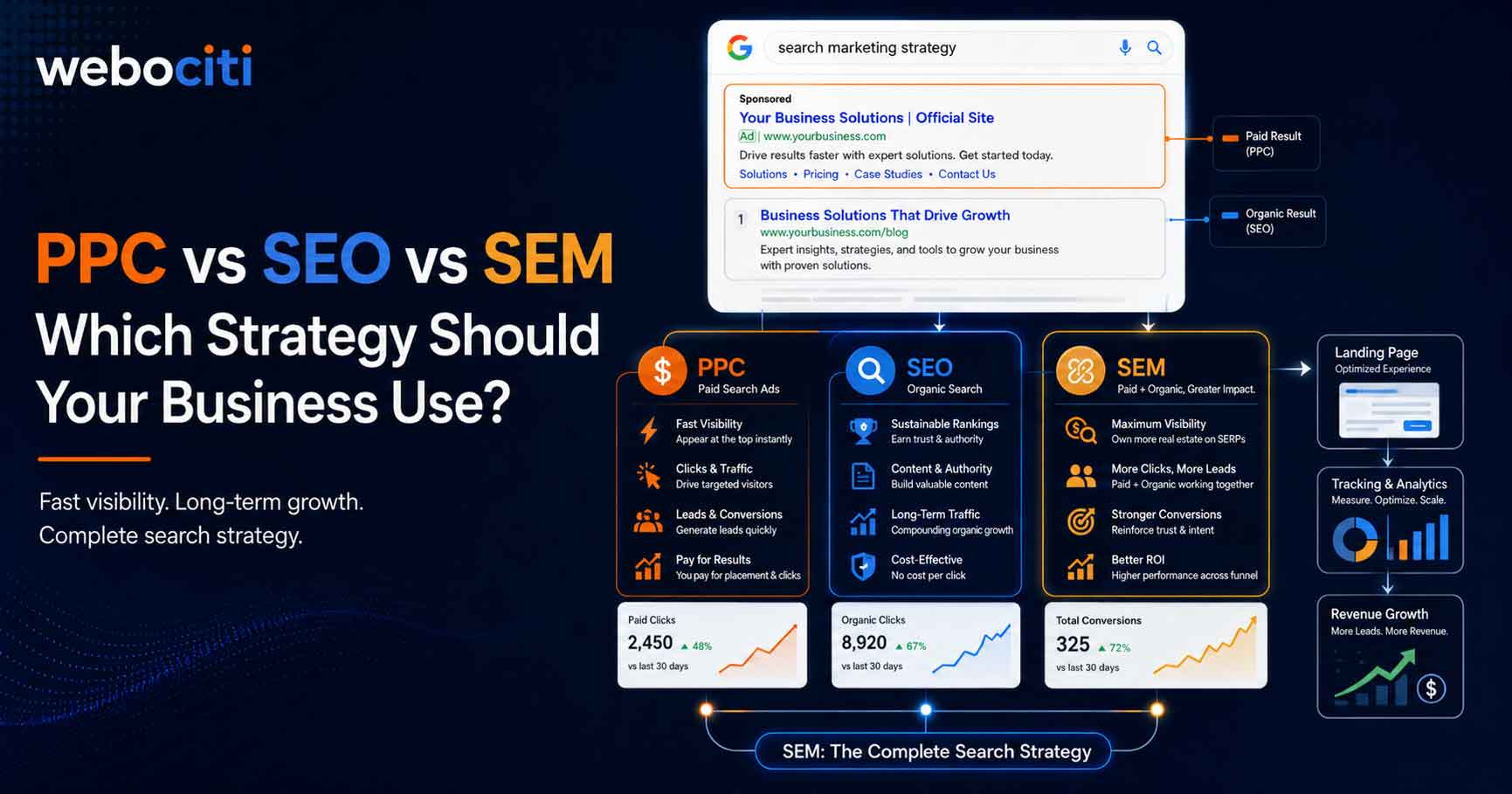
Pay-per-click (PPC) and search engine marketing (SEM) are two of the most popular digital marketing and advertising strategies used by businesses to increase their online visibility and drive traffic to their websites. While both PPC and SEM have their similarities, there are also some significant differences between the two. In this blog post, we’ll explore the differences between PPC and SEM and help you decide which one is right for your business.

What is PPC?

PPC is a type of digital advertising that allows businesses to place ads on search engine results pages (SERPs) and other websites. With PPC, businesses only pay when someone clicks on their ad. The most popular PPC platform is Google Ads, which allows businesses to create ads and bid on specific keywords related to their products or services.

What is SEM?

SEM is a broader term that encompasses a range of digital marketing strategies, including PPC. SEM involves using various tactics to increase a website’s visibility in search engine results pages (SERPs). These tactics can include SEO, PPC, and other forms of online advertising.

PPC vs SEM: What’s the difference?

The main difference between PPC and SEM is that PPC is a type of advertising, while SEM is a broader term that includes a range of digital marketing strategies. SEM involves optimizing a website for search engines and promoting it through various channels, including paid advertising.

PPC is a more focused strategy that involves placing ads on search engine results pages or other websites. With PPC, businesses can bid on specific keywords related to their products or services and pay only when someone clicks on their ad. PPC is a highly effective way to drive traffic to a website quickly and generate leads and sales.

Pros and Cons of PPC

Pros:

Highly targeted: With PPC, businesses can target specific keywords and demographics, ensuring their ads are seen by the right people at the right time.
Quick results: PPC campaigns can generate traffic and leads almost instantly, making it a great way to get fast results.
Easy to measure: PPC campaigns are easy to track and measure, making it easy to see which campaigns are working and which are not.

Cons:

Costly: PPC campaigns can be expensive, especially if businesses are bidding on highly competitive keywords.
Requires ongoing management: PPC campaigns require ongoing management to ensure they are optimized for maximum results.
Ad fatigue: Over time, users may become immune to the same ads, leading to ad fatigue and reduced effectiveness.

Pros and Cons of SEM

Pros:

Long-term benefits: SEO and other SEM strategies can have long-term benefits for a website’s visibility and organic traffic.
Cost-effective: Compared to PPC, SEM can be more cost-effective, as businesses don’t have to pay for clicks.
Greater reach: SEM includes a range of tactics, including SEO and social media, allowing businesses to reach a broader audience.

Cons:

Slow results: Unlike PPC, SEM strategies can take time to produce results, making it less effective for businesses looking for fast results.
Requires ongoing effort: SEM requires ongoing effort and optimization to ensure maximum effectiveness.
Limited targeting: SEO and other SEM strategies are less targeted than PPC, making it harder to reach specific demographics and audiences.

Which one should you choose?

The choice between PPC and SEM ultimately depends on your business goals, budget, and timeline. If you’re looking for fast results and have a budget for advertising, then PPC may be the best option. However, if you’re looking for a long-term strategy that can drive organic traffic to your website, then SEM may be the better choice.

Ultimately, the most effective digital marketing strategy will likely involve a combination of PPC and SEM tactics, tailored to your business goals and budget. By leveraging the strengths of both PPC and SEM, businesses can maximize their online visibility, generate leads, and increase sales.

How can you get started?

In the world of digital marketing, the right strategy can make all the difference in driving your business towards success. Whether you choose PPC, SEM, or a combination of both, having the expertise and guidance of a trusted partner can amplify your efforts and deliver exceptional results.

At Webociti, we specialize in helping businesses navigate the complexities of digital marketing, harness the power of PPC and SEM, and unlock their full online potential. Our team of experts is ready to create tailored strategies that align with your business goals, optimize your online visibility, and drive growth like never before. Take the next step towards digital marketing excellence and contact Webociti today. Your journey to online success starts here! 678-892-7157

Benefits of Using Paid Advertising Online

When it comes to marketing, there is no substitute for paid advertising online. Its benefits are substantial and deliver results that most other methods simply cannot match. Whether you are running paid ads on Google or other search engines, this approach offers one of the best returns on investment (ROI) for your marketing dollars.

A smart business strategy includes leveraging internet advertising. Here are the top benefits of doing so:

Paid Advertising Online

1. Instant Visibility on the First Page of Search Engines

The ultimate goal for any company is to appear on the first page of search engine results. Studies show that most users rarely venture past the first page when searching for a product or service. Appearing in the top three results dramatically increases your chances of generating clicks, traffic, and conversions.

While organic SEO can take months (or even years) to achieve these results, paid advertising online guarantees immediate placement in the top search results. With strategic keyword targeting, your website will attract high-quality traffic and generate a strong ROI. To better understand how Google Ads work, check out this Google Ads Overview.

2. A/B Testing to Optimize Ad Performance

One significant advantage of paid advertising is the ability to test and refine your ads. Through A/B testing, you can experiment with different headlines, descriptions, and keywords to identify what resonates best with your audience.

With tools like Google Ads, you can:

  • Monitor which ads are driving the most clicks and conversions.
  • Tweak underperforming ads to improve their effectiveness.
  • Fine-tune your keyword strategy for consistent, long-term success.

This testing is also invaluable for launching new products or services. By analyzing ad performance, you can determine what generates the most interest, helping your business focus on profitable opportunities.

3. Reach a Wider Audience with Precision Targeting

Search engines remain the most popular way for people to find information online. Compared to social media or banner ads, search engine ads reach a broader, more intent-driven audience. Google alone dominates with a market share of over 65% and extends its reach through an extensive network of partner websites.

Paid search advertising allows you to target:

  • Specific demographics, locations, and interests.
  • Users actively searching for your products or services.
  • Audiences across multiple platforms (Google Display Network, YouTube, and more).

Maximize Your ROI with Paid Advertising

When it comes to online advertising, search engine marketing is an investment that pays off. The ability to reach a vast audience, optimize ads, and achieve top visibility makes paid advertising one of the most effective digital marketing strategies available.

Ready to take your business to the next level? Contact Webociti today to set up and manage your paid advertising campaigns. We’ll design a custom program that works for your business needs.
Call us at 678-892-7157.

How Does It Work and Why Should I Use It?

As a business owner or marketing manager, do you have difficulty driving new traffic to your website and converting leads into sales? The vastness of the online marketplace means that many forms of digital advertising get lost in the shuffle, thereby reducing the chance that your company’s website will see results. Thankfully, pay per click (PPC) marketing is a powerful, cost-effective digital advertising tool that can quickly boost brand awareness, generate leads, and increase online sales or bookings. Keep reading to see how pay per click advertising works and why it should be an integral part of your marketing strategy:

How Pay Per Click Advertising Works

Although pay per click advertising is still a relatively new form of online marketing, by now everyone has seen and followed some of the “sponsored” ads or links seen on Google, Bing, Facebook, LinkedIn, and other websites. Unlike other forms of digital advertising, pay per click marketing is unique because it offers both immediate results and targeted promotions. Thanks to its keyword-based bidding system, PPC ads can be approved within hours, driving traffic immediately. Depending on the platform, the options for targeting consumers may include:

  • Age and gender
  • Language
  • Keywords (SEO)
  • Geography (geo-targeting)
  • Interests or Facebook “likes”
  • LinkedIn job titles and skills
  • Type of computer or mobile device
  • Time of day
  • Seasonal advertisements

Two of the most common platforms for PPC advertising are Google AdWords and Bing Ads, which operate similarly. As an advertiser, you will bid on keywords against other advertisers but only pay when someone clicks the advertisement and visits your website. The more competitively you bid, the more often your ad will appear and the less you will pay per click. As a consumer runs a search, the search engine chooses a set of “winning” advertisers from the pool, based on bid amount and keyword and ad text relevancy and quality. Overall, this flexible system means that even entrepreneurs or businesses with small marketing budgets will see results.

Managing Account Activity

Once your PPC ad is in place, analyze early results and keep revising and improving your strategies. Proper pay per click advertising management is key to ensuring you make the most of your marketing dollars. To improve and expand your results, consider adding more relevant keywords, adding negative keywords (any non-converting terms), and review expensive or under-performing keywords.

Since relevant keywords are what drive results, invest heavily in keyword research and design tests. Take the time to determine which keywords are best related to your products or services. This includes obvious or “popular” terms, but also highly relevant low-tail keywords that are less competitive and, therefore, less expensive.

Reasons to Incorporate Pay Per Click Marketing

Here are a few of the reasons PPC advertising should be included among your digital marketing strategies:

  1. Puts Advertisers Where They will be Seen
    Google Ad Words’ bidding system lets you be the boss in terms of who sees your advertisements. The fact that sponsored search engine results involve such targeted marketing means that your business will be seen by those who need it, and keep your name from being buried within pages of web results.
  2. Helps Searchers Find the Content They Want
    As you may know from personal experience, consumers respond better to relevant advertising. PPC advertising in the form of sponsored search engine results takes this a step further by actually helping searchers find the products and services they want.
  3. Rewards Advertisers for Quality Content
    When searchers respond to ads, it means that both your advertisement and the search engine algorithms are on track. Because of this, Google and other ad networks reward good performance. High-quality ads are often rewarded with lower costs and greater click-through rates.
  4. Gives Immediate and Cost-Effective Results
    Pay per click advertising begins working immediately, whether you choose to utilize Google AdWords or create a sponsored ad elsewhere. As soon as your ad or sponsored content goes live, consumers will begin to respond. This results in low-cost leads, because you only pay when a searcher clicks your link, which will be directly related to what they are searching for. This means that unique visitors are more likely to convert from leads into buyers thanks to effective pay per click advertising.

To learn more about Pay Per Click Advertising contact the PPC professionals at Webociti for a free consultation 678-892-7157.

Digital Advertising 101

What you need to know for modern advertising

As of 2014, an estimated 86.75 percent of the population of the United States used the internet. Digital advertising gives companies the tools they need to reach these potential customers and share their brand. As people gain increasing amounts of control over the advertisements they see, companies must find new ways to find and appeal to their customers if they want their organization to grow. Digital advertising offers these businesses a solution.

The goals of digital advertising

Digital advertising gives companies a way to target precise groups of people based upon their likelihood to make a purchase from a particular company. Each ad works to drive traffic towards the company’s website.

Customers today have become increasingly relationship focused and they want to feel as though they can trust the companies with which they are doing business. Unlike in the past, when consumers were dependent upon sales teams to contact them with information about new products or services, customers today do  their own research. They are in charge of much of the sales funnel. It is the role of the organization to cast their brand into the prominent spotlight and build the crucial relationship with customers, so that when the time comes for them to buy, they turn to the company they trust. The first step in this process is attracting their attention, which is the job of the digital ad.

How digital ads work

When a company designs the ad, they will have to bid on particular keywords for the platform they desire. For example, an HVAC company in Sacramento, California might bid on the keyword ‘air conditioner repair Sacramento’ on Google. When certain user types that keyword into the search bar, their ad will show up. The frequency of the ad appearing for a particular keyword will depend upon the bid and the competition.

Digital advertising 101 can be used just about anywhere on the internet. Organizations can use advertising on social media platforms such as Facebook or Twitter to hit particular demographics. They can use search engines to identify other types of potential customers. Retargeted campaigns, when particular ads are shown to customers on websites based upon their past interest in a company, can also be run in a variety of different settings.

How to design a good digital advertisement

The key to creating a worthwhile digital advertisement revolves around getting the ad in front of the right person. Organizations must first understand precisely who they seek. They should identify buyer personas, including the job, income, budget, and pain points for different categories of specific customers. This information will give them crucial insight about who each advertisement will be intended for, the types of keywords the customers will use, and where the customer might be found.

Bid on the keywords for the ad on several different platforms where the particular persona is expected to be. Carefully monitor the feedback the web advertisement receives and how the site performs. Look at traffic, the number of leads gained, the number of purchases made, and how engaged visitors seemed to be from the site. It would also be a good idea to regularly poll new customers to learn where they first heard about the company. This will give valuable feedback about the success of the campaign on different platforms and where the digital advertising campaign might need some adjustment.

Digital advertising 101 offers companies the exciting opportunity to pinpoint precisely who needs to see the advertisement, boosting engagement and those visiting the website. Those who have not used digital advertising before should carefully review the goals of this method and how to successfully run a campaign before they started.

What to know more about Digital Advertising 101 ? Our company, Webociti, specializes in providing solutions for your Internet marketing challenges. Call us for a free marketing consultation at 678-892-7157.