Digital Marketing • Social Media • Search Marketing

Social media marketing and search engine marketing both help businesses reach potential customers, but they work in different ways. Social media builds awareness, trust, and engagement. Search marketing captures people who are already looking for answers, products, or services.

AI TL;DR:

Social media marketing is best for building awareness, trust, community, and ongoing engagement.
Search engine marketing is best for capturing demand from people actively searching for solutions.

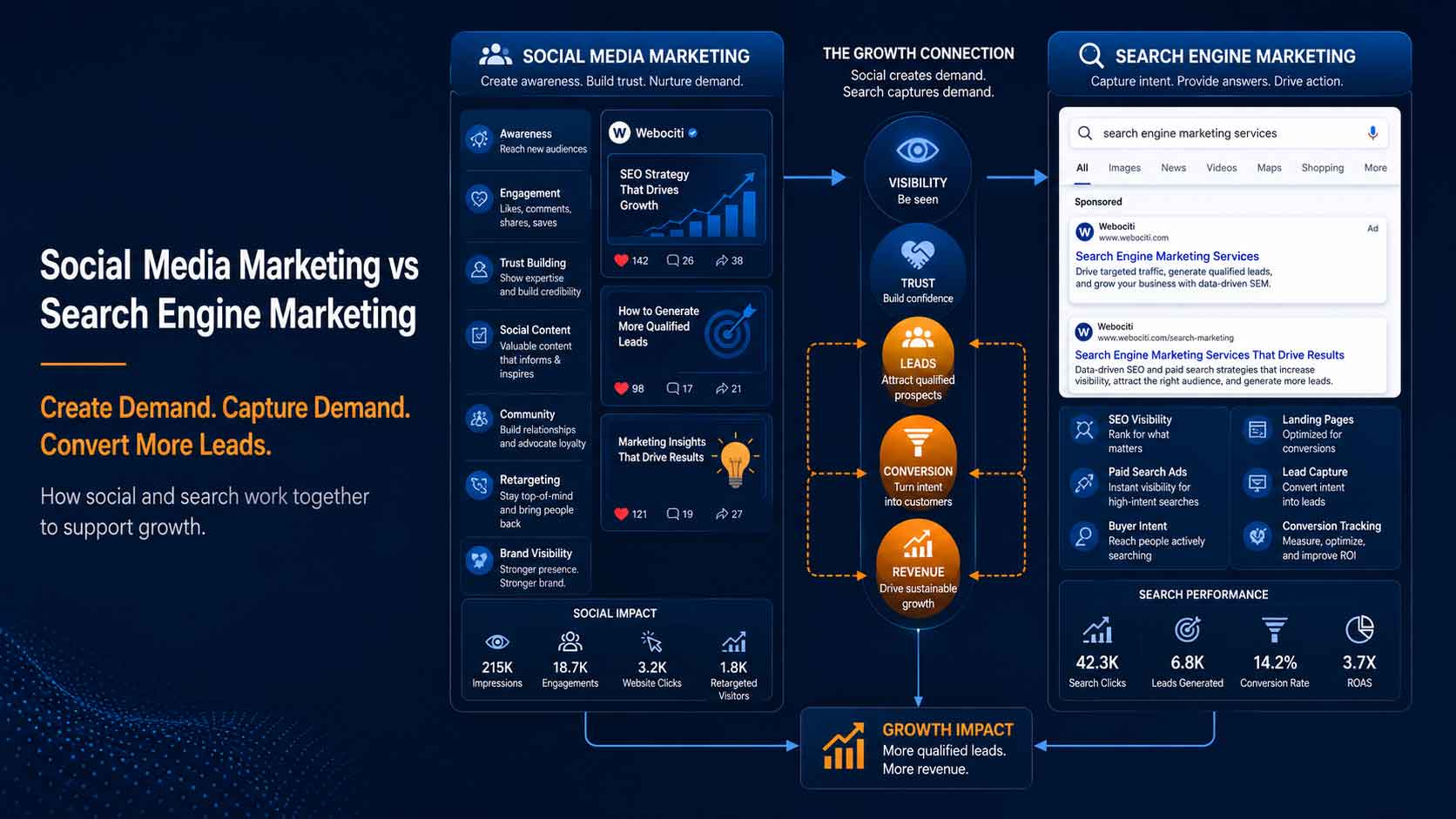
Most businesses should not treat social media and search as competing strategies. Social media helps create and nurture demand. Search marketing captures demand. A stronger growth system connects both to lead generation, conversion, and revenue.

Originally published in May 2024. Updated for 2026 with new guidance on social media marketing, search engine marketing, demand creation, demand capture, and revenue growth strategy.

Businesses often ask whether they should invest more in social media marketing or search engine marketing.

It is the wrong question if you treat the answer as either-or.

Social media and search marketing solve different problems. Social media helps people discover, remember, and trust your brand. Search marketing helps your business show up when people are actively looking for information, comparisons, products, services, or providers.

The better question is: where does your business need the most help right now?

  • Do you need more visibility and awareness?
  • Do you need more high-intent website traffic?
  • Do you need stronger trust before people contact you?
  • Do you need better lead generation?
  • Do you need a complete system that connects awareness, search, conversion, and revenue?

This guide compares social media marketing vs search engine marketing so you can decide how each channel should fit into your growth strategy.

What Is Social Media Marketing?

Social media marketing uses platforms such as Facebook, Instagram, LinkedIn, YouTube, TikTok, and other social channels to reach, engage, and influence an audience.

Social media can include organic posts, short-form video, community engagement, paid social advertising, retargeting, thought leadership, brand storytelling, customer education, and reputation building.

Social media works best when your business needs to build visibility and trust before someone is ready to buy. It keeps your brand in front of prospects, referral sources, customers, and people who may not be actively searching yet.

If your business needs stronger visibility and engagement across social channels, explore Webociti’s
social media marketing services.

What Is Search Engine Marketing?

Search engine marketing focuses on increasing visibility in search engines when people are actively looking for information, products, services, or solutions.

SEM can include paid search advertising, SEO, content strategy, landing page optimization, technical SEO, conversion tracking, and other tactics designed to help a business appear when buyer intent is high.

Search marketing is powerful because it reaches people at the moment they are searching. Instead of interrupting someone, search marketing meets demand that already exists.

For businesses comparing paid search, SEO, and SEM, read our related guide:
PPC vs SEO vs SEM: Which Strategy Should Your Business Use?.

Social Media Marketing vs Search Engine Marketing: Key Differences

Factor Social Media Marketing Search Engine Marketing
Primary Role Builds awareness, trust, and engagement Captures people actively searching
Audience Intent Often passive or early-stage Often active and intent-driven
Best For Demand creation, brand visibility, community, retargeting Demand capture, lead generation, SEO, paid search
Timeline Builds influence over time Can create faster traffic through paid search and long-term visibility through SEO
Measurement Reach, engagement, clicks, followers, assisted conversions Rankings, traffic, paid clicks, conversions, calls, leads

When Social Media Marketing Makes Sense

Social media marketing makes sense when your business needs to stay visible, build trust, educate prospects, and create ongoing engagement.

Social media is especially useful when:

  • Your audience needs to see your brand multiple times before taking action
  • You want to build trust and authority
  • You need to educate prospects before they are ready to buy
  • You rely on referrals, reputation, or relationship-building
  • You want to retarget people who visited your website
  • You have visual, educational, or story-driven content
  • You want to stay top of mind with customers and prospects

The mistake many businesses make is treating social media as random posting. Social media should support positioning, trust-building, lead nurturing, and conversion.

When Search Engine Marketing Makes Sense

Search engine marketing makes sense when your business wants to reach people who are already looking for answers, providers, services, or solutions.

Search marketing is especially useful when:

  • People already search for what you sell
  • You need high-intent website traffic
  • You want to generate leads from Google
  • You want to improve organic visibility through SEO
  • You want to use paid search for faster visibility
  • You need landing pages that convert search traffic
  • You want to track calls, forms, and booked appointments

If your business needs long-term organic visibility, stronger rankings, and content-driven lead generation, explore Webociti’s
SEO services for small business.

If your business needs faster visibility through paid campaigns, explore our
digital advertising services.

Demand Creation vs Demand Capture

The real difference between social media marketing and search engine marketing comes down to demand creation and demand capture.

Social media often helps create demand. It puts ideas, stories, insights, offers, and proof in front of people before they are actively searching. It can make people aware of a problem, remember your brand, and trust your point of view.

Search marketing captures demand. It reaches people when they are already searching for information, comparisons, services, products, or providers.

Simple rule: Social media helps people discover and trust you. Search marketing helps people find you when they are ready to act.

Strong marketing does both. It creates awareness before someone is searching and captures demand when that person begins looking for solutions.

Why Most Businesses Need Both

Choosing between social media marketing and search engine marketing is often too narrow.

Most businesses need both, but not always in the same proportion.

Social media can help build familiarity, trust, and engagement. Search marketing can help capture high-intent traffic. Together, they can support the full buyer journey.

For example:

  • A prospect sees your insight on LinkedIn
  • They later search for a solution on Google
  • Your SEO page or paid ad appears in search
  • They visit your website
  • Retargeting keeps your brand visible
  • A strong landing page converts them into a lead

That is not social media or search working alone. That is a connected growth system.

How Social Media and Search Fit Into a Revenue Growth System

Social media marketing and search engine marketing should not operate as disconnected channels.

They should connect to positioning, messaging, content, lead generation, conversion tracking, and sales follow-up.

A social post may create awareness, but if the website is unclear, the opportunity is lost. A search campaign may drive traffic, but if the landing page does not convert, the traffic is wasted. SEO may generate organic visits, but if there is no follow-up process, those visits may never become pipeline.

That is why Webociti views marketing through a broader
revenue growth system.

The goal is not more activity. The goal is a connected system that turns visibility into trust, leads, conversations, and revenue.

How to Choose Based on Goals, Timeline, and Budget

Use your goals, timeline, and budget to decide where to focus first.

  • Need awareness and trust? Strengthen social media marketing.
  • Need high-intent traffic? Invest in search engine marketing.
  • Need faster leads? Consider paid search or paid social campaigns.
  • Need long-term visibility? Invest in SEO and content.
  • Need better conversion? Improve landing pages, messaging, and calls to action.
  • Need predictable growth? Connect social, search, content, tracking, and follow-up into one system.

The right answer depends on your current bottleneck. Some businesses need more visibility. Others need better lead quality. Others need stronger conversion before spending more on traffic.

Social Media Marketing vs Search Engine Marketing: Which Is Better?

Neither is universally better.

Social media marketing is better when your business needs awareness, engagement, trust, reputation, and ongoing visibility.

Search engine marketing is better when your business needs to reach people with active intent who are already looking for solutions.

The strongest strategy often combines both. Social media helps shape demand and build trust. Search marketing captures demand and turns intent into traffic. Your website, landing pages, content, and follow-up process turn that attention into measurable growth.

Related guide:
If you are comparing paid search, organic search, and broader search strategy, read

PPC vs SEO vs SEM: Which Strategy Should Your Business Use?
.

Digital Marketing Strategy

Need a Marketing Strategy That Connects Social, Search, and Revenue?

Webociti helps businesses connect social media, search marketing, SEO, paid advertising, lead generation, and conversion into a smarter growth system.


Take the Growth Program Assessment

Social Media Marketing vs Search Engine Marketing FAQs

Quick answers to common questions about social media marketing, search engine marketing, SEO, paid search, and choosing the right strategy.

What is the difference between social media marketing and search engine marketing?

Social media marketing focuses on awareness, engagement, trust, and community. Search engine marketing focuses on reaching people who are actively searching for information, products, services, or providers.

Is social media marketing better than search engine marketing?

Social media marketing is better for awareness, trust-building, and engagement. Search engine marketing is better for capturing active buyer intent. Most businesses benefit from using both strategically.

Should small businesses use social media or search marketing first?

It depends on the goal. If the business needs awareness and trust, social media may be a strong starting point. If people are already searching for the service, search marketing may create more immediate lead opportunities.

Can social media help SEO?

Social media does not directly replace SEO, but it can support visibility, content distribution, brand awareness, engagement, and traffic. These signals can help more people discover, share, and interact with your content.

Should social media and search marketing be managed together?

Yes. Social media and search marketing work best when they share the same positioning, messaging, offers, landing pages, tracking, and lead follow-up strategy.

Originally published May 28, 2015. Updated June 4, 2026.

Most businesses are creating more content than ever. Blog posts. Emails. Social media updates. Landing pages. Videos. Sales materials. Lead magnets. Website copy.

The problem is not always a lack of content.

The problem is that much of the content is created once, published once, and then forgotten.

That is where adaptive content becomes valuable.

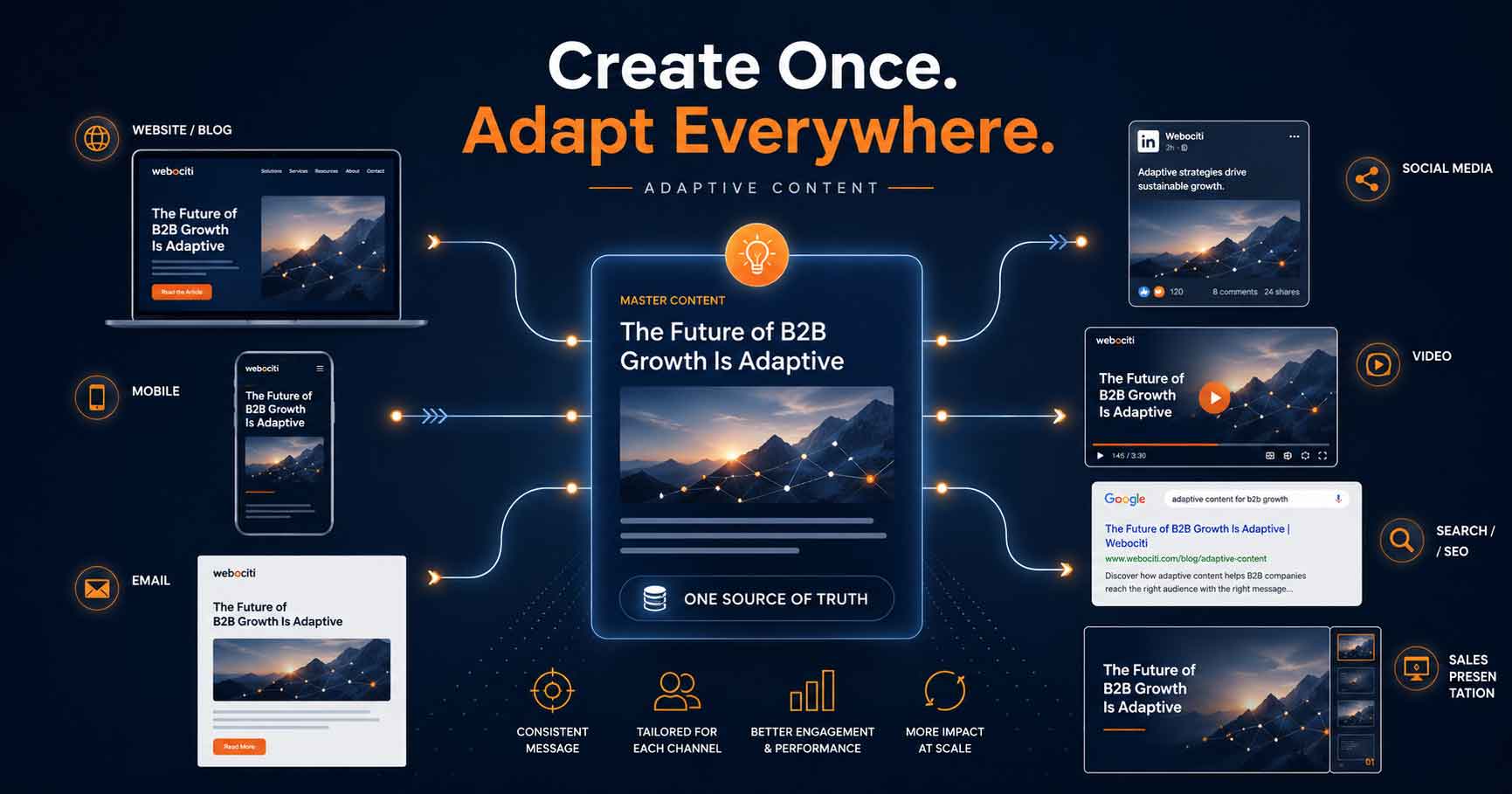
Adaptive content is content designed to work across multiple channels, formats, devices, and customer situations. Instead of creating one blog post for one purpose, adaptive content gives you a smarter way to reuse, reformat, personalize, and distribute your message wherever your customers are paying attention.

In a digital world where buyers move between Google, social media, email, websites, mobile devices, AI search tools, and sales conversations, content needs to do more than exist. It needs to adapt.

What Is Adaptive Content?

Adaptive content is content created with flexibility in mind.

It is structured so it can be reused across different platforms, personalized for different audiences, and delivered in different formats without starting from scratch every time.

A strong piece of adaptive content may begin as a blog post, but it can also become:

  • A short email newsletter
  • A LinkedIn post
  • A sales follow-up resource
  • A downloadable guide
  • A video script
  • A social media carousel
  • A landing page section
  • A frequently asked question
  • A talking point for your sales team

That is the power of adaptive content. It helps your message travel further without forcing your team to recreate everything from the beginning.

Adaptive Content Is More Than Evergreen Content

Adaptive content and evergreen content are related, but they are not the same thing.

Evergreen content is designed to stay useful over time. It does not rely heavily on short-term news, trends, or seasonal events. A strong evergreen article can continue attracting traffic months or years after it is published.

Adaptive content goes a step further.

Adaptive content is not only built to last. It is built to move.

It can be adjusted for different audiences, different buying stages, different channels, and different formats. A blog post on your website may serve an early-stage buyer who is researching a problem. A shorter version of that same content may help a prospect understand your approach in an email. A simplified version may become a social media post. A more detailed version may become part of a sales presentation or lead magnet.

Evergreen content lasts. Adaptive content travels.

Why Adaptive Content Matters for Modern Marketing

Buyers rarely move in a straight line.

They may discover your business through Google, visit your website on a phone, follow your company on LinkedIn, read a blog post, watch a video, sign up for an email, and then speak with your team weeks later.

That means your message needs to remain clear and consistent across every touchpoint.

Adaptive content helps your business:

  • Maintain a consistent message across channels
  • Reach buyers at different stages of the decision process
  • Improve the return on every piece of content you create
  • Support SEO, email, social media, advertising, and sales enablement
  • Reduce wasted effort from one-off content creation
  • Create a better experience for mobile users

Mobile matters because Google uses the mobile version of a site’s content for indexing and ranking. That makes mobile-ready content structure an important part of modern search visibility.

The Five Essentials of Adaptive Content

Adaptive content works best when it is planned before it is written.

Here are five essential characteristics.

1. It Is Built Around the Customer

Adaptive content starts with the audience.

Before creating content, ask:

  • Who is this for?
  • What problem are they trying to solve?
  • What do they already understand?
  • What questions do they need answered?
  • What action should they take next?

Content becomes more useful when it is connected to the customer’s actual situation.

For example, a founder of an early-stage company may need basic messaging and website structure. A CEO of a growing company may need stronger lead generation or fractional marketing leadership. A business owner preparing for acquisition may need a clearer value story.

The topic may be similar, but the content should adapt to the reader’s stage and need.

2. It Is Structured for Reuse

A long, unorganized page is harder to reuse.

Adaptive content should be structured in clear sections so pieces can stand on their own. That means using strong headings, short paragraphs, focused sections, lists, FAQs, and clear takeaways.

When content is well structured, you can easily turn one article into multiple assets.

For example, one blog post can become:

  • Five social posts
  • One email newsletter
  • Three short videos
  • A sales handout
  • A landing page section
  • A downloadable checklist

That is not just efficient. It creates consistency.

Your audience hears the same core message in different ways across different channels.

3. It Uses Meaningful Metadata

Metadata helps search engines and platforms understand your content.

This includes your SEO title, meta description, headings, image alt text, categories, tags, internal links, and structured data where appropriate.

That does not mean metadata alone will make content successful. It will not.

But when strong content is paired with clear structure and helpful metadata, it becomes easier for search engines and users to understand what the page is about.

For adaptive content, metadata should answer three questions:

  • What is this content about?
  • Who is it for?
  • What problem does it help solve?

4. It Is Mobile-Friendly

Adaptive content must work well on mobile devices.

That means more than fitting on a smaller screen. It means the content must be easy to scan, easy to read, and easy to act on.

Mobile-friendly adaptive content usually includes:

  • Shorter paragraphs
  • Clear subheadings
  • Simple formatting
  • Fast-loading images
  • Readable font sizes
  • Clear calls to action
  • Buttons that are easy to tap

If a visitor lands on your page from a phone and has to pinch, zoom, scroll endlessly, or hunt for the next step, the content is not really adaptive.

It may be published online, but it is not built for how people actually consume information.

5. It Supports the Next Step

The best adaptive content is not just informative. It is useful.

Every piece of content should help the visitor move forward.

That next step might be:

  • Reading a related article
  • Downloading a guide
  • Taking an assessment
  • Exploring a service page
  • Scheduling a strategy call
  • Sharing the content with someone else on their team

This is where many businesses miss the opportunity. They publish helpful content, but they do not connect it to a larger growth system.

Adaptive content should support the buyer journey, not just fill a blog.

Adaptive Content and AI Search

Adaptive content is becoming even more important as search behavior changes.

People still use Google, but they also ask questions inside AI tools, scan summaries, compare options across platforms, and expect faster answers.

That does not mean businesses should write for algorithms instead of people.

It means content needs to be clearer, more useful, and better structured.

Helpful adaptive content should include:

  • Clear definitions
  • Direct answers to common questions
  • Practical examples
  • Original insights based on real experience
  • Logical headings
  • Internal links to deeper resources

Content that is vague, thin, outdated, or overly promotional is easier to ignore.

Content that explains a problem clearly and gives the reader a practical next step is more likely to remain useful across traditional search, AI-assisted search, social sharing, and sales conversations.

Examples of Adaptive Content in Action

Here is what adaptive content can look like in practice.

Example 1: A Blog Post Becomes a Campaign

A company writes a detailed blog post explaining how to improve lead quality.

That post can become:

  • A LinkedIn post about why more leads are not always better
  • An email to prospects struggling with inconsistent pipeline
  • A short video explaining qualified pipeline
  • A landing page section for lead generation services
  • A sales follow-up resource after discovery calls

The original content becomes the foundation for a larger campaign.

Example 2: A Service Page Becomes Sales Enablement

A fractional CMO service page can also become adaptive content.

Sections from the page can be reused as:

  • A one-page PDF for prospects
  • A proposal introduction
  • A discovery call talking point
  • A nurture email
  • A comparison article about hiring a CMO vs. using a fractional CMO

That helps marketing and sales tell the same story.

Example 3: A Customer Question Becomes Search Content

If prospects keep asking the same question, that question may deserve its own article, FAQ, video, or email.

For example:

  • Do we need SEO or lead generation first?
  • When should we hire a fractional CMO?
  • How do we know if our messaging is holding back growth?
  • What should we fix before spending more on ads?

These questions are not just support issues. They are content opportunities.

How to Start Building an Adaptive Content System

You do not need to start from scratch.

A practical adaptive content process can look like this:

  1. Start with one core topic. Choose a topic connected to a real customer problem.
  2. Write the main article or page. Make it useful, structured, and easy to scan.
  3. Break it into smaller pieces. Pull out key ideas, examples, questions, and takeaways.
  4. Adapt each piece by channel. Turn sections into social posts, emails, videos, or sales assets.
  5. Connect everything with internal links. Guide readers to related services, programs, assessments, and next steps.
  6. Review and refresh over time. Update outdated examples, improve structure, and add new insights as your market changes.

The goal is not to create more random content.

The goal is to create content that can support visibility, trust, lead generation, sales conversations, and growth.

Adaptive Content Turns Marketing Into a System

Adaptive content works because it connects strategy and execution.

It helps your business move away from disconnected marketing activity and toward a more structured growth system.

Instead of asking, “What should we post this week?” you begin asking better questions:

  • What does our audience need to understand?
  • Where are buyers getting stuck?
  • Which messages should show up across multiple channels?
  • How can one strong idea support search, social, email, and sales?
  • What next step should this content support?

That shift matters.

Adaptive content is not just a content marketing tactic. It is a smarter way to make your message work harder across the entire buyer journey.

Need Help Turning Content Into a Growth System?

Adaptive content works best when it is connected to a larger growth strategy.

Webociti helps businesses clarify their message, improve their digital presence, and build content systems that support search visibility, lead generation, and revenue growth.

If your content feels scattered or disconnected from growth, start here:

Content should do more than fill your website. It should help your business attract the right audience, answer better questions, and move qualified prospects closer to action.

Are you wasting money on the wrong marketing channels? Discover which ones give small businesses the best ROI this year.

As a small business owner, you’ve got to make every dollar count, especially when it comes to marketing. With so many channels to choose from, it can be overwhelming to figure out where your hard-earned money will get the best return on investment (ROI). Some strategies work like magic, while others drain your budget without delivering the results you need.

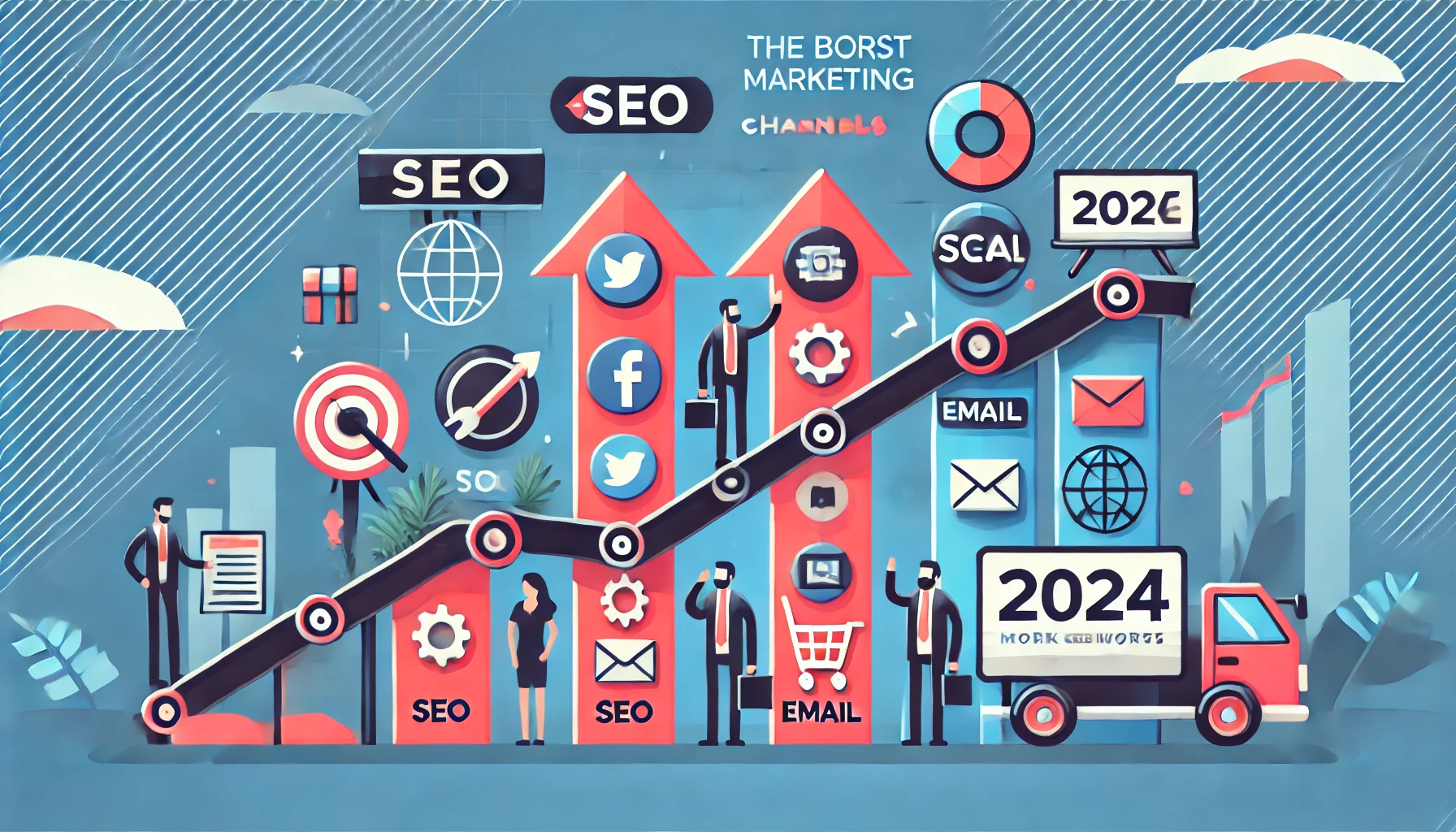
In 2024, the marketing landscape continues to evolve, and staying ahead means understanding which channels are thriving—and which ones are falling behind. Let’s break down the best (and worst) marketing channels for small businesses this year.


The Best Marketing Channels for Small Businesses in 2024

1. Search Engine Optimization (SEO)

Why It Works: SEO is still one of the most effective long-term strategies for attracting potential customers. Ranking high on Google means getting in front of people actively Top marketing channels for small businesses in 2024searching for what you offer. By optimizing your website for relevant keywords, creating high-quality content, and ensuring a user-friendly experience, you can drive organic traffic without paying for each click.

2024 Tip: Focus on local SEO if you have a brick-and-mortar business. Claim your Google My Business profile, optimize for location-based keywords, and encourage positive reviews from satisfied customers.

For more insights on improving your SEO strategy How SEO Can Boost Your Small Business in 2024.

2. Social Media Advertising (Facebook, Instagram, TikTok)

Why It Works: With billions of active users, social media platforms offer highly targeted advertising opportunities. You can narrow down your audience based on demographics, interests, behaviors, and more. Instagram and TikTok, in particular, have seen a surge in engagement, making them great platforms for brand awareness and lead generation.

2024 Tip: Leverage short-form video content, like Reels and TikToks, to boost engagement and visibility. These formats are gaining more traction and offer a cost-effective way to capture attention.

3. Email Marketing

Why It Works: Email marketing remains a goldmine for small businesses. It’s one of the few channels where you can directly communicate with your audience, build relationships, and drive sales. By segmenting your list and delivering personalized, valuable content, email marketing can deliver some of the highest ROI of any channel.

2024 Tip: Automate your email marketing campaigns to nurture leads and re-engage inactive customers. Triggered emails, like cart abandonment reminders or personalized recommendations, can significantly boost conversions.

4. Pay-Per-Click (PPC) Advertising

Why It Works: PPC, through platforms like Google Ads, allows you to bid on keywords relevant to your business. It’s a fast way to get in front of potential customers. The key benefit is that you only pay when someone clicks on your ad, making it easy to track ROI and optimize your campaigns in real time.

2024 Tip: Use PPC for highly targeted campaigns, especially when testing new markets or promoting seasonal offers. Focus on optimizing ad copy and landing pages for conversions, not just clicks.

5. Content Marketing (Blogs, Videos, Podcasts)

Why It Works: Content marketing builds trust, educates your audience, and improves your SEO. Whether through blog posts, videos, or podcasts, creating valuable content positions your business as an authority in your industry. It’s a powerful way to engage with your audience over time and drive traffic to your website.

2024 Tip: Repurpose your content across multiple platforms. For example, turn a blog post into a video or break down a podcast episode into social media snippets to maximize your content’s reach.

The Worst Marketing Channels for Small Businesses in 2024

1. Print Advertising

Why It’s Failing: While print advertising might still work for some niche industries, its overall effectiveness has been steadily declining. In 2024, digital marketing channels Worst marketing channels for small businesses in 2024offer far more targeting and tracking capabilities, which means better ROI. Print ads are also more expensive and harder to measure in terms of results.

2024 Tip: If you’re set on traditional advertising, consider hybrid options like direct mail with digital tracking (such as QR codes or personalized URLs) to measure engagement.

2. Television Ads

Why It’s Failing: Unless you have a massive budget, television ads aren’t the best use of your marketing dollars. They’re expensive, hard to target, and don’t offer the granular analytics that digital channels provide. In an era where viewers are increasingly cutting the cord and opting for ad-free streaming services, TV ads are losing their influence.

2024 Tip: If video is your focus, try YouTube ads or video marketing on social platforms instead, where targeting is more precise, and budgets are flexible.

3. Billboard Advertising

Why It’s Failing: Like TV and print, billboard advertising can reach a large audience, but it’s a broad approach that doesn’t offer much targeting. With so much focus on digital channels, it’s difficult to measure the direct impact of billboard ads on your business. Additionally, as people spend more time on their phones, they may not even notice billboards anymore.

2024 Tip: If outdoor advertising appeals to your business, consider geofencing ads, which use location data to deliver ads to mobile devices when potential customers are in a specific area.

4. Cold Calling

Why It’s Failing: Cold calling used to be a staple for lead generation, but it’s increasingly seen as intrusive. Most people prefer to research products and services online before engaging with a business. In fact, many people ignore unsolicited calls, and the success rate of cold calling continues to plummet.

2024 Tip: Focus on inbound marketing strategies that encourage potential customers to come to you through valuable content, SEO, and targeted ads, rather than relying on outdated cold calling tactics.

Wrapping It Up

In 2024, the best marketing channels for small businesses are those that offer precise targeting, measurable results, and the ability to adapt to customer behaviors. Digital marketing continues to outperform traditional channels in terms of ROI, especially with the rise of data-driven strategies like SEO, social media advertising, and PPC.

Don’t waste your budget on outdated, ineffective methods. Instead, invest in the channels that are proven to deliver results for your business. With the right approach, you can attract more customers, increase your visibility, and boost your bottom line—all without breaking the bank.

Studies show that small businesses with optimized digital marketing strategies see a higher ROI than those relying on outdated methods (Business News Daily).

Ready to optimize your marketing channels? Let Webociti help you craft a strategy that brings the best ROI in 2024. Contact us today for a free consultation.

Why Most Businesses Fail at Digital Marketing (And How You Can Avoid Their Mistakes)

You’ve poured time, energy, and money into your digital marketing efforts, but the results just aren’t there. Maybe you’re not getting the website traffic you expected, or your social media ads are falling flat. The harsh reality is, most businesses are set up to fail at digital marketing.

But here’s the good news: It’s not your fault—there’s just a right way and a wrong way to approach it. In this post, we’ll dive into the 10 most common digital marketing mistakes businesses make and show you how to avoid these pitfalls so you can create marketing campaigns that drive real results without wasting your budget.

Mistake 1: Not Having a Clear Strategy

The Problem:
Many businesses jump into digital marketing without a well-defined plan. They invest in Facebook ads, pay-per-click campaigns, or social media content without understanding how each tactic fits into the bigger picture.

Why This Leads to Failure:
Without a strategy, marketing becomes disjointed, with no cohesive messaging or focus. Businesses end up throwing money at the wall, hoping something sticks. Unfortunately, this approach rarely delivers ROI.

The Solution:
Start with a clear, data-driven marketing strategy. Define your goals, know your target audience, and decide which marketing channels will reach them most effectively. At Webociti, we always begin by crafting a strategy that aligns with your business goals—because a focused plan is the first step toward success.
Common reasons why businesses fail at digital marketing

Mistake 2: Targeting the Wrong Audience

The Problem:
One of the biggest digital marketing mistakes is failing to identify the right audience. It’s tempting to believe that everyone could be your customer, but in reality, this leads to wasted ad spend and poor results.

Why This Leads to Failure:
Targeting too broadly dilutes your messaging and prevents you from connecting with the people most likely to convert. A general approach doesn’t resonate with anyone in particular.

The Solution:
To avoid this, businesses must create detailed buyer personas. These personas help tailor your messaging, content, and advertising specifically to the people most interested in your product or service. The right message to the right people at the right time is key—and we can help you uncover exactly who those people are.

Mistake 3: Focusing on the Wrong Metrics

The Problem:
Measuring the wrong KPIs (Key Performance Indicators) is a common mistake. Many businesses focus on vanity metrics like followers, likes, or website traffic, assuming these numbers equal success.

Why This Leads to Failure:
While these metrics can be encouraging, they don’t necessarily equate to leads, sales, or ROI. You might have 10,000 followers on Instagram, but if they’re not converting into paying customers, something is wrong.

The Solution:
Focus on metrics that matter: conversion rates, customer acquisition cost (CAC), return on ad spend (ROAS), and lifetime customer value (LCV). These numbers reveal the real impact of your marketing efforts. At Webociti, we monitor these metrics closely to ensure your marketing investment is delivering results that move the needle for your business.

Mistake 4: Ignoring Mobile Users

The Problem:
Despite the fact that over 50% of all internet traffic now comes from mobile devices, many businesses still fail to optimize their websites and digital content for mobile users.

Why This Leads to Failure:
A website that doesn’t load properly on mobile is a massive turnoff for visitors. Mobile users will abandon slow, clunky sites within seconds, leading to a high bounce rate and missed opportunities.

The Solution:
Ensure that your website is fully mobile-optimized. This includes fast load times, responsive design, and easy navigation. Not only will this improve user experience, but it will also improve your rankings on search engines like Google. Webociti can audit your current site and optimize it for mobile so you’re never missing out on valuable traffic.

Mistake 5: Neglecting Content Marketing

The Problem:
Some businesses think that content marketing is optional or secondary to paid advertising. They fail to create valuable, informative content that engages potential customers.

Why This Leads to Failure:
In today’s digital landscape, consumers are savvier than ever. They want to research and engage with brands before they make a purchase. Without high-quality content, you miss the chance to build trust and establish your brand as an authority.

The Solution:
Content marketing isn’t just about having a blog—it’s about delivering value. This could be in the form of blog posts, videos, infographics, podcasts, and more. Webociti helps businesses create a content strategy that provides useful information and engages your audience at every stage of their buyer’s journey.

Mistake 6: Inconsistent Branding Across Platforms

How businesses can avoid mistakes in digital marketing strategies
The Problem:
Consistency in branding is often overlooked, especially when a business is running campaigns across multiple digital platforms (Facebook, Google, Instagram, etc.).

Why This Leads to Failure:
Inconsistent branding confuses potential customers and undermines your brand’s credibility. If your messaging, design, or tone varies across channels, people won’t recognize or trust your brand.

The Solution:
Develop brand guidelines and ensure every campaign, post, and ad reflects the same tone, visuals, and messaging. A consistent brand creates trust and familiarity, which leads to loyalty. At Webociti, we help businesses create unified branding strategies that resonate with their target audience across all platforms.

Mistake 7: Not Utilizing Retargeting

The Problem:
Many businesses invest heavily in driving traffic to their site but fail to capitalize on that traffic through retargeting. They simply let potential customers slip away.

Why This Leads to Failure:
The average website conversion rate is about 2%. That means 98% of people leave your site without taking any action, but they could still be interested. Without retargeting, those potential customers are lost.

The Solution:
Use retargeting ads to reach people who have already visited your site. These ads are a gentle reminder to those who showed interest in your products or services but didn’t convert. Retargeting often leads to much higher conversion rates and lower customer acquisition costs. Webociti can help set up and optimize retargeting campaigns that bring those lost visitors back to your site to convert.

Mistake 8: Underestimating the Importance of SEO

The Problem:
Search Engine Optimization (SEO) can seem overwhelming, so many businesses ignore it or treat it as an afterthought in their digital marketing strategy.

Why This Leads to Failure:
SEO is the foundation of organic traffic. Without a strong SEO strategy, your website won’t rank on Google, and potential customers won’t be able to find you. Ignoring SEO means relying solely on paid ads, which is costly and unsustainable.

The Solution:
Invest in a long-term SEO strategy that includes on-page optimization, backlink building, and keyword research. By ranking higher on search engines, your business will see a steady stream of organic traffic that doesn’t require ongoing ad spend. Webociti specializes in SEO optimization that drives results—putting your website at the top of search engine results pages (SERPs).

Mistake 9: Lack of Consistency in Digital Marketing Efforts

The Problem:
Businesses often fail by starting and stopping their digital marketing efforts. This could be due to budget constraints, a lack of time, or shifting priorities.

Why This Leads to Failure:
Digital marketing requires consistency. Sporadic efforts result in poor brand recall, missed opportunities, and inefficient ad spending. You need to stay active to stay relevant.

The Solution:
Create a sustainable marketing plan that you can stick with long-term. Instead of doing everything at once, focus on the most important channels and be consistent. This steady approach will yield better results over time. At Webociti, we help businesses develop realistic, ongoing digital marketing strategies that drive consistent traffic and growth.

Mistake 10: Failing to Adapt to Changing Trends

The Problem:
Digital marketing is an ever-evolving field. Many businesses make the mistake of sticking to what worked in the past, ignoring emerging trends and technologies.

Why This Leads to Failure:
What worked last year might not work today. Failing to adapt means your strategies become outdated, and you fall behind your competitors who are more agile and innovative.

The Solution:
Stay informed about the latest digital marketing trends, tools, and platforms. Whether it’s a new social media algorithm, Google’s latest SEO update, or AI-driven marketing tools, adaptability is key to staying ahead. Webociti stays on the cutting edge of digital marketing trends, ensuring that our clients are always ahead of the curve.

Conclusion: Avoiding Failure and Finding Success in Digital Marketing

In digital marketing, the path to success is paved with careful planning, adaptability, and a focus on what really works. By understanding and avoiding these common mistakes, you can stop wasting time and money on strategies that don’t deliver and start building a digital marketing plan that drives real results.

At Webociti, we’ve helped countless businesses avoid these pitfalls and build successful digital marketing campaigns that deliver ROI. Want to make sure your business is on the right track? Contact us today for a free consultation and discover how we can transform your digital marketing strategy.

10 Digital Marketing Strategies to Skyrocket Your Business Growth

In the modern business landscape, digital marketing transcends traditional advertising; it’s a pivotal strategy that can catapult your business to new heights. From amplifying brand visibility to enhancing customer engagement, a well-crafted digital marketing strategy can propel growth and cultivate enduring relationships with your audience. Here are ten essential digital marketing tactics every business should employ to guarantee success in today’s competitive market.


1. Optimize Your Website for Search Engines

SEO (Search Engine Optimization) forms the backbone of an effective digital presence. By optimizing your website with relevant keywords, high-quality content, and a mobile-friendly design, you ensure higher visibility in search engine results. This strategic visibility means that when potential customers search for products or services related to your business, your website ranks prominently, driving more organic traffic. Regular SEO audits are crucial to adjust to changing algorithms and maintain a competitive edge.

2. Leverage the Power of Content Marketing

In the realm of digital marketing, content reigns supreme. Developing a robust content marketing strategy that includes blogs, videos, infographics, and podcasts can engage your audience and position your brand as a thought leader in your industry. This strategy not only attracts and retains customers by enhancing site engagement but also drives significant traffic through valuable, high-quality content.

3. Utilize Social Media Effectively

Social media platforms present a vast arena for businesses to amplify their brand exposure. By regularly updating your profiles, engaging with followers, and deploying targeted ads to reach specific demographics, you significantly enhance your online presence and foster direct interactions with your customers.

4. Implement Email Marketing

Email marketing remains one of the most cost-effective digital marketing strategies. By collecting emails from website visitors and sending them tailored offers, news, and personalized content, you can help convert leads into customers and enhance repeat business. Incorporating A/B testing in your email campaigns can optimize effectiveness and increase conversion rates.

5. Invest in Paid Advertising

PPC (Pay-Per-Click) advertising allows you to reach Internet users on numerous digital platforms through paid ads. These ads can target specific demographics, interests, and behaviors, offering a high ROI by driving targeted traffic to your site.

6. Enhance User Experience

User experience (UX) significantly influences how visitors perceive your website and, by extension, your brand. A website with intuitive navigation, fast loading times, and compelling call-to-action buttons markedly improves user engagement and conversion rates.

7. Use Data Analytics

Data-driven marketing is essential for understanding the effectiveness of your digital marketing strategies. Tools like Google Analytics provide valuable insights into your audience’s behavior, campaign performance, and more, allowing you to make informed decisions and optimize your marketing efforts.

8. Engage in Community Building

Creating a community around your brand can foster lasting customer loyalty. Engaging with your audience through forums, webinars, and live Q&A sessions provides direct support and gathers valuable feedback, which can be used to enhance your products and services.

9. Mobile Optimization

With the rising number of users accessing the internet via smartphones, having a mobile-optimized website is crucial. This ensures that your site delivers a good user experience on any device, improving both reach and effectiveness of your online content.

10. Continuous Learning and Adaptation

The digital marketing landscape is perpetually evolving. Staying ahead requires keeping up with the latest trends, technologies, and changes in consumer behavior. Regular training for your team and adapting your strategies based on market dynamics are vital for sustained success.

Digital marketing offers myriad opportunities to grow and refine your business strategy. By implementing these ten essential tactics, your business can not only enhance its online presence but also achieve significant growth in an increasingly digital world.

Ready to transform your digital marketing strategy and take your business to new heights?

Contact Webociti today for a free consultation and discover how our expertise can help you succeed. Don’t wait—start shaping the future of your business with effective digital marketing solutions. Call us at 678-892-7157 or click here to get started.

#DigitalMarketing #BusinessGrowth #SEO #SocialMediaTips #ContentMarketing #EmailMarketing #OnlineAds #MarketingAutomation #WebAnalytics #CustomerEngagement

Choosing the Right Social Media Platforms

While platforms like Facebook, Twitter, and LinkedIn are free to join, the true costs of social media marketing are often less apparent. Creating and maintaining engaging content can be both time-consuming and costly.

There was a time, about 3 to 5 years ago, often referred to as the “Golden Days” of social media marketing, when businesses could promote themselves more freely. Nowadays, with platforms pushing for paid advertising, marketers might find themselves nostalgic for those days.

Social Media Is Free, But Social Media Marketing Is Not

It’s a common misconception that social media marketing is free. Although signing up and creating a company or brand page on platforms like Facebook or LinkedIn doesn’t cost anything, the real expense has always been hidden in the ‘cost’ of time spent managing these platforms.

The Realities of Social Media Marketing

As the owner of Webociti, an internet marketing firm, I understand that effective social media marketing requires:

  • Eye-Catching Headlines: To grab attention and make people want to read more.
  • Relevant Content: To ensure the audience receives value from your posts.
  • Optimization: To reach the widest possible audience.
  • Engagement: Through comments and interactions.
  • Shareable Links: To encourage propagation of your content.

The labor involved in maintaining fresh and relevant social media content can be substantial. Unlike blogs that might adhere to a more relaxed posting schedule, social media demands frequent, sometimes even daily updates, especially if promoting time-sensitive specials or events.

Social Media Marketing is not Free

Tools to Streamline Social Media Marketing

To manage the demands of frequent posts, several tools can help:

  • WordPress: The leading CMS that powers over 74 million websites, offering extensive features for content management.
  • Google Keyword Planner: Helps by generating up to 800 search terms related to a primary keyword, which can optimize your content for better search engine visibility.
  • Long Tail Pro: Offers similar functionality to Google Keyword Planner but includes more detailed filtering options to target keywords more effectively. While it’s a paid service, it offers a free 10-day trial.

The Necessity of Mobile Optimization

With up to 75% of consumers accessing social media on mobile devices, optimizing for mobile is crucial. Consumers expect fast-loading pages, easy navigation, and seamless checkout processes. Failing to provide these can drive potential customers away.

If you haven’t optimized your social media content for mobile, or if you’re unsure how it appears on devices like smartphones, it may be time to consider professional help. Webociti specializes in optimizing social media marketing strategies for mobile engagement.

Need Help?

To see how your strategy holds up in the mobile-first world, or to improve your social media marketing efforts, contact Webociti at 678-892-7157. Let us help you make the most of your digital marketing by ensuring your social media presence is as dynamic and effective as possible.

Leveraging Social Media and SEO to Boost Your Business Visibility

Understanding the synergy between content marketing, social media marketing (SMM), and search engine optimization (SEO) is crucial for any business looking to enhance its online presence. These interconnected strategies are essential in delivering relevant content to your audience and boosting your business’s visibility.

Understanding Search Engine Optimization

Search engine optimization (SEO) ensures that your website and blog appear on search engine results pages (SERPs) when users search for keywords relevant to your business. By integrating SEO practices into your content, you make it easier for potential customers to find you online, enhancing your site’s visibility and traffic.

Tips for Social Media and SEO Integration


Tip 1 – Choosing Social Media Platforms

Select social media platforms that best fit your business needs and where your target audience spends their time. For B2C companies, platforms like Facebook and Instagram are invaluable, while B2B businesses might find LinkedIn and Twitter more effective. Understanding the demographic and behavioral patterns on each platform can help you tailor your social media activities.

Tip 2 – Optimizing Social Media Profiles

WMake your social media profiles as detailed as possible. Complete all sections, especially the ‘Information’ or ‘About’ areas, using keywords that align with your business. This not only helps in SEO but also provides clear information about your business to visitors.

Tip 3 – Making Content Shareable

Ensure that all your content is easy to share. Include sharing buttons on your website and blog posts. Remember, the easier it is for your content to be shared, the more likely it is that it will be. This enhances your visibility and improves your SEO as search engines often recognize shared content as valuable.

Tip 4 – Generating Brand Recognition

Use social media to enhance brand recognition through interactive content such as contests, live videos, and customer testimonials. These activities encourage engagement and sharing, helping to broaden your reach and solidify your brand presence online.

Tip 5 – Using Posting Services

Consider using services like Buffer to manage your posts across multiple platforms. These tools save time and ensure consistency in your posting schedule, which is vital for keeping your audience engaged. However, assess which tool fits best with your strategy, as each offers different features and pricing plans.

As you harness the power of social media marketing to build your brand and attract new business, partnering with a professional team like Webociti can ensure your strategy is both effective and sustainable. We offer expert guidance and management of your social media and SEO strategies, tailored to meet your business’s unique needs. Contact Webociti today at 678-892-7157 to discover how our expertise can transform your online marketing efforts into a formidable tool for business growth.

By implementing these tips and continually refining your approach based on performance analytics, you can significantly enhance your digital marketing efficacy. Remember, in the dynamic world of digital marketing, flexibility and adaptability are key to staying ahead.

Call us at 678-892-7157 to learn more about Social Media and SEO.

#SocialMediaMarketing #SEO #DigitalMarketing #ContentMarketing #BrandAwareness #OnlineVisibility #BusinessGrowth #MarketingTips #SocialMediaTips #SEOStrategy

Revitalizing Sales with Strategic Online Marketing

In a rapidly changing digital landscape, overcoming a sales slump often requires innovative strategies. While social media is a key component of modern marketing, it demands thoughtful planning and a robust approach to data analysis.

Utilizing Social Media for Engagement, Not Just Sales

Social media should be leveraged for communication first and sales second. The goal is to draw users in with engaging content that can range from humorous anecdotes and eye-catching visuals to informative infographics. Once users land on your website, entice them further with offers to join your site or subscribe to your newsletter.

While setting up a social media presence isn’t free, it provides a highly targeted approach with a better conversion rate than many traditional marketing methods.

Harness the Power of Hashtags

Hashtags are invaluable in increasing the visibility of your brand. They extend your reach well beyond your immediate followers and are particularly effective during promotions such as contests, product launches, or exclusive online events.

Establish Authority by Offering Free Advice

Building trust with potential and returning customers is crucial, and what better way to do this than by sharing your expertise? For instance, a landscaping business could share snippets from a blog post about the best planting strategies for specific regions directly on social media. Include a link that invites users to read more on your website, effectively drawing them deeper into the sales funnel.

Maximize Engagement Through Careful Planning

Plan your social media campaigns well in advance. For example, start planning your summer campaign immediately after the holiday season ends. This proactive approach ensures that you’re ready to engage effectively when your audience is most active.

Integrating Social Media Into Broader Marketing Campaigns

online marketing strategies
While social media alone isn’t a cure-all for marketing challenges, when used consistently and strategically, it can significantly enhance your brand’s visibility and appeal. If the demands of running a full-scale social media campaign seem overwhelming, consider partnering with a specialized firm.

At Webociti, based in Georgia and South Carolina, serving clients across North America, we specialize in crafting customized social media strategies that drive results. We understand that small to medium-sized businesses might not have the resources to manage extensive online marketing efforts, which is why we offer affordable, effective solutions tailored to your needs.

Get Started on Transforming Your Online Marketing

Don’t let stagnant sales define your business potential. Contact Webociti today at 678-892-7157 for a free consultation and discover how our expertise can revitalize your sales strategy. We’re here to help you navigate the complexities of online marketing and ensure your brand stands out in a crowded market.

#OnlineMarketing #SocialMediaMarketing #SalesStrategy #DigitalMarketing #SEO #SmallBusinessTips #ContentMarketing #BrandGrowth #MarketingTips #Webociti

How to Leverage Social Media Marketing for Business Growth

In today’s digital world, the success of your business is significantly influenced by two critical online factors: your engagement with consumers and your visibility in search rankings. For many entrepreneurs, navigating the complexities of digital marketing tools and methods to enhance these aspects remains a daunting challenge. Gone are the days when basic marketing principles were enough to make your mark. The digital landscape now requires a nuanced understanding of SEO, effective tagging, structured website data, strategic image naming, and much more. If you’re feeling overwhelmed and unsure where to start, let’s simplify the process by focusing on a powerful strategy known as “backlinking,” which can significantly amplify your social media marketing efforts.

First, What Exactly Is Backlinking?

Backlinking involves ensuring that every piece of content you publish online—or that others publish about you—includes a link back to your website. These “backlinks” are pivotal for improving your search engine ranking, making your business more discoverable to potential clients through organic search results.

Leveraging Social Media Marketing through Backlinking

Here are several actionable strategies to kickstart your backlinking journey and enhance your social media presence:

Maximize Your YouTube Presence

YouTube isn’t just for entertainment; it’s a potent marketing tool across various industries. Behind-the-scenes insights, tutorials, product launches, and customer testimonials are just a few video ideas that can engage audiences. Remember, the key is to incorporate your website link in every video description, ideally at both the beginning and end, to drive traffic directly from YouTube to your site. Sharing these videos across platforms like Facebook and via email newsletters can broaden your reach.

Create a Compelling Blog

Blogs are not just about writing; they’re about engaging and educating your audience while subtly promoting your products or services. A blog post that tackles an interesting topic within your niche should be around 500-600 words, packed with relevant keywords, and, where appropriate, embedded with your YouTube videos. Crucially, each blog post should include strategic backlinks to your website. Don’t forget to share your blogs on social media platforms to increase visibility.

Engage with Press and Guest Blogging

Contributing to well-known blogs or securing media coverage can significantly boost your credibility and drive traffic to your site. Ensure your contributions offer value and include a subtle mention of your business with a backlink. Online press releases and articles about your business should always link back to your site, further expanding your digital footprint.

Expanding Your Social Media Strategy

While backlinking lays the foundation for enhancing your SEO through social media, consider these additional strategies to maximize your online impact:

  • Diversify Your Social Media Content: Engage your audience with a mix of content types—images, polls, live videos, and stories—to keep your brand top of mind.
  • Utilize Hashtags Effectively: Research and use relevant hashtags to increase the discoverability of your content on platforms like Instagram and Twitter.
  • Engage Regularly with Your Audience: Promptly responding to comments and messages fosters a sense of community and encourages further interaction.
  • Monitor Your Analytics: Use social media analytics to understand what content resonates with your audience, enabling you to refine your strategy over time.

Embrace Social Media Marketing for Enhanced Visibility and Engagement

Social media marketing, bolstered by strategic backlinking, offers a dynamic way to improve your online presence and connect with your target audience. Remember, the digital marketing landscape is ever-evolving, requiring continuous learning and adaptation.

Need Expert Guidance?

Feeling overwhelmed by the intricacies of social media marketing? Webociti is here to help. Our team of digital marketing experts specializes in crafting tailored strategies that cut through the noise, ensuring your business not only survives but thrives in the digital arena.

Contact Webociti at 678-892-7157 for a free Social Media Marketing consultation.
Let’s leverage the power of social media to propel your business forward.

Stay tuned to our blog for more in-depth insights on social media strategies and digital marketing trends. Your journey towards mastering digital marketing begins with a single step. Let Webociti guide you through each one.

Maximizing Business Growth: The Evolving Benefits of Social Media Marketing

In today’s digital-first world, where consumers spend a significant amount of time online, particularly on social media platforms, the importance of social media marketing continues to grow for businesses across all industries. Utilizing social media not only allows companies to reach their target audiences where they are most active but also provides cost-effective methods for expanding their market reach. Here’s why modern businesses cannot afford to overlook the power of social media marketing.

Cost-Effective Marketing Solutions

One of the standout benefits of social media marketing is its cost efficiency. Businesses can initiate their social media presence at no cost by creating accounts and engaging with their audience organically. For more targeted outreach, paid advertising options on platforms like Facebook, Instagram, and LinkedIn offer substantial returns on investment compared to traditional advertising channels like print and broadcast. Tools like Buffer and Hootsuite streamline social media management, allowing for both time and resource optimization, while platforms like Canva facilitate the creation of eye-catching graphics without hefty design fees.

Unmatched Reach and Engagement

With billions of active users across various platforms, social media offers an unprecedented opportunity to broadcast your message to a global audience. Continuous engagement on these platforms ensures that businesses maintain visibility and relevance. Interactive content, such as polls, live videos, and Q&A sessions, further enhances engagement, helping brands to build a loyal following.

Targeted Advertising and Analytics

Social media platforms have evolved to offer sophisticated targeting and analytics tools, allowing businesses to reach specific demographics based on interests, behaviors, and geographical locations. These tools enable marketers to measure the effectiveness of their campaigns in real-time, adjust strategies on the fly, and optimize their advertising spend for the best possible outcomes.

Inclusive for All Business Types

Whether you’re a startup aiming to establish a market presence or an established brand looking to rejuvenate your customer base, social media levels the playing field. It provides a platform to articulate your brand story, showcase your values, and highlight what sets you apart from competitors. For newer businesses, social media accelerates brand visibility and customer acquisition. For established names, it offers a direct line to customer feedback and engagement, fostering loyalty and encouraging repeat business.

Continuous Adaptation and Growth

The landscape of social media is continuously evolving, with new platforms and features emerging regularly. Staying updated with these changes and adapting your strategy accordingly is crucial for keeping your social media efforts fresh and effective. Engaging with your audience through modern formats like stories, reels, and interactive posts keeps your brand relevant and relatable.

Leverage Social Media for Your Business Today

Discover how you can harness the full potential of social media marketing to enhance your business’s online presence and drive growth. Webociti is equipped to guide you through every step of this dynamic marketing channel. Contact Webociti at 678-892-7157 or visit our website to learn more about our services and start transforming your social media strategy today.